• Skip to primary navigation
  • Skip to main content
  • Skip to footer

Join Me in my new Facebook Group! https://www.facebook.com/groups/417126059784261

Menu
  • Meet Deb – The Heart Behind DramaMommaSpeaks
    • Work with Me! 
    • Photo Gallery of DramaMommaSpeaks
    • Directorial Credits
  • I Give Book Talks! 
    • Book Talk Through Skype
    • Books
  • Freebies!
  • Bumbling Bea
  • Teaching Resume
  • Acting Resume
  • Contact Me
  • Blog
    • Drama Education
    • Arts Education
    • Youth Theatre
    • Middle Grades
    • Musical Theatre
    • Teaching
  • Meet Deb – The Heart Behind DramaMommaSpeaks
    • Work with Me! 
    • Photo Gallery of DramaMommaSpeaks
    • Directorial Credits
  • I Give Book Talks! 
    • Book Talk Through Skype
    • Books
  • Freebies!
  • Bumbling Bea
  • Teaching Resume
  • Acting Resume
  • Contact Me
  • Blog
    • Drama Education
    • Arts Education
    • Youth Theatre
    • Middle Grades
    • Musical Theatre
    • Teaching

Fine Arts Guild of the Rockies

5 Affordable Set Pieces for Theater Departments

August 19, 2025 By dhcbaldwin Leave a Comment

5 Affordable Set Pieces for Theater Departments
Deb building flats for The Giver

5 Affordable Set Pieces for Theater Departments

Welcome! If you’ve arrived at my blog because you are building a theater program in your school, I’m glad you did so. Today,  let’s talk about 5 affordable set pieces for theater departments.

Oh, gosh, I’ve been there.  Infact, I’ve created several programs for schools and community theaters in Colorado and Missouri. Check my resume here if you’d like more information about me:  Teaching Resume. Starting a drama program is exciting—but it can also feel overwhelming when budgets are small and storage space is limited. The good news? You don’t need elaborate sets or expensive rentals to create engaging productions. With just a handful of versatile set pieces, you can stage nearly any play, rehearse effectively, and stretch your students’ creativity.

Here are five must-have set pieces every beginning drama department can afford, build themselves, and use in countless ways.  Plus, I’ve included a bonus piece borrowed from the ancient Greeks. I’ve built every one of these set pieces several times, so you know I think they are essential.

5 Affordable Set Pieces for Theater Departments

5 Affordable Set Pieces for Theater Departments

1. Rehearsal Boxes (Stage Cubes)

  • Why: The ultimate multitaskers. Rehearsal cubes can become chairs, tables, steps, beds, or thrones—and they’re indispensable for rehearsals.
  • DIY Factor: Build from plywood or MDF, paint them black for neutral use, and stack for multiple levels.
  • Uses: Furniture, platforms, or even makeshift scenery.

Here’s a Youtube video that demonstrates how to build these gems: Learn to Build Actor Boxes

Scene Shop

2. Folding Flats (Walls That Go Anywhere)

  • Why: A basic flat is the backbone of any set. Just a couple can suggest endless locations.
  • DIY Factor: Create wooden frames covered with muslin or luan. Add hinges so they fold flat for storage.
  • Uses: Interior or exterior walls, doorways, murals, or projection screens.

These flats are made of wood.  Usually, mine are covered with muslin just like we’ve used for many years.  If you want to learn how to build a flat, go to: Stage Flat

5 Affordable Set Pieces for Theater Departments

Credit: https://buildersvilla.com

3. Platforms (Add Instant Levels)

  • Why: Theater becomes more dynamic when actors are on different heights. Platforms give depth and variety to any scene.
  • DIY Factor: Build 4×4 or 4×8 framed platforms topped with plywood. Keep them modular so you can reconfigure as needed.
  • Uses: Stairs, balconies, podiums, risers, or stages-within-a-stage.
5 Affordable Set Pieces for Theater Departments
Credit:  Buildersvilla.com

4. Freestanding Door Frame

  • Why: Nothing transforms a bare stage like an entrance. A door instantly suggests place and purpose.
  • DIY Factor: Build a sturdy wooden frame and mount a lightweight door. Keep it neutral so it fits multiple shows.
  • Uses:Entrances/exits for comedies, farces, haunted houses, or realistic dramas.

Doors and door frames are gold.  They do have go be built correctly, however.  If they are not, they will always be an issue for you.  If I was going to pay anyone to build something for me, I’d have someone built door frames and hang doors form. 


5 Affordable Set Pieces for Theater Departments5 Affordable Set Pieces for Theater Departments

Versatile Set Pieces: Tables and Chairs for Any Scene

5. Basic Table and Chairs

  • Why: The simplest set pieces are also the most used. A table and chairs can set dozens of scenes.

  • DIY Factor: Thrift store finds work beautifully. Refinish or paint them for versatility.

  • Uses: Dining rooms, courtrooms, offices, cafés, classrooms—the possibilities are endless.

During certain points in my career, I had access to a six feet long wooden table and bentwood chairs.  These are priceless!  You can use them in many ways whether for a dining room scene such as in The Miracle Worker, or the kitchen table in the annex of The Diary of Anne Frank.  Additionally you can use the chairs by themselves for two person scenes, etc.

5 Affordable Set Pieces for Theater Departments

Credit: //hstech.org

Bonus: Periaktoi (The Ancient Secret Weapon)

  • Why: Straight from ancient Greek theater, a periaktos is a three-sided flat mounted on a pivot. Spin it, and the scenery changes instantly! Perfect for schools with limited time and budgets.
  • DIY Factor:Construct tall triangular prisms with lightweight lumber and luan. Paint each side with a different setting—brick, sky, wallpaper, forest, etc.
  • Uses:Rotate between three locations in seconds. Ideal for one-acts, student-designed shows, or productions with quick transitions.

Whenever I begin a drama program or summer camp for someone, we always build periaktois.  Most theater groups are unfamiliar with them and they various uses.   They take time to build but are worth their weight in gold.  You can’t go wrong with them!

5 Affordable Set Pieces for Theater Departments

What if I have no carpentry skills and neither do my students?

Sometimes a teacher has the skills to build their own set.  In my case, my wonderful husband builds them for me.  However, sometimes he was unavailable to build, so, I’ve put a word out to parents volunteers to help build our sets. Usually, a group of fathers (and even grandfathers) would show up on a Saturday morning, I’d feed them donuts (that made them smile) and they’d build what I needed.  You can do that, too!

Another way to design the set is by the use of fabric.  When I directed The Giver at the Fine Arts Guild of the Rockies, I hung various colors of gray fabric from the battens.  It was a super way to pull the focus to the center and give mood.   Check out this blog post if you’d like to know about producing The Giver: The Reasons I Love The Giver Play

5 Affordable Set Pieces for Theater Departments

Teacher Benefits

Here’s some advice:  You simply must defend your program and its need for funds.  Consequently,  you should have a meeting with your administration and department chair.  If you’d like, use this blog post to defend your needs. 

  • Saves Money: Build once, reuse for years.
  • Encourages Creativity:Students learn to think outside the box when transforming simple pieces into new settings.
  • Teachable Moments:  Building these pieces doubles as a tech theater lesson.
  • Space Friendly: Most pieces stack or fold for easy storage.
  • Endlessly Versatile:From Shakespeare to contemporary plays, these pieces adapt to any production.

Last thoughts

To be honest, I think it’s a good thing for our students to see you being creative with what you have in your stock.  Too many times we are a throw away society–but by using these materials over and over in various configures, you are teaching them to be inventive and clever.

Lastly, you don’t need a giant scene shop or a massive budget to produce creative, polished shows. Start with these 5 affordable set pieces for theater departments—rehearsal boxes, flats, platforms, a door, and furniture—and add periaktoi for a touch of theatrical magic. With just these few items, your drama department can bring almost any story to life.

Want more budget-friendly tips for building your drama program? Join my newsletter for free resources, classroom-tested ideas, and exclusive discounts. This one is a free lesson about Audra McDonald!

If you are looking for set design units, check out:  Set Design High School and Set Design Middle School.

Click here:  We’re Live! Radio Theater #101

Deb directing The Miracle Worker
DEB DIRECTING THE MIRACLE WORKER


Share this:

  • Click to share on Tumblr (Opens in new window) Tumblr
  • More
  • Click to share on X (Opens in new window) X
  • Click to share on Facebook (Opens in new window) Facebook
  • Click to share on Pinterest (Opens in new window) Pinterest
  • Click to share on LinkedIn (Opens in new window) LinkedIn
  • Click to email a link to a friend (Opens in new window) Email
  • Click to share on Reddit (Opens in new window) Reddit
  • Click to share on Pocket (Opens in new window) Pocket
  • Click to share on Telegram (Opens in new window) Telegram
  • Click to share on WhatsApp (Opens in new window) WhatsApp

Like this:

Like Loading...

Filed Under: acting, Arts, arts education, arts integration, community theater, community theatre, creative dramatics, directing experiences, drama education, drama integration, excellence in teaching, Fine Arts Guild of the Rockies, Free Products, High School, plays, Producing plays and musicals, set design, Teacherspayteachers, youth theatre

Timeless Triumphs: 8 Unforgettable High School Plays

April 28, 2024 By dhcbaldwin Leave a Comment

A single actor on a stage in a spotlight

It’s May and theater teachers are chatting about high school plays they are thinking of directing in the next school.  Oh, gosh.  I remember those times.  Today let’s discuss timeless triumphs: 8 unforgettable high school plays.

As much as you consider and make predictions concerning your student body (how many males, how many females) for future productions, it’s still a crap shoot.  For instance, students who have always been ardent theater lovers suddenly decide they want to play soccer in the fall and track in the spring.  Sometimes it is difficult to keep a balanced perspective concerning our  students’ choices.  It is my opinion that a teacher must remind themself that primarily our job is to introduce theater to students who may not have ever considered it before. Hopefully those theater loving students will return to participate in the near future. Looking for the Stella Adler Acting Unit? Go here.

Timeless Triumphs: 8 Unforgettable High School Plays

Every high school drama department seeks that perfect play: the one that captivates audiences, challenges actors, and leaves a lasting impression long after the final curtain call. In the realm of high school theater, certain plays have stood the test of time, earning their place as perennial favorites. Let’s explore eight such masterpieces that continue to enchant audiences and inspire young actors around the world.

Timeless Triumphs: 8 Unforgettable High School Plays

1. The Crucible by Arthur Miller:

  • Drama
  • Two hours
  • 10 M, 10 F (plus extras)

Set during the Salem witch trials, The Crucible explores themes of hysteria, suspicion, and the consequences of unchecked power. This play tells the story of a village that becomes embroiled in a witch hunt. The people of Salem live in a constant state of fear as more and more people are accused of witchcraft. It is my belief that The Crucible is a perfect high school play, primarily because it offers many students an opportunity to participate. High school productions of Miller’s masterpiece often resonate deeply with audiences, sparking discussions about morality, justice, and the dangers of groupthink.

2. A Midsummer Night’s Dream by William Shakespeare:

  • Comedy
  • Two hours
  • 20 characters, equally male and female
In one of the most famous of literary love quadrangles, A Midsummer Night’s Dream tells the tale of Hermia, Demetrius, Lysander, and Helena. These four misguided lovers  journey into the woods which lands them in even more trouble. Additionally,  members of the fairy kingdom decide to use them as veritable pawns in their own love games.
Against the backdrop of the wedding of Duke Theseus and Hippolyta, and the fiery battle of wills between the Fairy King and Queen, Oberon and Titania, the four lovers are challenged by magic and trickery to finally work out what love is all about.
Filled with magical enchantment and unforgettable mischievous fairies,  A Midsummer Night’s Dream is an excellent choice for high school students. It’s fun for them to explore the complexities of love and the absurdity of human behavior.

Timeless Triumphs: 8 Unforgettable High School Plays

Credit: Aquinas Academy of Pittsburgh

Timeless Triumphs: 8 Unforgettable High School Plays

3. Our Town by Thornton Wilder:

  • Drama
  • Full-Length Play
  • 7w, 17m

This Pulitzer Prize-winning play offers a poignant exploration of small-town life and the passage of time. Narrated by a stage manager, the production is performed with minimal props and sets.  However, don’t be swayed by its simplicity.  The play depicts the simple daily lives of the Webb and Gibbs families as their children fall in love, marry. The most poignant moment is eventually – in one of the most famous scenes in American theatre – death.

Thornton Wilder’s final word on how he wanted his play performed is an invaluable addition to the American stage and to the libraries of theatre lovers internationally. With its minimalist staging and universal themes, Our Town provides high school students with a profound theatrical experience that resonates with audiences of all ages.

Timeless Triumphs: 8 Unforgettable High School Plays

How about a comedy?

4. The Importance of Being Earnest by Oscar Wilde:

  • Full-length Play
  • Comedy
  • 5m., 4w. (1 extra.)

Wilde’s razor-sharp wit and biting satire take center stage in this delightful comedy of manners. Set in England during the late 19th century, the play follows the lives of two young men, Jack Worthing and Algernon Moncrieff, who adopt fictional identities to escape social obligations. Jack invents a brother named Ernest, while Algernon creates an invalid friend named Bunbury.

Not surprisingly, high school productions of The Importance of Being Earnest allow students to revel in the absurdities of Victorian society while honing their comedic timing and delivery. Note:  This is a costume heavy show, but I still recommend it to directors because it’s worth the extra money to costume the students appropriately.

Dramatic Play, Anyone?

5. Inherit the Wind by Jerome Lawrence and Robert E. Lee:

  • Drama
  • Two Hours
  • 21 men, 6 women, 2 boys, 1 girl, extras Many of the parts can be doubled

Inspired by the Scopes Monkey Trial, Inherit the Wind is a powerful courtroom drama that explores the clash between science and religion, freedom of thought, and the pursuit of truth. This story centers around a Tennessee teacher was tried for teaching the theory of evolution. As you might expect, two persuasive attorneys argue the case in an effort to determine the balance of church and state. High school productions of this play encourage critical thinking and foster discussions about education, censorship, and intellectual freedom.

Timeless Triumphs: 8 Unforgettable High School Plays

6. The Giver adapted by Eric Coble from the novel by Lois Lowry:

  • Drama
  • 4m., 4w., extras as desired or 4m., 2w. with doubling, extras as desired.
  • 90 minutes

Based on Lois Lowry’s dystopian novel, The Giver offers a thought-provoking exploration of a society that suppresses individuality and emotion in pursuit of stability. To begin with, the story follows Jonas, a boy living in a community based on Sameness. During the Ceremony of Twelve, he is selected as the community’s new Receiver of Memory. The old Receiver, who Jonas calls The Giver, transmits generational memories to the young boy by placing his hands on Jonas’s bare back.

High school productions of The Giver allow students to delve into themes of identity, freedom, and the consequences of conformity, sparking important conversations about societal norms and individuality. I directed The Giver for a the Fine Arts Guild of the Rockies community theater in Colorado.  It was sensational having a mixed age cast, but high school students can excel with it as well.  For more information about The Giver, check out: The Reasons I Love The Giver Play

Timeless Triumphs: 8 Unforgettable High School Plays

Historical Plays Worth Producing

7. The Diary of Anne Frank by Frances Goodrich and Albert Hackett:

  • Drama
  • Full Length
    5 men, 5 women (3 extras)

Based on the real-life diary of Anne Frank, this powerful play chronicles the experiences of a Jewish family hiding from the Nazis during World War II. High school productions of  The Diary of Anne Frank offer students the opportunity to explore themes of resilience, hope, and the human spirit in the face of adversity. I directed The Diary of Anne Frank with a community theater.  It was an unforgettable experience for everyone concerned. However, one challenge for us was that the stage was the shape of an octagon. Looking for more information about this high school play?  Check out: The Most Important Play I’ve Directed in My 38 Year Career

Timeless Triumphs: 8 Unforgettable High School Plays

8.  The Miracle Worker by William Gibson:

  • Drama
  • Two hours
  • 7 M, 7F (with extras)

Inspired by the true story of Helen Keller and her teacher Anne Sullivan, “The Miracle Worker” is a compelling exploration of perseverance, communication, and the triumph of the human spirit over adversity. William Gibson’s drama  chronicles the relationship between the real-life Helen Keller, a young girl from Alabama who was blind and deaf, and her teacher, the Irish, headstrong Annie Sullivan from Boston. It’s sensational theater.

Without a doubt, high school plays such as The Miracle Worker provide students with the opportunity to portray iconic historical figures while delving into themes of empathy, determination, and the transformative power of education.

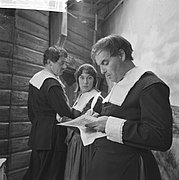
Deb directing The Miracle Worker Me directing The Miracle Worker

Why do I select older plays to direct?

When you are a purist as I am concerning high school plays, you stick close to tried and true material.  That doesn’t mean I haven’t done my share of more modern plays.  I’ve directed a few. However, I think it’s important that our students broaden their knowledge base and ultimately, their resume by participating in the classics.  You simply can’t go wrong with them.

In the world of high school theater, these eight high school plays stand out as enduring classics or at the very least of the classic nature.. They continue to captivate audiences and inspire young actors. From thought-provoking dramas to poignant historical narratives, each play offers students the opportunity to delve into complex characters.

These Plays are Winners for High School

As I stated previously, by exploring universal themes students can learn what it takes to create unforgettable theatrical experiences. In short, these high school plays demand it of them. As high school drama departments continue to stage these masterpieces, they ensure that the magic of theater lives on for generations to come.

Do you have a high school play which you would add to this list?  I’d love to know about it.  Contact me at DhcBaldwin@gmail.com.

Photo Gallery of DramaMommaSpeaks

Directing students in Aladdin, Jr.

Share this:

  • Click to share on Tumblr (Opens in new window) Tumblr
  • More
  • Click to share on X (Opens in new window) X
  • Click to share on Facebook (Opens in new window) Facebook
  • Click to share on Pinterest (Opens in new window) Pinterest
  • Click to share on LinkedIn (Opens in new window) LinkedIn
  • Click to email a link to a friend (Opens in new window) Email
  • Click to share on Reddit (Opens in new window) Reddit
  • Click to share on Pocket (Opens in new window) Pocket
  • Click to share on Telegram (Opens in new window) Telegram
  • Click to share on WhatsApp (Opens in new window) WhatsApp

Like this:

Like Loading...

Filed Under: acting, arts education, community theater, directing experiences, drama education, drama integration, Fine Arts Guild of the Rockies, High School, plays, Producing plays and musicals, Production Questions, theater, theatre, youth theatre Tagged With: Inherit the Wind, Midsummer Night's Dream, The Crucible, The Diary of Anne Frank, The Giver, The Importance of Being Earnest, The Miracle Worker

The Real Skills You Should Look For In A Stage Director

January 26, 2022 By dhcbaldwin Leave a Comment

The Real Skills You Should Look For in a Stage Director

Have you wondered about the real skills you should look for in a director for the stage?

When I was twenty-four years old, I fell into directing.

At the time, I was part of a blossoming community theater who produced monster seasons each year. Not only that, but they produced wonderful productions of shows such as South Pacific, The Music Man, Macbeth, The Odd Couple, etc. It was exciting!

Next show of the season was The Miracle Worker. The president of the company called asking, “There is no one to direct The Miracle Worker. We think you’d do a great job.  Would you be willing to head it up?”

Gulping, I said yes.

That was the beginning of my directing journey.  Now nearly forty years later, I’ve directed over 250 plays and musicals with adults and children alike.  Whew!

The Real Skills You Should Look For in a Stage Director

My second time to direct The Miracle Worker 

Truly, I have a perfect temperament for directing– natural born leader, charismatic, creative, inspiring and encouraging.

Luckily, I attended Stephen College in Columbia, Missouri and we trained as actors and technical theater positions.  I have plenty of experience as a property mistress, costumer, box office, house management, set construction and so forth.

There have been many times I’ve attended a production and wondered who directed it, because the show appears disorganized.  You know what I mean–one costume is fabulous while the next is from a different time period. Or the staircase piece is magnificent, but the basic set looks unfinished. In community theater, it is not uncommon for volunteers to be doing everything–performing and building the set. That’s not a negative, but a positive in my book.

(Don’t know much about community theater? Check out my post– Are You Missing These Kind of People in Your Life?)

When directing, I require my casts to put in some time building the set or helping sew costumes or gathering props.  I think it helps them to see that every aspect is important to a production.  You’ll see me there helping, too.

The Real Skills You Should Look For in a Stage Director

Julie Taymor, Spider-Man Director - Her Career on Stage, Screen - Photos - WSJ
Julie Taymore, Director of Spider Man the Musical

What are the skills a stage director needs? I was looking around the internet and stumbled upon this page from Berkley University which states,

“Successful directors possess a large suite of interpersonal skill, including personal and artistic sensitivity, aesthetic acuity, excellent communication and organization, and the confidence to lead and inspire others through a difficult and unpredictable process. They are superb multitaskers and steady as a rock in the face of adversity.

While not all directors are great collaborators, all must understand how to facilitate the collaborative process and synthesize the efforts of large creative teams. Finally, it’s vital that directors possess the ability to think critically and analytically about a text, and the passion and conviction to pursue their interpretations.

It’s the director’s job to answer the difficult question of “why”: why stage this show here, now, with these actors and for this audience? In essence, why does this performance matter?”

Their professional skills include:

  • Hiring and leading a production team
  • Casting and running auditions
  • Basic theatrical design
  • A unique vision
  • Critical and analytical thinking
  • Communication
  • Collaboration
  • Leadership
  • Multitasking
  • Networking
  • Time management

They must be:

  • Creative
  • Flexible
  • Encouraging
  • Positive
  • Excellent problem solvers
  • Self aware
  • Inspiring
  • Imaginative
  • Ethical
  • Unbiased
  • Organized

In short, they must be perfect!  Ha!

The Real Skills You Should Look For in a Director for the Stage

Upcoming Event: Devised Theater Workshop with Rachel Chavkin | Department of Theater
Rachel Chavkin directing Hadestown, the Musical

Several times a month, I read in Facebook groups of theater teachers begging for help.  Much like my scenario, they’ve been thrown into directing the school play or musical.  It’s difficult enough to direct young actors, but it’s made more challenging when a novice director must also serve as the production’s artistic director.

Recently, It dawned on me that I could help these novices.  Oddly sometimes I forget how much I’ve experienced–such as the time a student did a back flip off a bench (without my permission) only to break his arm right there in front of an audience or when a bat flew down from the catwalk of an old theater and out into the audience or the time I bumped a table with the cd player on it and made it skip a section of a dance in Fiddler on the Roof  I directed. 

Yes, I’ve been through the ups and downs and have the scars to prove it! .

I got to work and made eight checklists for directors to use the day of a production’s opening night.   These checklists include: set, costume, lights, sound, props, box office, concessions and stage management.   A director can hand them out to various crew heads and merely checked off once the job has been completed.

The Importance of a Leader Being Organized

I was looking for information about the reasons being an organized leader is important and found this great quote from www.commonsenseleadership.com,

“Being organized sends a positive image, which is so important as leaders are signal senders. We want to send an image that we have it all together, that we can and will focus on what is most important, not things that keep us busy and may not have the most beneficial impact.

Fact is, being organized enables us to be more productive, set an example for our team members and impress our external clients – to more efficiently manage our time.”

So good, huh?

Another attribute of a great director is somewhere aware of time.  They are first to rehearsals, follow their rehearsal schedule time allotments, don’t keep their actors late for unecessary reasons just to name a few.  I was taught,

If you are early, you are on time.

If you are on time, you are late.

   If you are late, you are in trouble.”

You Don’t Want to Be This Director

One director I worked with thought nothing of keeping an entire cast very late in evening at the last dress rehearsal only to give notes to just three cast members.  We were exhausted for opening night and then she’d gripe we had no energy on stage. WHAT?!? Needless to say, she ran off fabulous talent with this behavior.

Not me!  I understand my casts have volunteered and although the audience applause is their “payment”, they still gave up their free time to perform in the show.

When my cast wants to socialize during rehearsal, I ask them to arrive early. That gives them time to chat and it keeps us to my rehearsal time. Usually, I take breaks during rehearsal and stay to the time I’ve planned for each part of the rehearsal. I’m respectful of people’s time.

You have no idea how much people appreciate this.

If you want to save time, frustration and take aware your worry,  pick up a copy of  these checklists. I wish I’d had them when I began directing in 1980.

Pick up my Director’s Helper Checklist here: Director’s Checklist

Have you directed a production?  What experiences have you enjoyed?  I’d love to know.  Contact me at DhcBaldwin@gmail.com or my website at DeborahBaldwin.net

woman behind DramaMommaSpeaks


Share this:

  • Click to share on Tumblr (Opens in new window) Tumblr
  • More
  • Click to share on X (Opens in new window) X
  • Click to share on Facebook (Opens in new window) Facebook
  • Click to share on Pinterest (Opens in new window) Pinterest
  • Click to share on LinkedIn (Opens in new window) LinkedIn
  • Click to email a link to a friend (Opens in new window) Email
  • Click to share on Reddit (Opens in new window) Reddit
  • Click to share on Pocket (Opens in new window) Pocket
  • Click to share on Telegram (Opens in new window) Telegram
  • Click to share on WhatsApp (Opens in new window) WhatsApp

Like this:

Like Loading...

Filed Under: acting, arts education, community theater, community theatre, drama education, Fine Arts Guild of the Rockies, middle grades, plays, Producing plays and musicals, Production Questions, theater, theatre, youth theatre

Critical Steps in Choosing a Play or Musical: Stage Properties

August 30, 2016 By dhcbaldwin 5 Comments

L_E__and_Thelma_E__Stephens_Performing_Arts_Center_1337635322_photo_5[1]

Stephens College Theatre Department

Let’s talk about the critical steps in choosing a play or musical stage properties next.

I have something to admit.  I knew very little about the workings of a play production until I attended college,  Stephens College to be exact.  I was aware of this about myself, but you know, I had NO IDEA how much I didn’t know, you know?  Enter required technical theater hours.

I very gleefully signed up for  crew positions as I was expected to do.  In the theater department, at least at the time, we were not allowed to audition for productions until our second year of school there.  It was part of the process of this solid program that continues to be excellent.

036a

 A Christmas Story  Performing Arts in Children’s Education  December 2004

I’m an over achiever.  It’s terrible how much of an over achiever I can be at times.  Anyway, we were required to have 100 hours.  I finished with 200.  See?  Truthfully, I found I loved crewing backstage.

My first backstage crewing experience occurred when I worked on the stage properties crew and I’ll never forget it.  I enjoyed it so much that one summer I served as prop mistress at the Okoboji Summer Theater, Stephens’ summer theater venue.

Now, I’m virtually an expert  (because I’ve been around since dirt was invented) on stage properties.  A combination of art and theater, using one’s imagination and ingenuity, stage properties are important to the overall effect of the production. Think about it.  What is an important prop used in Into the Woods?  The milk cow. How about in Seussical?  The clover!

Critical Steps in a Play or Musical:  Stage Properties

In my very long career in theater, I have:

  • found two identical Afghan dogs
  • discovered and was loaned Venetian glass in the middle of Iowa
  • borrowed a baby grand piano
  • needlepointed an alphabet sampler (I didn’t know how to needle point when I began)
  • made a fake cheese ball complete with Mickey Mouse ears plopped on top for a chip bowl (I know you are impressed!)

and a gazillion more  cool things…

RSCN4385

The Giver  Fine Arts Guild of the Rockies 2013

Properties Master

If it’s your job to fill out your staff, then look for a volunteer who is very crafty  and clever and draft them to be in charge of your props.  Or, if you are working for a theater, they should provide you with someone.  I would advise you to stay out of their way and merely accept what they bring in if at all possible.

Volunteers do become very possessive of their things, especially when they “searched all weekend to find a pair of wooden knitting needles”. I rarely decline props, because I held a very specific discussion at my prop meeting and preplanned for my needs (including a LIST).  Yet, even with the preparation, I need props that I hadn’t thought of or my actors require personally as they develop their characters  or we discover spontaneously as we rehearse.

067

Into the Woods  Performing Arts in Children’s Education 2004

(The cow was created by a volunteer–wow!)

Back to Budget

Again, you will want to check and see what was allotted in your budget for props.  Props can be created –Gandalf’s staff for The Hobbit, a smoking cauldron for Macbeth, fake meat pies for Sweeney Todd or…a really inexpensive smoke machine you can create with dry ice and a plastic garbage can.  No joke!

You can purchase props on line from theatre supply companies such as RubiesCostumes.com.   They have an excellent inventory, broad and detailed, so if you are looking something historically accurate, I’d start there.  Of course, there are other suppliers, but I usually go to them first.  I have been a customer of theirs for over thirty years.

Many props can be borrowed–a Victorian love seat  for Arsenic and Old Lace, a hand water pump for The Miracle Worker, a Tesla coil for a mad scientist or even the smoke machine I mentioned previously.

I’ve asked many people if I could borrow a particular prop for them.  Usually, people are happy to loan something to you. You should sweeten the request by offering a pair of complimentary tickets and a listing in the program in exchange for their loan.  It’s standard protocol. Or place a sign in the lobby that acknowledges the business or person who helped you out.  That’s nice, too!

Balance of Production Value

I do have one gripe, however. It just really annoys me when the props in a production are uneven, for lack of a better phrase.  I mean, some are authentic looking, but others in the show are not.  I like for my entire “production package” to be equal from the set design to the lights, the costumes to the program.

If one piece is lacking (for instance, the sound equipment is inadequate and unable to amplify the actor’s voices over the orchestra who is full and loud), then the whole thing feels odd.

Perhaps it’s the director in me, but that’s what I notice when I attending a production–whether the show is comprehensive, balanced components.  I like to be a good role model and representative of the arts.  Anything I can do to attract a person to attend or participate in another production is my primary goal. To me, it is lifeblood of the art.

People laugh when I say, “When I direct in any theater, I think of myself as a cruise director.  I want the people to have such a wonderful, meaningful evening that they will be overcome with emotion and tell everyone they know about the experience. Then I smile and nod.” (An old teaching technique to persuade people to agree with you…)

If you are looking for particular lessons about stage properties, I have several available in my Teacherspayteachers.com store.  You can find them here:

Stage Properties Lesson

Slide1

Stage Properties Holiday Theme

STAGE PROPERTIES HOLIDAY THEME COVER

Next, I’ll give you some great tips on costumes.  Look for them soon!

Got a question? Ask me.

Contact me at dhcbaldwin@gmail.com  or DeborahBaldwin.net

Share this:

  • Click to share on Tumblr (Opens in new window) Tumblr
  • More
  • Click to share on X (Opens in new window) X
  • Click to share on Facebook (Opens in new window) Facebook
  • Click to share on Pinterest (Opens in new window) Pinterest
  • Click to share on LinkedIn (Opens in new window) LinkedIn
  • Click to email a link to a friend (Opens in new window) Email
  • Click to share on Reddit (Opens in new window) Reddit
  • Click to share on Pocket (Opens in new window) Pocket
  • Click to share on Telegram (Opens in new window) Telegram
  • Click to share on WhatsApp (Opens in new window) WhatsApp

Like this:

Like Loading...

Filed Under: arts education, directing experiences, drama education, Fine Arts Guild of the Rockies, Producing plays and musicals, Production Questions, Stephens College Tagged With: acting, Arsenic and Old Lace, stage properties, The Christmas Story, The Giver, The Hobbit, The Miracle Worker

Critical Steps in Selecting a Play or Musical: Casting

August 17, 2016 By dhcbaldwin 2 Comments

The Giver play

Critical Steps in Selecting a Play or Musical: Casting

Into the Woods   Performing Arts in Children’s Education  July 2004

Critical Steps in Selecting a Play or Musical: Casting

Today, I want to discuss the critical steps in selecting a play or musical: Casting. Have you ever seen someone do something  that you know is very difficult to do? Have you thought that they make it look easy? Me, too.  I’ve been watching the Olympic Games and in particular I’ve enjoyed cheering on Simone Biles as she catapults herself all over the gymnastic mat.  Incredible!

An experienced director looks much the same way.  They make it look effortless.  It is not. Casting a production can be challenging, or easy and even fun but it can also be hugely nerve wracking.

In this series on selecting a play or musical, this is the next item to consider–casting

first rehearsal
First rehearsal of Oklahoma!

Assessing Talent Requirements: Matching Roles to Performers When Casting

1. What abilities are required of performers for this production?

First, you have to look at the roles and decide who is most essential.  Does the show require tap dancers for 42 Street (not easy to come by in adult actors)  or singers who can sing in six part harmony for Sweeney Todd (not easy to come by either)? How many men? Men aren’t in great number in community theatre. Many plays and musicals require more men than women (aint’ it the way ?)

If the play calls for a thirteen year old female  for The Diary of Anne Frank, do you have one who can play the character?  If an elderly man is needed for King Lear, do you have person who can play it? How about someone who can dance the ballet in Oklahoma? Or juggle in Barnam? Or you think could learn to juggle? Really take the time and be honest with yourself about what the production requires.  My advice:  If you don’t think you have the people (or at least l/2 of them) that you need BEFORE you hold auditions then change shows.

Critical Steps in Selecting a Play or Musical: Casting

The Diary of Anne Frank  Fine Arts Guild of the Rockies  2012

2. What artistic expectations do you have of the company for which you are working?

If you are a guest director, I’d survey the theatre company you are working for and ask for their mission statement.  It may express something about including all community members participating in their productions. Looking to cast a youth theater production?  Check out: Ten Steps in a Play Rehearsal in Youth Theater

What does that look like exactly?  If they expect you to cast someone with a physical challenge, such as a blind person or one with hearing loss and you are directing The Miracle Worker for them, then you need to know that right up front.

Some companies leave everything to the director to decide.  That’s nice. However, sometimes the company will return to you later and request, “We need you to cast So-and-So because his father is a board member.” Have a personal opinion about such “favors” before you begin.  It will save you heaps of time and headaches, I guarantee you.  Make your wishes known as you pre-plan the show.

Critical Steps in Selecting a Play or Musical: Casting

The Music Man   Theatre Reading Young People and Schools  2001

3. Casting is a bugaboo

As I mentioned, casting  has the capacity to be difficult.  Experienced directors will share with you that casting can be very random. When casting productions I use my intuition to select the actors. If the essence of the character seems to be a part of the actor’s persona. When I am unfamiliar with the actor auditioning, I will attempt  during auditions to direct them in the characterization I’m seeking.

If  we (and I do mean “we”) can reach a common vision for the character, then I will be interested in casting them.  I don’t always have success with this method, but I am wiling to take a chance.

Unfortunately, there are directors that pre-cast their productions.  I really dislike that.  If Sue is cast that was not pre-cast like Mary, somehow Sue will find out that Mary  was selected ahead of time and that can make for hard feelings within the cast.  Play fairly.

Assessing Talent Requirements: Matching Roles to Performers When Casting

I think it is all right to invite people to audition for my shows, but I have a disclaimer clause that I mention to them, “I can’t promise you a role, because that wouldn’t be ethical.  But I am interested in hearing you read several parts.  If I cast you, I will treat you like every other cast member as I know you would want me to do.  That’s only fair.”  That’s sort of a salesman’s assumptive close, because it implies that the invited person would want to earn the part on their own merit, OF COURSE and not cheat to win it.

Critical Steps in Selecting a Play or Musical: Casting
The Giver 2012

4. The Talent Pool

Do consider whether you have actors who can sing the roles, dancers who can play dancing roles and actors with the hutzpah to carry off a two hour show.  If not, then I’d change shows.  Sure, there are directors who say, “Well, we will make it work.”  Really?

If the theatre company you are directing for has no problem with unqualified actors portraying roles, then give it a go.  Will you be so distracted by the duck-out-of-water person that you can not fully engage with the show?  Trust me, I’ve learned the hard way.  Once I cast a woman who was an incredible actress when she was young, but hadn’t acted in thirty years.  She was anxious about her lines, consequently taking herself out of the performing experience– inebriated.  I knew in my heart that this experience would be too much for her, but I went ahead and cast her anyway.

Consequently, I had to replace her with myself!  I should have known better.

PLAYING DOT IN CRICKET ON THE HEARTH

Some award-winning performers quotes about auditioning

  • Hugh Jackman (actor, musical theatre performer):

“Auditioning is really about being present and showing who you are—not trying to be what you think they want.”

  • Lin-Manuel Miranda (creator of Hamilton, In the Heights):

“Auditions are weird—you’re not trying to play a role; you’re trying to convince them you could play it.”

  • Philip Seymour Hoffman:

“Auditioning is a chance to act, so I never thought of it as torture. It’s a chance to play for five minutes.”

  • Alan Rickman:

“Talent is an accident of genes—and a responsibility. Auditions are where you prove you know what to do with that responsibility.”

  • Kristin Chenoweth (Broadway performer):

“Every ‘no’ in an audition is one step closer to the ‘yes’ that’s meant for you.”

A Secret of Mine

If you are there to set the benchmark for future directors and productions, then by all means only cast the very best.  I’ve directed all skill levels, some brilliant artists and some not so great.   I’ll tell you a secret:

If audience members are judging you by one actor’s performance, then they need to go home. 🙂

Herding cats is easier than directing.

Go to my next blog concerning set design and construction.

What insights to do you have about auditioning?  I’d love to learn about them?  Contact me at Dhcbaldwin@gmail.com


Share this:

  • Click to share on Tumblr (Opens in new window) Tumblr
  • More
  • Click to share on X (Opens in new window) X
  • Click to share on Facebook (Opens in new window) Facebook
  • Click to share on Pinterest (Opens in new window) Pinterest
  • Click to share on LinkedIn (Opens in new window) LinkedIn
  • Click to email a link to a friend (Opens in new window) Email
  • Click to share on Reddit (Opens in new window) Reddit
  • Click to share on Pocket (Opens in new window) Pocket
  • Click to share on Telegram (Opens in new window) Telegram
  • Click to share on WhatsApp (Opens in new window) WhatsApp

Like this:

Like Loading...

Filed Under: directing experiences, drama education, Fine Arts Guild of the Rockies, Musical Theatre, Presser Performing Arts Center, Producing plays and musicals, Production Questions, theater, theatre, youth theatre Tagged With: 42nd Street, Barnam, Brio Olympics 2016, Diary of Anne Frank, drama education, Into the Woods Jr., King Lear, Oklahoma!, Simone Biles, The Diary of Anne Frank, The Music Man Junior

Footer

Follow Us

logo3.png

FOLLOW US

Facebook X-twitter Pinterest Instagram Envelope Rss

Goodreads: read

Malibu Rising
Malibu Rising
by Taylor Jenkins Reid
People We Meet on Vacation
by Emily Henry
The Last Thing He Told Me
by Laura Dave
Faking It
Faking It
by Cora Carmack
Losing It
Losing It
by Cora Carmack

goodreads.com
Copyright © 2024 · Wellness Pro on Genesis Framework · WordPress.com.Log in
 

Loading Comments...
 

    %d