• Skip to primary navigation
  • Skip to main content
  • Skip to footer

Join Me in my new Facebook Group! https://www.facebook.com/groups/417126059784261

Menu
  • Meet Deb – The Heart Behind DramaMommaSpeaks
    • Work with Me! 
    • Photo Gallery of DramaMommaSpeaks
    • Directorial Credits
  • I Give Book Talks! 
    • Book Talk Through Skype
    • Books
  • Freebies!
  • Bumbling Bea
  • Teaching Resume
  • Acting Resume
  • Contact Me
  • Blog
    • Drama Education
    • Arts Education
    • Youth Theatre
    • Middle Grades
    • Musical Theatre
    • Teaching
  • Meet Deb – The Heart Behind DramaMommaSpeaks
    • Work with Me! 
    • Photo Gallery of DramaMommaSpeaks
    • Directorial Credits
  • I Give Book Talks! 
    • Book Talk Through Skype
    • Books
  • Freebies!
  • Bumbling Bea
  • Teaching Resume
  • Acting Resume
  • Contact Me
  • Blog
    • Drama Education
    • Arts Education
    • Youth Theatre
    • Middle Grades
    • Musical Theatre
    • Teaching

Production Questions

Critical Steps in Producing a Play or Musical: Costumes

November 19, 2016 By dhcbaldwin 5 Comments


The Secret Garden

Spring Version of The Secret Garden May 2016 St. Vrain Valley Schools

Jill Shepherd, Costume Coordinator

Critical Steps in Producing a Play or Musical: Costumes

When I was a little girl, Halloween at our house was not a big production.  Actually, I don’t know if it was ever as big a deal as it is now.  This was in the 1960’s and early 70’s (or ‘mid century’ as interior design people label it now…), so keep that in mind. I mean, we used to carve a pumpkin, buy some cheap candy and hand it out to the neighborhood kids.

I was coerced into dressing as a pilgrim (really?) because my sister had brought home a pilgrim-looking hat from an overseas trip with the Girl Scouts–her present to me.  It was a terrible costume and that’s all I remember probably because I stuffed away the memory. I was five year old.

It got a little better, however.  My mother put together a Queen Isabella costume for our class play about Christopher Columbus.  That was about as close as I came to a costume that you would expect, and I LOVED it!  The shoes were too small and crimped my chubby foot and the crown was made of aluminum foil and these blue bauble-looking things flailed themselves around my head.

My only line was, “Rise, Christopher!” because he was kneeling before me.  That was my first play and I’ll never forget it, mostly because of the costume my mother created for me. I also got to be the center of attention…

Mom didn’t create another for me ever again. Well, she did sew a celery stalk costume for me in high school for some sort of club initiation but I don’t think that counts as  a Halloween costume. Ironically, the celery stalk idea was mine and I thought it was a hysterical.  Don’t know that anyone else understood my vision, but there you go…

Critical Steps in a Play or Musical:  Costumes

Costumes are one of the most creative and exciting components of theatre.  Honestly, they are a critical step in your selection of a play or musical.  Two facts come to mind when I think of a particular production–costumes and set.  Can this company afford the costumes and built them?  Can we rent or borrow?

img_0344

Mulan, Jr.  Presser Performing Arts Center July 2015

Evelyn Zidick , Costume Designer

Critical Steps in Producing a Play or Musical: Costumes

Actors and Their Costumes

I find that novice actors are all about their costumes. I try to assuage their fears and trepidations right from the beginning.  Depending upon the company, during our first read thru, I show my cast some examples of what all of the costumes will look like. This includes the color palette for the show.

As a teacher, I know that most human beings are visual learners.  By showing costume examples to the cast, I help them to be more confident (if they weren’t so) and of course give them a rough idea of my director’s concept and a beginning step toward my thoughts about their character. It also excites them and gives them a preliminary focus as they rehearse.

Do you have a costumer designer?  Or is it you?

Again, if you have a costume designer you’ll need to communicate your concept to them.  I ask for the budget for the show.  Let’s say you are directing Oklahoma! and you are expected to costume the show yourself.  Oh my.  That’s a big one, although somewhat simple to create.

Years ago, I’d trudge to the public library and find photos or pictures of painting that depicted the time period of a particular play.  Now it’s soooo easy!  Hello internet! Look on line and find some examples that you can print for your costumer (if they are inexperienced) and/or the cast. Don’t forget your public library, though.  Sometimes it’s easier to peruse their book shelves than search around on the web.

And….I nearly forgot!  Walk yourself into a fabric store such as  Joanns Fabrics or Hobby Lobby and study the various pattern books. They have a plethora of costumes.  Years ago, we had maybe three patterns to choose from, but since then these companies have done an excellent job of re-creating clothing from several times periods.

In particular, check out the Simplicity costume patterns.  If you are expected to build the costumes yourself, I’d begin my designing at a fabric store.


  Mulan, Jr. April 2016 Apex Home School Enrichment program

Renting Costumes

You can easily find a costume company in your city  or near to you from which you can rent. Generally, costume companies rent costumes for a set amount of time such as two or three weeks, depending upon the length of your production.

Sometimes they will ask for a deposit (per costume, thank you very much).  There will be a contract with the company’s rental policy, etc. Someone will need to be responsible for these rentals. Also, check with other community theatres, college theatre departments and area high schools to see if anyone rents to outside groups.  Perhaps instead of renting, you could do a trade of advertising space in the program?

Critical Steps in Producing a Play or Musical: Costumes

Then there’s the good old thrift store.

I could write an entire blog about the value of thrift stores.  They are that useful to a theatre company. Everyone who works in theatre visits thrift stores at some point in their season. Obviously, it is cheaper than a box store and you’d be surprised at the gold mine you’ll find.

One tricky costume piece is children’s boots.  Recently, I directed Fiddler on the Roof, Jr. (for the fourth time in my career) and my entire cast of forty students, ages ten to eighteen, needed ankle length boots.  I warned the parents about six months ahead of time  (because this was a musical theatre class that lasted the entire school year).  Finding a pair of child’s boots can be difficult in the spring when our show was going to be performed.

Certain costume pieces such as children’s boots, are a hot commodity.

As usual, the diligent, enthusiastic parents went right out and found boots at thrift stores. Ta-da.  Those folks who waited until March were bereft for lack of inexpensive shoe wear. (That’s a funny phrase, I must say.) It was too late. So, start with your neighborhood thrift store in your quest for costumes.  It will save you time and money, I promise.

My One Concern

One thing I want to stress to you, friend.  I dislike present day plays or musicals not because they are modern, but because I find that those involved in the production can think a play set in 2016 will be easier to produce.  Oh contraire…

Recently, I directed On Golden Pond and boy, I grew weary saying, “No, you can’t wear your favorite skirt (or sweater or shoes or hat) on stage because you feel most comfortable in it. You need a costume that depicts your character, not you.”  Even if you are directing for 2016, the costumes must be treated with the same respect and care as if the show was of the 1860’s.

Remember, theater is a visual art although I don’t think that audiences often refer to it in this manner.  When the curtain rises and the lights warm the stage, an authentic looking costume which demonstrates time period, mood and character means EVERYTHING to the audience. It is the difference between a good show or an excellent one.

I don’t have the room here to go into great detail about the potential fun of costuming can be for you. But if you write to me privately, I’d be happy to help you.

I’ve costumed shows for nearly thirty-nine years.  Trust me or as my daughter says, “I got it covered.”

I have several costume design lesson and units available at my Teacherspayteachers store.  Maybe you’d be interested in them.

Costume Design High School Level
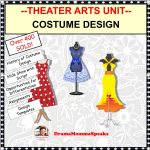
 

Costume Design Lesson with Fairy Tale Characters

Costume Design Lesson with Circus Performers

Slide3

Check out my other posts concerning critical steps in a play or musical:

Critical Steps in Choosing a Play or Musical: Stage Properties 

Critical Steps in Producing a Play or Musical: Stage Makeup

Critical Steps in Producing a Play or Musical: Set Design and Set Construction

Contact me at dhcbaldwin@gmail.com or Bumblingbea.com

I’d love to hear from you!

Deborah Baldwin


Share this:

  • Share on Tumblr (Opens in new window) Tumblr
  • More
  • Share on X (Opens in new window) X
  • Share on Facebook (Opens in new window) Facebook
  • Share on Pinterest (Opens in new window) Pinterest
  • Share on LinkedIn (Opens in new window) LinkedIn
  • Email a link to a friend (Opens in new window) Email
  • Share on Reddit (Opens in new window) Reddit
  • Share on Telegram (Opens in new window) Telegram
  • Share on WhatsApp (Opens in new window) WhatsApp

Like this:

Like Loading...

Filed Under: Broadway, community theatre, directing experiences, drama education, Producing plays and musicals, Production Questions, theater, theatre, youth theatre Tagged With: acting, Mulan Junior, Oklahoma!, On Golden Pond, Simplicity patterns, Simplicity.com, Spring version of The Secret Garden, theatre

Eighteen Ways to Make Your Directing Experience Less Stressful, Part Two

October 23, 2016 By dhcbaldwin 6 Comments

actors singing.jpg

Eighteen Ways to Make Your Directing Experience Less Stressful, Part Two

This is a continuation of my second post about my experiences in directing. Click here for my first post:

Eighteen Ways To Make Your Directing Experience Less Stressful, Part One

If I have learned anything over these thirty-eight years of directing it is that directing is stressful.  Hopefully, my lessons learned can help you!

9.  I begin and end rehearsal on the prearranged time. There is nothing worse than being told, “rehearsals will be from 7:00 to 9:00 pm” and then the rehearsal times change to three hours each night. Ugh.

10. Glib lines between weeks of the show. Glibbing lines is a way to rehearse the lines of the show in a quick and focused manner. Generally, I have my actors sit in a circle and run the lines, but other directors ask their casts to practice the blocking as well.

11. I announce a deadline for the off book date and stick to it. This is a biggie with me. Deadlines are deadlines. If I think a cast needs more time with their scripts in hand, I’ll adjust the schedule. But one can’t really “act” until her hands are free. The first rehearsal off book is usually laborious, if not excruciating. I bode up when I know it’s off book night, but the deadline is a necessary evil.

12.. Use rehearsal props and tape the floor to the set’s measurements. There are people who are tactile learners and all of us are visual learners. Using a rehearsal prop benefits the actor in several ways. Showing the set’s measurements, parameters, steps. window, etc. is hugely helpful.

13. I suggest to a cast, but don’t require, that they rehearse in the shoes they plan to wear for the show. It’s amazing how much an actor’s posture and gait will change once they don their shoes. Long skirts are necessary on ladies as well. We have become a very relaxed dress society. Some women have trouble carrying off the poise that they need once they put on heeled shoes and a long skirt.

DSC_0144.JPG

14. I always have two dress rehearsals.

15. I make time for a read thru of the script before my first blocking rehearsal. This gives me an opportunity to answer questions right from the beginning of the project. Everyone has a better idea of where I stand on everything.

16. I discourage an actor’s personal drama in rehearsals, encouraging them to leave it at the stage door. Enough said…

17. I  substitute swear words only  if I think the audience’s demographics can not tolerate them or the particular actor requests it of me.  If I think an audience is going to spend their whole evening shocked by a swear word, like the dirty four letter F word, then I’ll cut it. If I have an actor who is very religious and is uncomfortable when using the Lord’s name in vain, I’ll adjust the verbiage to something that will give the same feeling, but won’t upset him.

18. I teach novice and student actors the correct way to rehearse accepting that some will have their own method to rehearse.

19. I close my rehearsals to anyone outside the production staff or cast. There is nothing worse than having a surprise guest to rehearsals. It distracts me and my cast members.

W

( When I was six years old, I had  the opportunity to see Marcel Marceau in person in Paris, France. 

 I will NEVER forget it.)

20. I expect moments of frustration and euphoria in every rehearsal process. A little frustration isn’t going to hurt anyone, so long as it isn’t prolonged stress. And there is nothing more rewarding than a moment of “Oh my gosh, we did it!”

  I love to direct, I honestly do.  My resume is proof of that. If you’d like to hear my opinion about directing the Music Man musical, go to:  My Musical Recommendation and Why 

Next time, I’ll talk about my protagonist in Bumbling Bea, Beatrice Brace.

To purchase my book, Bumbling Bea, go to Amazon at Bumbling Bea

Contact me at Dhcbaldwin@gmail.com or DeborahBaldwin.net

woman behind DramaMommaSpeaks

Share this:

  • Share on Tumblr (Opens in new window) Tumblr
  • More
  • Share on X (Opens in new window) X
  • Share on Facebook (Opens in new window) Facebook
  • Share on Pinterest (Opens in new window) Pinterest
  • Share on LinkedIn (Opens in new window) LinkedIn
  • Email a link to a friend (Opens in new window) Email
  • Share on Reddit (Opens in new window) Reddit
  • Share on Telegram (Opens in new window) Telegram
  • Share on WhatsApp (Opens in new window) WhatsApp

Like this:

Like Loading...

Filed Under: directing experiences, Producing plays and musicals, Production Questions, Uncategorized Tagged With: advice for director, directing tips, Marcel Marceau, Music Man, play director, rehearsal etiquette

Critical Steps in Choosing a Play or Musical: Stage Properties

August 30, 2016 By dhcbaldwin 5 Comments

L_E__and_Thelma_E__Stephens_Performing_Arts_Center_1337635322_photo_5[1]

Stephens College Theatre Department

Let’s talk about the critical steps in choosing a play or musical stage properties next.

I have something to admit.  I knew very little about the workings of a play production until I attended college,  Stephens College to be exact.  I was aware of this about myself, but you know, I had NO IDEA how much I didn’t know, you know?  Enter required technical theater hours.

I very gleefully signed up for  crew positions as I was expected to do.  In the theater department, at least at the time, we were not allowed to audition for productions until our second year of school there.  It was part of the process of this solid program that continues to be excellent.

036a

 A Christmas Story  Performing Arts in Children’s Education  December 2004

I’m an over achiever.  It’s terrible how much of an over achiever I can be at times.  Anyway, we were required to have 100 hours.  I finished with 200.  See?  Truthfully, I found I loved crewing backstage.

My first backstage crewing experience occurred when I worked on the stage properties crew and I’ll never forget it.  I enjoyed it so much that one summer I served as prop mistress at the Okoboji Summer Theater, Stephens’ summer theater venue.

Now, I’m virtually an expert  (because I’ve been around since dirt was invented) on stage properties.  A combination of art and theater, using one’s imagination and ingenuity, stage properties are important to the overall effect of the production. Think about it.  What is an important prop used in Into the Woods?  The milk cow. How about in Seussical?  The clover!

Critical Steps in a Play or Musical:  Stage Properties

In my very long career in theater, I have:

  • found two identical Afghan dogs
  • discovered and was loaned Venetian glass in the middle of Iowa
  • borrowed a baby grand piano
  • needlepointed an alphabet sampler (I didn’t know how to needle point when I began)
  • made a fake cheese ball complete with Mickey Mouse ears plopped on top for a chip bowl (I know you are impressed!)

and a gazillion more  cool things…

RSCN4385

The Giver  Fine Arts Guild of the Rockies 2013

Properties Master

If it’s your job to fill out your staff, then look for a volunteer who is very crafty  and clever and draft them to be in charge of your props.  Or, if you are working for a theater, they should provide you with someone.  I would advise you to stay out of their way and merely accept what they bring in if at all possible.

Volunteers do become very possessive of their things, especially when they “searched all weekend to find a pair of wooden knitting needles”. I rarely decline props, because I held a very specific discussion at my prop meeting and preplanned for my needs (including a LIST).  Yet, even with the preparation, I need props that I hadn’t thought of or my actors require personally as they develop their characters  or we discover spontaneously as we rehearse.

067

Into the Woods  Performing Arts in Children’s Education 2004

(The cow was created by a volunteer–wow!)

Back to Budget

Again, you will want to check and see what was allotted in your budget for props.  Props can be created –Gandalf’s staff for The Hobbit, a smoking cauldron for Macbeth, fake meat pies for Sweeney Todd or…a really inexpensive smoke machine you can create with dry ice and a plastic garbage can.  No joke!

You can purchase props on line from theatre supply companies such as RubiesCostumes.com.   They have an excellent inventory, broad and detailed, so if you are looking something historically accurate, I’d start there.  Of course, there are other suppliers, but I usually go to them first.  I have been a customer of theirs for over thirty years.

Many props can be borrowed–a Victorian love seat  for Arsenic and Old Lace, a hand water pump for The Miracle Worker, a Tesla coil for a mad scientist or even the smoke machine I mentioned previously.

I’ve asked many people if I could borrow a particular prop for them.  Usually, people are happy to loan something to you. You should sweeten the request by offering a pair of complimentary tickets and a listing in the program in exchange for their loan.  It’s standard protocol. Or place a sign in the lobby that acknowledges the business or person who helped you out.  That’s nice, too!

Balance of Production Value

I do have one gripe, however. It just really annoys me when the props in a production are uneven, for lack of a better phrase.  I mean, some are authentic looking, but others in the show are not.  I like for my entire “production package” to be equal from the set design to the lights, the costumes to the program.

If one piece is lacking (for instance, the sound equipment is inadequate and unable to amplify the actor’s voices over the orchestra who is full and loud), then the whole thing feels odd.

Perhaps it’s the director in me, but that’s what I notice when I attending a production–whether the show is comprehensive, balanced components.  I like to be a good role model and representative of the arts.  Anything I can do to attract a person to attend or participate in another production is my primary goal. To me, it is lifeblood of the art.

People laugh when I say, “When I direct in any theater, I think of myself as a cruise director.  I want the people to have such a wonderful, meaningful evening that they will be overcome with emotion and tell everyone they know about the experience. Then I smile and nod.” (An old teaching technique to persuade people to agree with you…)

If you are looking for particular lessons about stage properties, I have several available in my Teacherspayteachers.com store.  You can find them here:

Stage Properties Lesson

Slide1

Stage Properties Holiday Theme

STAGE PROPERTIES HOLIDAY THEME COVER

Next, I’ll give you some great tips on costumes.  Look for them soon!

Got a question? Ask me.

Contact me at dhcbaldwin@gmail.com  or DeborahBaldwin.net

Share this:

  • Share on Tumblr (Opens in new window) Tumblr
  • More
  • Share on X (Opens in new window) X
  • Share on Facebook (Opens in new window) Facebook
  • Share on Pinterest (Opens in new window) Pinterest
  • Share on LinkedIn (Opens in new window) LinkedIn
  • Email a link to a friend (Opens in new window) Email
  • Share on Reddit (Opens in new window) Reddit
  • Share on Telegram (Opens in new window) Telegram
  • Share on WhatsApp (Opens in new window) WhatsApp

Like this:

Like Loading...

Filed Under: arts education, directing experiences, drama education, Fine Arts Guild of the Rockies, Producing plays and musicals, Production Questions, Stephens College Tagged With: acting, Arsenic and Old Lace, stage properties, The Christmas Story, The Giver, The Hobbit, The Miracle Worker

Critical Steps in Producing a Play or Musical: Set Design

August 18, 2016 By dhcbaldwin 18 Comments

Critical Steps in Producing a Play or Musical: Set Design 

Critical Steps in Producing a Play or Musical: Set Design


Let’s talk about critical steps in producing a play or musical, shall we?  I think a powerful, creative, unique set design is vital to a production.  Depending upon the production budget (there’s that word again-it’s going to come up a lot in these blog posts), the set can be as elaborate as possible or simple.

If a director has the freedom to choose what she wants, always keep in mind that old adage, “Less is more”.  Personally, I think a set can distract the audience from the production if one isn’t careful.  On the other hand, a simple set can be distracting as well especially if one’s actors aren’t skilled in creating the atmosphere themselves.  A skilled actor should be able to imagine the setting and demonstrate it through character and movement. As you might expect, I’m partial to one person in particular–my husband who designed sets for me many times.  (He designed the set you see below in the photo of The Diary of Anne Frank.)

Your Director’s Concept

First, you need to know whether a designer has been hired or volunteered to design your set.  If so, then you are generally stuck (and I do mean stuck) with that person.  I’ve worked with good ones, lazy ones, entitled ones and very creative-but-can-not-get-it done ones. 

If you are lucky, the designer will have ideas of his own and share them with you and vice versa. As I mentioned in the previous post, have your concept board handy to share with him.

If you are expected to design your own set, start by researching on the internet.  As you find ideas (probably from other companies’ productions of the show), you might want to make a copy of them.  Note:  I am going to say this one time.  If you are capable enough to direct the show then you are capable enough to come up with your own ideas for the set.  It is just tacky to lift (steal, copy or what have you) someone else’s design.  It isn’t polite, it certainly isn’t unique and it isn’t right.

I expect the designer to create a model of the set for me.  In fact, I require it.  Most humans are visual thinkers and consequently it helps the actors (and everyone involved for that matter) in their visualization of the show. As well, it aids me when I am blocking.  I remember directing Something’s Afoot and its first musical number is chaotic and busy.  Characters are entering and exiting one right after another.  The model helped me to keep straight everyone as I placed little spice bottles with each character’s name in the right places.

Critical Steps in Producing a Play or Musical: Set Design

The Diary of Anne Frank   Fine Arts Guild of the Rockies  2012

Ah, The Set Budget!

Set, costumes and stage properties budgets are the most challenging to estimate. If you are in charge of the budget, you will first need an inventory of the company’s set pieces (flats, platforms, stair units, etc.)   Are you thinking of using a scrim?  Does the company own a scrim?  If not, will they purchase one for you?  Would you rather have a stylistic set? What are using projections? Does the venue have the equipment to do so?

That’s a good idea, especially is there is little  money for the set. Is the production a period piece?  You need to consider that question, too. There’s many more questions to ask yourself, but you get the idea…

Critical Steps in Producing a Play or Musical: Set Design
The Giver Fine Arts Guild of the Rockies 2005

The Designer’s Job

If  I have a designer, it’s there responsibility  to create a line item budget.  Generally, designers (costumes too) ask for a color pallet from me.  It’s fairly easy to share my choices using my concept board which I created before the project began. 

There is something very special in having the pleasure to direct on a great looking set. Everyone feels it.  However, some of my most favorite are simpler ones like The Giver (photographed above).  It was understated, perfectly suited the play’s message and met the budget requirements.

Recently, I directed The Wizard of Oz (my first time ever, I know–better late than never).  It was important to me that we stayed away from the  movie version as much as possible.  For countless hours, my designer and I discussed how to create the set on a very limited budget, build it with inexperienced students all the while giving the audience something to imagine and enjoy.  The tornado and its metaphoric moments within the story was our thrust.

We used bicycle wheels, barbed wire and fence posts to create the witch’s lair. Additionally, it was stark looking which was our goal. 

Critical Steps in Producing a Play or Musical: Set Design

Get Organized

If you take the time to pre-plan every aspect of a production, it will save you time later.  Trust me, I have gone into rehearsals thinking I could be spontaneous and think out details as I rehearsed.  Admitting this to you now, I realized this is a ridiculous thought. I can guarantee you I still have spontaneous moments.  That’s part of my nature.  But everyone working with you will appreciate your forethought and find that people are more confident if they can rely on your somewhat established concept right from the first day of rehearsal.

Drama Resources for Busy Teachers

You may be aware I am a retired drama teacher.  Not only do I create drama education resources for drama, language arts, reading and vocal music teachers,  some teachers of  gifted upper elementary students and middle school purchase them too. .  You can see them on  Teachers Pay Teachers.

Bundle:  Study Guide & Set Design Units for Tom Sawyer play

Bundle:  Set Design with Fairy Tales or Bundle:  Set Design with School Setting


If you’d like a FREE lesson for middle school students concerning set design, go to: Set Design the Rendering 

For more advice, check out these posts:

https://dramamommaspeaks.com/2016/11/19/critical-steps-in-producing-a-play-or-musical-costumes/

https://dramamommaspeaks.com/2016/08/17/selecting-a-play-or-musical-casting/

Recently, I watched Phaedra on National Theater at Home and it is exceptional.  But friends, the set is phenomenal!  Check it out here- How we made it:  Phaedra’s Five Sets in One at the National Theatre

I’d love to hear about your experiences directing with unusual sets.  Contact me at dhcbaldwin@gmail.com

Critical Steps in Producing a Play or Musical: Set Design


Share this:

  • Share on Tumblr (Opens in new window) Tumblr
  • More
  • Share on X (Opens in new window) X
  • Share on Facebook (Opens in new window) Facebook
  • Share on Pinterest (Opens in new window) Pinterest
  • Share on LinkedIn (Opens in new window) LinkedIn
  • Email a link to a friend (Opens in new window) Email
  • Share on Reddit (Opens in new window) Reddit
  • Share on Telegram (Opens in new window) Telegram
  • Share on WhatsApp (Opens in new window) WhatsApp

Like this:

Like Loading...

Filed Under: arts education, community theater, community theatre, directing experiences, drama education, Education, Education, Musical Theatre, Presser Performing Arts Center, Producing plays and musicals, Production Questions, set design, Teacherspayteachers, theater, theatre, youth theatre Tagged With: acting, directing, drama education, set design, set designer, Wizard of Oz, youth theater

Critical Steps in Selecting a Play or Musical: Casting

August 17, 2016 By dhcbaldwin 2 Comments

The Giver play

Critical Steps in Selecting a Play or Musical: Casting

Into the Woods   Performing Arts in Children’s Education  July 2004

Critical Steps in Selecting a Play or Musical: Casting

Today, I want to discuss the critical steps in selecting a play or musical: Casting. Have you ever seen someone do something  that you know is very difficult to do? Have you thought that they make it look easy? Me, too.  I’ve been watching the Olympic Games and in particular I’ve enjoyed cheering on Simone Biles as she catapults herself all over the gymnastic mat.  Incredible!

An experienced director looks much the same way.  They make it look effortless.  It is not. Casting a production can be challenging, or easy and even fun but it can also be hugely nerve wracking.

In this series on selecting a play or musical, this is the next item to consider–casting

first rehearsal
First rehearsal of Oklahoma!

Assessing Talent Requirements: Matching Roles to Performers When Casting

1. What abilities are required of performers for this production?

First, you have to look at the roles and decide who is most essential.  Does the show require tap dancers for 42 Street (not easy to come by in adult actors)  or singers who can sing in six part harmony for Sweeney Todd (not easy to come by either)? How many men? Men aren’t in great number in community theatre. Many plays and musicals require more men than women (aint’ it the way ?)

If the play calls for a thirteen year old female  for The Diary of Anne Frank, do you have one who can play the character?  If an elderly man is needed for King Lear, do you have person who can play it? How about someone who can dance the ballet in Oklahoma? Or juggle in Barnam? Or you think could learn to juggle? Really take the time and be honest with yourself about what the production requires.  My advice:  If you don’t think you have the people (or at least l/2 of them) that you need BEFORE you hold auditions then change shows.

Critical Steps in Selecting a Play or Musical: Casting

The Diary of Anne Frank  Fine Arts Guild of the Rockies  2012

2. What artistic expectations do you have of the company for which you are working?

If you are a guest director, I’d survey the theatre company you are working for and ask for their mission statement.  It may express something about including all community members participating in their productions. Looking to cast a youth theater production?  Check out: Ten Steps in a Play Rehearsal in Youth Theater

What does that look like exactly?  If they expect you to cast someone with a physical challenge, such as a blind person or one with hearing loss and you are directing The Miracle Worker for them, then you need to know that right up front.

Some companies leave everything to the director to decide.  That’s nice. However, sometimes the company will return to you later and request, “We need you to cast So-and-So because his father is a board member.” Have a personal opinion about such “favors” before you begin.  It will save you heaps of time and headaches, I guarantee you.  Make your wishes known as you pre-plan the show.

Critical Steps in Selecting a Play or Musical: Casting

The Music Man   Theatre Reading Young People and Schools  2001

3. Casting is a bugaboo

As I mentioned, casting  has the capacity to be difficult.  Experienced directors will share with you that casting can be very random. When casting productions I use my intuition to select the actors. If the essence of the character seems to be a part of the actor’s persona. When I am unfamiliar with the actor auditioning, I will attempt  during auditions to direct them in the characterization I’m seeking.

If  we (and I do mean “we”) can reach a common vision for the character, then I will be interested in casting them.  I don’t always have success with this method, but I am wiling to take a chance.

Unfortunately, there are directors that pre-cast their productions.  I really dislike that.  If Sue is cast that was not pre-cast like Mary, somehow Sue will find out that Mary  was selected ahead of time and that can make for hard feelings within the cast.  Play fairly.

Assessing Talent Requirements: Matching Roles to Performers When Casting

I think it is all right to invite people to audition for my shows, but I have a disclaimer clause that I mention to them, “I can’t promise you a role, because that wouldn’t be ethical.  But I am interested in hearing you read several parts.  If I cast you, I will treat you like every other cast member as I know you would want me to do.  That’s only fair.”  That’s sort of a salesman’s assumptive close, because it implies that the invited person would want to earn the part on their own merit, OF COURSE and not cheat to win it.

Critical Steps in Selecting a Play or Musical: Casting
The Giver 2012

4. The Talent Pool

Do consider whether you have actors who can sing the roles, dancers who can play dancing roles and actors with the hutzpah to carry off a two hour show.  If not, then I’d change shows.  Sure, there are directors who say, “Well, we will make it work.”  Really?

If the theatre company you are directing for has no problem with unqualified actors portraying roles, then give it a go.  Will you be so distracted by the duck-out-of-water person that you can not fully engage with the show?  Trust me, I’ve learned the hard way.  Once I cast a woman who was an incredible actress when she was young, but hadn’t acted in thirty years.  She was anxious about her lines, consequently taking herself out of the performing experience– inebriated.  I knew in my heart that this experience would be too much for her, but I went ahead and cast her anyway.

Consequently, I had to replace her with myself!  I should have known better.

PLAYING DOT IN CRICKET ON THE HEARTH

Some award-winning performers quotes about auditioning

  • Hugh Jackman (actor, musical theatre performer):

“Auditioning is really about being present and showing who you are—not trying to be what you think they want.”

  • Lin-Manuel Miranda (creator of Hamilton, In the Heights):

“Auditions are weird—you’re not trying to play a role; you’re trying to convince them you could play it.”

  • Philip Seymour Hoffman:

“Auditioning is a chance to act, so I never thought of it as torture. It’s a chance to play for five minutes.”

  • Alan Rickman:

“Talent is an accident of genes—and a responsibility. Auditions are where you prove you know what to do with that responsibility.”

  • Kristin Chenoweth (Broadway performer):

“Every ‘no’ in an audition is one step closer to the ‘yes’ that’s meant for you.”

A Secret of Mine

If you are there to set the benchmark for future directors and productions, then by all means only cast the very best.  I’ve directed all skill levels, some brilliant artists and some not so great.   I’ll tell you a secret:

If audience members are judging you by one actor’s performance, then they need to go home. 🙂

Herding cats is easier than directing.

Go to my next blog concerning set design and construction.

What insights to do you have about auditioning?  I’d love to learn about them?  Contact me at Dhcbaldwin@gmail.com


Share this:

  • Share on Tumblr (Opens in new window) Tumblr
  • More
  • Share on X (Opens in new window) X
  • Share on Facebook (Opens in new window) Facebook
  • Share on Pinterest (Opens in new window) Pinterest
  • Share on LinkedIn (Opens in new window) LinkedIn
  • Email a link to a friend (Opens in new window) Email
  • Share on Reddit (Opens in new window) Reddit
  • Share on Telegram (Opens in new window) Telegram
  • Share on WhatsApp (Opens in new window) WhatsApp

Like this:

Like Loading...

Filed Under: directing experiences, drama education, Fine Arts Guild of the Rockies, Musical Theatre, Presser Performing Arts Center, Producing plays and musicals, Production Questions, theater, theatre, youth theatre Tagged With: 42nd Street, Barnam, Brio Olympics 2016, Diary of Anne Frank, drama education, Into the Woods Jr., King Lear, Oklahoma!, Simone Biles, The Diary of Anne Frank, The Music Man Junior

Critical Steps in Selecting a Play or Musical: Budget & Royalties

August 5, 2016 By dhcbaldwin 6 Comments

599251_10151928154440331_863385914_n[1]

Willy Wonka, Jr.  2010

Let’s discuss the critical steps in selecting a play or musical:  budget & royalties.  Sometimes I meet with directors of future productions who are excited and apprehensive at the same time.   Usually, they are certain in their decision of choice of show or are completely overwhelmed by the many selections in which they have to choose.  I thought I’d write a series of blog entries concerning this.This is the first of many.

Number One: Director’s Concept

You need a director’s concept.  A director’s concept is the message that the director wants to convey to the audience.  If you are directing “The Miracle Worker”, you will probably want a natural, historically accurate concept. If I’m directing a historical piece, I select costumes, props and have a set designed to demonstrate it. But what else is important to you?  Helen’s viewpoint?  How can you  present that to an audience?  I’d suggest to you to create a concept collage pertaining to your concept.  It’s really easy to do, fun and will help you in every facet of the production.  Get out a large piece of paper or posterboard, begin researching on the internet (which is the easiest way to research for this), find photos of everything that inspired you and your director concept.

Number Two:  Budget

What is the budget? Before a company can even get started, the budget must be considered. There is nothing worse than getting yourself caught in a snare of “Well, we have to buy it (or rent, borrow or steal it) because the script says so.”  Proper preplanning can help a company to avoid this dilemna. To me, the budget controls everything–where you can afford that really neat backdrop you want to rent for , or the authentic looking chain male for “Camelot”, puppets for   Lion King   and so on and so on.

Some amateur companies set a budget, but never look at it again.  Some have producers who guard the budget like a hawk.  Some others leave everything up to the director (as if they don’t have enough to do all ready). Make sure you know how the money is overseen.  You’d hate to find out that the fog machine you had rented can’t be used for the woods scenes in “Into the Woods” after you had enthusiastically worked it into the show.

And for heaven’s sake, read the script a couple of times to make sure there aren’t any surprises that you forgot about.  But where do you find the publishing companies’ names?  There is a great source, Findaplay.com  that can help you.  You can always search the web for the company, but if you want to produce a version of Tom Sawyer, for example, there are several companies that offer it.  Findaplay.com will list all of them and if they don’t, then go to the web and look around.

Several times I have wanted to produce a play version of some story.  One was Holes and another was The Stinky Cheese Man and Other Fairly Stupid Tales.  At the time, there were no publishers with rights to the stories.  It took a bit of searching, but I found the author of Holes which led me to the playwright of Holes.  I wrote to the playwright and asked if my school could produce his play and he agreed! Talk about fortuitous!  I did the same with Stinky Cheese Man.  I found the author, who sent me to the playwright who allowed the youth theatre company I was working with to produce the musical version.  Pay dirt!  So, if you are interested in a particular book and want to produce it as a play or musical, look around the internet.  You may find it in this manner.

But in no uncertain terms (please hear this loud and clear) you CAN NOT take someone else’s material and dramatize it for your own use.  This is a HUGE copyright infringement and just tacky.

https://readersfavorite.com/annual-book-award-contest.htm?affiliateID=1555

img_0183

Number Three:  Royalties

Personally, I think it’s important to know the cost of the royalties for your chosen production before even choosing it.  Usually, plays are no problem.  But musicals?  Well, that’s another challenge all together! Any time I hear about a company who is producing a fairly new show straight off of Broadway, I always think about the royalties.  The cost of royalties can stop a company in their tracks.  Musicals require a hefty sum of money to produce, not to mention the rental of scripts and librettos.  Oh yes, and if you plan to have an orchestra, you need to figure in the cost of their music to rent as well. (And paying your orchestra players, too.)

Also, you may need to pay the royalties to the publisher ahead of time.  It all depends upon the contract you sign, so read it overcarefully.

When you peruse a copy of a musical, you can ask the publishing company for a general royalty cost.  You’ll need to give them some information that’s necessary to them ( size of theatre, ticket prices, length of run, etc.)

So, there you have it!  There are the critical steps in selecting a play or musical:  budget & royalties.

If all of these decisions sound daunting, keep in mind that it is just part of the journey to direct or produce a show.  I promise you, once an audience sits down in the theatre and the house darkens, you will forget all about this stuff.  Because that’s all it is, stuff…..

Next look at my post on casting a production.

Contact me at Dhcbaldwin@gmail.com or BumblingBea.com

Share this:

  • Share on Tumblr (Opens in new window) Tumblr
  • More
  • Share on X (Opens in new window) X
  • Share on Facebook (Opens in new window) Facebook
  • Share on Pinterest (Opens in new window) Pinterest
  • Share on LinkedIn (Opens in new window) LinkedIn
  • Email a link to a friend (Opens in new window) Email
  • Share on Reddit (Opens in new window) Reddit
  • Share on Telegram (Opens in new window) Telegram
  • Share on WhatsApp (Opens in new window) WhatsApp

Like this:

Like Loading...

Filed Under: drama education, Musical Theatre, Producing plays and musicals, Production Questions Tagged With: ', beginner directors, budgets for theatrical productions, Bumbling Bea, deborah-baldwin, director's concept, Findplay.com, first time directors, musicals, plays

« Previous Page
Next Page »

Footer

Follow Us

logo3.png

FOLLOW US

Facebook X-twitter Pinterest Instagram Envelope Rss

Goodreads: read

Malibu Rising
Malibu Rising
by Taylor Jenkins Reid
People We Meet on Vacation
by Emily Henry
The Last Thing He Told Me
by Laura Dave
Faking It
Faking It
by Cora Carmack
Losing It
Losing It
by Cora Carmack

goodreads.com
Copyright © 2024 · Wellness Pro on Genesis Framework · WordPress.com.Log in
 

Loading Comments...
 

    %d