• Skip to primary navigation
  • Skip to main content
  • Skip to footer

Join Me in my new Facebook Group! https://www.facebook.com/groups/417126059784261

Menu
  • Meet Deb – The Heart Behind DramaMommaSpeaks
    • Work with Me! 
    • Photo Gallery of DramaMommaSpeaks
    • Directorial Credits
  • I Give Book Talks! 
    • Book Talk Through Skype
    • Books
  • Freebies!
  • Bumbling Bea
  • Teaching Resume
  • Acting Resume
  • Contact Me
  • Blog
    • Drama Education
    • Arts Education
    • Youth Theatre
    • Middle Grades
    • Musical Theatre
    • Teaching
  • Meet Deb – The Heart Behind DramaMommaSpeaks
    • Work with Me! 
    • Photo Gallery of DramaMommaSpeaks
    • Directorial Credits
  • I Give Book Talks! 
    • Book Talk Through Skype
    • Books
  • Freebies!
  • Bumbling Bea
  • Teaching Resume
  • Acting Resume
  • Contact Me
  • Blog
    • Drama Education
    • Arts Education
    • Youth Theatre
    • Middle Grades
    • Musical Theatre
    • Teaching

Teacherspayteachers

Middle School Drama Success: Choice Boards in Action

October 18, 2023 By dhcbaldwin Leave a Comment

Students studying with an ipad

Middle School Drama Success: Choice Boards in Action

If you are like me, you like to make choices for yourself.  That’s one of the cool things about being an adult, don’t you think? We make a lot of choices for ourselves. However, our students don’t have the opportunity to make decisions for themselves very often.  Let’s help them learn how to do so while learning from the subjects that interested them.  Today I’m going talk about setting the Stage for Success: Middle School Drama Meets Choice Boards.

Middle School Students are the Best

Middle School Drama Success: Choice Boards in Action

Middle school students are my favorite grades to teach.  In particular, they are vibrant, still curious and resilient.  Personally, I believe that teaching  middle school theater is the door to nurturing young talents. I find they are intensely interested in many subjects at this age.  Plus, creativity knows no bounds, and their self-expression takes center stage.

Middle school students can be engaged far faster than high school students.  They are just young enough to remember their beloved elementary teachers who they trusted.  Consequently, they quickly trust you when you propose an concept to them. Read this post, if you’d like more of my reflections about middle school students: Striking a Balance with Students in Their Middle School Years

In the heart of this theatrical journey lies a powerful tool – choice boards. Imagine giving your students the freedom to explore and make decisions in their drama education. First, let’s dive into how these versatile tools can breathe life into your drama classroom.

Setting the Stage for Success: Middle School Drama Meets Choice Boards

What Are Choice Boards?

Choice boards are visual organizers that present students with a variety of options for how they can engage with and demonstrate their learning. Consequently, they empower students to take ownership of their education by allowing them to choose activities that resonate with their interests, learning styles, and abilities.

Why Do Teachers Use Choice Boards in Drama?

  1. Individualized Learning: Middle school students are at an age where they’re discovering their unique talents and interests. Choice boards offer a range of activities, catering to diverse learning styles and abilities.
  2. Enhanced Engagement: When students have a say in their learning, they’re more invested in the process. Drama is all about passion and expression, and choice boards can ignite that spark.
  3. Creativity Unleashed: Drama thrives on creativity. Choice boards encourage students to think outside the box, explore different aspects of theater, and come up with fresh ideas.
  4. Differentiated Instruction: Drama classrooms often have a mix of skill levels. Choice boards allow the teacher to provide activities that cater to both beginners and experienced performers. Additionally, it’s effortless for the teacher to do so.

Did you know I have the secret to boosting student engagement?  My new book, “We’re Live! Radio Theater #101” explains my journey to implementing this unique tool in the classroom. Check it out here

Middle School Drama Success: Choice Boards in Action

Benefits for Drama Students

Implementing choice boards in your middle school drama classroom can lead to:

  • Increased Confidence: Students gain confidence as they engage in activities that align with their interests and strengths. It is far easier to be successful when learning something new if you are interested in the subject.  What a plus!
  • Broadened Horizons: Exposure to a variety of drama aspects can help students discover new passions within the world of theater.  As a matter of fact, my Choice Board products receive many 5 star reviews. In addition, teachers express their excitement to have taught something unique to their students which they would not have the time to study in depth.
  • Ownership of Learning: Empowering students to make choices fosters a sense of ownership over their education. Here’s that choice thing again.  By making choices for themselves, students see themselves as independent and capable.  Aren’t those attributes we want for them?
  • Joy in Learning: Drama should be fun! Choice boards infuse a sense of joy and excitement into the classroom. I think we’d all agree it’s difficult to compete with fun, yes?
Middle School Drama Success: Choice Boards in Action

My Choice Board Resources

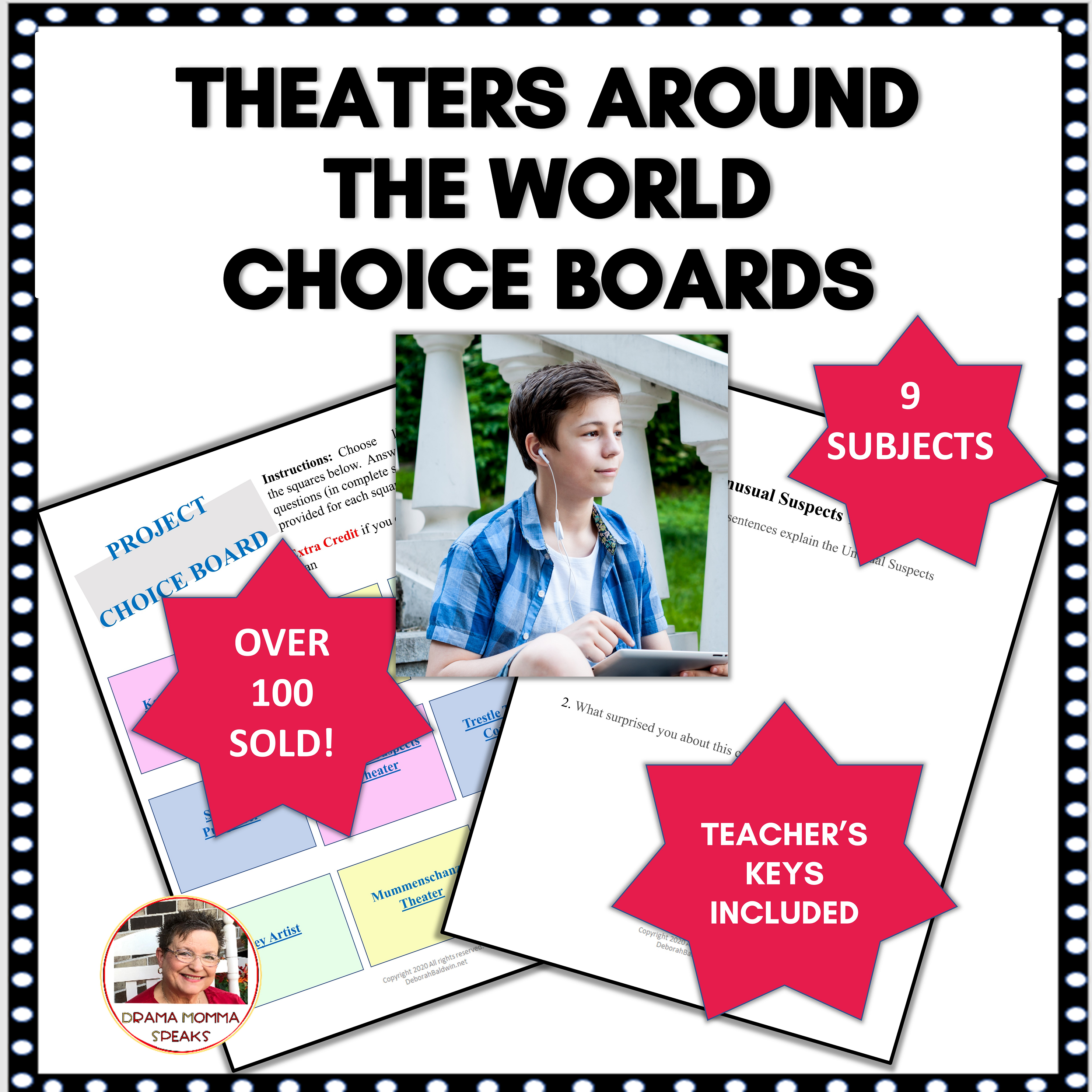
I have three choice board resources ready for you to use.  One pertains to theaters around the world.  This low prep- high student engagement lesson gives students an opportunity to learn about various theater companies such as Mummenschanz, Deaf West, Trestle Theatre, Kabuki Theater,Marcel Marceau or what is means to be a Foley Engineer. Additionally, they are excellent for gifted learners or students who need independent study or an alternative assignment.

Got some introverted students in your class?  Check out: Drama Games for the Introvertive Student 

The resource includes:

  • Teachers Letter
  • 9 Choices on a colorful board which can be displayed on a white board
  • 21 Questions–no sets of questions are alike
  • Teacher’s Key–hooray! (many possible answers are included for each clip)
  • Live Links– ready to go

Middle School Drama Success: Choice Boards in Action

Another choice board product concerns technical theater. This product is wildly popular!

This resource includes:

  • Teacher’s Letter
  • 9 Choices on a colorful board which can be displayed on a white board
  • 48 Questions–no two set of questions are alike (shows–Wicked, Hamilton, Spongebob Squarepants, War Horse, School of Rock)
  • Teacher’s Key–hooray!
  • Live Links– ready to go

The third is brand new.  You know how your students become chatty when you are focused on a small group and their rehearsal?  This is the answer to your problem.  Students learn about virtually every aspect of play or musical production from designing poster, drawing a costume or creating a movement piece concerning one of the themes of the production.  Students can be assigned to complete every choice or only a few.

Play production choice board cover

This board has 16 engaging assignments to keep everyone interested and busy creating.  There is plenty of room for individuality and some group work, too.  You can find it at:  Drama Class Production Choice Board

Looking for something free?  Pick up this one.
Middle School Drama Success: Choice Boards in Action

An Alternative Choice Board Format

If your students do not have I-pads,  access to the computer or WIFI, a teacher can use these resources instead. They are basically the same as the Choice Boards, however a student receives the link from the teacher. These are excellent for a substitute to use, too.

Middle School Drama Success: Choice Boards in Action        Middle School Drama Success: Choice Boards in Action

Students could vote on the subject they’d like to learn about and view the video clips which pertain to that subject.  Accordingly,  students are assigned to watch the video clips on their own at home.  You will find these products here.

Incorporating choice boards in your middle school drama classroom is like handing the spotlight to your students. It allows them to explore, express, and create in ways that resonate with their unique personalities. So, go ahead and embrace this dynamic tool to ignite the passion for drama in your middle school students’ hearts. The stage is set, and the choice is theirs!

Have you used Choice Boards in your classroom?  I’d love to hear how you have used them.  Feel free to email me at DhcBaldwin@gmail.com
Woman behind DramaMommaSpeaks


Share this:

  • Share on Tumblr (Opens in new window) Tumblr
  • More
  • Share on X (Opens in new window) X
  • Share on Facebook (Opens in new window) Facebook
  • Share on Pinterest (Opens in new window) Pinterest
  • Share on LinkedIn (Opens in new window) LinkedIn
  • Email a link to a friend (Opens in new window) Email
  • Share on Reddit (Opens in new window) Reddit
  • Share on Telegram (Opens in new window) Telegram
  • Share on WhatsApp (Opens in new window) WhatsApp

Like this:

Like Loading...

Filed Under: arts education, arts integration, creative dramatics, creative movement, drama education, drama integration, Education, middle grades, Teacherspayteachers, Teaching, teaching strategies Tagged With: choice boards, Deaf West, differentation, Hamilton, Kabuki Theater, Marcel Marceau, Mummenschanz, School of Rockical, spongebob squarepants, Trestle Theatre, War Horse, Wicked

How to Celebrate Hispanic and Latino Heritage Month in the Drama Classroom

September 27, 2023 By dhcbaldwin Leave a Comment

A sombrero celebrating national HIspanic and Latino culture month

How to Celebrate Hispanic and Latino Heritage Month in the Drama Classroom

How to Celebrate Hispanic and Latino Heritage Month in the Drama Classroom

In this blog post, let’s discuss How to Celebrate Hispanic and Latino Heritage Month in the Drama Classroom. First, I want to share a little memory of mine…When I was in my teens, my father, mother and I traveled to Mexico driving from Kansas.  Needless to say, it was an amazing trip full of wrong turns, teen angst and hilarity.

The Language Barrier Gone Amok

Anyway, we hadn’t studied the Mexican language prior to traveling there.  Consequently, communicating with the Mexican people was difficult for us. One day, somehow, we ended up in the middle of a car race. My father turned a corner too tightly and put our travel trailer up on a curb where we were stuck for several hours. The racing cars had to slow down because of us.

When the policeman scolded my dad, I remember my mother (who was raised in Japan) and my father (who fought in WWII) began speaking in Japanese and German to him. Of course, he became even more furious.  Needless to say, it was embarrassing and humiliating to poor little fourteen-year-old me. Remember being fourteen?

Fortunately, we were lucky enough to see the Folklorico Ballet of Mexico one evening.  As you would expect, it was absolutely amazing! For me, it was the highlight of the entire trip. That, and the really cute boys hanging out on the Matzatland beach.

Our Family Trip to Mexico

Accordingly, we returned home and that was the end of my education about the Mexican culture.  I studied French in high school, never once considering I might enjoy learning to speak Spanish.  At the time, social studies classes didn’t study different cultures.  Surprisingly, I believe we only studied the United States. Talk about living in a bubble!

However, you and your students can celebrate different cultures right in your drama classroom.  Let’s begin with Hispanic and Latino Heritage Month.  When I began researching this subject, I was pleasantly surprised by the volume of resources available for this celebratory month.  Plus, there are many sources in theater for this celebration.  Therefore, not only do you have an opportunity to study a different culture, albeit briefly, you also can integrate drama (or vice versa) into your class.

How to Celebrate Hispanic and Latino Heritage Month in the Drama Classroom

National Hispanic and Latino Heritage Month’s Beginnings

The year was 1970 only two years after President Johnson proclaimed a week-long celebration of Hispanic people and their culture.  However President Reagan expanded the week to a month in 1988 and it was titled National Hispanic Heritage month!

If you are unfamiliar with National Hispanic and Latino Heritage month it is a time to honor and celebrate the rich cultural contributions of Hispanic and Latinx communities in the United States.  September 15 to October 15 gives a teacher  an excellent opportunity to engage their students in a diverse and immersive experience within a drama class. I think you’ll be surprised by how easy it is to celebrate the culture through your drama curriculum.  Additionally, you can foster cultural awareness, appreciation, and creativity in your students. Want to learn more about this subject? Check out another blog post, Celebrate National Hispanic Heritage Month in Your Drama Classroom Tomorrow

How to Celebrate Hispanic and Latino Heritage Month in the Drama Classroom

Seven Ways to Celebrate National Hispanic and Latino Heritage Month

  1. Exploring Hispanic Playwrights and Theater

One of the best ways to immerse your drama class in Hispanic culture is by introducing them to renowned Hispanic playwrights and their works. Discussing plays by writers such as Lin Manuel Miranda opens up conversations about the Hispanic experience, identity, and history. If you teach middle school students,  you can study Lin Manuel Miranda through these two resources:  Newspaper Article or pick up this free lesson here. Or pick up a biography lesson and one pager assignment concerning Anthony Ramos here.

  1. Performing Hispanic Plays

Organize a class performance of a Hispanic play or scene. You can select a one-act play or adapt a scene from a famous Hispanic playwright’s work. This hands-on experience will not only deepen your students’ understanding of Hispanic culture but also enhance their acting skills. I suggest purchasing a copy of Esperanza Rising play to use as a read aloud. Want to know more about the theater? Check out: The Seven Reasons I Recommend Plays for New Audiences Scripts

How to Celebrate Hispanic and Latino Heritage Month in the Drama Classroom

  1. Guest Speakers and Workshops

If possible, I’d suggest inviting guest speaker or theater professionals with a Hispanic heritage to share their experiences and insights with your drama class. They can discuss their journey in the theater world, the importance of representation, and the cultural significance of their work. Workshops on Latinx theater techniques, dance, or music can also add a dynamic dimension to your drama curriculum. Or maybe you want to show your students what is possible for them if they are of Hispanic descent and interested in a professional career.  Use this video clip to teach about Hispanic American Theatre  Want to know other ways to use video in your classroom?  Check out:  Underestimate the Influence of Teaching with Videos

More Celebration Ideas

  1. Research and Presentations

Another idea is to assign students to complete a short research project focused on a prominent Hispanic actor, director, or playwright. They can explore their contributions to the theater world and the impact of their work on Hispanic culture. Require your students to make a presentation of it.  However, if your students don’t have time to study anyone in depth, check out: Designing Broadway:  On Your Feet!  Costume Designer Emilio Sosa. 

How to Celebrate Hispanic and Latino Heritage Month in the Drama Classroom

  1. Bilingual Performances

Although this is a little difficult to do, it would be very interesting for your students to perform a scene or monologue in both English and Spanish. This exercise not only improves their language skills but also allows them to connect with the material on a deeper level.

Most importantly, it emphasizes the importance of language as a bridge between cultures. Here are some you could use: Quiara Alegría Hudes: Barrio Girl. Dramatic Publishing. Luis Alfaro. Black Butterfly, Jaguar Girl, Piñata Woman and Other Superhero Girls, Like Me. Playscripts, Coleman A. Jennings: Nine plays by José Cruz González (anthology). Dramatic Publishing. or Karen Zacarías: Cinderella Eats Rice and Beans. How the Garcia Girls Lost their Accent. Looking for Roberto Clemente. Magical Piñata. Frida Libre. Dramatic Publishing.

  1. Cultural Immersion

To truly celebrate Hispanic culture, consider organizing a cultural immersion day. This could include a screening of a Hispanic film, a salsa dancing lesson or perform a readers theater script. Any of these activities will engage your students.  By immersing students in the sights, sounds, and flavors of Hispanic culture can be a memorable and enjoyable experience. Check out these units:  The Magic Lake (Peruvian Legend), The Legend of the Poinsettia (Mexican Legend) or In the Heights Broadway Musical Unit (Latino culture).

How to Celebrate Hispanic and Latino Heritage Month in the Drama Classroom

Collaborative Projects

Lastly, students enjoy learning with a partner. Additionally, they enjoy costume design.  How about assigning students to design costumes for a Hispanic version of  the story of Cinderella in play form  using Vogue magazine fashion design sketching app.? Or creating a stage property with a Latin theme using an app. like Tinkercard.com?

The Hispanic Culture and Heritage is Deserves Our Respect

I’ve only scratched the surface as far as the resources available to use when celebrating this terrific culture.  Just remember that celebrating Hispanic and Latino Heritage month in drama class is not only educational but also a celebration of the rich tapestry of American culture.  Lastly, I hope you embrace this month as an occasion to broaden horizons, encourage empathy, and promote the importance of diversity and inclusion in the world of theater. Because as I always say…there’s no better place to learn than through theater! 

What celebrations do you have planned for your students?  I’d love to hear about them.  Contact me at DhcBaldwin@gmail.com and we’ll chat!

Woman behind DramaMommaSpeaks


Share this:

  • Share on Tumblr (Opens in new window) Tumblr
  • More
  • Share on X (Opens in new window) X
  • Share on Facebook (Opens in new window) Facebook
  • Share on Pinterest (Opens in new window) Pinterest
  • Share on LinkedIn (Opens in new window) LinkedIn
  • Email a link to a friend (Opens in new window) Email
  • Share on Reddit (Opens in new window) Reddit
  • Share on Telegram (Opens in new window) Telegram
  • Share on WhatsApp (Opens in new window) WhatsApp

Like this:

Like Loading...

Filed Under: acting, Arts, arts education, community theater, drama education, drama integration, Education, excellence in teaching, High School, middle grades, Teacherspayteachers, Teaching, teaching strategies, theater, theatre Tagged With: Barrio Girl. Dramatic Publishing. Luis Alfaro. Black Butterfly, drama class, Dramatic Publishing, high school theater, Hispanic American Theatre, Hispanic culture, In the Heights Broadway Musical, Jaguar Girl, Like Me. Playscripts, Lin Manuel Miranda, Middle school, Piñata Woman and Other Superhero Girls, The Legend of the Poinsettia Readers Theater Unit, The Magic Lake Readers Theater Unit

Stage Makeup and Its Transformative Power for Students

July 19, 2023 By dhcbaldwin Leave a Comment

Theater student in stage makeup

I’m mentioned this in the past, but thought I’d reiterate it if you’ve not heard it. Let’s talk about Stage Makeup and Its Transformative Power for Students.

The Transformative Power When Students Apply Stage Makeup

Stage Makeup and Its Transformative Power for Students

This is a true story.

When I was in seventh grade, I wanted to wear makeup. Of course, that was about 100 years ago, so let’s keep it in perspective…My mother wasn’t ready for that step in my life quite yet, but I was.  Boy, was I ready.
I read in a Seventeen magazine that I could make my own “home made” mascara using charcoal and petroleum jelly.  I went to work!
Now I’m not known to be very patient (although I am better now that I have grown older), so I looked around our house for the two ingredients I needed.  Hmmm.  I found a jar of petroleum jelly  in my bathroom cabinet, but charcoal? The only charcoal I knew of was charcoal briquettes.

My Makeup Journey

Briquette - Wikipedia
Being my impulsive self as well and not taking into account that perhaps a charcoal briquette was the wrong kind of charcoal for my DIY mascara, I mixed it into the petroleum jelly anyway.  Yes. I. Used. A. Charcoal. Briquette. No kidding. Needless to say, it was a flop.
Upon entering our dining room for dinner that evening while modeling my  “homemade mascara”, my mother let out an “Oh my!” Not surprisingly, soon after she drove to a Merle Norman store and enrolled me in a class about makeup.

Stage Makeup and Its Transformative Power for Students

Luckily, I learned to apply makeup and in later years discovered in college that I really enjoyed designing stage makeup or theatrical makeup. It seems obvious that students would enjoy studying about stage makeup.  Additionally, it helps so much for novice actors to “see” what their character will look like.  Coupled with a costume, some actors come to life as the character for the first time.  It is really that magical.

Did you know I have the secret to boosting student engagement?  My new book, “We’re Live! Radio Theater #101” explains my journey to implementing this unique tool in the classroom. Check it out here

The Transformative Power When Students Apply Stage Makeup

Reasons To Study Theatrical Makeup

  1. Character Transformation: Stage makeup is a powerful tool that allows actors to transform their appearance and effectively portray a wide range of characters. By studying stage makeup, theater students learn how to use makeup techniques to enhance facial features, create age, gender, or ethnic-specific looks, and convey emotions. This skill helps them bring their characters to life and make them more believable on stage.
  2. Visual Communication: In theater, makeup serves as a visual language that communicates important information to the audience. Different makeup techniques can convey specific time periods, social statuses, or cultural backgrounds of characters. By understanding the principles of stage makeup, theater students learn how to use color, shading, highlighting, and contouring to visually communicate the desired message and enhance storytelling.
  3.  Versatility: Stage makeup is not limited to traditional theater productions. Various performing arts disciplines such as film, television, opera, and dance use stage makeup as well.  Students can study to become a professional stage makeup artist and they’ve got themselves a job!

Reasons to Study Theatrical Makeup

4.  Collaboration and Teamwork: For particular productions using a certain style or concept, stage makeup involves collaboration with other artists, such as costume designers, lighting designers, and directors. One of the most   important skills our students can learn is how to work with others because in the professional world of theater, it’s a team effort for certain. Learn more about how theater skills help in careers here: Why Theater Education Matters: Developing Key Life Skills

5.  Self-Sufficiency: In many theater companies (particularly those with small budget), actors are often responsible for applying their own makeup depending upon the budget of the show. By studying, designing and applying  stage makeup theater students gain the ability to create their own character looks.  Accordingly, this can be particularly beneficial in smaller productions, when working on independent projects. This independence allows actors to take more control over their creative process and in bringing their characters to life. What a terrific differentiation! 

6.   Understanding Lighting and Stage Effects: By studying stage makeup, theater students gain an understanding of how makeup interacts with stage lighting.  Thus, ensuring that their character’s features remain visible and expressive even under different lighting conditions. Having this information helps actors develop  makeup techniques to the specific requirements of a production.  Consequently, this results  in a more polished and professional performance.

A Bundle of Stage Makeup Units

You may be unaware, but I create theater education resources.  You can purchase them here.

I have a bundle of stage makeup units. Here’s its description for you:

SAVE 30%! This bundle contains 4 lessons on stage makeup (old age, neutral, circus, zombie and fantasy) and gives your students a chance to be makeup artists. They’ll view, study, take notes on concepts, apply the knowledge, design and apply their own ideas. These are great for an upper middle school ( a little challenging) or high school drama class.

Each Stage Makeup Lesson includes:

  • Warm-Up Exercises
  • The History of Stage Makeup (separate file of PowerPoint slides & teacher’s lecture notes)
  • Theatre Quote page–great to use for discussion and/or bell ringers
  • Teacher’s Script–what I say and how I say it!
  • Procedures
  • Materials List
  • Source & Video link list ( old age, basic and circus and fantasy makeup tutorials, etc.)
  • Pinterest board links with examples for some lessons
  • Female Makeup Design Template
  • Male Makeup Design Template

My stage makeup studies include entire lessons for you. If you still need some persuading, check out this blog post: Critical Steps in Producing a Play or Musical: Stage Makeup

The Transformative Power When Students Apply Stage Makeup

Choice Boards for Differentiation

If you are looking for a way to teach students about theaters around the world, check out these Choice Boards. 

What are Choice Boards, you ask?  In this case, my choice boards are a collection of links which lead to video clips.  Students select the subjects they are most interested in, view the video clips and answer the questions.  This is super differentiation! By tailoring instruction to meet individual needs. through content, process, products, the learning environment,  ongoing assessment or  flexible grouping, differentiation creates a successful approach to instruction.

I hope you’ll considering teaching about stage makeup with your students.  It’s so important.  Just watch the transformation of your students as they apply it! Suddenly, you’ll see a student transform into a character.  Costumes do the same thing for them. As I mentioned above, these skills contribute to students’ overall artistic development and enable them to deliver compelling performances that captivate and engage audiences.
What styles of stage makeup design have you taught your students?  Did they enjoy it?  I’d love to learn about it.  Contact me at DhcBaldwin@gmail.com
Woman behind DramaMommaSpeaks

Share this:

  • Share on Tumblr (Opens in new window) Tumblr
  • More
  • Share on X (Opens in new window) X
  • Share on Facebook (Opens in new window) Facebook
  • Share on Pinterest (Opens in new window) Pinterest
  • Share on LinkedIn (Opens in new window) LinkedIn
  • Email a link to a friend (Opens in new window) Email
  • Share on Reddit (Opens in new window) Reddit
  • Share on Telegram (Opens in new window) Telegram
  • Share on WhatsApp (Opens in new window) WhatsApp

Like this:

Like Loading...

Filed Under: arts integration, community theater, drama education, drama integration, Education, excellence in teaching, middle grades, Teacherspayteachers, Teaching, theater, youth theatre Tagged With: choice boards, cooperative learning, differentiation, high school drama class, middle school drama class, stage makeup, stage makeup design, theater profession

Unlocking the Secrets of Elementary Theater Class: A Comprehensive Guide

June 14, 2023 By dhcbaldwin Leave a Comment

two boys making funny faces for the camera

Unlocking the Secrets of Elementary Theater Class: A Comprehensive Guide

At this time of year, many newly employed teachers are perusing the internet for lessons for their classes.  Today I’m going to discuss unlocking the secrets of elementary theater class: a comprehensive guide.

A little history about me–My first job was as an English teacher in a junior high school.  Bear in mind that I was certified to teach English, but had never taught it or even experienced teaching it as a student teacher. My student teaching was in theater which in the 1970s was almost unheard of in the mid-west.

Anyway,  I remember they gave me this HUGE book with all of the benchmarks or objectives I was to reach.  It was so full of jargon, I had to sit and translate it into layman’s English.  Finally, I got the hang of it.

My Teaching Journey

When I began teaching middle school theater in the mid 90s (yikes), no one seemed to be clear on what they wanted me to cover.  I came into the position with twenty years of teaching and directing experience outside the classroom, so I knew what to do in those circumstances. Continuing in this position for thirteen years, we then moved to Estes Park, CO which was a dream we never thought would occur.  We loved it!

While in Colorado for six years,  I taught a creative dramatics class to second through fifth  grade students in a home school enrichment program called Apex Home School Enrichment.   The classes were fifty-five minutes in length, once a week.  I saw around 175 students a week over three days. Because I came to the position with so much teaching experience, it was very easy for me to create a curriculum , because I knew what worked and what didn’t.  I hope I can pass along some of this experience to you now.

Unlocking the Secrets of Elementary Theater Class: A Comprehensive Guide

Unlocking the Secrets of Elementary Theater Class: A Comprehensive Guide

To be frank, there are good and not-so-good parts of being the only theater teacher in a school.  The good is that you can make your own decisions as to the content you teach without having to go through a department chair for their approval.  The greatest challenge I believe is that because you are alone in teaching the subject, you don’t have anyone to bounce ideas off of who truly understands what you are teaching.

I know what that’s like.  Having taught for over thirty-eight years, I’ve felt alone many times in my career.  Plus, when you are just starting out its easy to become overwhelmed by all the necessary details.  You probably say to yourself, do I have to create all these lessons all by myself.  The answer is no.

Unlocking the Secrets of Elementary Theater Class: A Comprehensive Guide

Where can I find creative dramatics lessons?

You can join some fancy membership website and spend a lot of money buying lessons you may ever need. Maybe you purchase the membership at the beginning of the year because it sounded like a really good deal.  And maybe it is.  Perhaps you discover after assessing your students for a week or so that this website doesn’t offer what you need. You feel stuck because you paid your money and well, the lessons will suffice.

There is nothing worse than the nagging feeling that you are not doing something especially useful for your students. I’ve been there and I understand.  I bet deep in your soul you know these are not the lessons your students need and really, you need to work ala carte! You want to pick and choose what you cover with your students, planning a month or two at a time.  Check out my latest article in One Classroom Over magazine.

Many times when teaching elementary students, in my opinion, there is too much emphasis placed on the wrong aspects of theater. The secret to unlocking curriculum is go right to ala carte! 

Unlocking the Secrets of Elementary Theater Class: A Comprehensive Guide

Here are some things you do not need to cover:

  1.  Scene study
  2.  Monologues
  3.  Writing a play
  4.  A comprehensive study of the history of theater
  5.  Memorizing large quantities of lines
  6.  Performing in a play longer than fifteen minutes
  7.  Performing in a musical longer than 30 minutes
  8.  Stock characters–Greek and Roman theater helped flesh out stock characters as a concept, but many of the ones we have now would  not originate until much, much later.

When I taught these creative dramatics  lessons in this particular order I began with the easiest concepts and progressed to the most challenging. This was a pass/fail course.  I gave a daily participation grade as well.

Unlocking the Secrets of Elementary Theater Class: A Comprehensive Guide

Here are some concepts they do need to study:

  1. Tableau (1 day)–Tableau is a staple of theater and a non-threatening concept which beginning theater students can learn. Students learn how to make stage pictures (which is one of the basic of directing as well), however they don’t have to say anything. You can find my tableau lessons here:
  2. . Chanting (1 day)–Chanting, (in my TPT store) or a repeated word or phrase used to illicit an effect is the second component I teach novices. Got some questions about teaching middle school? You can also find it in my Made by Teachers store at: Chanting
  3. Movement (2 days)–Just like tableau, students enjoy creative movement because there is no speaking.  Plus, it does a great job of giving students some physical exercise which they sorely need.
  4. Storytelling–(3 days) To learn to tell a story with all of its parts (beginning, middle and end, etc.) is an important skill. You can also find it in my Payhip store at: Storytelling Unit 
  5.  Parts of the stage–(1 day) Students have a difficult time understanding these labels unless they are learned right along with performing. So, keep that in mind.
  6. Improvisation (2 days)–Some advice for you: never begin your year by throwing students into improvisation.  It’s terribly difficult for the novice actor or those who are reluctant about the class.  Build up their trust for at least a month. Take it in baby steps. Try this drama circle for Halloween!
  7. Mask making (2 days)–Students enjoy creating masks and using them in movement pieces or to create a character. My advice?  Use animal masks which are premade or they can create their own.
  8. Costume Design (2 days)–Who doesn’t like costume design?  Depending upon the time of year, I like to teach about costume design with a thematic approach. In this case, it’s Halloween characters or teach with fairy tale characters.
  9. Components of a Stage (1 day) –It’s best to teach these positions as students study set design so they can apply the information you give them.
  10. Set Design (2 days)– Teaching how to draw a rendering of a set is super useful and fun!
  11. Stage Properties (4 days)–Creating and making a stage prop is a magnet for student engagement.  Maybe you can make a prop which is used in the class play, such as snowflakes for a play, Ojisan and the Grateful Statues which is set in winter.
  12. Performance (1 week) You can choose to direct your students in a short one act class play, readers theater or a radio theater play-I liked to switch it up every now and then using something different.   Word of caution–don’t have one class performing a play while the others are studying radio theater.  You will make yourself crazy.
  13. Audience etiquette (weekly)–You can teach how to be a good audience member every day if you like.  Reminding students of what a quiet, attentive audience looks like goes a long way with them.
  14. Warm up Exercises–You can never go wrong with a good warm-up exercise.  Here is one which always works–Firecracker Freeze Tag

If you’d like you can purchase a bundle of them at a discounted cost right here: Theater Arts Lessons for Grades 3 to 5

Unlocking the Secrets of Elementary Theater Class: A Comprehensive Guide

Unlocking the Secrets of Elementary Theater Class: A Comprehensive Guide

In 2018, I opened my store on Teacherspayteachers.com.  My plan was to recoup the pension I lost by staying home with our daughters when they were very young.  I understood that I would lose half of my pension at the time of my retirement, but to this day I have no regrets.  This was a real privilege and I’m aware that many educators don’t have the luxury to do the same.  To this day, I know our daughters almost as well as they do themselves because I was with them when they were young. I treasure that. The aforementioned words in blue are links to my resources which you are welcome to use in your classroom.

If you need defenses for your lessons, check out National Core Arts Standards: A Conceptual Framework for Arts Learning

Do you have any questions?  One feature of my business is that I am available for any teacher who needs a bit of advice or direction for their theater class, no matter the grade level.  You can find me at DhcBaldwin@gmail.com

Unlocking the Secrets of Elementary Theater Class: A Comprehensive Guide


Share this:

  • Share on Tumblr (Opens in new window) Tumblr
  • More
  • Share on X (Opens in new window) X
  • Share on Facebook (Opens in new window) Facebook
  • Share on Pinterest (Opens in new window) Pinterest
  • Share on LinkedIn (Opens in new window) LinkedIn
  • Email a link to a friend (Opens in new window) Email
  • Share on Reddit (Opens in new window) Reddit
  • Share on Telegram (Opens in new window) Telegram
  • Share on WhatsApp (Opens in new window) WhatsApp

Like this:

Like Loading...

Filed Under: arts education, arts integration, creative dramatics, creative movement, drama education, drama integration, Education, elementary, performing arts, Radio Theatre, readers theater, storytelling, Teacherspayteachers, Teaching, youth theatre Tagged With: chanting, costume design, movement, mulicultural plays, readers theaterplay production, set design, storytelling

5 Easy Drama Games for Emergency Sub Plans

May 31, 2023 By dhcbaldwin Leave a Comment

If you are reading this blog post, you are probably a. collecting materials for the next school for your theater class or b. sick as a dog and you need help fast!  Either way, you have come to the right place. I only offer sound teaching lessons (some made with Google slides)  or advice to teachers–no gimmicks!  Today, let’s talk about 5 easy drama games for emergency sub plans.

In some ways, I don’t want to divulge this secret I have.  The site I’m going to share with you is full of fabulous theater improv. games and exercises. But in the interest and support of theater teachers around the world, I would like to introduce Hoopla to you.

Who is Hoopla?

Hoopla is the United Kingdom’s first improvisation theatre, established for over twelve years.

From their website, “Hoopla is an improv comedy (also known as improvised comedy, impro and improvisation) company based in London, UK. Hoopla were founded in 2006 by Steve Roe and Edgar Fernando.

Hoopla run a selection of improv classes and courses across London and also an improv comedy club in London Bridge featuring a selection of groups from across the UK improv scene. Hoopla are the founders of the UK’s first ever improvised comedy club. Hoopla also do improv based corporate training.

Mission of Hoopla

The aim of Hoopla is to make improv fun and accessible for everyone from all backgrounds. We’re especially focused on teaching beginners improv and we love introducing people to improv for the first time in a fun, friendly and safe way.

Also, Hoopla encourages and supports a growing improv community with shows, courses, networking events, socials and more.”

Did you know I have the secret to boosting student engagement?  My new book, “We’re Live! Radio Theater #101” explains my journey to implementing this unique tool in the classroom. Check it out here

History of Hoopla

From their website, “Hoopla was founded in January 2006 by Steve Roe and Edgar Fernando, two old school friends who have known each other since they were 4 years old. Hoopla was originally based in Balham SW London, near to where Steve and Edgar grew up.

Originally it was just them and some school friends from their old GCSE drama group running a free workshop once a week, to have fun after work and keep the joy of drama and play in adult life. But it rapidly grew to friends of friends and then friends of friends of friends, and with word of mouth Hoopla soon became the UK’s biggest improv company.

Not surprisingly, Hoopla now teach 1000s of improv students a year in various venues around London and run shows five nights a week featuring improv groups from across the world. Don’t know much about improvisation?  Check out: What You Know About Improvisation In Theater And What You DON’T Know About Improvisation In Theater

5 Easy Drama Games for Emergency Sub Plans

In 2010 Hoopla’s shows moved to The Miller in London Bridge and with the help of the amazing staff there and a large community of improvisers the venue was converted to the UK’s first ever improv theatre.

Recently, the company is honored to have been involved in the huge rise of improv in the UK over the last decade and to be part of such a great improv community.”

The games I’ve included games would be best for middle school students and larger classes.  They take little to no set up and are easy to implement.  Here are several of their drama games that would work in a pinch if you needed something a substitute teacher could lead. 

5 Easy Drama Games for Emergency Sub Plans

1. Curveball Story ⚾️⚾️

Directions: 
This is played in pairs (trios work too). One person makes up a story. As they tell it, the other will call out random words that need to be incorporated into the story. Wait for the last word to be folded in before giving another.🌟

Variations
Similar to What If? where the other person says something like “what if it started raining?” “What if you jumped on a boat?” and they incorporate that into the story.

🌟Grades 3 and up would have gobs of fun with this warm-up. Use vocabulary words for the random “curve ball” or maybe characters from a book, or particular facts from a science lesson. Looking for additional warm up exercises?  Check out: Drama Class Exercises for the First Two Weeks of School

5 Easy Drama Games for Emergency Sub Plans

If you are looking for a lessons to begin the school year, check out: First Week of School Drama Class Lessons

2.  Book Club

Directions:
Two improvisers have a book each given to them from the audience and all their lines of dialogue come from those. The third person makes sense of those lines in the context of the scene. A location or relationship call-out helps at the beginning.

NOTE: I took quotes from Charlotte’s Web and Harry Potter and the Goblet of Fire to show you.

Example
Player A (No book): Thanks for helping me out today

Player B (Book): If I can fool a bug… I can surely fool a man. People are not as smart as bugs..

Player A (No book): Perhaps you are right. Go bugs!

Player B (Book): It is deeply satisfying to win a prize in front of a lot of people.

Players A (No book): I bet! So what will you do with the prize?

Third player enters

Player C (Book): It takes a great deal of bravery to stand up to our enemies, but just as much to stand up to our friends.

Player A (No book): Oh hi Kim! That’s a nice to thing to say after losing so terribly.

Player C (Book): Numbing the pain for a while will make it worse when you finally feel it.

Player A (No book): Well, that’s good know.

Player B (Book): Salutations are greetings; it’s my fancy way of saying hello.

Player A (No book): Wow, you win one game and now you think you are special!

Player B (Book): It matters not what someone is born, but what they grow to be.

Teaching Purpose
It’s fun! By the end, students learn how to accept and justify offers given. Got introvertive students?  Check out: Drama Games for the Introvertive Student

5 Easy Drama Games for Emergency Sub Plans

5 Easy Drama Games for Emergency Sub Plans

3. Car Journey 🚗🚕🚙( I renamed it, Family Vacation)

Everyone has stories of a family vacation or journey.  I think this is what makes this exercise so successful–it’s a universal theme! 

Directions:
Begin by having five people on stage in a car set-up.

Tell them they are on their way somewhere they don’t normally go (a convention, concert, festival, theme park, etc.).

They must be silent for the first 30 seconds of the scene.

Lastly, inform them that they cannot stop the car or get out.

Ideally they will establish relationship before any dialogue happens.

Variation
After you’ve done a few of these, ask the same casts to return to the stage and perform their return trips. They can swap places in the car.

With elementary students, you may need to get their creative juices flowing by asking them about what people talk about while they are traveling somewhere. 😊

I would think middle and high school students would have no trouble with this exercise.

Variation
After you’ve done a few of these, ask the same casts to return to the stage and perform their return trips. They can swap places in the car. (How fun would that be?)

If you choose to try this with elementary students, you may need to get their creative juices flowing by asking them about what people talk about while they are traveling somewhere. 😊
5 Easy Drama Games for Emergency Sub Plans

5 Easy Drama Games for Emergency Sub Plans

4. Columns/Pillars 👉👉

Description:
For this game you need 2 volunteers from the audience. They stand/sit at the front sides of the stage, and act as pillars for the players. 2 players do a scene, and whenever they need a word they tap one of the pillars on the shoulder.

The pillars say whatever comes to them, and the players then justify why that has been said. Some words fit perfectly, others will be completely random!

Example
Gary: Thanks for helping me fix this car, Denise.

Denise: No problem Gary, I’m glad I could (PILLAR) “help”.

Gary: I really appreciate it, you know I’m so nervous about the race tomorrow.

Denise: You shouldn’t be, you’re (PILLAR) “Batman”. The others don’t stand a chance!

Gary: I know, I’m just scared that if I don’t win I’ll also lose my (PILLAR) “cook”. He only wants to work for winners.

Denise: He does make great (PILLAR) “statues” out of chocolate. I’m sure you’ll win. Hand me the (PILLAR) “oats”.

Gary: I would never think to use oats to repair a car. You’re a genius.

⭐️Additional Tips for Playing

Give the pillars a chance to practice (e.g., “this morning for breakfast I had…”)
Repeat the word after the pillar has said it
Listen, and justify what has just been said

Remember to thank your lovely volunteers!

5 Easy Drama Games for Emergency Sub Plans

Are you looking for more warm up exercises?  Check out this category: Emergency Sub Plans

5.  Oracle

Directions:

The Oracle involves four people, set behind each other. (It will look a little like the photo above.) First, one person is at the front sitting on the floor, second one behind sits on a chair, the third one behind that standing and lastly, the fourth one stands on a chair. In this way, we can see all their faces. Oracle is a brilliant low stakes word-at-a-time short form game.

To begin, the host simply takes big life questions from the audience, like ‘Is there a God?’ and ‘Why are we here?’ or ‘Will the United States win the World Cup?’ and then asks the Oracle, who answers it a word at a time (per person). When Oracle is in action everyone’s arms wave to the side. If Oracle is in silent contemplation everyone’s hands are together in a kind of ‘prayer’ pose.

It’s funny, simple and daft. And being word at a time you can guess how wise oracle sounds. Sometimes very. Sometimes just plain ridiculous!

Example–

Audience question: What is love?

Player A: Love

Player B: is

Player C: hot

Player D: chocolate

Player A: on

Player B: a

Player C: rainy

Player D: day.

In this game listening and being obvious are important, as you follow what the previous person has said. You don’t have to make complete sense or try to be funny; just say the first thing that comes to you.

Or are you looking for Drama resources made with Google slides?

5 Easy Drama Games for Emergency Sub Plans

I hope these games/exercises work out well for you.  If you’d like more warm up exercises (and you can expect me to have many favorites over the 38 years of teaching and directing), check out my free collection of warm ups for middle school students.  You can pick it up here. Or maybe you are wanting something a little quieter and individual? Check out these word searches.

Did you know I have the secret to boosting student engagement?  My new book, “We’re Live! Radio Theater #101” explains my journey to implementing this unique tool in the classroom. Check it out here


A collection of theater warm-up exercises for middle schoolers.

What do you leave for your substitute to teach while you are absent?  I’d love to hear about it.  Feel free to email me at DhcBaldwin@gmail.com.

Dramamommaspeaks Blog Author Deborah Baldwin


Share this:

  • Share on Tumblr (Opens in new window) Tumblr
  • More
  • Share on X (Opens in new window) X
  • Share on Facebook (Opens in new window) Facebook
  • Share on Pinterest (Opens in new window) Pinterest
  • Share on LinkedIn (Opens in new window) LinkedIn
  • Email a link to a friend (Opens in new window) Email
  • Share on Reddit (Opens in new window) Reddit
  • Share on Telegram (Opens in new window) Telegram
  • Share on WhatsApp (Opens in new window) WhatsApp

Like this:

Like Loading...

Filed Under: acting, arts education, Back to School, drama education, drama integration, Education, English Language Learners, High School, middle grades, Musical Theatre, New Teacher, Teacherspayteachers, Teaching, teaching strategies, theater, theatre, youth theatre Tagged With: cooperative learning, emergency substitute plans, lesson plans for substitute, partner storytelling, reluctant student, shy student, storytelling, substitute lesson plans, theater games, warm up games

An Amazing Play That Most Theater Teachers Never Produce

May 2, 2023 By dhcbaldwin Leave a Comment

An Amazing Play That Most Theater Teachers Never Produce

An Amazing Play That Most Theater Teachers Never Produce

There’s an amazing play written by Playwight Aurand Harris that most theater teachers never produce. It’s name?  Orphan Train. Busy theater teachers/directors have no time to consider plays other than those from their past successes. They simply don’t have the brain space left to do so. That’s where I come in.

The Orphan Train published by Dramatic Publishing.

An Amazing Play That Most Theater Teachers Never Produce

An Amazing Play That Most Theater Teachers Never Produce

Synopsis

The play tells the story of nine orphans on an “orphan train” that left New York City on May 28, 1914. The train travels to Midwestern towns in search of homes, any homes, anywhere for the orphaned and unwanted children. There’s Mary, Evie, spunky Pegeen, Annie and Little Lucy, a quiet one.
Other orphans include Frank (who later becomes Frankie, a small girl), Raymond, Lucky and Danny the song-and-dance boy. And there are the men and women hoping for children. The lonesome whistle wails as the train chugs between encounters of anxiety, laughter, wistfulness, rejection and acceptance. Eight stories unfold, each a memorable surprise.  Cast size: 6m., 7w., 6 boys, 6 girls, or 11 (1m., 1w., 3 boys, 6 girls) with doubling.
An Amazing Play That Most Theater Teachers Never Produce

An Amazing Play That Most Theater Teachers Never Produce

Probably the first reason a teacher/director might not consider The Orphan Train is the size of the cast–13. There is a way around this issue.  Have you ever double cast a production?  Although it appears as extra work for you, long term it is a Godsend.  Usually, one of the two actors double cast in a role will always be in attendance so you can progress through your rehearsal calendar as planned. Also, if you are short on males, a female can portray one of the male characters. Or vice versa.
If you’d like more information about double casting, check out: Double Casting a Show? Here’s Advice
or help with directing– Ten Important Elements to Consider When Directing a Youth Theater Production.

Technical Requirements of The Orphan Train

I directed The Orphan Train with middle school students.  One reason I selected it is that there is no need for a set.  We legged several platforms and placed them together making different levels. Stage pieces consisted of black boxes and several wooden chairs.
The necessary stage properties are minimal as I recall.  That’s another plus to selecting this production for your season.
An Amazing Play That Most Theater Teachers Never Produce

Costume Design for The Orphan Train

Usually, I designed the costumes for my middle school plays partly because I have an intense interest in costume design. However, I took a chance with this play and did something completely different–I asked the students to find their own costumes. My budget paid for those students who could not afford it.

My color palette for the production was black and white hopefully denoting a black and white photograph.  To this end, I asked the students to bring in costume pieces for their character of either black, white or even gray. I guessed that most of the students could find what they needed quite easily and I was correct.  It worked great!  When they created a tableaux at the end of the show, they looked like a vintage photograph.

Did you know I have the secret to boosting student engagement?  My new book, “We’re Live! Radio Theater #101” explains my journey to implementing this unique tool in the classroom. Check it out here

An Amazing Play That Most Theater Teachers Never Produce

(We used this photo as a template for our show tee shirts! )

Light Design for The Orphan Train

I was fortunate.  My principal at the time was very supportive of the arts (in fact, all of the principals I worked for were supportive of the arts), and purchased lighting equipment for us.  Lighting the show was fairly simple–I used the stage lights (on little dimmers if you can imagine) and then our light board, trees and several ellipsoidal and fresnel.


Sound Design for The Orphan Train

My husband and I are avid music lovers.  We listen to all types of music.  Consequently, we knew of music which would be perfect for pre-show, intermission and post show.  We used period music such as Popular Roaring 1920s Music from the Year 1926.  The sound of trains was another thing we used between scenes–steam engines puffing, rolling around, train whistles, etc.

An Amazing Play That Most Theater Teachers Never Produce

Historical Significance of The Orphan Train

When I began researching the play, I found this entry in Wikipedia.com, “The Orphan Train Movement was a supervised welfare program that transported children from crowded Eastern cities of the United States to foster homes located largely in rural areas of the Midwest. The orphan trains operated between 1854 and 1929, relocating from about 200,000 children.

The co-founders of the Orphan Train movement claimed that these children were orphaned, abandoned, abused, or homeless, but this was not always true. They were mostly the children of new immigrants and the children of the poor and destitute families living in these cities. Criticisms of the program include ineffective screening of caretakers, insufficient follow-ups on placements, and that many children were used as strictly slave farm labor.

Charitable Institutions Aid to Orphans

Three charitable institutions, Children’s Village (founded 1851 by 24 philanthropists ), the Children’s Aid Society (established 1853 by Charles Loring Brace) and later, New York Foundling Hospital, endeavored to help these children. The institutions were supported by wealthy donors and operated by professional staff. The three institutions developed a program that placed homeless, orphaned, and abandoned city children, who numbered an estimated 30,000 in New York City alone in the 1850s, in foster homes throughout the country.

The children were transported to their new homes on trains that were labeled “orphan trains” or “baby trains”. This relocation of children ended in 1930 due to decreased need for farm labor in the Midwest. The phrase “orphan train” was first used in 1854 to describe the transportation of children from their home area via the railroad. However, the term “Orphan Train” was not widely used until long after the Orphan Train program had ended.

An Amazing Play That Most Theater Teachers Never Produce

Interviewing An Orphan 

We lived in Missouri at the time in which I directed the play. We’d heard there were several people still alive who rode the Orphan train many years prior.  With a little extra work, a parent volunteer found one of the children (now adult) who was an orphan and traveled by Orphan Train.  

This lovely lady came and spoke to our cast about what it was like to ride the train.  Although that was many years ago, I recall she said that the family she ended up with were not very nice to her but she grew up with them.

You always want a story like this to have a happy ending, don’t you?  However, it’s important that our students see life as it can be sometimes, especially in a case such as this one.

An Amazing Play That Most Theater Teachers Never Produce

Maybe you found this blog because you are interested in integrating drama into your core class.  I found a terrific site with plenty of information and teaching suggestions–The Orphan Train.  Start here to build your unit around The Orphan Train.  

Additionally, you could purchase a class set of this play to use as a read aloud. (Make sure you check it out before you purchase for your entire class–you don’t just want to take my word for it.  I remember there are several swear words which you may want to switch out with others not as flowery.)

The cover of a costume design lesson.

Use the script to study set or costume design.  This particular lesson would be helpful to you if you study costume design accompanying the play.  Or use this unit to study set design to accompany the play.

Have I convinced you to check out The Orphan Train play?  If hope so.  If you have any questions about directing this play or any other questions, please feel free to email me.  I receive emails every week from teachers needing a veteran teacher to give them advice.  That’s what I’m here for. Want a FREE lesson great for middle grade students?  Go here:  Lin Manuel Miranda


Share this:

  • Share on Tumblr (Opens in new window) Tumblr
  • More
  • Share on X (Opens in new window) X
  • Share on Facebook (Opens in new window) Facebook
  • Share on Pinterest (Opens in new window) Pinterest
  • Share on LinkedIn (Opens in new window) LinkedIn
  • Email a link to a friend (Opens in new window) Email
  • Share on Reddit (Opens in new window) Reddit
  • Share on Telegram (Opens in new window) Telegram
  • Share on WhatsApp (Opens in new window) WhatsApp

Like this:

Like Loading...

Filed Under: acting, arts education, arts integration, community theater, directing experiences, drama education, drama integration, Education, Education, middle grades, plays, Production Questions, Teacherspayteachers, Teaching, teaching strategies, theater, theatre, youth theatre Tagged With: double casting, early 1900s, historical events, Middle school, orphan trains, orphans

« Previous Page
Next Page »

Footer

Follow Us

logo3.png

FOLLOW US

Facebook X-twitter Pinterest Instagram Envelope Rss

Goodreads: read

Malibu Rising
Malibu Rising
by Taylor Jenkins Reid
People We Meet on Vacation
by Emily Henry
The Last Thing He Told Me
by Laura Dave
Faking It
Faking It
by Cora Carmack
Losing It
Losing It
by Cora Carmack

goodreads.com
Copyright © 2024 · Wellness Pro on Genesis Framework · WordPress.com.Log in
 

Loading Comments...
 

    %d