• Skip to primary navigation
  • Skip to main content
  • Skip to footer

Join Me in my new Facebook Group! https://www.facebook.com/groups/417126059784261

Menu
  • Meet Deb – The Heart Behind DramaMommaSpeaks
    • Work with Me! 
    • Photo Gallery of DramaMommaSpeaks
    • Directorial Credits
  • I Give Book Talks! 
    • Book Talk Through Skype
    • Books
  • Freebies!
  • Bumbling Bea
  • Teaching Resume
  • Acting Resume
  • Contact Me
  • Blog
    • Drama Education
    • Arts Education
    • Youth Theatre
    • Middle Grades
    • Musical Theatre
    • Teaching
  • Meet Deb – The Heart Behind DramaMommaSpeaks
    • Work with Me! 
    • Photo Gallery of DramaMommaSpeaks
    • Directorial Credits
  • I Give Book Talks! 
    • Book Talk Through Skype
    • Books
  • Freebies!
  • Bumbling Bea
  • Teaching Resume
  • Acting Resume
  • Contact Me
  • Blog
    • Drama Education
    • Arts Education
    • Youth Theatre
    • Middle Grades
    • Musical Theatre
    • Teaching

acting

Is In the Heights The Next Big Thing in Movie Musicals?

June 9, 2021 By dhcbaldwin Leave a Comment

Pink, yellow and purple streamers about In the Heights

Is In the Heights The Next Big Thing in Movie Musicals

The first time I saw In the Heights on the Tony awards I wasn’t sure I would relate to it and enjoy it.

However, when it toured through Denver we had a chance to grab some last minute tickets to see the production and wow!

I loved it!

Its fresh outlook, fabulous music, incredible dancing and story won me over right from the beginning.

I think we will all be thrilled with the new movie version.  The reviewers are raving about it!  Check out In the Heights on Broadway 

In the Heights

What is the story of In the Heights?

From Broadway.com:

In the Heights tells the universal story of a vibrant community in New York’s Washington Heights neighborhood – a place where the coffee from the corner bodega is light and sweet, the windows are always open, and the breeze carries the rhythm of three generations of music. It’s a community on the brink of change, full of hopes, dreams, and pressures, where the biggest struggles can be deciding which traditions you take with you, and which ones you leave behind.

What makes In the Heights so long awaited?

Where do I begin to answer this question.

I create drama education lessons and In the Heights was one of the first Broadway musicals which I examined. Although I greatly enjoyed the musical, I never thought about the elements which would be terrific to teach in the classroom. Oh. my. gosh!

Five Reasons to See In the Heights


1.Family viewing--First, the show is suitable for your family, ages 11 and up.  That’s a big plus because it means the family could have a special outing and see the film together.  Hooray! (If you parents are okay with just a little language, then you can see it without any trepidations.)

2. Message–An important part of a play or musical is its message.  In the Heights doesn’t disappoint in this manner                with a message of hope and optimism.  Don’t we all need hope?

The Next Big Thing in Movie Musicals

3. Setting–Many areas of New York City are hotbeds of cultural exchange and diffusion, and Washington Heights is no           exception. This neighborhood has transformed drastically over the years as the majority ethnic group in the area                     changes. Today, the large majority of residents are hispanic, and thus, the neighborhood is sometimes referred to as              “Quisqeya Heights,” referring to a municipality in the Dominican Republic. While traces of previous cultures remain such           as the Jewish population and the Irish and Germans, the area is extremely rich in Latino food, religion, events, and                   languages.

4. Diversity--How refreshing to see a musical about a very vibrant and important culture in our country.  The Latino               people deserve some recognition for their presence here and I, for one, am thrilled to see this!

5. Music–How can you beat Lin-Manuel Miranda’s music?  Clever, appropriate, spicey in all the good ways.

6. Dancing--Have you seen the dancing? Chris Scott’s choreography is spot on.  If you aren’t familiar with him,                       Christopher   Scott is a three-time Emmy-nominated choreographer whose bold routines and fearless creativity step             beyond the traditional boundaries of dance. He is most recognized for his innovative hip-hop duets and signature group routines that fuse dance styles on Fox’s SO YOU THINK YOU CAN DANCE.  Here’s an example of his work from the movie trailer:  https://www.youtube.com/watch?v=V4CRPvel2Vc

The Origin of In the Heights

Miranda wrote the earliest draft of In the Heights in 1999 his freshman year of college. After the show was accepted by Wesleyan University’s student theater company Second Stage, Miranda added “freestyle rap … bodegas, and salsa numbers.”[

It played from April 27 to 29, 2000 as an 80-minute, one-act show that reportedly sounded like “A hip-hop version of Rent“. After seeing the play, two Wesleyan seniors and two alumni, John Buffalo Mailer, Neil Patrick Stewart, Anthony Veneziale and Thomas Kail, approached Miranda and asked if the play could be expanded with a view to a Broadway production. In 2002, Miranda worked with director Kail and wrote five separate drafts of In the Heights.Book writer Quiana Alegría Hudes joined the team in 2004.

The rest, as they say, is history….

In the Heights Broadway Musical Lesson

As I mentioned, I have a lesson about In the Heights.  In fact, I have several–one is a PDF, one is digital and one is for the Google classroom.  

This two-day lesson focuses on the Tony award winning In the Heights musical. In the Heights tells the story of a vibrant Hispanic community in New York’s Washington Heights neighborhood. Students have an opportunity to become very familiar with the production itself and its journey to Broadway.

The lesson can stand alone or be combined with one of my Famous Artist Biographies (Lin Manuel Miranda or Sarah Bareilles for example) or other musical lessons (Hamilton or The Wiz)

Wicked the Musical Broadway Musical Lesson

HOW DO I USE THIS LESSON IN MY CLASSROOM? A drama, music, reading or a language arts class would enjoy this lesson. Study its music, story line, elements, cultural references–you name it!

The lesson contains:

  • Letter to Teacher
  • Warm Up–MY Version of a Popular Acting Exercise
  • Teacher’s Script–What I Say and How I Say it!
  • Photos of Lin Manuel Miranda
  • Synopsis of the Musical
  • Plot of the Musical
  • Short Biography about Lin Manuel Miranda, book writer Quiara Alegria Hudes and choreographer Andy Blankenbuehler
  • Separate File of Photos for Teacher’s Use in Lecture
  • History about the Origination of the Production
  • AND a Mini Lesson on: What are the Tony Awards?
  • List of Tony Awards
  • New York City Map with Competing Theaters Labeled
  • Student Note Page
  • Teacher Note Page Key
  • Trivia about Broadway and In the Heights
  • Songs List
  • Pinterest Board Link Specifically about In the Heights
  • Extension Activities– NINE Terrific Suggestions of Ways to Secure the Learning and Enrich the Experience either Individual or Group
  • Sources & Links to Film Clips from the Show
  • And More!

I can’t believe In the Heights first opened on Broadway in 2008!  It just seems like yesterday when my husband and I left singing and dancing our way to the parking lot afterward.  (That’s a great memory for us.)

If you’d like more information about Lin-Manuel Miranda or my Hamilton lesson, check out these posts Hamilton the Musical: A Drama Lesson with a Unique Perspective or want to have your students create their own musical (at least the beginning steps), check out Create Your Own Musical

In the Heights opens in select theaters on June 4, 2021.   It’s full of wonderful elements, themes and messages which we all need to hear. What do you like most about the show?  You know, I’d love to hear your thoughts.  Contact me at DhcBaldwin@gmail.com or DeborahBaldwin.net.

woman behind DramaMommaSpeaks

Wicked the Musical Broadway Musical Lesson


Share this:

  • Click to share on Tumblr (Opens in new window) Tumblr
  • More
  • Click to share on X (Opens in new window) X
  • Click to share on Facebook (Opens in new window) Facebook
  • Click to share on Pinterest (Opens in new window) Pinterest
  • Click to share on LinkedIn (Opens in new window) LinkedIn
  • Click to email a link to a friend (Opens in new window) Email
  • Click to share on Reddit (Opens in new window) Reddit
  • Click to share on Pocket (Opens in new window) Pocket
  • Click to share on Telegram (Opens in new window) Telegram
  • Click to share on WhatsApp (Opens in new window) WhatsApp

Like this:

Like Loading...

Filed Under: Arts, arts education, arts integration, community theater, community theatre, creative dramatics, creative movement, drama education, e-learning, Education, excellence in teaching, middle grades, Musical Theatre, performing arts, plays, Teacherspayteachers, theater, theatre Tagged With: acting, dancing, in the heights, movie musical, musical movies, New York, singing

Ten Audition Secrets From a Director

September 23, 2017 By dhcbaldwin 2 Comments

Ten Audition Secrets from a Director

ME DIRECTING THE MIRACLE WORKER

You knew this subject was coming, didn’t you? It only seems natural to speak about how I make decisions about casting someone in a play. These ten audition secrets from a director are experiences I’ve observed.

Remember, these are only my opinions. Someone else will have a different viewpoint, obviously.
Here is my advice (and secrets) to landing the part:

1. Arrive on time for the auditions and stay until they are finished. If you arrive late or are in a rush to leave early, it implies that the production is not that important to you.

2. Dress appropriately for the audition. If you are auditioning for a musical and there are going to be dance auditions, either bring the right shoes to wear or wear them. There is nothing more distracting to a director than observing someone flop around in the wrong shoes as they attempt to dance or move about the stage. And ladies, you hair needs to be swept back away from your face and controlled with a bobby pin or something.

3. Read the script prior to auditions. Reading the script ahead of time does not guarantee you a part in the production, but most scripts are very well written (that’s why they are produced) and worth your time to read. Or at least watch a movie version of the play or musical if there is one available. My guess is some people don’t read the entire script before auditioning because they don’t want to commit their free time because if they aren’t cast, it feels like they have wasted their time. One hasn’t wasted their time. They have enriched it.

I try to be patient with people who haven’t read the script ahead of time, but secretly nothing is more frustrating than having someone say to me, “So, what’s this play about?” I don’t have the time to explain the story to them nor do I think it is my job to do so.

4. Pay attention during the auditions. If the auditions aren’t closed and you are able to observe them, watch other actors. You never know when a director might call you up to read with someone and if you pay attention you are ready to go.

Ten secrets to a great audition


5. A director doesn’t need to know if you have a cold or don’t feel well, or whatever the excuse might be at the moment. So, don’tannounce your maladies–just audition confidently. A director will ask the actor to call backs if he thinks he needs to hear the actor once the cold or illness is over.

6. If you mark on your audition sheet that you will accept any role you are offered, please tell the truth. Nothing is more frustrating than taking the time to cast someone and afterward they announce they won’t accept the role you gave them (since the person wanted another one instead.) Tacky! And, if the accused auditions for another one of the director’s plays, chances are the actor won’t even be considered them based on their past actions.

7. If you mark on your audition sheet that you have no conflicts, then a director expects you to have no conflicts! Avoiding informing the director of a few conflicts and spinning that you have none then coming back later with a litany of conflicts does nothing for the actor’s relationship with the director. Better to tell the truth and let the director work around the conflicts if he thinks he can do so. An actor’s behavior gets around in a theater community very quickly, so just be honest and up front.

8. Sometimes a director will put out the word that they are looking for a particular age actor for a role. It is not wise to try and make yourself up to look half your age if you aren’t really able to convince your best friend of your age change. If your friend thinks you look silly trying to be twenty-five when you are fifty-five, then believe them. Audition for a play that suits your age range.

Congratulating a student in my production of The Secret Garden
STUDENT AND I AFTER SECRET GARDEN OPENING NIGHT

If you are an adult, you can usually appear ten years either direction of your age. Children and teen agers are a bit different in this regard. Personally, I am more likely to cast someone who is taller and thirteen to play a sixteen year old than a short thirteen year old to play a ten year old.

9. No matter what, always finish your audition with a thank you and get the heck off the stage. An actor trying to make conversation with the director can come across as a desperate attempt for attention. If the director initiates the conversation, then I think it is safe to chat a moment with him or her. But I wouldn’t begin the conversation. Directors are usually considering many things during auditions, so it’s best not to interrupt them.

DIRECTING RADIO THEATER

10. Be confident in your audition. If you audition with others and someone does something that is comical (and the director reacts by laughing), it does not mean you must do the same thing if you read the same part. Be yourself. Be clever and memorable, but don’t behave in such a manner that you make others feel uncomfortable by your audition. In other words, keep your clothes on, keep your mouth clean and be polite.

Want to hear about one of the best places to meet people?  Check out: Are You Missing These Kind of People in Your Life?

10. The biggest secret to auditions? Listen to what the director asks of you. I am more likely to cast someone who honestly tries to do what I ask of him (such as lowering the pitch of his voice, trying an unusual laugh or reaction), than someone who has a preconceived vision of the character and can not or will not budge from that idea.

Also, I really don’t like it when an actor just imitates someone else portraying the role–either someone else at the auditions or someone they have seen portray the role in the film version, for example. Generally, if I don’t think the person can adapt themselves to my needs, then I can’t cast them. Simple as that.

So, there you go—audition secrets from a director.  I hope this helps you. I would love to answer any other questions you might have about auditions, so send them on.

Want more information?  Check out my Instagram videos at: The Reason You Didn’t Get a Part in the Play 


Contact me at dhcbaldwin@gmail.com or DeborrahBaldwin.net

Share this:

  • Click to share on Tumblr (Opens in new window) Tumblr
  • More
  • Click to share on X (Opens in new window) X
  • Click to share on Facebook (Opens in new window) Facebook
  • Click to share on Pinterest (Opens in new window) Pinterest
  • Click to share on LinkedIn (Opens in new window) LinkedIn
  • Click to email a link to a friend (Opens in new window) Email
  • Click to share on Reddit (Opens in new window) Reddit
  • Click to share on Pocket (Opens in new window) Pocket
  • Click to share on Telegram (Opens in new window) Telegram
  • Click to share on WhatsApp (Opens in new window) WhatsApp

Like this:

Like Loading...

Filed Under: acting, community theatre, directing experiences, youth theatre Tagged With: acting, do's and don't to auditioning, musical auditions, performing, play auditions, secrets to auditioning

Arts Quote We Love #2–Art Enables Us

December 31, 2016 By dhcbaldwin 1 Comment

arts-finds-ourselves


Some quotes really speak to me. Art does enable me.  How about you?  In every role I have portrayed, I have found another part of my personality which I had not discovered on my own or gave attention.

I have spoke about the roles I’ve played, but this is something else.  If you want to check out a resume (abbreviated), go toa;

You do lose yourself in a role if you are totally committed to the part.

I was raised in a conservative mid-western community.  I attended church.  I was a Girl Scout for ten years.  Just that accomplishment explains a lot.

I knew very little about “worldly” whiles–you know sex, drugs and rock and roll.  All the evils of my generation, the late sixties and early seventies.

In college, my roommates were far more worldly than I was, so I lived vicariously through their escapades. HOnestly, it wasn’t until I graduated from college that I discovered some part of myself I hadn’t noticed. (You might say I was a late bloomer in that regard.)

If you want to learn about how theatre saved my life, go to: https://dramamommaspeaks.com/2017/01/17/how-theatre-saved-my-life/

Early in my marriage, I was cast as Nancy in Oliver!

It was such a feather in my cap to have been cast as Nancy.  I thought it would be wonderful to portray this very strong woman who sacrificed herself for the life of Oliver Twist.

Little did I know what that actually meant until I portrayed the role.

If you know the show, you’ll recall Nancy dies at the hands of her lover, Bill Sykes.  Although this violence is not dramatized on stage, merely hearing her scream sends shivers up your spine.

Try being Nancy and realizing what that scream really meant.

I had no problem with the singing and dancing in the part, but the emotional and physical abuse was startling to me.  It was the first time in my life I truly understood what a battered woman survives each and every day.

It’s not pretty.

Although, thank goodness, I have not lived a life like Nancy’s, I have had moments of emotional abuse.

Everyone has if you think about it.  This is where the acting comes in.

When I was portraying Nancy, as I spoke her linfes I reflected upon these moments of people saying hurtful things to me and merely amplified those feelings in my mind.

Even though that sounds painful to do, it is actually very cleansing.  By remembering those moments in my life, I dealt with them which I may have stuffed in my memory otherwise.

That’s what Thomas Merton’s quotation means to me.


Contact me at dhcbaldwin@gmail.com or check me out at DeborahBaldwin.net

Share this:

  • Click to share on Tumblr (Opens in new window) Tumblr
  • More
  • Click to share on X (Opens in new window) X
  • Click to share on Facebook (Opens in new window) Facebook
  • Click to share on Pinterest (Opens in new window) Pinterest
  • Click to share on LinkedIn (Opens in new window) LinkedIn
  • Click to email a link to a friend (Opens in new window) Email
  • Click to share on Reddit (Opens in new window) Reddit
  • Click to share on Pocket (Opens in new window) Pocket
  • Click to share on Telegram (Opens in new window) Telegram
  • Click to share on WhatsApp (Opens in new window) WhatsApp

Like this:

Like Loading...

Filed Under: Arts, arts education, drama education, theatre Tagged With: acting, acting resume, self esteem

Art Quotes We Love–Art is What Others See

December 30, 2016 By dhcbaldwin 2 Comments

Art is Not What You See


Is art what others see?  My husband and I took a vacation to Florida last week.  We traveled to Florida in the past, but never in February.  It was warm, sunny and wonderful. Our favorite part was watching the sunset every evening over the horizon.

While there, we visited the Ringling art museum.

If you haven’t heard of this museum before, don’t be surprised.  It’s quite a gem.

From Wikipedia:

The John and Mable Ringling Museum of Art is the state art museum of Florida, located in Sarasota, Florida.[1] It was established in 1927 as the legacy of Mable and John Ringling for the people of Florida. Florida State University assumed governance of the Museum in 2000.

Designated as the official state art museum for Florida, the institution offers twenty-one galleries of European paintings as well as Cypriot antiquities and Asian, American, and contemporary art. The museum’s art collection currently consists of more than 10,000 objects that include a variety of paintings, sculpture, drawings, prints, photographs, and decorative arts from ancient through contemporary periods and from around the world. The most celebrated items in the museum are 16th–20th-century European paintings, including a world-renowned collection of Peter Paul Rubens paintings.[4] Other famous artists represented include Benjamin West, Marcel Duchamp, Diego Velázquez, Paolo Veronese, Rosa Bonheur, Gianlorenzo Bernini, Giuliano Finelli, Lucas Cranach the Elder, Frans Hals, Nicolas Poussin, Joseph Wright of Derby, Thomas Gainsborough, Eugène Boudin, and Benedetto Pagni.

I enjoy listening to people as they take in the art.  Everyone notices something different.  For me, I noticed the use of light and shadow by some of the Masters.  I learned from an art teacher to get as close as you can to the art piece to see the brush strokes and techniques the artist used.  Just imagine, you are actually looking at the brush strokes by Ruben.  Wow!

That’s art for you.  It’s incredibly personal.  All of us have lived different lives filled with different experiences and while viewing art, those memories color our perception of the art.  Isn’t that interesting?

Contact me at dhcbaldwin@gmail.com or DeborahBaldwin.net

Share this:

  • Click to share on Tumblr (Opens in new window) Tumblr
  • More
  • Click to share on X (Opens in new window) X
  • Click to share on Facebook (Opens in new window) Facebook
  • Click to share on Pinterest (Opens in new window) Pinterest
  • Click to share on LinkedIn (Opens in new window) LinkedIn
  • Click to email a link to a friend (Opens in new window) Email
  • Click to share on Reddit (Opens in new window) Reddit
  • Click to share on Pocket (Opens in new window) Pocket
  • Click to share on Telegram (Opens in new window) Telegram
  • Click to share on WhatsApp (Opens in new window) WhatsApp

Like this:

Like Loading...

Filed Under: Arts, arts education Tagged With: acting, dancing, drawing, singing, writing

How to Make Your Drama Class More Successful–Lessons Learned from 38 Years of Teaching Drama-Elementary

December 8, 2016 By dhcbaldwin 5 Comments

How to Make Your Drama Class More Successful–Lessons Learned from 38 Years of Teaching Drama-Elementary

This is part one of two. Click here for post two and three:

https://dramamommaspeaks.com/2016/12/09/how-to-make-your-drama-class-more-successful-part-two/

https://dramamommaspeaks.com/2016/12/12/how-to-make-your-drama-class-more-successful-lessons-learned-from-38-years-of-teaching-part-three/


Novice drama teachers ask me what is my secret to success in the classroom. How do I make my drama classes so successful? Heck, I don’t know really.  I’m intense, have high expectations of all my students, energetic and enthusiastic about the subject matter.

I’m guessing those are innate descriptors of me, but not of everyone who teaches drama.  (Although I am acquainted with many drama teachers who are quite a lot like me.) But I have taught drama for thirty-eight years with students of all ages from all walks of life. Generally, I retain them, too.  How?  Smoke and mirrors folks, smoke and mirrors.

The first part of these series of blog posts are about teaching drama to elementary students.  If you want to remember the reason that you loved the theatre so much, teach a creative dramatics class.  In the words of a second grader, “I love drama class.  It’s awesome!” That pretty much sums up an elementary kid.

Here is a list of lessons I have learned from teaching drama for 38 years. I can’t believe it’s been that long.  Really?

img_0359These cast members of Aladdin, Kids who were hanging out during rehearsals.  I found that coloring pages worked wonderfully this last summer during camp.

Here is a bit of advice for a Creative Dramatics class (grades second through fifth)

  • Think of each class in 15 minute increments. If your class is about sixty minutes in length, you’ll need about three to four activities per class. This includes a warm up exercise at the beginning and cool down at the end.

  • Be flexible with your time allotments.  Sometimes the students will wear out quickly or want to play the game longer or practice their performance a little more. Or you have too many students absent from class that day and you are unable to move ahead on the lesson or rehearsal. This one is tough to learn.  Just because you have planned for three days on some unit of study doesn’t mean you are going to get them. 

  • At first, the students will wear out very quickly–want to get drinks, go to the bathroom, etc. if you are studying creative movement in particular. Over time, say several days, they will be able to go longer stretches of time. Usually, we take a bathroom/water break half way through class.

  • If students exhibits signs of wearing out too quickly, help them to temper their energy. Give them permission to slow down or rest for a second, but we stay on our feet so that this doesn’t become a crutch.

  • Use drama games, read aloud age appropriate books about theatre as filler or warm ups or cool downs at the end of class. Vary the exercises–do some that are for sitting down, a few physical execises and/or working in teams or individually.

  • It is my opinion, improvisation is something that young students do not fully understand.  Better to play games where they must think quickly or practice using one’s imagination than to jump head long into improvisation.  They could study how to create a story with a beginning, middle and end.  Your Language Arts teachers will thank you.  🙂

aristocats-kids


  • Avoid doing all the movement exercises with them, but allow them to discover the movements themselves. If you do all the movements for and with them, they stop creating and just imitate you instead. I believe in the “Suzuki Method of Acting” (my own title)–I model for them a few times and afterward encourage them through side coaching.

  • Steer clear of costumes for class performances. I know this seems like a mistake, but think of it this way: if one student brings a fantastic costume from home and the other students forget or their parent was unable to find one or is unable to purchase one, it makes for problems.  Collect costume pieces yourself and use those instead.  Or ask for donations for a “costumes box”.  It will fill up quickly!  Here’s a lesson about costume design for elementary grade level students: Costume Design for Little Red Riding Hood

  •  The use of props can become a crutch for a beginning student. However, if a wooden spoon can be used as a wand and then in another scene it is used as a sword, that’s a better choice.  By substituting one object for another, the students begin to think creatively.

  • The students love creating masks. I can recommend ones that work well.  (write me at dhcbaldwin@gmail.com or Deborah@DeborahBaldwin.net)

  • Have plenty of extra scripts, pencils and hi-lighters for the students to use. They lose their originals a lot.

  • If your students have never performed a script, you’ll need to teach them the fine art of hi-lighting their lines. Also, you’ll need to show them how to write blocking down in their script and the importance of notating.

  • Practice bowing!  There are several styles you can use, but take a bit of time and teach them how to bow.

  •  Practice applauding for one another. This isn’t that “everyone gets a trophy” philosophy, though. We practice applauding to show support for one another not the quality of the performance.  For some students, merely standing in front of their peers is frightening to them.

  • Practice stage etiquette, especially those manners we practice during rehearsals.  I stress teaching them to say, “thank you” when I give them a note.  Also, learning to stay quiet while others are rehearsing is tantamount with me.


  • Refrain from planning performances on shortened school days.  Some students have a difficult time with changes in the routine and will act up on those days.  Avoid parent/teacher conference days, school holiday performance or end of the year performance days for your class plays, too.

honk-jr


  • Lastly, have fun!  Above all, youngsters who are just beginning to act should enjoy themselves. This doesn’t mean you have to have chaos or unbridled silliness. On the contrary, having boundaries helps all involved. If the students are having a great time with you, they are learning.  Laughter encourages sustained learning and we laugh a lot in my classes. I find the more fun I have teaching my students, the happier we all are.  Don’t you?

I am certain there are more tidbits of advice I could extoll, but these come to mind first.

Read part two of this post.  It’s all about middle and high school drama class.

Contact me at dhcbaldwin@gmail.com  or Deborah@DeborahBaldwin.net

I’d love to hear from you.


Share this:

  • Click to share on Tumblr (Opens in new window) Tumblr
  • More
  • Click to share on X (Opens in new window) X
  • Click to share on Facebook (Opens in new window) Facebook
  • Click to share on Pinterest (Opens in new window) Pinterest
  • Click to share on LinkedIn (Opens in new window) LinkedIn
  • Click to email a link to a friend (Opens in new window) Email
  • Click to share on Reddit (Opens in new window) Reddit
  • Click to share on Pocket (Opens in new window) Pocket
  • Click to share on Telegram (Opens in new window) Telegram
  • Click to share on WhatsApp (Opens in new window) WhatsApp

Like this:

Like Loading...

Filed Under: arts education, drama education, Uncategorized, youth theatre Tagged With: acting, dancing, directing young actors, elementary school, singing

Critical Steps in Producing a Play or Musical: Costumes

November 19, 2016 By dhcbaldwin 4 Comments


The Secret Garden

Spring Version of The Secret Garden May 2016 St. Vrain Valley Schools

Jill Shepherd, Costume Coordinator

Critical Steps in Producing a Play or Musical: Costumes

When I was a little girl, Halloween at our house was not a big production.  Actually, I don’t know if it was ever as big a deal as it is now.  This was in the 1960’s and early 70’s (or ‘mid century’ as interior design people label it now…), so keep that in mind. I mean, we used to carve a pumpkin, buy some cheap candy and hand it out to the neighborhood kids.

I was coerced into dressing as a pilgrim (really?) because my sister had brought home a pilgrim-looking hat from an overseas trip with the Girl Scouts–her present to me.  It was a terrible costume and that’s all I remember probably because I stuffed away the memory. I was five year old.

It got a little better, however.  My mother put together a Queen Isabella costume for our class play about Christopher Columbus.  That was about as close as I came to a costume that you would expect, and I LOVED it!  The shoes were too small and crimped my chubby foot and the crown was made of aluminum foil and these blue bauble-looking things flailed themselves around my head.

My only line was, “Rise, Christopher!” because he was kneeling before me.  That was my first play and I’ll never forget it, mostly because of the costume my mother created for me. I also got to be the center of attention…

Mom didn’t create another for me ever again. Well, she did sew a celery stalk costume for me in high school for some sort of club initiation but I don’t think that counts as  a Halloween costume. Ironically, the celery stalk idea was mine and I thought it was a hysterical.  Don’t know that anyone else understood my vision, but there you go…

Critical Steps in a Play or Musical:  Costumes

Costumes are one of the most creative and exciting components of theatre.  Honestly, they are a critical step in your selection of a play or musical.  Two facts come to mind when I think of a particular production–costumes and set.  Can this company afford the costumes and built them?  Can we rent or borrow?

img_0344

Mulan, Jr.  Presser Performing Arts Center July 2015

Evelyn Zidick , Costume Designer

Critical Steps in Producing a Play or Musical: Costumes

Actors and Their Costumes

I find that novice actors are all about their costumes. I try to assuage their fears and trepidations right from the beginning.  Depending upon the company, during our first read thru, I show my cast some examples of what all of the costumes will look like. This includes the color palette for the show.

As a teacher, I know that most human beings are visual learners.  By showing costume examples to the cast, I help them to be more confident (if they weren’t so) and of course give them a rough idea of my director’s concept and a beginning step toward my thoughts about their character. It also excites them and gives them a preliminary focus as they rehearse.

Do you have a costumer designer?  Or is it you?

Again, if you have a costume designer you’ll need to communicate your concept to them.  I ask for the budget for the show.  Let’s say you are directing Oklahoma! and you are expected to costume the show yourself.  Oh my.  That’s a big one, although somewhat simple to create.

Years ago, I’d trudge to the public library and find photos or pictures of painting that depicted the time period of a particular play.  Now it’s soooo easy!  Hello internet! Look on line and find some examples that you can print for your costumer (if they are inexperienced) and/or the cast. Don’t forget your public library, though.  Sometimes it’s easier to peruse their book shelves than search around on the web.

And….I nearly forgot!  Walk yourself into a fabric store such as  Joanns Fabrics or Hobby Lobby and study the various pattern books. They have a plethora of costumes.  Years ago, we had maybe three patterns to choose from, but since then these companies have done an excellent job of re-creating clothing from several times periods.

In particular, check out the Simplicity costume patterns.  If you are expected to build the costumes yourself, I’d begin my designing at a fabric store.


  Mulan, Jr. April 2016 Apex Home School Enrichment program

Renting Costumes

You can easily find a costume company in your city  or near to you from which you can rent. Generally, costume companies rent costumes for a set amount of time such as two or three weeks, depending upon the length of your production.

Sometimes they will ask for a deposit (per costume, thank you very much).  There will be a contract with the company’s rental policy, etc. Someone will need to be responsible for these rentals. Also, check with other community theatres, college theatre departments and area high schools to see if anyone rents to outside groups.  Perhaps instead of renting, you could do a trade of advertising space in the program?

Critical Steps in Producing a Play or Musical: Costumes

Then there’s the good old thrift store.

I could write an entire blog about the value of thrift stores.  They are that useful to a theatre company. Everyone who works in theatre visits thrift stores at some point in their season. Obviously, it is cheaper than a box store and you’d be surprised at the gold mine you’ll find.

One tricky costume piece is children’s boots.  Recently, I directed Fiddler on the Roof, Jr. (for the fourth time in my career) and my entire cast of forty students, ages ten to eighteen, needed ankle length boots.  I warned the parents about six months ahead of time  (because this was a musical theatre class that lasted the entire school year).  Finding a pair of child’s boots can be difficult in the spring when our show was going to be performed.

Certain costume pieces such as children’s boots, are a hot commodity.

As usual, the diligent, enthusiastic parents went right out and found boots at thrift stores. Ta-da.  Those folks who waited until March were bereft for lack of inexpensive shoe wear. (That’s a funny phrase, I must say.) It was too late. So, start with your neighborhood thrift store in your quest for costumes.  It will save you time and money, I promise.

My One Concern

One thing I want to stress to you, friend.  I dislike present day plays or musicals not because they are modern, but because I find that those involved in the production can think a play set in 2016 will be easier to produce.  Oh contraire…

Recently, I directed On Golden Pond and boy, I grew weary saying, “No, you can’t wear your favorite skirt (or sweater or shoes or hat) on stage because you feel most comfortable in it. You need a costume that depicts your character, not you.”  Even if you are directing for 2016, the costumes must be treated with the same respect and care as if the show was of the 1860’s.

Remember, theater is a visual art although I don’t think that audiences often refer to it in this manner.  When the curtain rises and the lights warm the stage, an authentic looking costume which demonstrates time period, mood and character means EVERYTHING to the audience. It is the difference between a good show or an excellent one.

I don’t have the room here to go into great detail about the potential fun of costuming can be for you. But if you write to me privately, I’d be happy to help you.

I’ve costumed shows for nearly thirty-nine years.  Trust me or as my daughter says, “I got it covered.”

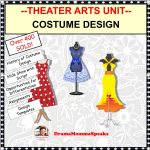
I have several costume design lesson and units available at my Teacherspayteachers store.  Maybe you’d be interested in them.

Costume Design High School Level


Costume Design Lesson with Fairy Tale Characters

Costume Design Lesson with Circus Performers

Slide3

Check out my other posts concerning critical steps in a play or musical:

Critical Steps in Choosing a Play or Musical: Stage Properties 

Critical Steps in Producing a Play or Musical: Stage Makeup

Critical Steps in Producing a Play or Musical: Set Design and Set Construction

Contact me at dhcbaldwin@gmail.com or Bumblingbea.com

I’d love to hear from you!

Deborah Baldwin


Share this:

  • Click to share on Tumblr (Opens in new window) Tumblr
  • More
  • Click to share on X (Opens in new window) X
  • Click to share on Facebook (Opens in new window) Facebook
  • Click to share on Pinterest (Opens in new window) Pinterest
  • Click to share on LinkedIn (Opens in new window) LinkedIn
  • Click to email a link to a friend (Opens in new window) Email
  • Click to share on Reddit (Opens in new window) Reddit
  • Click to share on Pocket (Opens in new window) Pocket
  • Click to share on Telegram (Opens in new window) Telegram
  • Click to share on WhatsApp (Opens in new window) WhatsApp

Like this:

Like Loading...

Filed Under: Broadway, community theatre, directing experiences, drama education, Producing plays and musicals, Production Questions, theater, theatre, youth theatre Tagged With: acting, Mulan Junior, Oklahoma!, On Golden Pond, Simplicity patterns, Simplicity.com, Spring version of The Secret Garden, theatre

« Previous Page
Next Page »

Footer

Follow Us

logo3.png

FOLLOW US

Facebook X-twitter Pinterest Instagram Envelope Rss

Goodreads: read

Malibu Rising
Malibu Rising
by Taylor Jenkins Reid
People We Meet on Vacation
by Emily Henry
The Last Thing He Told Me
by Laura Dave
Faking It
Faking It
by Cora Carmack
Losing It
Losing It
by Cora Carmack

goodreads.com
Copyright © 2024 · Wellness Pro on Genesis Framework · WordPress.com.Log in
 

Loading Comments...
 

    %d