• Skip to primary navigation
  • Skip to main content
  • Skip to footer

Join Me in my new Facebook Group! https://www.facebook.com/groups/417126059784261

Menu
  • Meet Deb – The Heart Behind DramaMommaSpeaks
    • Work with Me! 
    • Photo Gallery of DramaMommaSpeaks
    • Directorial Credits
  • I Give Book Talks! 
    • Book Talk Through Skype
    • Books
  • Freebies!
  • Bumbling Bea
  • Teaching Resume
  • Acting Resume
  • Contact Me
  • Blog
    • Drama Education
    • Arts Education
    • Youth Theatre
    • Middle Grades
    • Musical Theatre
    • Teaching
  • Meet Deb – The Heart Behind DramaMommaSpeaks
    • Work with Me! 
    • Photo Gallery of DramaMommaSpeaks
    • Directorial Credits
  • I Give Book Talks! 
    • Book Talk Through Skype
    • Books
  • Freebies!
  • Bumbling Bea
  • Teaching Resume
  • Acting Resume
  • Contact Me
  • Blog
    • Drama Education
    • Arts Education
    • Youth Theatre
    • Middle Grades
    • Musical Theatre
    • Teaching

community theater

What Everyone Should Know About Selecting a Musical For Their School

July 5, 2023 By dhcbaldwin Leave a Comment

Today, I want to talk to you about what everyone should know about selecting a musical for their school. As much as it is exciting to think about what production would serve your students the best, it’s also a huge challenge to do so.

Before you, the director, do anything you of course must read several scripts and select the one you like the most. This needs to occur at least six months in advance–don’t wait on this decision. (Why?  Because everyone and their dog is getting rights to productions.) I suggest you check out: Music Theater International or  Concord Theatrical, but there are many more just as good. 

First, I’d look over the music and make certain you have students who can sing the roles. Check vocal ranges, too.  Musicals are notorious for having many scene and costume changes, so be on the look out for those needs.  All that will matter when you begin to mount the production.  I have a lot of experience with Music Theater International.  Check out this post concerning my opinion of them:  MTI Junior Musicals– A Dream Come True!

My First Choice for a Musical

People ask for my advice concerning which musical they should select.  Generally, if it’s their first musical I suggest the near classic The Music Man.  It is still my go-to if I have the opportunity to choose the production.

What Everyone Should Know About Selecting a Musical For Their School

Selecting a Musical for Your School

Here’s the synopsis straight from Music Theater International, “By turns wicked, funny, warm, romantic and touching, The Music Man is family entertainment at its best. Meredith Willson’s six-time, Tony Award-winning musical comedy has been entertaining audiences since 1957 and is a family-friendly story to be shared with every generation.

The Music Man follows fast-talking traveling salesman, Harold Hill, as he cons the people of River City, Iowa, into buying instruments and uniforms for a boys’ band that he vows to organize – this, despite the fact that he doesn’t know a trombone from a treble clef. His plans to skip town with the cash are foiled when he falls for Marian, the librarian, who transforms him into a respectable citizen by curtain’s fall.”

This script is written very well.  If you’ve ever seen a play written by Neil Simon, you know that no matter who directs it the script will carry the actors’ performances no matter their quality.  Meredith Willson’s book for The Music Man is the same way.  To think that this gem was written in 1957 and still stands the test of time, never feels dated or old is a testament to its quality.

Looking to teach how to write your own musical to beginning students?  Go here.

File:Meredith willson 1937edited.jpg

Meredith Wilson

Selecting a Musical for Your School

Ever heard the phrase “butts in the seats”? In theatre, one of our biggest challenges is paying the bills for a production.  Some companies mount only musicals because they’ve discovered musicals have wide appeal. They are big money makers which is a good thing, because they cost a fortune to just rent!

So, if you want to fill your venue’s seats with more than just parents and students’ friends, pick something like The Music Man as your first production. If you are the first person to begin a program in your school, you want to wow your audience and establish a strong foundation for the future.  I do not recommend you do the latest and trendiest musical right now, whatever it may be.  Establish your program first and then select something more modern.

I recommend Music Man because the show has been around for many years and people have either seen it many times, on screen and a theater or they’ve performed in it.  It’s a staple of most theater companies, especially community theater.

What Everyone Should Know About Selecting a Musical For Their School

Your Objective

It’s important for you to have an objective with your production.  Some questions to ask yourself–Are you trying to establish a new program?  Or establish yourself in the department?  Or do you want a theater program which parents can trust and support?

The selection of your future musicals and plays will address your objective if you first decide upon it. You can always change your mind after a year or two and head a different direction if you aren’t having the success you expect.

The Music

This music has a “toe tappin'” kind of feel.  A lot of the songs are very familiar to people and you will find that your students may not them by having heard them so much.  Songs like “76 Trombones” is the most famous.  Most of the music is easy to learn.

The only difficult is that of the barbershop quartet (aka the School Board) with songs such as “Lida Rose.”  Also, Marion has an exciting one–“My White Knight.” Generally, the music can be learned to sing either unison if you need or several parts or a full out chorus

What Everyone Should Know About Selecting a Musical For Their School

Cast Break down

The show requires thirteen males and females and a chorus.  Your chorus can be as large as you need which in a school setting is so helpful.   Your biggest challenge is finding a male to play Harold Hill, the lead.  If he can act well, but his singing isn’t the best that’s okay.  It’s most important that your female lead, who portrays Marion Paroo, be a lovely singer who sings soprano.

The Music Man is a terrific vehicle for females.  Halleluijah!  If you are producing this at the high school level, you can feature a group of dancers who portray the students in the band at the end of the show.  Also, you need a few younger students.  You can involve elementary students or use students who are small and look younger.

Several of the characters require acting which is comedic and broad. Generally, novice actors  can do this believably.  Directing broad acting is easiest for novice directors as well.  The Mayor, his wife Eulailee,  his daughter Zaneeta, Zaneeta’s boyfriend Tommy, Harold’s friend Nathan.

Plus, some members of the chorus such as the Pick a Little Ladies and the School Board have great moments for comedy.  If the acting becomes too melodramatic, it is easy to direct actors to “pull it back a bit.” I always say if you have a strong Harold Hill and Marion Paroo the show can ride on that!

What Everyone Should Know About Selecting a Musical For Their School

Set Design

Another plus to The Music Man is the set.  There are several settings in the show:  the library, the Paroo home and porch, the school gymnasium and the town square. They can be depicted with the use of flats made into periaktois which display the different places in the story.

If you have room for a turntable, it’s useful in this situation and keeps the production moving along smoothly.  If you have room for platforms, you could use them instead.  And the use of white lattices goes a long way to give the idea of a small town at the turn of the century.

What Everyone Should Know About Selecting a Musical For Their School

Costumes

As we probably know, costumes play a vital role in a production.  This show is set in the early 1900s.  Never you mind about that!  I’ve found that if you have one costume per person for this production you can get by adequately.  The woman need long skirts, long sleeved blouses with high collars.

The girls need calf length skirts and blouses like the ladies. The men and boys need trousers, a long sleeved shirt and a hat.  Generally, my Harold and Marion have several costumes. There is a barbershop quartet which are fun to dress alike and a group of ladies who dress in Grecian togas for one scene.  Everything is up to your concept, so just do the best you can. 

Here’s a secret.  If everyone has the proper shoe wear for the show, you can pull it off.  So, women in heeled lace up boots (which look like the time period), and children in a neutral shoe like a short boot or girls in a black flat are adequate.

A good place to find hats for this musical is Amazon.  I see they have skimmer hats for men.  Or you can purchase  inexpensive simmer hats which are made of  sytrofoam  and paint them with craft paint to look more believable.  In the past, my ladies purchased hats with large brims. They’d get together and have a hat party decorating their hat for their character. I’d suggest a few of these hats. Hot glue some flowers on these babies and you are good to go!

The only big challenge in costuming are the marching band uniforms.  Your solution is to talk with your music departments and see if they keep their old marching band uniforms.  If they do, you can use those.
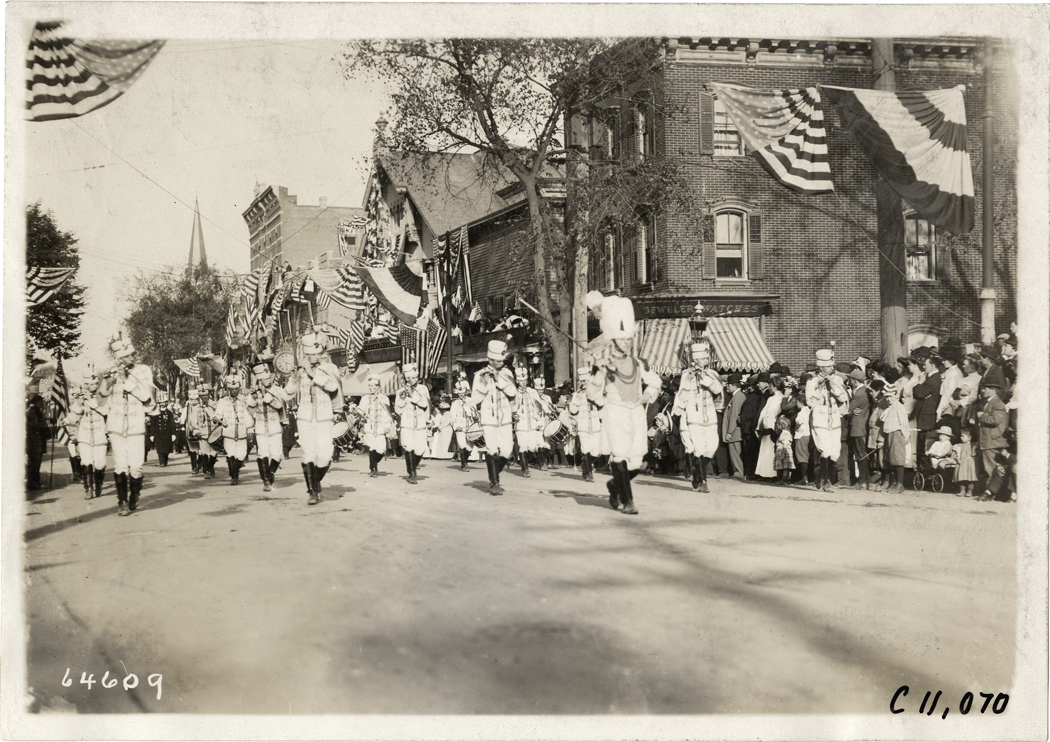
What Everyone Should Know About Selecting a Musical For Their School

Stage Properties

Most of the stage props are simple to collect though a few are tricky. You need a firecracker or something that makes the sound of a firecracker for the gymnasium scene.  This show requires band instruments for your “kid band” to hold near the end of the musical  They don’t have to work very well.  Your students don’t need to play them so if they are broken but look fine, that’s okay.

I’ll be honest here. I know I’m partial to this musical.  My husband  and I met while he conducted the orchestra for a production of it and I played Marion.  In addition, I’ve produced and directed both the adult version and junior versions four times.

All I can say friend is, it works.  It works. every. time. If you are looking for a Broadway musical to study with your students, check out my Broadway Musical and Unit of The Music Man. It contains everything a busy teacher needs to be successful in teaching it and engaging their students.

So there you have it–what everyone should know about selecting a musical for their school.  What musical do you suggest to new directors?  I have several others I suggest as well.  They are another blog post.

Woman behind DramaMommaSpeaks


Share this:

  • Click to share on Tumblr (Opens in new window) Tumblr
  • More
  • Click to share on X (Opens in new window) X
  • Click to share on Facebook (Opens in new window) Facebook
  • Click to share on Pinterest (Opens in new window) Pinterest
  • Click to share on LinkedIn (Opens in new window) LinkedIn
  • Click to email a link to a friend (Opens in new window) Email
  • Click to share on Reddit (Opens in new window) Reddit
  • Click to share on Pocket (Opens in new window) Pocket
  • Click to share on Telegram (Opens in new window) Telegram
  • Click to share on WhatsApp (Opens in new window) WhatsApp

Like this:

Like Loading...

Filed Under: acting, Arts, arts education, Broadway, community theater, directing experiences, drama education, music education, Musical Theatre, Producing plays and musicals, youth theatre Tagged With: casting, community theater, costume design, directing advice, set design, stage production advice, stage properties, The Music Man Broadway musical, themes

The Meaning Behind “There Are No Small Acting Parts Only Small Actors”

May 9, 2018 By dhcbaldwin 4 Comments

Two actors in a musical

The Meaning Behind “There Are No Small Acting Parts Only Small Actors”

The Hidden Meaning Behind "There Are No Small Acting Parts Only Small Actors"

Let’s consider the meaning of  “There are no small acting parts, only small actors.” Constantin Stanislavski, considered the father of acting,  is credited with saying this quote. Here is a my director’s advice to actors seeking acting parts. Having taught/directed productions for over 38 years, I’ve experienced every kind of actor’s personality that’s possible.

However, first I want to consider my directing philosophy.  Although I am certainly not the father of modern acting, I do have an extensive teaching and directing career from which I can draw my opinions of the quote’s meaning.  Here’s my take on it. 

(Did you know I have the secret to boosting student engagement?  My new book, “We’re Live! Radio Theater #101” explains my journey to implementing this unique tool in the classroom. Check it out here)

The Meaning Behind "There Are No Small Acting Parts Only Small Actors"

There Are No Small Acting Parts Only Small Actors

The Tony Awards are the Oscar Awards for Broadway–except they are more genuine in my humble opinion. Theatre is different.

One reason–it is special because it is live.

The Hidden Meaning Behind "There Are No Small Acting Parts Only Small Actors"

I was thinking about the performers who portray smaller roles in the nominated productions.  If you ever see them on television in a short quip on syndicated news or talk show, you’ll observe those supporting characters and chorus members are just as invested in the production as the leading actors.

That’s impressive.  Generally, the nominated actors and actresses began as chorus members and understudies many years ago.  They put in their time portraying small acting parts and earned their stripes to finally receive the spotlight. However, this is not always the case.  If you’d like to learn about Broadway actors and actresses, check out: Bright Lights: Broadway’s Rising Stars

There Are No Small Acting Parts Only Small Actors

The Hidden Meaning Behind "There Are No Small Parts Only Small Actors"

Just because you are cast in a small acting role does not mean you are not important to the show. If you think so, you have missed the point entirely.

You are still important to the show.  Believe me. 

If you find yourself unable to move beyond the belief that you should have been cast in a particular role, perhaps it’s time to redirect your focus elsewhere in your life. Coping with disappointment is an inevitable aspect of life, whether positive or negative. While nobody relishes the feeling of letdown, it’s essential to acknowledge its presence and explore alternative avenues for personal fulfillment.

 Get over yourself, you know? Do you agree with me?

The Hidden Meaning Behind "There Are No Small Acting Parts Only Small Actors"

I was Blanche in “Brighton Beach Memoirs” 1989

Some advice from me–if you aren’t cast in the acting part you wanted, it is not an important enough reason to drop out of the show.  Maybe you are to learn something or gain knowledge from the experience? Life is a journey, you know.

Director’s Procedure for Casting 

For several days after I cast a production, I deal with hurt egos of cast members or those who audition for me and didn’t receive the role they desired.

I’ve previously mentioned this–casting a production has a lot to do with who a director envisions in a role. Sometimes I have no idea who I want to play an acting part.  Other times, the right person walks in and is perfect. They are the essence of the character already. If you’d like more information about my experiences and advice, check out Eighteen Ways To Make Your Directing Experience Less Stressful, Part One Eighteen Ways to Make Your Directing Experience Less Stressful, Part Two

 Some people can mold themselves into what I am looking for in a character.  Those people are special because they are versatile.

Casting Questions I Consider

There are other factors in the decision to cast someone, however. For instance, do I know their work?  Are they responsible?  Also, have I known them to be difficult to direct and/or not a team member?

The Hidden Meaning Behind "There Are No Small Parts Only Small Actors"

I was Dot in “Cricket on the Hearth” 2000

Let’s discuss acting parts.  First, there are people who only portray straight roles.  Straight roles are those parts most closely related to your personality.  

Have you ever seen someone in a movie who plays the same sort of roles in each movie?  The role the actor portrays is much like his/her personality off-screen. Aha. Personally, I think Meg Ryan is a good example of someone who can only portray a straight role.

Additionally, there are character roles.  Character roles are those parts that are unlike you–because of your age, stature or personality. Paul Giamatti portrayed character roles with such genius. He’s up for an Oscar award for his work in The Holdovers. Also, Tracey Ullman is a super example. You may remember her from the voice of the mother on The Simpsons.  Another phenomenal actor is  Jared Leto. You won’t even recognize him in House of Gucci. 

Versatile Performer: Embracing Both Character and Straight Roles

Character roles:

  • Ugly Step Sister
  • Wicked Witch
  • Cowardly Lion
  • Shrek

Straight roles:

  • Cinderella
  • Rapunzel
  • Dorothy
  • Fiona

Luckily, I can play both straight and character roles. That makes me more valuable to a director.   To be honest, I enjoy performing character roles the most, because usually they are interesting and unique.

This is my opinion (but I bet a lot of directors would agreed with me)–It isn’t about playing the lead.  It is about who you are best suited to portray. 

This is such a great discussion question.  If you want additional class conversation questions, check out: Conversation Starters

The Meaning Behind "There Are No Small Acting Parts Only Small Actors"

About Me

Guess what?  I have not been cast in a production before.  No joke!  So, chin up! If you don’t receive the role you craved for, your time will come in the future.

If you are interested in my acting  journey, check this out: https://wordpress.com/post/dramamommaspeaks.com/389 

The next time the Tony Awards are televised, look for the chorus members or those supporting characters, folks portraying small acting parts.  See if you notice them.  You’ll only observe them filling out the stage–sort of like shadows in a painting.

There will be several actors who perform that evening that I know personally.  As always, I am very excited for them. Shout a “Bravo!” to your television. I will, too.

Perhaps they will magically hear us…

The Hidden Meaning Behind "There Are No Small Parts Only Small Actors"

I was Miss Prism in “The Importance of Being Earnest” 1976

From My Classroom to Yours: Drama Made Easy

Now, I’m a retired drama teacher who created drama education resources for teachers all over the world.  If you are looking for cohesive, engaging, fun drama lessons and units, check out my store at: Dramamommaspeaks Store

Teaching High School Set Design? 

Or are you looking for a bunch of FREE resources? Check out this category. Maybe you’d like to teach your students about a famous actor’s life?  Check out:  James Earl Jones or Julie Andrews

Have you ever not being cast in a production?  I’d love to hear about your experience.  Contact me at dhcbaldwin@gmail.com. 


The Hidden Meaning Behind "There Are No Small Parts Only Small Actors"

Share this:

  • Click to share on Tumblr (Opens in new window) Tumblr
  • More
  • Click to share on X (Opens in new window) X
  • Click to share on Facebook (Opens in new window) Facebook
  • Click to share on Pinterest (Opens in new window) Pinterest
  • Click to share on LinkedIn (Opens in new window) LinkedIn
  • Click to email a link to a friend (Opens in new window) Email
  • Click to share on Reddit (Opens in new window) Reddit
  • Click to share on Pocket (Opens in new window) Pocket
  • Click to share on Telegram (Opens in new window) Telegram
  • Click to share on WhatsApp (Opens in new window) WhatsApp

Like this:

Like Loading...

Filed Under: acting, community theater, directing experiences, drama education, theatre Tagged With: acting advice, advice for director, Arts, auditioning, casting, community theater, Constantin Stanislavski, Sirius Broadway, Straight roles vs. character roles, There are no small parts in acting, Tony Awards, Why chorus or supporting roles are beneficial, youth theater

Footer

Follow Us

logo3.png

FOLLOW US

Facebook X-twitter Pinterest Instagram Envelope Rss

Goodreads: read

Malibu Rising
Malibu Rising
by Taylor Jenkins Reid
People We Meet on Vacation
by Emily Henry
The Last Thing He Told Me
by Laura Dave
Faking It
Faking It
by Cora Carmack
Losing It
Losing It
by Cora Carmack

goodreads.com
Copyright © 2024 · Wellness Pro on Genesis Framework · WordPress.com.Log in
 

Loading Comments...
 

    %d