• Skip to primary navigation
  • Skip to main content
  • Skip to footer

Join Me in my new Facebook Group! https://www.facebook.com/groups/417126059784261

Menu
  • Meet Deb – The Heart Behind DramaMommaSpeaks
    • Work with Me! 
    • Photo Gallery of DramaMommaSpeaks
    • Directorial Credits
  • I Give Book Talks! 
    • Book Talk Through Skype
    • Books
  • Freebies!
  • Bumbling Bea
  • Teaching Resume
  • Acting Resume
  • Contact Me
  • Blog
    • Drama Education
    • Arts Education
    • Youth Theatre
    • Middle Grades
    • Musical Theatre
    • Teaching
  • Meet Deb – The Heart Behind DramaMommaSpeaks
    • Work with Me! 
    • Photo Gallery of DramaMommaSpeaks
    • Directorial Credits
  • I Give Book Talks! 
    • Book Talk Through Skype
    • Books
  • Freebies!
  • Bumbling Bea
  • Teaching Resume
  • Acting Resume
  • Contact Me
  • Blog
    • Drama Education
    • Arts Education
    • Youth Theatre
    • Middle Grades
    • Musical Theatre
    • Teaching

differentiation

Why Drama Is the Ultimate Life Skills Curriculum

March 3, 2026 By dhcbaldwin Leave a Comment

Drama Is Life Skills: How the Classroom Becomes Real-World Practice

Drama Is Life Skills: How the Classroom Becomes Real-World Practice

I believe drama class is life skills. One of my favorite classroom memories explains exactly why Drama Is Life Skills: How the Classroom Becomes Real-World Practice — and it doesn’t involve a standing ovation.

It involves a triangle.

The Power of Being Needed

Years ago, during one of our radio play performances, my student with support needs, Joey, desperately wanted to be part of the show. Speaking lines felt overwhelming for him, but I found a place for him anyway.

He played the triangle — not once or twice, but throughout the performance– small shimmering notes signaling transitions and adding atmosphere. Every time his cue approached, Joey stood up excitedly. He watched closely. With his aide by his side to help if needed, he waited with complete concentration.

And when the moment came, Joey struck that triangle with confidence and pride.

Joey  wasn’t on the sidelines.

He was essential. And for the first time, his classmates truly saw him.

That day confirmed something I had known deep down for years.

Drama isn’t enrichment. It’s life skills education.


Drama Is Life Skills: How the Classroom Becomes Real-World Practice

Communication Without Pressure

In Life Skills classrooms, students are constantly navigating communication challenges. Conversations can feel unpredictable. Social cues are subtle. Consequently, expectations shift.

As you might expect, drama removes much of that unpredictability.

  • Scripts provide structure.
  • Lines are rehearsed.
  • Turns are clearly defined.
  • Tone can be practiced safely.

Often, students’ greatest worry is simply not knowing what to expect. Through radio-style performances, students who feel uncomfortable being physically “on stage” begin to relax. Early on, they discover that we rehearse the script many times. In addition, we practice reading expressively, fine-tune sound effects, and embellish narration.

By the time it’s ready for an audience, the spotlight feels softer. The expectations are clear.

Students practice:

  • Listening for cues–This one skill is more difficult to learn than you would think
  • Waiting their turn–During the first rehearsal, I teach students that part of being a grown up is learning how to wait. They can practice doing so through the rehearsal.
  • Speaking clearly–When directing my casts I remind them, “If they can’t hear you or understand you, it doesn’t matter how good or entertaining you are.”
  • Modulating volume–As well as coaching students to learn to control their speaking volume, students learn its power to define their character.
  • Responding appropriately–Understanding that the director has the final say and responding appropriately and respectfully is a valuable skill to learn for any occupation.

In other words, these aren’t just theater skills.

They’re workplace skills. Community skills. Independence skills.


Drama Is Life Skills: How the Classroom Becomes Real-World Practice

Social Rehearsal in a Safe Space

Think about how many life skills involve social interaction:

  • Greeting someone
  • Resolving a misunderstanding
  • Expressing emotion appropriately
  • Working cooperatively

Drama provides rehearsal for all of it.

Through structured role-play, students can practice ordering food, asking for help, introducing themselves, or solving a conflict. If something doesn’t go well, we simply pause and try again.

No real-world consequences.
No embarrassment that lingers.
Just practice.

Drama Is Life Skills: How the Classroom Becomes Real-World Practice

Since students with support needs are often mainstreamed into arts classes alongside their peers, they also have the opportunity to learn from classmates, not solely from their teacher.

Learning Without the Spotlight

When a student watches a peer:

  • They see what commitment looks like. The students see their peers practice their lines many times, fixing errors as they go and then trying again.

  • Everyone experiences what happens when someone forgets a line and recovers. The fear of ridicule is a big worry for most students However, they can observe how a classmates handles the error and bounce back without any embarrassment.

  • Students notice vocal projection, posture, pacing, gesture. We ask a lot of students when they enroll in a theater class.  One of the most challenging things is to be willing to express one’s emotions. Once you point out to students what a particular emotion looks and feels like, they are more open to experiment themselves.

Perhaps most importantly,  because they’re not “on,” the student’s  brain is free to analyze instead of survive. For reluctant learners especially, this lowers anxiety while still building skill.

Some educators even create simple communication scripts specifically designed to help students practice real-world interactions. As children, most of us eventually figured out how to ask someone to play or start a conversation. But for students with differing abilities, expressing needs can be far more challenging.

Those structured supports pair beautifully with drama-based activities. The scripts provide the language. Drama provides the rehearsal space.

If you’re looking for ready-made communication scripts, my colleague Charlotte Lim offers thoughtfully designed resources that focus on these social exchanges. You can explore her materials here: Colourful Teaching For You.


Drama Is Life Skills: How the Classroom Becomes Real-World Practice

Structure Creates Safety

Many Life Skills students thrive on routine and predictability.

Drama, when taught intentionally, is structured creativity.

Every activity has:

A beginning, middle and an end. There are clear roles and  expectations.

Even improvisation operates within boundaries. Ever heard of  the phrase “Yes, and…”? I believe this improv. exercise is popular simply because it has very clear rules and boundaries for the actors.

That structure creates safety. And safety builds participation.

I watched it happen over and over again. When students understood the framework, they relaxed into it. They began to trust the process. And once they trusted the process, they took risks.

Small risks at first. Then bigger ones. And the payoff is huge.

Before long, you’ll see these students included not only within their Life Skills class, but alongside other peers and school friends. They shine.


Drama Is Life Skills: How the Classroom Becomes Real-World Practice

Confidence That Transfers

Here’s what I saw year after year.

Students who once hesitated began to:

  • Raise their voices with clarity
  • Initiate conversations
  • Make eye contact
  • Volunteer for responsibilities
  • Take pride in completing a public task

Confidence built in a drama classroom does not stay in the drama classroom.

It transfers to everywhere and everything –job interviews, classroom presentations, community interaction and daily life.

Joey wasn’t just playing the triangle.

He was learning to:

  • Follow timing and direction
  • Monitor attention
  • Contribute to a team
  • Complete a task under gentle pressure
  • Experience the pride of being necessary — and that is monumental

He didn’t need dialogue.

He needed purpose.

Drama Is Life Skills: How the Classroom Becomes Real-World Practice

Every Student Gets a Role

One of my guiding beliefs as a drama teacher was simple: Every student gets a role.

Not every student needs the spotlight. Furthermore, neither does every student wants it.

But every student deserves participation.

Students might read lines or narrate the story. While others focus on sound effects or manage props. Small groups bring scenes to life.

And occasionally, one holds a triangle — waiting for the exact right moment to strike.

The difference is this:
Drama allows differentiation without isolation. It allows contribution without comparison. That’s part of the magic!

And that is what makes it such a powerful life skills curriculum.


Drama Is Life Skills: How the Classroom Becomes Real-World Practice

Drama Is Not a Luxury

If we truly want to prepare students for life beyond school, we must give them opportunities to rehearse life itself. This is discussed in the core classes, but not focused on as much in the elective classes. It’s always a struggle for us–to convince a parent or student that our classes  can teach them skills which can set them up for their future. The arts create structured opportunities for students to develop the habits and skills real life requires.

There is communication, collaboration, emotional expression, problem-solving, responsibility as well as pride in contribution.

After implementing one of my radio play units in her Life Skills Music class, a fellow teacher shared:

“I used this entire unit with my Life Skills Music class. We learned all about radio, created theme songs, and performed Foley artistry sound effects. We recorded The Bow Wow Blues, and I edited it together. Well done, Dramamommaspeaks!!!”

You can even hear their finished recording here:
https://www.youtube.com/watch?v=ixawAaZZa2k

Rehearsing for Real Life

This teacher’s experience reinforces what I have seen for decades: when students are given structure, creativity, and meaningful roles, they rise to the occasion. They collaborate, take ownership and produce something real.

And that kind of engagement isn’t accidental. It’s intentional.

Worksheets cannot replicate that. Drama can.

In my classroom, drama was never about applause. It was about belonging.

A Place to Practice

My goal is to  make sure every student — even the one holding a triangle — understood that they mattered. That they contributed. Ultimately, they were more important than they realized.

Because long before students step into a job interview, introduce themselves in a new setting, or navigate a difficult conversation, they deserve a place to practice.

Drama gives them that place.

And that is why drama isn’t an extra.

It’s the ultimate life skills curriculum.

If you’d like to explore drama resources specifically designed for Life Skills and inclusive classrooms, you can browse the collection here. Drama for Life Skills Classrooms.

How have you used drama in your classes?  I’d love to hear about it.  Email me at DhcBaldwin@gmail.com

Drama Is Life Skills: How the Classroom Becomes Real-World Practice

Share this:

  • Share on Tumblr (Opens in new window) Tumblr
  • More
  • Share on X (Opens in new window) X
  • Share on Facebook (Opens in new window) Facebook
  • Share on Pinterest (Opens in new window) Pinterest
  • Share on LinkedIn (Opens in new window) LinkedIn
  • Email a link to a friend (Opens in new window) Email
  • Share on Reddit (Opens in new window) Reddit
  • Share on Telegram (Opens in new window) Telegram
  • Share on WhatsApp (Opens in new window) WhatsApp

Like this:

Like Loading...

Filed Under: arts education, arts integration, creative dramatics, creative movement, drama education, Education, Education, elementary, middle grades, performing arts, Radio Theatre, storytelling, Teacherspayteachers, teaching strategies, theater, theatre Tagged With: differentiation, Life Skills class

Stage Makeup and Its Transformative Power for Students

July 19, 2023 By dhcbaldwin Leave a Comment

Theater student in stage makeup

I’m mentioned this in the past, but thought I’d reiterate it if you’ve not heard it. Let’s talk about Stage Makeup and Its Transformative Power for Students.

The Transformative Power When Students Apply Stage Makeup

Stage Makeup and Its Transformative Power for Students

This is a true story.

When I was in seventh grade, I wanted to wear makeup. Of course, that was about 100 years ago, so let’s keep it in perspective…My mother wasn’t ready for that step in my life quite yet, but I was.  Boy, was I ready.
I read in a Seventeen magazine that I could make my own “home made” mascara using charcoal and petroleum jelly.  I went to work!
Now I’m not known to be very patient (although I am better now that I have grown older), so I looked around our house for the two ingredients I needed.  Hmmm.  I found a jar of petroleum jelly  in my bathroom cabinet, but charcoal? The only charcoal I knew of was charcoal briquettes.

My Makeup Journey

Briquette - Wikipedia
Being my impulsive self as well and not taking into account that perhaps a charcoal briquette was the wrong kind of charcoal for my DIY mascara, I mixed it into the petroleum jelly anyway.  Yes. I. Used. A. Charcoal. Briquette. No kidding. Needless to say, it was a flop.
Upon entering our dining room for dinner that evening while modeling my  “homemade mascara”, my mother let out an “Oh my!” Not surprisingly, soon after she drove to a Merle Norman store and enrolled me in a class about makeup.

Stage Makeup and Its Transformative Power for Students

Luckily, I learned to apply makeup and in later years discovered in college that I really enjoyed designing stage makeup or theatrical makeup. It seems obvious that students would enjoy studying about stage makeup.  Additionally, it helps so much for novice actors to “see” what their character will look like.  Coupled with a costume, some actors come to life as the character for the first time.  It is really that magical.

Did you know I have the secret to boosting student engagement?  My new book, “We’re Live! Radio Theater #101” explains my journey to implementing this unique tool in the classroom. Check it out here

The Transformative Power When Students Apply Stage Makeup

Reasons To Study Theatrical Makeup

  1. Character Transformation: Stage makeup is a powerful tool that allows actors to transform their appearance and effectively portray a wide range of characters. By studying stage makeup, theater students learn how to use makeup techniques to enhance facial features, create age, gender, or ethnic-specific looks, and convey emotions. This skill helps them bring their characters to life and make them more believable on stage.
  2. Visual Communication: In theater, makeup serves as a visual language that communicates important information to the audience. Different makeup techniques can convey specific time periods, social statuses, or cultural backgrounds of characters. By understanding the principles of stage makeup, theater students learn how to use color, shading, highlighting, and contouring to visually communicate the desired message and enhance storytelling.
  3.  Versatility: Stage makeup is not limited to traditional theater productions. Various performing arts disciplines such as film, television, opera, and dance use stage makeup as well.  Students can study to become a professional stage makeup artist and they’ve got themselves a job!

Reasons to Study Theatrical Makeup

4.  Collaboration and Teamwork: For particular productions using a certain style or concept, stage makeup involves collaboration with other artists, such as costume designers, lighting designers, and directors. One of the most   important skills our students can learn is how to work with others because in the professional world of theater, it’s a team effort for certain. Learn more about how theater skills help in careers here: Why Theater Education Matters: Developing Key Life Skills

5.  Self-Sufficiency: In many theater companies (particularly those with small budget), actors are often responsible for applying their own makeup depending upon the budget of the show. By studying, designing and applying  stage makeup theater students gain the ability to create their own character looks.  Accordingly, this can be particularly beneficial in smaller productions, when working on independent projects. This independence allows actors to take more control over their creative process and in bringing their characters to life. What a terrific differentiation! 

6.   Understanding Lighting and Stage Effects: By studying stage makeup, theater students gain an understanding of how makeup interacts with stage lighting.  Thus, ensuring that their character’s features remain visible and expressive even under different lighting conditions. Having this information helps actors develop  makeup techniques to the specific requirements of a production.  Consequently, this results  in a more polished and professional performance.

A Bundle of Stage Makeup Units

You may be unaware, but I create theater education resources.  You can purchase them here.

I have a bundle of stage makeup units. Here’s its description for you:

SAVE 30%! This bundle contains 4 lessons on stage makeup (old age, neutral, circus, zombie and fantasy) and gives your students a chance to be makeup artists. They’ll view, study, take notes on concepts, apply the knowledge, design and apply their own ideas. These are great for an upper middle school ( a little challenging) or high school drama class.

Each Stage Makeup Lesson includes:

  • Warm-Up Exercises
  • The History of Stage Makeup (separate file of PowerPoint slides & teacher’s lecture notes)
  • Theatre Quote page–great to use for discussion and/or bell ringers
  • Teacher’s Script–what I say and how I say it!
  • Procedures
  • Materials List
  • Source & Video link list ( old age, basic and circus and fantasy makeup tutorials, etc.)
  • Pinterest board links with examples for some lessons
  • Female Makeup Design Template
  • Male Makeup Design Template

My stage makeup studies include entire lessons for you. If you still need some persuading, check out this blog post: Critical Steps in Producing a Play or Musical: Stage Makeup

The Transformative Power When Students Apply Stage Makeup

Choice Boards for Differentiation

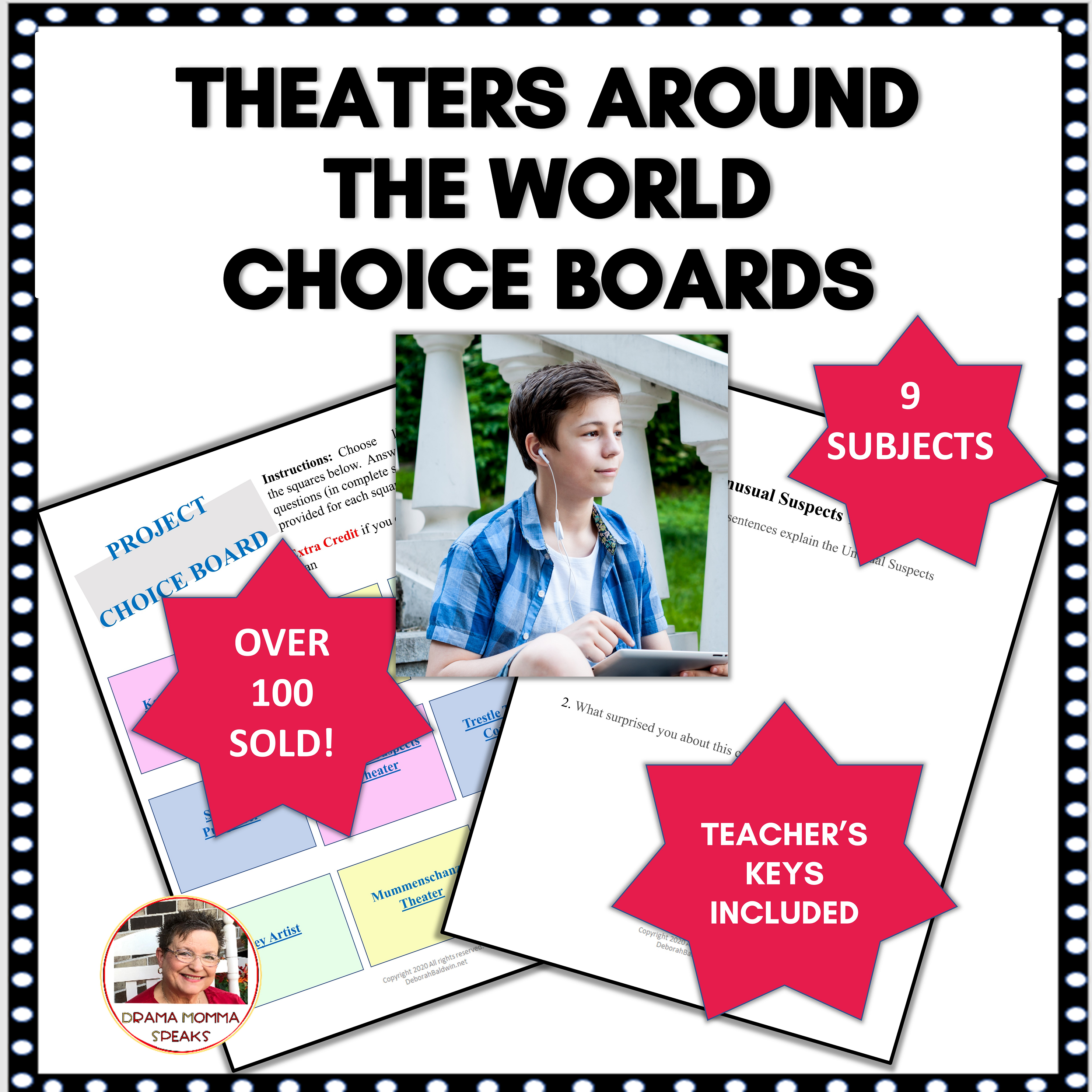
If you are looking for a way to teach students about theaters around the world, check out these Choice Boards. 

What are Choice Boards, you ask?  In this case, my choice boards are a collection of links which lead to video clips.  Students select the subjects they are most interested in, view the video clips and answer the questions.  This is super differentiation! By tailoring instruction to meet individual needs. through content, process, products, the learning environment,  ongoing assessment or  flexible grouping, differentiation creates a successful approach to instruction.

I hope you’ll considering teaching about stage makeup with your students.  It’s so important.  Just watch the transformation of your students as they apply it! Suddenly, you’ll see a student transform into a character.  Costumes do the same thing for them. As I mentioned above, these skills contribute to students’ overall artistic development and enable them to deliver compelling performances that captivate and engage audiences.
What styles of stage makeup design have you taught your students?  Did they enjoy it?  I’d love to learn about it.  Contact me at DhcBaldwin@gmail.com

Woman behind DramaMommaSpeaks

Share this:

  • Share on Tumblr (Opens in new window) Tumblr
  • More
  • Share on X (Opens in new window) X
  • Share on Facebook (Opens in new window) Facebook
  • Share on Pinterest (Opens in new window) Pinterest
  • Share on LinkedIn (Opens in new window) LinkedIn
  • Email a link to a friend (Opens in new window) Email
  • Share on Reddit (Opens in new window) Reddit
  • Share on Telegram (Opens in new window) Telegram
  • Share on WhatsApp (Opens in new window) WhatsApp

Like this:

Like Loading...

Filed Under: arts integration, community theater, drama education, drama integration, Education, excellence in teaching, middle grades, Teacherspayteachers, Teaching, theater, youth theatre Tagged With: choice boards, cooperative learning, differentiation, high school drama class, middle school drama class, stage makeup, stage makeup design, theater profession

Three Lessons to Engage Your Drama Class Using Differentiation

February 3, 2021 By dhcbaldwin 2 Comments

Three Lessons to Engage Your Drama Class Using Differentiation

Three Lessons to Engage Your Drama Class Using Differentiation

Today I want to talk with you about three lessons to engage your drama class using differentiation.

I wasn’t a very good math student when I was a child.  I made it okay to third grade but then Mrs. Gibson had to take off the rest of the school year.  Mrs. Butterfield tried to teach me, but I got behind during division and then fell through the cracks. Of course, we only learned from textbooks–no cute clipart, certainly nothing thematic and blah, blah blah.

Our daughters were great math students.  That was some thirty years later and students were using manipulatives and calculators.  Wow, what a difference! Observing them utilizing various methods of learning to arrive at an answer, I know I could have done it, too.  My math skills would be much better than at present.

Three Lessons to Engage Your Drama Class Using Differentiation

What does “differentiation” mean to you?

“Differentiation means tailoring instruction to meet individual needs. Whether teachers differentiate content, process, products, or the learning environment, the use of ongoing assessment and flexible grouping makes this a successful approach to instruction.”

I can’t imagine a drama teacher not using differentiation, can you? It’s just what we do~ 

When I was researching this topic, I found some great information and suggestions.  One in particular from the Ontario Ministry of Education shared a tremendous example.  You really should check this out: edugain.ca

The best point made was that differentiation can offer many choices for students in their learning.  Throughout this terrific lesson the students were instructed to change their groupings, involve other classmates, shuffle themselves while continuing to learn.

Want some more help in the classroom? Check out my FREE Guide and ten page lesson Here 

Oh, I do that naturally!  I don’t know about you, but I like changing the group chemistry.  Have you ever worked on a problem with student learning groups and they solve it one way and another group solves it a different way?

Three Lessons to Engage Your Drama Class Using Differentiation

Number One:  Creative Movement

After reading this cool lesson from the Ontario Ministry of Education, I was reminded of a movement warm-up exercise from Viola Spolin’s book, Theater Games in the Classroom.

The warm up is called Freeze and Melt.  It’s not an easy warm-up (best with middle grades and older.)   Usually students need to be fairly comfortable with each other and/or willing participants.

Basically, they create a statue.

Here is my version–I encourage them to put themselves in unusual positions–twists, bent over, one arm stretched out, etc. One requirement is absolutely a must– They must be physically connected to their partner.  Usually, I suggest they connect foot to foot because it’s the least threatening contact.

As always, the lights are turned low in the classroom which helps them feel less vulnerable and exposed.  Classical music is played in the background to encourage a calm and relaxed feeling.

Once the students create their “statue”, I give them instructions about the different places the imaginary sun would be warmest on their body.  Their job is to melt very slowly focused on that part of their body where the sun is warming them.  I give each melting movement about five to ten seconds. I coach them as they move, so they don’t rush by counting them down. At this point, I ask them to freeze again. Observing them, I point out interesting shapes which occurred for them. We try a different place for the sun to warm them.  They melt and freeze when I direct them.

Three Lessons to Engage Your Drama Class Using Differentiation

Now they understand the warm up.

We end the exercise.  They shake out.  I give them a second to chat with their friend and take a new position.

We begin again and go through the same steps.  I encourage them to remember their face can express a particular emotion.  This deepens the experience for them as they realize the value of facial expression.  However, this time, the exercise lasts at least a minute (which sounds like a short time, but is actually quite long when you consider what I’ve asked of them to do.)

Now for differentiation--the group brings in two more people.  I give them very little time to make this new group, because I don’t want them to think too much.

The third time I push them to freeze in unusual positions.  At the very end of the exercise, I charged the students slowly “ooze” to the floor. We do this very slowly–on a ten count.   I encourage them to take unusual, ugly positions.  This is absolutely fascinating to watch!

If the class is very comfortable with the exercise, I’ve been known to have all of them create a statue together.  I like to push my students because I know if they trust me and they are relaxed and having fun, anything is possible. Check out this blog post for more movement suggestions: The Ultimate Guide for Drama Teachers: Creative Movement? Are you Kidding Me?

or check out this Thanksgiving themed creative movement lesson 

Number Two: Set Design

Three Lessons to Engage Your Drama Class Using Differentiation

It is very infrequent for me that I do not give students choices.  I mean, don’t you like it when you get to select the size of drink you’d like instead of someone just slapping down a huge soda when you thought it would be of a reasonable size? Me too.

My set design unit gives allows for differentiation.  First, they can study it in parts.  For instance, the set design rendering lesson gives them a chance to take their ideas and draw them.

Do you teach grades two to five?  Pick up this free guide and ten page lesson Here:

Three Lessons to Engage Your Drama Class Using Differentiation

Set Design Lesson

After they study set design, they have many choices. For instance, high school students are required to read a play of their choice.  Middle grade students might read aloud a play they are studying, but they’ll design a set for it which they choose.  In one set design unit, students design sets of their school.  Again, choice!

When it comes time to build a scale model of their set, they find a partner. Additionally, this gives them an opportunity to make a decision as to who they would work best with and could work cooperatively with for several days.  I like this requirement because it teaches them to consider their own learning styles while carefully considering their classmates’. Check out this blog post for more information Critical Steps in Producing a Play or Musical: Set Design

Did you know I have the secret to boosting student engagement?  My new book, “We’re Live! Radio Theater #101” explains my journey to implementing this unique tool in the classroom. Check it out here

Number Three: Improvisation

Three Lessons to Engage Your Drama Class Using Differentiation

No matter the class or grade level, I give students who are new to a drama class an opportunity to learn at their own pace. However, this does not mean we can wait until next year to try improvisation.

If a class is extremely reluctant, I’ll seek out the least worried student and demonstrate with them.  If the students are ELL and language is a barrier for us, I will stay with theater games until I see them relax and begin enjoying the experiences.  Again, this gives students another method of differentiation.

Check out this lesson:  Theater Professions

Sometimes I will group students by the color of their shirt, shoes or season in which they were born.  They never know how I will group them, because it depends upon their willingness to “play” along with me. Other times, they group themselves.

In most situations students write, read, listen, speak and demonstrate their learning to me.   You might say I’m thorough, but I’m not pedantic–I ignore the small stuff and concentrate on the big picture.  There is time enough to be perfectionistic down the road. Besides, no one is perfect. For more information about me, check out this blog post The Lessons I Learned from Working as a Drama Teacher

Here’s a brand new lesson which uses differentiation and cooperative learning–Norman Rockwell Paintings Creative Writing Play Dialogue Theater Arts lesson.

Three Lessons to Engage Your Drama Class Using Differentiation

I’d never really thought about the ways I use differentiation in my classroom. Wow, I use it a lot.  This was a good exercise for me to do! I hope it helps you, too!

How do you use differentiation in your classroom?  Contact me at DhcBaldwin@gmail.com or DeborahBaldwin.net

Deborah Baldwin of DramaMommaSpeaks

Share this:

  • Share on Tumblr (Opens in new window) Tumblr
  • More
  • Share on X (Opens in new window) X
  • Share on Facebook (Opens in new window) Facebook
  • Share on Pinterest (Opens in new window) Pinterest
  • Share on LinkedIn (Opens in new window) LinkedIn
  • Email a link to a friend (Opens in new window) Email
  • Share on Reddit (Opens in new window) Reddit
  • Share on Telegram (Opens in new window) Telegram
  • Share on WhatsApp (Opens in new window) WhatsApp

Like this:

Like Loading...

Filed Under: acting, arts education, creative dramatics, creative movement, drama education, Education, High School, middle grades, Teacherspayteachers, teaching strategies, theater, youth theatre Tagged With: acting exercises, acting warm-up, differentiation, elementary drama class, high school drama class, improvisation exercises, middle school drama class, movement, set design, tableau, using differentiation in the drama classroom

Footer

Follow Us

logo3.png

FOLLOW US

Facebook X-twitter Pinterest Instagram Envelope Rss

Goodreads: read

Malibu Rising
Malibu Rising
by Taylor Jenkins Reid
People We Meet on Vacation
by Emily Henry
The Last Thing He Told Me
by Laura Dave
Faking It
Faking It
by Cora Carmack
Losing It
Losing It
by Cora Carmack

goodreads.com
Copyright © 2024 · Wellness Pro on Genesis Framework · WordPress.com.Log in
 

Loading Comments...
 

    %d