• Skip to primary navigation
  • Skip to main content
  • Skip to footer

Join Me in my new Facebook Group! https://www.facebook.com/groups/417126059784261

Menu
  • Meet Deb – The Heart Behind DramaMommaSpeaks
    • Work with Me! 
    • Photo Gallery of DramaMommaSpeaks
    • Directorial Credits
  • I Give Book Talks! 
    • Book Talk Through Skype
    • Books
  • Freebies!
  • Bumbling Bea
  • Teaching Resume
  • Acting Resume
  • Contact Me
  • Blog
    • Drama Education
    • Arts Education
    • Youth Theatre
    • Middle Grades
    • Musical Theatre
    • Teaching
  • Meet Deb – The Heart Behind DramaMommaSpeaks
    • Work with Me! 
    • Photo Gallery of DramaMommaSpeaks
    • Directorial Credits
  • I Give Book Talks! 
    • Book Talk Through Skype
    • Books
  • Freebies!
  • Bumbling Bea
  • Teaching Resume
  • Acting Resume
  • Contact Me
  • Blog
    • Drama Education
    • Arts Education
    • Youth Theatre
    • Middle Grades
    • Musical Theatre
    • Teaching

musicals

Youth Theater Musical Rehearsal: What You Need to Know

November 9, 2022 By dhcbaldwin Leave a Comment

This blog posts concerns how to rehearse a musical in youth theater.

The Youth Theater Musical Process: What You Need to Know

The youth theater musical process: what you need to know is one of those subjects you figure anyone who has acted at least once will know. Not so. This is a two part post. Here is the first post. The Steps in a Play Rehearsal in Youth Theater. 

Lately, I’ve read several posts from newbie teachers with no idea about the steps of the rehearsal process for a musical.  That seems odd to me, but maybe they are teachers whose focus is Language Arts or Social Studies? I know that sometimes the administration will ask a non-theater teacher to direct the school play or supervise the drama club, so that could be the reason for the unfamiliarity.

Regardless, I will take you through the process for a musical.  You can depend upon this process to prepare your young actors because I’m an expert in directing youth theater.  Having directed over 350 plays and musicals with both adults and children, I know the process like the back of my hand. Looking for a free lesson?  Go Here.

Youth Theater Musical Rehearsal: What You Need to Know

Step One: Selecting the Script

Before you, the director, do anything you of course must read several scripts and select the one you like the most. This needs to occur at least six months in advance–don’t wait on this decision. (Why?  Because everyone and their dog is getting rights to productions.) I suggest you check out: Music Theater International or  Concord Theatrical, but there are many more just as good. 

First, I’d look over the music and make certain you have students who can sing the roles. Check vocal ranges, too.  Musicals are notorious for having many scene and costume changes, so be on the look out for those needs.  All that will matter when you begin to mount the production.  I have a lot of experience with Music Theater International.  Check out this post concerning my opinion of them:  MTI Junior Musicals– A Dream Come True!

After you’ve chosen the musical, you may want to announce it to your students.  When?  It depends upon when you plan to announce it and when the production is to be performed.  Me?  I announce a month ahead of the auditions and no sooner. You need to decide whether you want your students to audition with songs for the musical.  If so, have photocopies of those songs available to the students.

The Youth Theater Musical Process: What You Need to Know

Step Two:  Auditions

Auditions for musicals contain three parts–singing, dancing and acting.  They will take several days to complete.

In the singing audition, will you audition students individually or in groups?  Make sure you have thought about if a non singer can be cast in a singing role and vice versa.

How important is it to you that the cast be able to dance?  Is it a tap show?  Are you going to require all dancers have tap dance experience? Will they need tap shoes?  Who will pay for those shoes, your department or the student?  Trust me, you can not learn to tap dance in just six weeks–you can do a few steps in a combination, but that’s asking a lot of non-dancers. This decision is very important.

The Youth Theater Musical Process: What You Need to Know

Youth Theater Musical Rehearsal: What You Need to Know


All School Production

Here is something else–will you accept everyone who auditions to be in the production?  Musicals allow for this much more than a play.  This question could be answered by your mission.  If your mission is to give everyone an opportunity to be on the stage, then auditions will go more quickly than if you are having a set amount of cast members.

In the call backs, you will want to hear the students sing and read again. Will these be cold call backs where by the students do not see the script ahead of time?  Or will you provide script sides for the callbacks?

Casting Tips

After the production is cast, at the first cast meeting I encourage students who did not receive the role they wanted to take dance classes and private singing lessons. This is a general statement and not directed to any one student.  Those who are serious about being cast will probably take some lessons before the next set of auditions.

Post the cast list either on a Friday afternoon  (when you can leave the school or theater for the weekend and give students time to unruffle their disappointed feathers) or post on-line on your website. Handling emails from parents on Monday is another blog post….someday.

Youth Theater Musical Rehearsal: What You Need to Know

The Read Through

Step Three:  Cast and Crew Read-Through

Usually, at the first meeting I ask the students to stand and say their name and what role they are playing. This is especially important to do for the chorus.  In fact, I have them introduce themselves first.  It’s a psychological boost for them if you think about it.  You focused on them first.  It may never occur again during the rehearsal process.

Next, we sing thru the music in the show.  I share my concept for the production as the songs progress.  Usually, I have a collage of photos, textures, colors or I might just talk about my thoughts.  If I have a model of the set, I share the model with them so they have a good idea of what the production will look like.

Just as with a play, the stage manager hands out a rehearsal schedule. I make it clear to the cast and the crew that their attendance matters.  They all ready know the absence policy because I gave it to them at the auditions.

Step Four:  Music Rehearsals

The first two weeks of rehearsals are planned for singing only.  The rehearsals are no longer than two hours and I begin with the large numbers first.  As the first week progresses, I call smaller group numbers and then solos.  Students only attend the rehearsals when they are included in the music.  I give them as much as of their free time back as I can at the beginning of the rehearsal, because I know that there will come a time when I need them more than what I originally planned.

The Youth Theater Musical Process: What You Need to Know

Youth Theater Musical Rehearsal: What You Need to Know

Step Five:  Choreography and Staging Rehearsals

The next two weeks are for choreography and staging of songs. Musical Staging is the choreographic elements that make a song or performance look more “theatrical” but doesn’t necessarily include intense dance choreography. Sometimes my choreographer will stage the numbers and sometimes I do them–frequently we split them up with both taking an equal amount.

Advice: It is my opinion that you first choreograph the songs which are the most difficult and include the largest group of people.  It’s possible that the last song in act one is challenging, so begin with it.  That gives the students more time to cogitate on the music.  Look at the second act and see what else is difficult.  It’s probably a song near the end of the show or even the last song of the show.  That’s fairly typical.  Choreograph this number second.  Then go to the next most difficult musical number and choreograph it.

The Youth Theater Musical Process: What You Need to Know

Youth Theater Musical Rehearsal: What You Need to Know

Step Six:  Blocking Rehearsals

Blocking rehearsals take one week to complete. Large group scenes are murder to block.  You might want to block sections of a scene a bit at a time.  Generally, I block three scenes in one rehearsal and follow a building block method as I do with a play.  Check out my first post:  Ten Steps to a Play or Musical Rehearsal 

Step Seven:  Working Rehearsals

In working rehearsals, I often put the musical number of a scene with the lines leading in and out of it so we can all see how it flows together.  Working rehearsals take me at least a week or more to accomplish. I go slowly and rehearse each scene several times in a two hour stretch.

At this point, most of your cast will be in attendance at rehearsals.  Until now their rehearsals have been spotty–sometimes once or twice a week, others will have rehearsal every day and so forth. Don’t be surprised if the students are chatty at the first two rehearsals.  Why?  They aren’t used to being all together!  The enormity of the production becomes very real for them at this point.  They see it taking shape right before their eyes–that’s exciting and can be a little anxiety ridden.  That’s natural.

The Youth Theater Musical Process: What You Need to Know
Youth Theater Musical Rehearsal: What You Need to Know

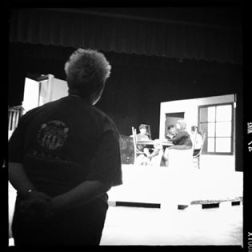
Advice: It’s best to work the scene in numerical order so the cast begins to get a feel for the show’s through line.  What’s a through line?  The through line is the connecting theme or plot of the musical.  My guess is that you mentioned your through line at the first cast meeting, but that was several weeks ago and students forget.

Here’s another bit of advice:  If the show is technically challenging and my actors are going to help with scene changes, I have been known to block scenes changes during working rehearsals. Even if students don’t have the actual set pieces to place on stage, they can at least begin to think about them.  Again, it aids the students in becoming very familiar with the production.

Step Eight:  Polishing Rehearsals and Off Book

It’s not unusual for me to ask my cast to be off book early on the show.  However, similar to a play I allow them a blocking rehearsal and one working rehearsal but then they must be off book.  The sooner they can put down their script the better for a musical production.

You will want at least two rehearsals just for the orchestra as you focus on the orchestra’s needs during each rehearsal.  These rehearsals are an opportunity to sing through the show and work out any kinks which emerge.

The Youth Theater Musical Process: What You Need to Know

Youth Theater Musical Rehearsal: What You Need to Know

Step Nine:  Technical Rehearsals

Remember me discussing having your cast member practice scene changes if they are helping with them? You may have two to four technical rehearsals depending upon the complexity of the musical.  Each act needs at least one rehearsal of a two hour stretch.  This gives the students’ brain time to adjust to the challenges or their responsibilities in a scene change in that one act. When you add props, you will find that the acting goes out the window.  Suddenly, an actor is holding a prop and for many students this distracts them.  For several rehearsals it is not uncommon for the students to back peddle a bit. A lot of details are being thrown at them–never fear.  They will get it!  Your stage manager will need to help them figure out if they must strike the props after it’s used or it’s preset, etc.  Everything is planned ahead of time.  I always say, “We plan for perfection, but we expect mistakes.”

The schedule could be:

Act One  6:30 to 8:30 (scene changes included)

Act Two 6:30 to 8:30  (scene changes included)

Act One  6:30 to 8:30 (add props. )

Act Two 6:30 to 8:30 (add props.)

The Youth Theater Musical Process: What You Need to Know

Youth Theater Musical Rehearsal: What You Need to Know

Step Ten:  Dress Rehearsals

Recently, someone asked me if four dress rehearsals was enough for a cast.  That’s too many in my opinion.  If the students are having trouble changing then just rehearse the costume changes.

Be careful that you don’t over rehearse the show.  This can occur too.  It’s okay that your dress rehearsals have a few problems, provided you brainstorm how to improve them and practice the changes a couple of times. Here’s a wonderful video clip of a costume change in Mary Poppins.

The Youth Theater Musical Process: What You Need to Know

Your show does not need to be perfect (if it ever is) by the second dress rehearsal. Trust me, you want your cast just a little nervous but confident for opening night. Careful not to burn them out!

Advice:  Teach your cast how to handle off balanced unplanned moments is so important.  Viola Spolin book Theater Games  Games for the Classroom contains a game which really helps with this problem.  It’s called Kitty Wants a Corner.  You can find the game through this link to her book.  

Whew!  This was a lot of information.  I hope I’ve given you a comprehensive guide for your rehearsals.  You can always email me if you need extra guidance.  That’s what I’m here for.  Until next time.

Woman behind DramaMommaSpeaks


Share this:

  • Click to share on Tumblr (Opens in new window) Tumblr
  • More
  • Click to share on X (Opens in new window) X
  • Click to share on Facebook (Opens in new window) Facebook
  • Click to share on Pinterest (Opens in new window) Pinterest
  • Click to share on LinkedIn (Opens in new window) LinkedIn
  • Click to email a link to a friend (Opens in new window) Email
  • Click to share on Reddit (Opens in new window) Reddit
  • Click to share on Pocket (Opens in new window) Pocket
  • Click to share on Telegram (Opens in new window) Telegram
  • Click to share on WhatsApp (Opens in new window) WhatsApp

Like this:

Like Loading...

Filed Under: acting, arts education, community theater, community theatre, directing experiences, drama education, Musical Theatre, Production Questions, theater, theatre, youth theatre Tagged With: musicals, rehearsal process for a musical, rehearsing a musical

Play Production for Newbie Theater Teachers: Expectations Versus Reality

June 22, 2022 By dhcbaldwin Leave a Comment

Play Production for Newbie Theater Teachers: Expectations Versus Reality

Play Production for Newbie Theater Teachers: Expectations Versus Reality

Play Production for Newbie Theater Teachers: Expectations Versus Reality

Congratulations!  You’ve been hired to teach theater and direct several productions a year. You probably have the class curriculum nailed down or you are in the midst of it.  However, you realize that although you have some experience on stage as a performer, you may need some help with other facets of a production.  This post should help–Play Production for Newbie Theater Teachers: Expectations Versus Reality

When I majored in theater at Stephens College about a 100 years ago, although I was mostly interested in performing we were expected to work backstage for the first semester.  I still think that’s an excellent idea. Some students who began as performance majors find they are more suited to stage management, costume or set design for instance. Plus, an actor needs to understand what goes into mounting a production.

Too many people get out there and think they are going to end up on the Broadway stage after their first audition. Many give up too quickly, but perhaps if they’d found another way to be involved with theater they would have stayed with it.

I love theater so much, I didn’t care if all I ever did was sweep the stage–it was that important to me.  If you want to know how theater saved my life, go to How Theatre Saved My Life

Newbie Theater Teacher Expectations

Play Production for Newbie Theater Teachers: Expectations Versus Reality

It’s only natural to think that when you enter your first teaching position in your career, everything is provided for your classroom and stage.  You may have come from a high school or certainly college which fully supported the theater arts department.  That’s understandable and certainly the way it should be.

Some high schools even have technical directors who oversee the technical aspects of productions and teach the technical theater classes.  That’s terrific!

You expect to have a lot of materials and resources all ready organized–set pieces, costumes, makeup, storage space, etc.  If the school and their theater department has been in existence for several years, you should expect to take what was left from the previous teacher and grow from there.

Did you know I have the secret to boosting student engagement?  My new book, “We’re Live! Radio Theater #101” explains my journey to implementing this unique tool in the classroom. Check it out here


The Reality

Play Production for Newbie Theater Teachers: Expectations Versus Reality

Here is the reality– In many school systems, the theater department and arts in general are looked upon as unimportant. (Because the general public does not understand what it takes to teach theater much less produce a play or musical.) Generally, the arts play second fiddle to sports. It’s not fair and not right but it happens all. the.time

If you find a school, which is not a performing arts school, who supports the arts you are lucky to teach there.

I can’t even count how many times people have said, “This school doesn’t have a budget for me!  They don’t have materials or resources for mounting a production. What do I do?”

Tip:  One question you need to ask when you interview for any teaching position should be about the budget for your classes and/or productions.  If the administrator doesn’t know the budget, this is a red flag. It doesn’t mean you don’t have a budget, but this is easy to ascertain for them and they should be willing to divulge it.

Tip:  When you interview, ask to see the stage and check out backstage as well. See if they have any costumes, props or set pieces.  Do they have stage lights, light trees and amplification equipment? Does anyone else use the stage other than the theater department?  Who and how much time do they use it?

Tip:  Find out if there is a parent booster club for the arts. They are invaluable to your success at this particular school. They can help you in many ways–fundraising, building sets and sewing costumes, advertising and box office.

Play Production for Newbie Theater Teachers: Expectations Versus Reality

Play Production for Newbie Theater Teachers: Expectations Versus Reality

If the school doesn’t have a production budget, the first thing you will need to do is raise money to pay the expenses of the production.  These expenses can range anywhere from $500 to (gulp) $10,000 a piece.  Consider ticket prices and talk with other teachers in the district to see what they charge.  Check out my fundraising suggestions here: Turn Your Theater Department Fundraising Into A High Performing Machine

If your set inventory doesn’t have much to offer, then you may need to build flats. There are many ways to do so.  I’d check out this video for instruction on building a Hollywood flat. Or you can build a muslin flat.

I’d suggest watching the Cal State A & L videos on youtube.com  They teach just about everything you’d need to know in a clear and concise method.

If you need help with costume design, check out my post: Critical Steps in Producing a Play or Musical: Costumes

Play Production for Newbie Theater Teachers: Expectations Versus Reality

One of my lesser strengths is light design. I know what I want, but I don’t know how to make it happen.  I defer to my husband about light design because he’s designed for me for years. (See the photo above)  In your case, I’d check Cal State for help there.

Did you know I have the secret to boosting student engagement?  My new book, “We’re Live! Radio Theater #101” explains my journey to implementing this unique tool in the classroom. Check it out here

My Most Important Advice

Play Production for Newbie Theater Teachers: Expectations Versus Reality

Many directors of school productions think they have to produce their shows having the quality of a Broadway production.  Not only is this unreasonable to expect of yourself, but not necessary.  If you do a good job and balance the production so that everything is of equal quality (your show is imbalanced if the only set piece which was completed for your set is the staircase you spent all month building for your play), then you can rest knowing you did your best under the circumstances.

You should not be expected to do more with less.  Just do the best you can understand the circumstances. You shouldn’t spend all weekend for several months working on one production. You shouldn’t be doing all the work yourself. Don’t forget that without YOU, none of the magic happens and the students need YOU the most. 

What is most important is what your students learn from the experience, right?

Here are a few blog posts that can answer some questions or help you:

Critical Steps in Producing a Play or Musical: Stage Makeup 

Critical Steps in Producing a Play or Musical: Costumes


My Advice for FREE

Play Production for Newbie Theater Teachers: Expectations Versus Reality

I am willing to advise you for free.  You can find me many places– on instagram @dramamommaspeaks, Facebook @dramamommaspeaks or email me at DhcBaldwin@gmail.com.  I have been where you are now.  Luckily, you have someone like me to advise you.

No one learns much of anything completely by themselves.  A good teacher asks for advice and help.  You will be a better teacher for it, I promise!

If you’ve had any experiences you’d like to share, please hit reply and share them with me.  I’d love to hear from you.

You can contact me at DhcBaldwin@gmail.com

Deborah Baldwin, Dramamommaspeaks


Share this:

  • Click to share on Tumblr (Opens in new window) Tumblr
  • More
  • Click to share on X (Opens in new window) X
  • Click to share on Facebook (Opens in new window) Facebook
  • Click to share on Pinterest (Opens in new window) Pinterest
  • Click to share on LinkedIn (Opens in new window) LinkedIn
  • Click to email a link to a friend (Opens in new window) Email
  • Click to share on Reddit (Opens in new window) Reddit
  • Click to share on Pocket (Opens in new window) Pocket
  • Click to share on Telegram (Opens in new window) Telegram
  • Click to share on WhatsApp (Opens in new window) WhatsApp

Like this:

Like Loading...

Filed Under: Arts, arts education, drama education, Education, High School, Producing plays and musicals, Production Questions, Stephens College, Teaching, theater, theatre, youth theatre Tagged With: musicals, new teacher, new teacher help, newbie teacher, play production, plays, producing a musical

Hamilton the Musical A Drama Lesson Using Differentiated Instruction

August 31, 2019 By dhcbaldwin 5 Comments

Marquee of Hamilton the Broadway Musical

Hamilton the Musical A Drama Lesson Using Differentiated Instruction

I think blogging about this particular musical is crucial.   That’s why I am blogging about it here. Hamilton the Musical a Drama Lesson Using Differentiated Instruction.” Recently, my husband and I finally had the fabulous opportunity  in catching the touring company performance of it in Kansas City. It’s truly breathtaking.

A combination of rap, musical, history and fabulous storytelling Hamilton is more than exceptional.  It transcends modern-day musicals with its unique crafting.

Hamilton the Musical A Drama Lesson Using Differentiated Instruction  Hamilton the Musical A Drama Lesson Using Differentiated Instruction


Many American History and Language Arts teachers are teaching the musical in their classroom. Consequently, our students are learning about American history which they might never have learned otherwise

Hamilton the Musical A Drama Lesson Using Differentiated Instruction

Hooray, I say!

What about the theater teachers? Or music teachers? They are probably teaching the story and listening to the music. That’s great, but frankly, I think there’s a lot more to teach about the musical.

I teach theater with a twist.  This is a pretty good description of what I mean. 

Do you like to use quotes in your classroom?  Grab a set of pendants which include Lin Manuel Miranda for your classroom here: Bulletin Board Pendants and Posters

Some of our students do NOT want to perform, but they might be interested in some other part of the theater if we can pique their curiosity.

Here is one way to do so.

How Teaching with Hamilton is Unique

Hamilton the Musical A Drama Lesson Using Differentiated Instruction

You may be aware I am creating a series called Page to Stage–musical theater lessons about Tony award-winning Broadway musicals and one concerning the Tony Awards.   You can check them out– Bundle Drama Lessons: Broadway Musicals

My lessons offer many things.  One of the most important is a description of the responsibilities a playwright, composer, lyricist or producer have bringing a production to life. Plus, I include video clips like this, Lin Manuel Breaks Down His Biggest Songs : https://youtu.be/Urp9MjHLP0s

In the Heights is my latest creation. it includes these descriptions and I’m mighty proud of it, too! Check it out here:  In the Heights 

Teachers purchase these lessons because they work with our students. I always use differentiated instruction in my classroom. For instance, here is a fairly new costume design lesson using the Hamilton Broadway characters as the inspiration. Emergency Substitute Lesson Costume Design with Hamilton Broadway Musical Characters.

Comprehensive Teaching Resources for a Seamless Lesson

Here are the strengths:

  1.  Letter to the teacher explaining the lesson and how to use it which alleviates any worries they might have.
  2.   Warm-up game is included–after 38 years of teaching, I know which ones are appropriate and successful and I give you my version of the games
  3.  Procedure–need I say more?
  4.  Teacher’s Script–sometimes it helps to have a script, especially if you are leaving this for a substitute or an inexperienced teacher
  5.  Photos of the production--we are all visual thinkers, so this is a big plus
  6. Tony Awards it Received (or Nominations)
  7. What are the Tony Awards–brief information about the Tony Awards and which awards the particular musical was nominated for or won
  8. New York City Map with Competing Theaters Labeled–this helps students visualize the theater section of NYC
  9. Trivia About the Shows and Broadway–these are so fun for me to compile!
  10. Lyrics Quotes from the Musical–Good for Discussions and Assignments
  11. Student Notes and a teacher’s key which makes grading a breeze
  12.  Extension Activities--these are probably my most fun to create for teachers.  Each lesson is completely different depending upon the nature of the musical.
  13. Exit Slip Suggestions–if a teacher wants to double-check if the students are comprehending the learning, this is a good way to do so
  14. New!  Flip Book so students can take notes in a different method if need be (only in the PDF version)
  15. Film clip links (hot)–these links are hand-picked by me and include the length and sometimes a recommendation of the grade level who would most appreciate them–all the teacher does is click the link and go!
  16. Sources— a teacher can check out the information if they are curious

Data, Data, Data

Hamilton the Musical A Drama Lesson Using Differentiated Instruction

When I was writing this blog, I found some facts concerning the importance of theater education.  Anyone needing to defend the reasons to teach it?

Do You Need to Be Convinced?

Here are some from the American Alliance of Theater and Education website:

Did you know…

  • Students involved in drama performance coursework or experience outscored non-arts students on the 2005 SAT by an average of 65 points in the verbal component and 34 points in the math component(1)?
  • Drama activities improve reading comprehension, and both verbal and non-verbal communication skills?
  • Drama helps to improve school attendance and reduce high school dropout rates(2)?
  • A 2005 Harris Poll revealed that 93% of the public believes that arts, including theatre, are vital to a well-rounded education (3)?
  • Drama can improve skills and academic performance in children and youth with learning disabilities?

Hamilton the Musical A Drama Lesson Using Differentiated Instruction

More Reasons To Teach Theater to our Students

Theater Students:

  • involved in drama performance scored an average of 65.5 points higher on the verbal component and 35.5 points higher in the math component of the SAT
  • on average, score 55 points higher on verbal and 26 points higher on math than their non-arts classmates.
  •  participate in drama performance outscored the national average SAT score by 35 points on the verbal portion and 24 points on the math section.
  • considered to be at high risk for dropping out of high school cite drama and other arts classes as their motivations for staying in school.
  • who are engaged in the arts are 3 times more likely to win an award for school attendance than those who do not
  • A series of studies on the arts and education revealed a consistent causal link between performing texts in the classroom and the improvement of a variety of verbal skills, including especially significant increases in story recall and understanding of written material.
  •  students’ understanding of other complex texts including science and math material when they attend a performance of Shakespeare
  • can improve reading skills and comprehension better than other activities, including discussion.
  • who are highly involved in drama demonstrate an elevated self-concept over those who are not involved.
  • help to build their self-esteem and communication skills of high school students when they write plays and perform in dramatic presentations of existing works can
  •  recognize their potential for success and improve their confidence through the sheer act of performing
  • can improve and help to maintain social and language skills of students with learning disabilities and remedial readers through drama activities.
  •  improve reading achievement and attitude in disadvantaged students through improvisational drama


My Final Thoughts

Finally, I wanted to share that a study published in Champions of Change (1999) cites theatre arts, including performance, classes, and participation in a drama club, as a source for “gains in reading proficiency, gains in self-concept and motivation, and higher levels of empathy and tolerance towards others” among youth of low socio-economic status.

Most importantly, 93 percent of Americans believe that the arts are essential to a complete education, 79 percent are convinced that the arts should be a priority in education reform and 79 percent consider the issues facing arts education to be significant enough to merit their personally taking action. Wow!  Amazing data and stats, huh?

Check out Hamilton, the Broadway Musical at: Hamilton the Broadway Musical on Teacherspayteachers.com or in my MadebyTeachers store at: Hamilton the Broadway Musical

and my newest version for the Google Classroom  Hamilton Lesson Distance Learning on Teacherspayteachers.com 

What have you learned from a musical?  Musicals enrich my life so much it is difficult to know where to begin sharing.

I’d love to hear from you.  Contact me at dhcbaldwin@gmail.com or DeborahBaldwin.net

Hamilton the Musical A Drama Lesson Using Differentiated Instruction


Share this:

  • Click to share on Tumblr (Opens in new window) Tumblr
  • More
  • Click to share on X (Opens in new window) X
  • Click to share on Facebook (Opens in new window) Facebook
  • Click to share on Pinterest (Opens in new window) Pinterest
  • Click to share on LinkedIn (Opens in new window) LinkedIn
  • Click to email a link to a friend (Opens in new window) Email
  • Click to share on Reddit (Opens in new window) Reddit
  • Click to share on Pocket (Opens in new window) Pocket
  • Click to share on Telegram (Opens in new window) Telegram
  • Click to share on WhatsApp (Opens in new window) WhatsApp

Like this:

Like Loading...

Filed Under: Broadway, drama education, Musical Theatre, performing arts, Teacherspayteachers, Teaching, teaching strategies, theater, Tony Awards, youth theatre Tagged With: Broadway musicals, Disney plus, Eduham at Home, google classroom, Hamilton, musical theater lessons, musicals, Page to Stage, Tony award winner

Do You Wanna Dance? I do! Introducing: Juke Box Musicals, A Review

November 18, 2016 By dhcbaldwin Leave a Comment

Do You Wanna Dance?

Do You Wanna Dance?  I do!

Are you looking for a musical with lots of roles so all your students can be involved? One that is entertaining, fast moving and light?  One with “ear worm” songs and hip, dancing beats?  Then Juke Box Musical’s Do You Wanna Dance is for you!

juke-box-musical

When I saw this musical advertised on Facebook, I asked the advertising firm if they were looking for pre-launch reviews.  They were and I accepted.

After directing productions for nearly forty years and creating a national playwriting contest, I can call myself an expert in both fores.

 I’m a tremendously experienced drama teacher, too.  I have read countless scripts and directed over 250 productions. I’m the gal you want for this job, that’s for sure.

There are many positives to this cute musical:

  • Twelve leading roles with an even split of female and male. (Hooray!) Plus a chorus of indeterminate size portrays many different characters.  Kids like to be busy on stage, not bored backstage.  This is a real plus.

  • At least twelve “catchy”  popular songs that encourage the listener to reminisce of latter days when they listened to a jukebox

  • List of characters with noted vocal ranges and brief character descriptions

  • Appropriate singing range for younger students (my advice– the production is mountable by middle school students and younger)

  • Simple plot, somewhat easy to project its outcome but moves along nicely and has a good message– Don’t let anyone stop you from the joy of dancing and singing. Everyone can dance.

  • Set description per scene (useful when planning production)

  • Stage directions, indepth (novice directors will appreciate these)

  • Simple costuming that most groups can create (another PLUS in my book)

  • Prop list with no difficult props to secure

  • Projection package of the various locales so that an erected set is not needed (this is a separate cost to the renter)

  • Suitable story for the whole family

Co-writers Mark Brymer and John Jacobsen are qualified and experienced musicians who can easily take on the challenges of writing a musical.  Mark Brymer has been a leading choral writer/arranger for the educational and church choral music markets for many years.

John Jacobson is known as a music educator, choreographer and author.  Both gentlemen are prolific creators.  Their resumes attest to their expertise.

boy-158152_1280-2girl-158151_1280 (1).png

Do You Wanna Dance seems like a musical review. I think that’s what the writers were aiming for in writing it. I did a little research online and found a youtube video of the co-writers discussing the show.  John Jacobson called the show “campy fun.”

I’d agree with him. Kids love to dance and sing and surprisingly, they will sing songs from other time periods with no qualms or embarrassment.

“Walking on Sunshine” was released in 1979. That was over thirty years ago.  That doesn’t matter with music-a popular song continues to be popular long after its time.

Think about it… A family is sitting around the dinner table and their student begins humming one of the songs he’s hearsing from  Do You Wanna Dance. Before you know it, the parents recognize the song, begin singing along and the little sister jumps up and dances with a broom.

 (Sorry, I got a little carried away there…) if you ask me, that’s a pretty clever way to involve the whole family and the show hasn’t even opened yet.

Most importantly, Do You Wanna Dance doesn’t talk down to students and that’s a plus for me. Next time, I would challenge the writers to create another jukebox musical with a more difficult plot–our kids can handle it these days.  They are quite sophisticated and love a good challenge.

Other than the junior musicals through Music Theatre International, there aren’t many musicals appropriate for younger students to perform. Or they are insipid and not worth anyone’s time. If nothing else, Do You Wanna Dance is just plain fun! A church youth group, Scout troop or an after school drama club could produce Do You Wanna Dance quite successfully.

kids-dancing[1]


Who doesn’t like to sing and dance? (Now I’ve got Walking in Sunshine stuck in my head…)

Which is your favorite?  Singing or Dancing?

Contact me at dhcbaldwin@gmail.com or DeborahBaldwin.net I’d love to hear from you.

Do you have a budding musical composer in your home?  Or maybe you have a class full of students who love writing and music?  

I have a lesson which they may enjoy:  Create Your Own Musical

Information on this website may be copied for personal use only. No part of this website may be reproduced, stored, or transmitted in any form or by any means, electronic, mechanical, photocopying, recording, scanning, or otherwise, except as permitted under Section 107 or 108 of the 1976 United States Copyright Act, without the prior written permission of the author. Requests to the author and publisher for permission should be addressed to the following email: dhcbaldwin@gmail.com


Share this:

  • Click to share on Tumblr (Opens in new window) Tumblr
  • More
  • Click to share on X (Opens in new window) X
  • Click to share on Facebook (Opens in new window) Facebook
  • Click to share on Pinterest (Opens in new window) Pinterest
  • Click to share on LinkedIn (Opens in new window) LinkedIn
  • Click to email a link to a friend (Opens in new window) Email
  • Click to share on Reddit (Opens in new window) Reddit
  • Click to share on Pocket (Opens in new window) Pocket
  • Click to share on Telegram (Opens in new window) Telegram
  • Click to share on WhatsApp (Opens in new window) WhatsApp

Like this:

Like Loading...

Filed Under: drama education, Producing plays and musicals, youth theatre Tagged With: creative writing, dancing, family time, juke box musicals, musical composition, musical creating, musical lyrics, musicals, school, singing, vocal music

Critical Steps in Selecting a Play or Musical: Budget & Royalties

August 5, 2016 By dhcbaldwin 6 Comments

599251_10151928154440331_863385914_n[1]

Willy Wonka, Jr.  2010

Let’s discuss the critical steps in selecting a play or musical:  budget & royalties.  Sometimes I meet with directors of future productions who are excited and apprehensive at the same time.   Usually, they are certain in their decision of choice of show or are completely overwhelmed by the many selections in which they have to choose.  I thought I’d write a series of blog entries concerning this.This is the first of many.

Number One: Director’s Concept

You need a director’s concept.  A director’s concept is the message that the director wants to convey to the audience.  If you are directing “The Miracle Worker”, you will probably want a natural, historically accurate concept. If I’m directing a historical piece, I select costumes, props and have a set designed to demonstrate it. But what else is important to you?  Helen’s viewpoint?  How can you  present that to an audience?  I’d suggest to you to create a concept collage pertaining to your concept.  It’s really easy to do, fun and will help you in every facet of the production.  Get out a large piece of paper or posterboard, begin researching on the internet (which is the easiest way to research for this), find photos of everything that inspired you and your director concept.

Number Two:  Budget

What is the budget? Before a company can even get started, the budget must be considered. There is nothing worse than getting yourself caught in a snare of “Well, we have to buy it (or rent, borrow or steal it) because the script says so.”  Proper preplanning can help a company to avoid this dilemna. To me, the budget controls everything–where you can afford that really neat backdrop you want to rent for , or the authentic looking chain male for “Camelot”, puppets for   Lion King   and so on and so on.

Some amateur companies set a budget, but never look at it again.  Some have producers who guard the budget like a hawk.  Some others leave everything up to the director (as if they don’t have enough to do all ready). Make sure you know how the money is overseen.  You’d hate to find out that the fog machine you had rented can’t be used for the woods scenes in “Into the Woods” after you had enthusiastically worked it into the show.

And for heaven’s sake, read the script a couple of times to make sure there aren’t any surprises that you forgot about.  But where do you find the publishing companies’ names?  There is a great source, Findaplay.com  that can help you.  You can always search the web for the company, but if you want to produce a version of Tom Sawyer, for example, there are several companies that offer it.  Findaplay.com will list all of them and if they don’t, then go to the web and look around.

Several times I have wanted to produce a play version of some story.  One was Holes and another was The Stinky Cheese Man and Other Fairly Stupid Tales.  At the time, there were no publishers with rights to the stories.  It took a bit of searching, but I found the author of Holes which led me to the playwright of Holes.  I wrote to the playwright and asked if my school could produce his play and he agreed! Talk about fortuitous!  I did the same with Stinky Cheese Man.  I found the author, who sent me to the playwright who allowed the youth theatre company I was working with to produce the musical version.  Pay dirt!  So, if you are interested in a particular book and want to produce it as a play or musical, look around the internet.  You may find it in this manner.

But in no uncertain terms (please hear this loud and clear) you CAN NOT take someone else’s material and dramatize it for your own use.  This is a HUGE copyright infringement and just tacky.

https://readersfavorite.com/annual-book-award-contest.htm?affiliateID=1555

img_0183

Number Three:  Royalties

Personally, I think it’s important to know the cost of the royalties for your chosen production before even choosing it.  Usually, plays are no problem.  But musicals?  Well, that’s another challenge all together! Any time I hear about a company who is producing a fairly new show straight off of Broadway, I always think about the royalties.  The cost of royalties can stop a company in their tracks.  Musicals require a hefty sum of money to produce, not to mention the rental of scripts and librettos.  Oh yes, and if you plan to have an orchestra, you need to figure in the cost of their music to rent as well. (And paying your orchestra players, too.)

Also, you may need to pay the royalties to the publisher ahead of time.  It all depends upon the contract you sign, so read it overcarefully.

When you peruse a copy of a musical, you can ask the publishing company for a general royalty cost.  You’ll need to give them some information that’s necessary to them ( size of theatre, ticket prices, length of run, etc.)

So, there you have it!  There are the critical steps in selecting a play or musical:  budget & royalties.

If all of these decisions sound daunting, keep in mind that it is just part of the journey to direct or produce a show.  I promise you, once an audience sits down in the theatre and the house darkens, you will forget all about this stuff.  Because that’s all it is, stuff…..

Next look at my post on casting a production.

Contact me at Dhcbaldwin@gmail.com or BumblingBea.com

Share this:

  • Click to share on Tumblr (Opens in new window) Tumblr
  • More
  • Click to share on X (Opens in new window) X
  • Click to share on Facebook (Opens in new window) Facebook
  • Click to share on Pinterest (Opens in new window) Pinterest
  • Click to share on LinkedIn (Opens in new window) LinkedIn
  • Click to email a link to a friend (Opens in new window) Email
  • Click to share on Reddit (Opens in new window) Reddit
  • Click to share on Pocket (Opens in new window) Pocket
  • Click to share on Telegram (Opens in new window) Telegram
  • Click to share on WhatsApp (Opens in new window) WhatsApp

Like this:

Like Loading...

Filed Under: drama education, Musical Theatre, Producing plays and musicals, Production Questions Tagged With: ', beginner directors, budgets for theatrical productions, Bumbling Bea, deborah-baldwin, director's concept, Findplay.com, first time directors, musicals, plays

MTI Junior Musicals– A Dream Come True!

January 25, 2016 By dhcbaldwin 5 Comments

MTI junior musical
MTI junor musical
MTI junior Mulan, Jr.

MTI Junior Musicals– a Dream Come True!

Are you selecting an MTKI Junior or Kids Musical?  In my opinion, they are a dream come true!This year, my co-teacher and I are directing a musical that is NOT a MTI show. In case you aren’t familiar with the initials, MTI stands for Music Theatre International.   I knew MTI was good, but boy, I didn’t realize how excellent until now. I won’t go into detail, but suffice to say that I highly recommend sticking to MTI shows.

You ask the reason why we ventured out of MTI? We weren’t unhappy with their quality or professionalism. A lot of it had to do with the students who enrolled in our class this year and their level of talent. MTI has a plethora of musicals with new ones coming out all the time. Their website is: http://www.mtishows.com.

MTI junior Into the Woods

Several years ago, my artistic director at Presser Hall Performing Arts Center and I ventured to Atlanta to attend the MTI junior theater festival. What a treat it was! It was wonderful to be around other educators that spent most of their school year in the “trenches” teaching middle school students. One of the most exciting parts of the festival us the announcement of new musicals ready to produce!

As you may know, I have a very extensive resume directing numerous plays and musicals. It is just what I do. But a quick list for you: Fiddler on the Roof (4), Aladdin (2), Suessical (4), Willy Wonka (3), Music Man (4), Alice in Wonderland (4), Aristocats (3), Annie (1), Sleeping Beauty (1) Lil Mermaid (2), Honk (2), Mulan (1) and School House Rock (2). Whew!

 MTI Junior Musical–A Dream Come True!

I could speak about the festival in length, however as I mentioned above, this is my endorsement for the MTI Junior and Kids musicals. No one asked me to write this blog post. But I know that many teachers and directors are considering their next musical and maybe this list will be helpful.
So, why these particular musicals?

First of all, this company does an excellent job of considering their consumers. Not only are their junior versions, but also kid ones. Juniors run aroun 70 to 90 minutes in length, with Kids around 45 minutes. I use both types every year depending upon the length of time I have and where I am directing at the time. If MTI could receive a grade, I would definitely give them an “A”.

MTI junior Alice in Wonderland

The kit includes the materials mentioned below:

Director’s prompt book–I’ve directed productions for nearly forty years, so I can definitely label myself as an expert. And even with all these experiences, I still need help from time to time. Their prompt book is excellent! The sound and light cues are listed, props, costumes and set suggestions as well as suggestions in the directing of the show.

The MTI junior book’s page numbers are the same as the casts’ so that alleviates confusion. Measure numbers are listed, generally the cast libretto is exactly the same as the director’s. There’s a page that one could copy for auditions, and even guidance for novice directors.

Piano score–It includes cues as well.

Cross Curricular Lessons-
-Oh yeay! It is always good to have some other department involved in your production. Although I haven’t had the chance to use them because I teach in a very nontraditional school, the lessons are great.

Chorus books–I believe ten copies are part of the kit.

Individual scripts–Trust me when I say, the MTI junior scripts are the best in the market. The student’s script includes several pages concerning the particular production, a page about stage directions and how to write in one’s script, a page for autographs and several blank pages at the back of the script for cast notes.

CD’s–These are a Godsend for youth theatrer. There is usually one CD that is labeled for performance and one for rehearsals. Or both might be included on one CD. Oh my gosh, I don’t know how much time it has saved us having these CD’s. Because music cues are included, students can learn their cues right along with their songs.

Plus, you are guaranteed of a well paced production because there is no inconsistency in the meter of the songs–no cast member can slow down the show by singing their song too slowly. Lastly, there is even an “orchestra warm up” at the beginning of the show! Sometimes I use that to signify to the audience that the production is about to begin.

Family Matters booklet: If one’s child has never been involved in a production, its a pretty heady experience. This little gem of a book answers questions about what to expect during the rehearsal and performance process. This would have been a lot of help to me when my own children were performing in productions. How does one deal with your child once the production is over? That’s a toughie, but this book addresses it perfectly.

Choreography DVD--Who does this? This is an excellent idea.  Usually, the DVd includes major numbers in the show as well as a step by step rehearsal aide, too. Tremendous help.

So there you have it! I hope you’ll consider an MTI junior or kid musical in the future. I can guarantee you your show will be successful.

Have you produced any MTI junior musicals?  What were your experiences?  I’d love to hear about them.  Contact me at Dhcbaldwin@gmail.com or DeborahBaldwin.net

Needing some help with set construction and have questions? Check out:

Selecting a Play or Musical Set Design and Set Construction

Critical Steps in Producing a Play or Musical:  Costume Design

Deb

Share this:

  • Click to share on Tumblr (Opens in new window) Tumblr
  • More
  • Click to share on X (Opens in new window) X
  • Click to share on Facebook (Opens in new window) Facebook
  • Click to share on Pinterest (Opens in new window) Pinterest
  • Click to share on LinkedIn (Opens in new window) LinkedIn
  • Click to email a link to a friend (Opens in new window) Email
  • Click to share on Reddit (Opens in new window) Reddit
  • Click to share on Pocket (Opens in new window) Pocket
  • Click to share on Telegram (Opens in new window) Telegram
  • Click to share on WhatsApp (Opens in new window) WhatsApp

Like this:

Like Loading...

Filed Under: drama education, middle grades, Musical Theatre Tagged With: Annie Kids, Aristocats Kids, Fiddler on the Roof, Honk, Jr. Aladdin, Jr. Alice in Wonderland, Jr. Middle school high school musicals, Jr. Music Man, Jr. Seussical, Jr. Willy Wonka, Lil Mermaid, MTI. com, Mulan, Music Theatre International, musicals, School House Rock, Sleeping Beauty Kids, youth theater, youth theatre

Footer

Follow Us

logo3.png

FOLLOW US

Facebook X-twitter Pinterest Instagram Envelope Rss

Goodreads: read

Malibu Rising
Malibu Rising
by Taylor Jenkins Reid
People We Meet on Vacation
by Emily Henry
The Last Thing He Told Me
by Laura Dave
Faking It
Faking It
by Cora Carmack
Losing It
Losing It
by Cora Carmack

goodreads.com
Copyright © 2024 · Wellness Pro on Genesis Framework · WordPress.com.Log in
 

Loading Comments...
 

    %d