• Skip to primary navigation
  • Skip to main content
  • Skip to footer

Join Me in my new Facebook Group! https://www.facebook.com/groups/417126059784261

Menu
  • Meet Deb – The Heart Behind DramaMommaSpeaks
    • Work with Me! 
    • Photo Gallery of DramaMommaSpeaks
    • Directorial Credits
  • I Give Book Talks! 
    • Book Talk Through Skype
    • Books
  • Freebies!
  • Bumbling Bea
  • Teaching Resume
  • Acting Resume
  • Contact Me
  • Blog
    • Drama Education
    • Arts Education
    • Youth Theatre
    • Middle Grades
    • Musical Theatre
    • Teaching
  • Meet Deb – The Heart Behind DramaMommaSpeaks
    • Work with Me! 
    • Photo Gallery of DramaMommaSpeaks
    • Directorial Credits
  • I Give Book Talks! 
    • Book Talk Through Skype
    • Books
  • Freebies!
  • Bumbling Bea
  • Teaching Resume
  • Acting Resume
  • Contact Me
  • Blog
    • Drama Education
    • Arts Education
    • Youth Theatre
    • Middle Grades
    • Musical Theatre
    • Teaching

Oklahoma!

Six Great Lessons Students Can Learn from Ground Breaking Musicals

January 20, 2021 By dhcbaldwin Leave a Comment

Ground Breaking Musicals

Six Great Lessons Students Can Learn from Ground Breaking Musicals

Lin-Manuel Miranda is quoted as saying, “The musicals that leave us kind of staggering on our feet are the ones that really reach for a lot.”

I agree with him.  Recently, I happened upon a YouTube video of performers in a Smash Mob from Les Mis’.  The video was from 2017.  The singing made me cry it was so beautiful.

Certain musicals do leave me staggering, how about you?  I consider them to be ground breaking.

What are some ground breaking musicals?

That’s a tough question.  There are many, almost too numerous to list here.

Number One: Rent

My curiosity for information regarding those exceptional musicals was piqued.  Which musicals carved their own way in musical theater?  Looking around, I found this information.

“You might call this one, the “anti-Cats” musical. Drawing on his memories of his first apartment in New York — with rotting floorboards, no heat and a shower in the kitchen — and the friends he’d made then, writer Jonathan Larson created the musical “Rent.” Based on the Puccini opera “La Bohéme,” “Rent” tells the story of a group of struggling artists, and while it’s meant to capture the passion and love often associated with the Bohemian lifestyle, it also illustrates the dire aspects of being a “starving artist,” so to speak.

The re-imagining of the famed opera takes it from tuberculosis-riddled Paris to the East Village in New York City, at a time when AIDS was causing much distress. It depicts love and passion in spite of progressive, incurable illness. The musical, which dispensed with many Broadway staples, like dimming the lights and starting with an overture, went on to win a Pulitzer Prize for drama. It was only the seventh musical ever to earn the distinction.”

The lesson to be learned from Rent?  Live in the moment and to live every day like it is your last.

A teacher who used my unit of Rent, stated,  :Extremely satisfied This was fantastic for discussing and analyzing “Rent”. My student’s were completely focused and active participants. Thank you for such a professional and high quality resource.:

Other Ground Breaking Musicals

Lesson Two:  Oklahoma!

From the 1920s into the 1940s, popular tunes inevitably came from Broadway musicals. Composers such as Cole Porter, George Gershwin, Rodgers and Hammerstein and Irving Berlin were in the height of their careers. Oklahoma! was ground breaking in several ways. Rather than a huge ensemble number it opens with cowboy Curly singing, Oh, What a Beautiful Mornin’! There’s a healthy dose of insanity and murder. Songs aren’t just musical window dressing anymore; they drive the story forward.

The lesson to be learned from Oklahoma!: Treat others with respect; follow the Golden Rule; Be tolerant of differences; Use good manners, not bad language; Be considerate of the feelings of others; Don’t threaten, hit or hurt anyone; Deal peacefully with anger, insults, and disagreements. Pick up my unit for Oklahoma here: Oklahoma! Broadway Musical Unit

One teacher who reviewed the unit said, “Extremely satisfied. This resource is very complete and provided lots of teaching options to use with my students. Versatile and appealing!”

Lesson Three:  West Side Story

Another innovative musical is West Side Story.  Wow, you can’t beat it, can you?  The carefully cut costumes of the Jets and the Sharks still look fresh from the dryer. There is no profanity (unless you count, “Krup you!”) and only one gun. But in the 1950s, a gang version of Romeo and Juliet packed with racial tension and a bittersweet conclusion was a big deal. Reviewer Walter Kerr of the New York Herald Tribune summed up the reaction after opening night when he wrote, “The radioactive fallout from West Side Story must still be descending on Broadway this morning.” The musical scored by Leonard Bernstein was also doubted initially as too operatic.

The lesson to be learned from West Side Story:  There are consequences of racial/ethnic/cultural hatred and what occurs when one’s pride controls a person’s behavior and attitude. You can find my unit here: West Side Story Broadway Musical Unit.

One review said, “Extremely satisfied. This resource is extremely detailed and well-written. I love West Side Story. This resource kept my older students engaged. What a awesome lesson!”

Lesson Four:  Jesus Christ Superstar

Let’s not forget Jesus Christ Superstar!  Composer Andrew Lloyd Webber and librettist Tim Rice, both British, debuted with the first rock opera, all of the dialogue set to music. That style of libretto has since evolved into the norm for musicals. I remember hearing the musical for the first time at a youth group meeting–amazing experience.  If you haven’t seen the live television version of it, check out my blog post concerning the talent who portrayed Judas, Brandon Victor Dixon and  The Two Most Inspiring People I’ve Seen This Year

The lesson to be learned from Jesus Christ Superstar: There are consequences to success and the power that comes from it.  

Lesson Five:  Chorus Line

“Five, six, seven, eight!”  Those are familiar directions to a cast.  Chorus Line looks inside the lives of seventeen dancers competing for eight spots in a Broadway production. Before its fifteen-year run ended, the Michael Bennett musical further loosened the definition of how musicals had to be structured. With A Chorus Line, monologues and songs could serve as their own plot, if they stayed consistent with a central idea. This philosophy gave future musicals permission to try other, less traditional innovative forms.

The lesson to be learned from Chorus Line: Dreaming is important, but action is even more important.  

Lesson Six:  Hamilton

Here are several quotes from websites about Hamilton which I think say it better than I can,  “The show combines hip-hop, rap, R&B, soul, and traditional show tunes to create its novel score. And Miranda’s witty, sophisticated lyrics bring the familiar historical characters to life in a whole new way, drawing the audience in with their humanity and familiarity. The resounding success of Hamilton is undeniable.”

The blog, Broadwayinbound, mentions, “America’s founding fathers were all white, and many of them owned black slaves; in Hamilton, however, people of color play the leading roles — and Miranda says that was very intentional. “This is a story about America then, told by America now, and we want to eliminate any distance.”

Here’s another from https://www.cbc.ca, “From childhood Miranda loved musicals, and performed in several high school productions. One of his all-time favorites is Les Misérables, and that musical theatre classic inspired Miranda’s thinking on Hamilton. The things that you can see in Hamilton that are affecting people are also present in Les Mis. One, it’s trying to capture so much of the human experience that even if we fall short, we’ve got a lot of it. I mean, Les Misérables starts in prison. It’s ‘Look down, look down, you’re standing in your grave.’ And then it goes up from there,” he said in an interview.”

I especially like this quote from The Guardian, :Hamilton features black and brown actors, but its story never depicts a slave. That said, it’s also true that minstrelsy is crucial to Miranda’s project: he takes the long American minstrelsy tradition of white people in blackface on stage and reverses it.”

Isn’t it easy to understand why it is so popular?

Every season in the fall,  I look forward to the next ground breaking musical, don’t you?

I have several Broadway musical lessons (all useful for distance learning)  which demonstrate these lessons.  For more information about them, check out:  DramaMommaSpeaks

What musical do you think is significant?  I’d love to know.  Contact me at DhcBaldwin@gmail.com or DeborahBaldwin.net

Deborah Baldwin of DramaMommaSpeaks


Share this:

  • Click to share on Tumblr (Opens in new window) Tumblr
  • More
  • Click to share on X (Opens in new window) X
  • Click to share on Facebook (Opens in new window) Facebook
  • Click to share on Pinterest (Opens in new window) Pinterest
  • Click to share on LinkedIn (Opens in new window) LinkedIn
  • Click to email a link to a friend (Opens in new window) Email
  • Click to share on Reddit (Opens in new window) Reddit
  • Click to share on Pocket (Opens in new window) Pocket
  • Click to share on Telegram (Opens in new window) Telegram
  • Click to share on WhatsApp (Opens in new window) WhatsApp

Like this:

Like Loading...

Filed Under: acting, arts education, arts integration, Distance Learning, drama education, e-learning, Education, excellence in teaching, High School, hybrid learning, Musical Theatre, performing arts, Teacherspayteachers, youth theatre Tagged With: Chorus Line, ground breaking musicals, Hamilton, Jesus Christ Super Star, Oklahoma!, Rent, West Side Story

Critical Steps in Producing a Play or Musical: Costumes

November 19, 2016 By dhcbaldwin 4 Comments


The Secret Garden

Spring Version of The Secret Garden May 2016 St. Vrain Valley Schools

Jill Shepherd, Costume Coordinator

Critical Steps in Producing a Play or Musical: Costumes

When I was a little girl, Halloween at our house was not a big production.  Actually, I don’t know if it was ever as big a deal as it is now.  This was in the 1960’s and early 70’s (or ‘mid century’ as interior design people label it now…), so keep that in mind. I mean, we used to carve a pumpkin, buy some cheap candy and hand it out to the neighborhood kids.

I was coerced into dressing as a pilgrim (really?) because my sister had brought home a pilgrim-looking hat from an overseas trip with the Girl Scouts–her present to me.  It was a terrible costume and that’s all I remember probably because I stuffed away the memory. I was five year old.

It got a little better, however.  My mother put together a Queen Isabella costume for our class play about Christopher Columbus.  That was about as close as I came to a costume that you would expect, and I LOVED it!  The shoes were too small and crimped my chubby foot and the crown was made of aluminum foil and these blue bauble-looking things flailed themselves around my head.

My only line was, “Rise, Christopher!” because he was kneeling before me.  That was my first play and I’ll never forget it, mostly because of the costume my mother created for me. I also got to be the center of attention…

Mom didn’t create another for me ever again. Well, she did sew a celery stalk costume for me in high school for some sort of club initiation but I don’t think that counts as  a Halloween costume. Ironically, the celery stalk idea was mine and I thought it was a hysterical.  Don’t know that anyone else understood my vision, but there you go…

Critical Steps in a Play or Musical:  Costumes

Costumes are one of the most creative and exciting components of theatre.  Honestly, they are a critical step in your selection of a play or musical.  Two facts come to mind when I think of a particular production–costumes and set.  Can this company afford the costumes and built them?  Can we rent or borrow?

img_0344

Mulan, Jr.  Presser Performing Arts Center July 2015

Evelyn Zidick , Costume Designer

Critical Steps in Producing a Play or Musical: Costumes

Actors and Their Costumes

I find that novice actors are all about their costumes. I try to assuage their fears and trepidations right from the beginning.  Depending upon the company, during our first read thru, I show my cast some examples of what all of the costumes will look like. This includes the color palette for the show.

As a teacher, I know that most human beings are visual learners.  By showing costume examples to the cast, I help them to be more confident (if they weren’t so) and of course give them a rough idea of my director’s concept and a beginning step toward my thoughts about their character. It also excites them and gives them a preliminary focus as they rehearse.

Do you have a costumer designer?  Or is it you?

Again, if you have a costume designer you’ll need to communicate your concept to them.  I ask for the budget for the show.  Let’s say you are directing Oklahoma! and you are expected to costume the show yourself.  Oh my.  That’s a big one, although somewhat simple to create.

Years ago, I’d trudge to the public library and find photos or pictures of painting that depicted the time period of a particular play.  Now it’s soooo easy!  Hello internet! Look on line and find some examples that you can print for your costumer (if they are inexperienced) and/or the cast. Don’t forget your public library, though.  Sometimes it’s easier to peruse their book shelves than search around on the web.

And….I nearly forgot!  Walk yourself into a fabric store such as  Joanns Fabrics or Hobby Lobby and study the various pattern books. They have a plethora of costumes.  Years ago, we had maybe three patterns to choose from, but since then these companies have done an excellent job of re-creating clothing from several times periods.

In particular, check out the Simplicity costume patterns.  If you are expected to build the costumes yourself, I’d begin my designing at a fabric store.


  Mulan, Jr. April 2016 Apex Home School Enrichment program

Renting Costumes

You can easily find a costume company in your city  or near to you from which you can rent. Generally, costume companies rent costumes for a set amount of time such as two or three weeks, depending upon the length of your production.

Sometimes they will ask for a deposit (per costume, thank you very much).  There will be a contract with the company’s rental policy, etc. Someone will need to be responsible for these rentals. Also, check with other community theatres, college theatre departments and area high schools to see if anyone rents to outside groups.  Perhaps instead of renting, you could do a trade of advertising space in the program?

Critical Steps in Producing a Play or Musical: Costumes

Then there’s the good old thrift store.

I could write an entire blog about the value of thrift stores.  They are that useful to a theatre company. Everyone who works in theatre visits thrift stores at some point in their season. Obviously, it is cheaper than a box store and you’d be surprised at the gold mine you’ll find.

One tricky costume piece is children’s boots.  Recently, I directed Fiddler on the Roof, Jr. (for the fourth time in my career) and my entire cast of forty students, ages ten to eighteen, needed ankle length boots.  I warned the parents about six months ahead of time  (because this was a musical theatre class that lasted the entire school year).  Finding a pair of child’s boots can be difficult in the spring when our show was going to be performed.

Certain costume pieces such as children’s boots, are a hot commodity.

As usual, the diligent, enthusiastic parents went right out and found boots at thrift stores. Ta-da.  Those folks who waited until March were bereft for lack of inexpensive shoe wear. (That’s a funny phrase, I must say.) It was too late. So, start with your neighborhood thrift store in your quest for costumes.  It will save you time and money, I promise.

My One Concern

One thing I want to stress to you, friend.  I dislike present day plays or musicals not because they are modern, but because I find that those involved in the production can think a play set in 2016 will be easier to produce.  Oh contraire…

Recently, I directed On Golden Pond and boy, I grew weary saying, “No, you can’t wear your favorite skirt (or sweater or shoes or hat) on stage because you feel most comfortable in it. You need a costume that depicts your character, not you.”  Even if you are directing for 2016, the costumes must be treated with the same respect and care as if the show was of the 1860’s.

Remember, theater is a visual art although I don’t think that audiences often refer to it in this manner.  When the curtain rises and the lights warm the stage, an authentic looking costume which demonstrates time period, mood and character means EVERYTHING to the audience. It is the difference between a good show or an excellent one.

I don’t have the room here to go into great detail about the potential fun of costuming can be for you. But if you write to me privately, I’d be happy to help you.

I’ve costumed shows for nearly thirty-nine years.  Trust me or as my daughter says, “I got it covered.”

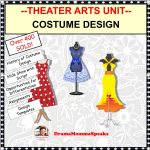
I have several costume design lesson and units available at my Teacherspayteachers store.  Maybe you’d be interested in them.

Costume Design High School Level


Costume Design Lesson with Fairy Tale Characters

Costume Design Lesson with Circus Performers

Slide3

Check out my other posts concerning critical steps in a play or musical:

Critical Steps in Choosing a Play or Musical: Stage Properties 

Critical Steps in Producing a Play or Musical: Stage Makeup

Critical Steps in Producing a Play or Musical: Set Design and Set Construction

Contact me at dhcbaldwin@gmail.com or Bumblingbea.com

I’d love to hear from you!

Deborah Baldwin


Share this:

  • Click to share on Tumblr (Opens in new window) Tumblr
  • More
  • Click to share on X (Opens in new window) X
  • Click to share on Facebook (Opens in new window) Facebook
  • Click to share on Pinterest (Opens in new window) Pinterest
  • Click to share on LinkedIn (Opens in new window) LinkedIn
  • Click to email a link to a friend (Opens in new window) Email
  • Click to share on Reddit (Opens in new window) Reddit
  • Click to share on Pocket (Opens in new window) Pocket
  • Click to share on Telegram (Opens in new window) Telegram
  • Click to share on WhatsApp (Opens in new window) WhatsApp

Like this:

Like Loading...

Filed Under: Broadway, community theatre, directing experiences, drama education, Producing plays and musicals, Production Questions, theater, theatre, youth theatre Tagged With: acting, Mulan Junior, Oklahoma!, On Golden Pond, Simplicity patterns, Simplicity.com, Spring version of The Secret Garden, theatre

Critical Steps in Selecting a Play or Musical: Casting

August 17, 2016 By dhcbaldwin 2 Comments

The Giver play

Critical Steps in Selecting a Play or Musical: Casting

Into the Woods   Performing Arts in Children’s Education  July 2004

Critical Steps in Selecting a Play or Musical: Casting

Today, I want to discuss the critical steps in selecting a play or musical: Casting. Have you ever seen someone do something  that you know is very difficult to do? Have you thought that they make it look easy? Me, too.  I’ve been watching the Olympic Games and in particular I’ve enjoyed cheering on Simone Biles as she catapults herself all over the gymnastic mat.  Incredible!

An experienced director looks much the same way.  They make it look effortless.  It is not. Casting a production can be challenging, or easy and even fun but it can also be hugely nerve wracking.

In this series on selecting a play or musical, this is the next item to consider–casting

first rehearsal
First rehearsal of Oklahoma!

Assessing Talent Requirements: Matching Roles to Performers When Casting

1. What abilities are required of performers for this production?

First, you have to look at the roles and decide who is most essential.  Does the show require tap dancers for 42 Street (not easy to come by in adult actors)  or singers who can sing in six part harmony for Sweeney Todd (not easy to come by either)? How many men? Men aren’t in great number in community theatre. Many plays and musicals require more men than women (aint’ it the way ?)

If the play calls for a thirteen year old female  for The Diary of Anne Frank, do you have one who can play the character?  If an elderly man is needed for King Lear, do you have person who can play it? How about someone who can dance the ballet in Oklahoma? Or juggle in Barnam? Or you think could learn to juggle? Really take the time and be honest with yourself about what the production requires.  My advice:  If you don’t think you have the people (or at least l/2 of them) that you need BEFORE you hold auditions then change shows.

Critical Steps in Selecting a Play or Musical: Casting

The Diary of Anne Frank  Fine Arts Guild of the Rockies  2012

2. What artistic expectations do you have of the company for which you are working?

If you are a guest director, I’d survey the theatre company you are working for and ask for their mission statement.  It may express something about including all community members participating in their productions. Looking to cast a youth theater production?  Check out: Ten Steps in a Play Rehearsal in Youth Theater

What does that look like exactly?  If they expect you to cast someone with a physical challenge, such as a blind person or one with hearing loss and you are directing The Miracle Worker for them, then you need to know that right up front.

Some companies leave everything to the director to decide.  That’s nice. However, sometimes the company will return to you later and request, “We need you to cast So-and-So because his father is a board member.” Have a personal opinion about such “favors” before you begin.  It will save you heaps of time and headaches, I guarantee you.  Make your wishes known as you pre-plan the show.

Critical Steps in Selecting a Play or Musical: Casting

The Music Man   Theatre Reading Young People and Schools  2001

3. Casting is a bugaboo

As I mentioned, casting  has the capacity to be difficult.  Experienced directors will share with you that casting can be very random. When casting productions I use my intuition to select the actors. If the essence of the character seems to be a part of the actor’s persona. When I am unfamiliar with the actor auditioning, I will attempt  during auditions to direct them in the characterization I’m seeking.

If  we (and I do mean “we”) can reach a common vision for the character, then I will be interested in casting them.  I don’t always have success with this method, but I am wiling to take a chance.

Unfortunately, there are directors that pre-cast their productions.  I really dislike that.  If Sue is cast that was not pre-cast like Mary, somehow Sue will find out that Mary  was selected ahead of time and that can make for hard feelings within the cast.  Play fairly.

Assessing Talent Requirements: Matching Roles to Performers When Casting

I think it is all right to invite people to audition for my shows, but I have a disclaimer clause that I mention to them, “I can’t promise you a role, because that wouldn’t be ethical.  But I am interested in hearing you read several parts.  If I cast you, I will treat you like every other cast member as I know you would want me to do.  That’s only fair.”  That’s sort of a salesman’s assumptive close, because it implies that the invited person would want to earn the part on their own merit, OF COURSE and not cheat to win it.

Critical Steps in Selecting a Play or Musical: Casting
The Giver 2012

4. The Talent Pool

Do consider whether you have actors who can sing the roles, dancers who can play dancing roles and actors with the hutzpah to carry off a two hour show.  If not, then I’d change shows.  Sure, there are directors who say, “Well, we will make it work.”  Really?

If the theatre company you are directing for has no problem with unqualified actors portraying roles, then give it a go.  Will you be so distracted by the duck-out-of-water person that you can not fully engage with the show?  Trust me, I’ve learned the hard way.  Once I cast a woman who was an incredible actress when she was young, but hadn’t acted in thirty years.  She was anxious about her lines, consequently taking herself out of the performing experience– inebriated.  I knew in my heart that this experience would be too much for her, but I went ahead and cast her anyway.

Consequently, I had to replace her with myself!  I should have known better.

PLAYING DOT IN CRICKET ON THE HEARTH

Some award-winning performers quotes about auditioning

  • Hugh Jackman (actor, musical theatre performer):

“Auditioning is really about being present and showing who you are—not trying to be what you think they want.”

  • Lin-Manuel Miranda (creator of Hamilton, In the Heights):

“Auditions are weird—you’re not trying to play a role; you’re trying to convince them you could play it.”

  • Philip Seymour Hoffman:

“Auditioning is a chance to act, so I never thought of it as torture. It’s a chance to play for five minutes.”

  • Alan Rickman:

“Talent is an accident of genes—and a responsibility. Auditions are where you prove you know what to do with that responsibility.”

  • Kristin Chenoweth (Broadway performer):

“Every ‘no’ in an audition is one step closer to the ‘yes’ that’s meant for you.”

A Secret of Mine

If you are there to set the benchmark for future directors and productions, then by all means only cast the very best.  I’ve directed all skill levels, some brilliant artists and some not so great.   I’ll tell you a secret:

If audience members are judging you by one actor’s performance, then they need to go home. 🙂

Herding cats is easier than directing.

Go to my next blog concerning set design and construction.

What insights to do you have about auditioning?  I’d love to learn about them?  Contact me at Dhcbaldwin@gmail.com


Share this:

  • Click to share on Tumblr (Opens in new window) Tumblr
  • More
  • Click to share on X (Opens in new window) X
  • Click to share on Facebook (Opens in new window) Facebook
  • Click to share on Pinterest (Opens in new window) Pinterest
  • Click to share on LinkedIn (Opens in new window) LinkedIn
  • Click to email a link to a friend (Opens in new window) Email
  • Click to share on Reddit (Opens in new window) Reddit
  • Click to share on Pocket (Opens in new window) Pocket
  • Click to share on Telegram (Opens in new window) Telegram
  • Click to share on WhatsApp (Opens in new window) WhatsApp

Like this:

Like Loading...

Filed Under: directing experiences, drama education, Fine Arts Guild of the Rockies, Musical Theatre, Presser Performing Arts Center, Producing plays and musicals, Production Questions, theater, theatre, youth theatre Tagged With: 42nd Street, Barnam, Brio Olympics 2016, Diary of Anne Frank, drama education, Into the Woods Jr., King Lear, Oklahoma!, Simone Biles, The Diary of Anne Frank, The Music Man Junior

Footer

Follow Us

logo3.png

FOLLOW US

Facebook X-twitter Pinterest Instagram Envelope Rss

Goodreads: read

Malibu Rising
Malibu Rising
by Taylor Jenkins Reid
People We Meet on Vacation
by Emily Henry
The Last Thing He Told Me
by Laura Dave
Faking It
Faking It
by Cora Carmack
Losing It
Losing It
by Cora Carmack

goodreads.com
Copyright © 2024 · Wellness Pro on Genesis Framework · WordPress.com.Log in
 

Loading Comments...
 

    %d