

Teach Playwriting with Norman Rockwell Paintings
When I taught playwriting, one of the biggest challenges was helping students move past the blank page. That’s why I began to teach playwriting with Norman Rockwell paintings, using images filled with character, emotion, and story to spark student ideas. Instead of asking students to invent everything from scratch, I gave them a moment already in progress—and suddenly, writing dialogue didn’t feel so overwhelming. This approach works just as well in an ELA classroom as it does in drama, making it a flexible option for interdisciplinary teaching.

Teach Playwriting with Norman Rockwell Paintings
Norman Rockwell was a famous American illustrator best known for his warm, detailed paintings that captured everyday life in the United States. His work often appeared on the covers of The Saturday Evening Post, where he told visual stories about family, community, and American values.
Rockwell’s art is known for its realism, humor, and emotion. Some of his most famous works, like Rosie the Riveter and The Problem We All Live With, also reflected important social issues of his time.
He remains one of America’s most beloved artists because his paintings feel like snapshots of real life—making viewers both smile and think.

Why This Lesson Works So Well
This approach removes the pressure of traditional playwriting by giving students:
- A clear setting
- Built-in characters
- An immediate conflict to explore
This method keeps it non-threatening for the students. You aren’t giving them a blank page of paper and saying, “Okay, let’s playwright today.” They are stepping into a story that’s already begun.
Even better, this lesson is designed to be confidence-building, making it ideal for reluctant writers and performers. Plus, the playwriting lesson using Norman Rockwell paintings supports both drama and ELA learning goals.
👉 Students aren’t asked to create from nothing—they’re asked to continue a story already in motion.

Why Postcards Make This Even Better
This is a three day lesson, although you could teach the entire lesson in one day. Fortunately, you don’t need anything fancy to make this work.
In fact, I often use postcard-sized prints of Rockwell’s paintings. You can purchase sets or simply print and cut them yourself. If you have the budget for it, I highly recommend you purchase these postcards. Norman Rockwell paintings postcards. They run around $15.00 for 24. There are various sets of these.
There’s something about handing a student a physical image that makes it easier. Not everyone can imagine a scene on their own.
It feels:
- Manageable
- Personal
- Inspiring
I’ve seen students dive right into this lesson because they were easily inspired by the art. That is what you want–instant interest and engagement.

How I Use This Lesson in My Classroom
Day 1: Image Exploration
Students study their painting and respond to questions such as:
- Who are these people?
- What is happening in this moment?
- What might have just happened before this scene?

Day 2: Character & Conflict
Students develop:
- Character backstories
- Relationships
- A clear conflict
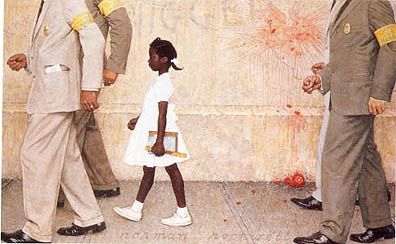
On day two, give students a different painting. Help them to write short backstories about the characters. Also, they should establish the conflict. This can be as simple as man versus man or the conflict could be about a little girl wants to go to school, but can’t without the men’s help.
Day 3: Writing the Scene
Students write a short scripted scene using dialogue. Expect about a page in length. It’s wise to give them an example, too so they know what you are expecting. Pick up this example to show them: Norman Rockwell Scene Example
This is where the magic happens—because they already understand the situation, the dialogue comes more naturally.

Day 4 (Optional): Sharing or Performance
Students can:
- Read their scenes aloud
- Perform them
- Or share in small groups

Why Students Respond So Well
I’ve always enjoyed teaching this lesson because it meets students where they are. Consequently, if students can relate to a lesson, they are more likely to be successful. In the same way, I like to direct students in plays or musicals where they get to be kids like them. Check out: Ten Reasons Why Everyone Produces Anne of Green Gables
- Visual learners have an immediate entry point
- Reluctant writers feel supported
- Creative students expand the story in unique ways
Furthermore, because every student receives a different image, the variety of scenes is always engaging. My advice is to process after each scene and discuss its assets. Plus, You could use this lesson many times during the school years by using other painters art. Some other artists you would use are Edward Hopper, Grant Wood and Jacob Lawrence.

by Edward Hopper
A Flexible Lesson You Can Use Anytime
This activity works beautifully as:
- A playwriting introduction
- A creative writing extension
- A sub plan
- Or part of a larger drama unit
As I’ve mentioned it’s simple to implement—and easy to revisit throughout the year with different images. Or you can leave for a substitute to teach! It’s remarkably useful and versatile.

Want a Ready-to-Use Version?
If you’d like a structured version of this lesson—with warm-up, guiding questions, and student handouts—you can find it in my Dramamommaspeaks resources.
In conclusion, by using artwork like Norman Rockwell’s as a starting point, students begin to see that stories are everywhere—not just on the stage, but in everyday moments. With just an image and a little imagination, even reluctant writers can find their voice and bring a scene to life.