• Skip to primary navigation
  • Skip to main content
  • Skip to footer

Join Me in my new Facebook Group! https://www.facebook.com/groups/417126059784261

Menu
  • Meet Deb – The Heart Behind DramaMommaSpeaks
    • Work with Me! 
    • Photo Gallery of DramaMommaSpeaks
    • Directorial Credits
  • I Give Book Talks! 
    • Book Talk Through Skype
    • Books
  • Freebies!
  • Bumbling Bea
  • Teaching Resume
  • Acting Resume
  • Contact Me
  • Blog
    • Drama Education
    • Arts Education
    • Youth Theatre
    • Middle Grades
    • Musical Theatre
    • Teaching
  • Meet Deb – The Heart Behind DramaMommaSpeaks
    • Work with Me! 
    • Photo Gallery of DramaMommaSpeaks
    • Directorial Credits
  • I Give Book Talks! 
    • Book Talk Through Skype
    • Books
  • Freebies!
  • Bumbling Bea
  • Teaching Resume
  • Acting Resume
  • Contact Me
  • Blog
    • Drama Education
    • Arts Education
    • Youth Theatre
    • Middle Grades
    • Musical Theatre
    • Teaching

word wall

My Theatre Vocabulary List for the Classroom

June 23, 2021 By dhcbaldwin 4 Comments

My Theatre Vocabulary List for the Classroom

My Theatre Vocabulary List for the Classroom

My theater vocabulary list for the classroom

Let’s talk about my theatre vocabulary list for the classroom.  I apologize. It never occurred to me that teachers needed a list of vocabulary for their theatre classes.

Theatre is such a major part of my life, I’d forgotten not everyone comes into teaching theatre classes as knowledgeable as I was. However, as I think about it, I remember what it’s like getting started teaching a theatre class.

It’s tough to get started.  Although there are colleagues who will advise you, sometimes you need someone sort of “at your finger tips” to help you.  That’s me!

Why teach vocabulary words?

This seems this would have an obvious answer.  But just as in every other subject students teach, theater students need to know the words and phrases you will use in your classroom.  We can’t expect out students to be good communicators if we don’t help them, yes?

There are many processes students can  use to learn these words.  If you pick up my Word Wall product, I’ve included several different ways to learn the vocabulary words.

Teach by osmosis!  What’s that, you say?  Learning by proxy, or being exposed to someone, can naturally achieve an unconscious assimilation of ideas, vocabulary, knowledge and even technical skills. It’s called osmosis.

A teacher could share a vocabulary word each day. Start the day with the word and even demonstrate it.  Honestly, you will be surprised how quickly the students will learn them using osmosis. Just by seeing, demonstrating themselves and writing them, they’ll learn many of these words as if by magic.

++++++++ I am sorry there aren’t more words and their definitions listed here. I think students were coming here and filling out their vocabulary and definition sheet list and not finding the words and their definitions on their own.

Tsk, tsk. So, I edited the list to give you a basic idea..
My theater vocabulary list for the classroom

Actor to Choreography:

Actor    A male  person who performs a role in a play, work of theatre, or movie

Actress     A female person who performers in a role in a play, work of theatre, or movie.

Apron    The section of the stage floor which projects towards or into the auditorium. In proscenium theatres, it’s the part of the stage in front of the house tabs, or in front of the proscenium arch, above the orchestra pit

My Theatre Vocabulary List for the Classroom (Example)

Cast       A set of actors in a play

Catharsis    A moment of high tragedy at the emotional climax of a play is followed by an emotional cleansing for the characters and the audience

Chanting     A word or phrase repeated for an effect

Character   A person in a novel, play, or movie

Are you considering becoming a teacher?  Check out this blog post Why is it Important to Create a Lesson Plan?

My theater vocabulary list for the classroom

If you are a student, sorry.  You are going to have to look up these words yourself to attain the rest of the defintions.

Looking for a lesson for tomorrow?  Pick up this one about Lin Manuel Miranda.

My Theatre Vocabulary List for the Classroom

My theatre vocabulary list for the classroom

I was looking around the internet and found this great blog post about the reasons it is important to know how to spell.

Everything is provided for you.  Check it out at: Word Wall


My Theatre Vocabulary List for the Classroom

The Reasons It’s Important to Learn to Spell

  • It develops reading skills: Knowing how to spell correctly helps children become better readers. If they don’t know how to spell a word, they’re more likely to guess at its meaning, rather than understand its true meaning. Additionally, being able to accurately spell words helps to build fluency and allow kids to read faster.
  • It enhances writing skills: Knowing how to spell words correctly helps children become better writers as well. When they’re able to accurately spell words, they can express their thoughts and feelings more clearly, resulting in stronger writing overall.
  • It builds confidence: Being able to accurately spell words is a great confidence booster for primary school kids. Knowing that they can spell words correctly helps them become more confident readers and writers.
  • It improves vocabulary: Learning how to spell words correctly helps children learn the meanings of unfamiliar words and increase their vocabulary. This can be very beneficial for them in the future as they continue their education.
  • It helps with concentration: Spelling correctly requires focus and concentration, both of which are important skills for primary school children to learn. By mastering spelling, kids will be able to transfer these skills to other areas of their studies as well.
  • Ultimately, spelling is an essential skill for primary school children to learn. Not only does it help them become better readers and writers, but it also boosts their confidence, expands their vocabulary, and helps them develop concentration skills. Therefore, it’s important that primary school kids take the time to practice their spelling regularly.

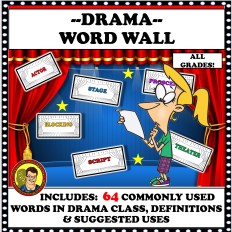
Instead of copying all of these words and making printables for your students, there are 64 in this product! Check out this WORD WALL:

My Theatre Vocabulary List for the Classroom

First African American to Win National Spelling Bee

Have you heard of Zaila Avant-garde?  The multitalented teenage phenomenon Zaila Avant-garde, became an overnight sensation with her Scripps National Spelling Bee win at the age of fourteen, when she became the first African American contestant to win. Zaila Avant-garde, now sixteen, will add “author” to her already-impressive list of accolades that includes: 2021 Scripps National Spelling Bee champion, 2021 Sports Kid of the Year by Sports Illustrated Kids; and two-time Guinness World Record holder for feats related to her basketball prowess.

Her books, IT’S NOT BRAGGING IF IT’S TRUE: HOW TO BE AWESOME AT LIFE, a non-fiction middle-grade and a picture book, WORDS OF WONDER FROM Z TO A, a children’s picture book, will be published on June 27, 2023, by Doubleday Books for Young Readers and edited by VP, Editor-in-Chief Frances Gilbert.

Pick up my Drama Word Wall.  Everything is provided for you.  Check it out at: Word Wall or you can pick up posters (some are FREE) for your classroom, too!  Growth Mindset Posters and Vocabulary

I hope this helps you.  Please feel free to contact me at DhcBaldwin@gmail.com or DeborahBaldwin.net

Want some more help in the classroom? Check out my FREE Guide and ten page lesson Here 

woman behind DramaMommaSpeaks

Share this:

  • Click to share on Tumblr (Opens in new window) Tumblr
  • More
  • Click to share on X (Opens in new window) X
  • Click to share on Facebook (Opens in new window) Facebook
  • Click to share on Pinterest (Opens in new window) Pinterest
  • Click to share on LinkedIn (Opens in new window) LinkedIn
  • Click to email a link to a friend (Opens in new window) Email
  • Click to share on Reddit (Opens in new window) Reddit
  • Click to share on Pocket (Opens in new window) Pocket
  • Click to share on Telegram (Opens in new window) Telegram
  • Click to share on WhatsApp (Opens in new window) WhatsApp

Like this:

Like Loading...

Filed Under: Arts, arts education, arts integration, creative dramatics, creative movement, drama education, Education, elementary, excellence in teaching, High School, middle grades, Musical Theatre, performing arts, Play, Professional Theatre, Radio Theatre, Teacherspayteachers, Teaching, youth theatre Tagged With: drama terminology, drama terms, drama vocabulary, spelling words, theatre terminology, theatre terms, word wall

The Importance of a Drama Word Wall for Secondary Students

August 6, 2019 By dhcbaldwin 2 Comments

drama bulletin board with drama vocabulary words posted on it

The Importance of a Drama Word Wall for Secondary Students

Let’s chat about the importance of a drams word wall for secondary students. When I was a child, I remember spelling word tests. Education has changed a lot since then, thank goodness.

The Importance of a Drama Word Wall for Secondary Students

I’m a good speller and I give all the credit to Miss DeLong.  She was my scary first grade teacher who nearly beat phonics into our brains.  I still remember what she looked like.  That’s how much of an impression she made on me!

One of her most useful tactics for learning was fear.

The Dog House–An Old School Teaching Method

Miss DeLong was an old school teacher.  When we were learning how to spell our name and address, your name would placed in the “dog house” until you could spell it correctly.  The dog house was a chalked picture of a dog house in the upper right corner of her blackboard.  It confused me–the outside of the dog house had grass and flowers drawn around it.  I suppose she wanted it to look non-threatening…

I hated it.

Theatre Vocabulary Words and a red curtain with a student looking at a paper. s

It worked, though.  I learned to spell my name and address very quickly.

Maybe you are wanting a word search puzzle.  Here is a bundle of them:  Word Search Puzzles Bundle

Now teachers use word walls instead.  Oh, thank goodness.

It makes much more sense to me, you know?

A word wall is a terrific teaching method.   High frequency words of your particular subject printed in large visible letters are posted on a wall, bulletin board or other display surface in a classroom.  A student sees the words all the time and consequently the words become a part of the student vocabulary in a more natural and stress free manner.

Looking for posters, too? Here are some.

posters of growth mindset theater artists quotes
bulletin board and pendants of theater artist quotes

This is how to use word walls

Researching this post, I check out the readingrockets.com blog.  Here are their suggestions:

  • Make words accessible by putting them where every student can see them. They should be written in large black letters using a variety of background colors to distinguish easily confused words.
  • Teachers and students should work together to determine which words should go on the word wall. Try to include words that children use most commonly in their writing. Words should be added gradually — a general guideline is five words per week.
  • Use the word wall daily to practice words, incorporating a variety of activities such as chanting, snapping, cheering, clapping, tracing, word guessing games as well as writing them.
  • Provide enough practice so that words are read and spelled automatically and make sure that words from the wall are always spelled correctly in the children’s daily writing.
  • New information should be added on a regular basis.
  • Use content-area material from the curriculum rather than randomly selected words.
  • Word walls should be referred to often so students come to understand and see their relevance.

What’s a Word Wall?

Several years ago, I taught drama until my retirement.  I never had a word wall.  Wow, it really would’ve  helped!

The Importance of a Drama Word Wall for Secondary Students

How to Use a Drama Word Wall Effectively

You may wonder how to use Word Walls.  Our secondary level students need word walls just as much as the primary level.

You can post the words just about anywhere.  Some teachers add words to their wall generated by other words the students require.  That makes loads of sense.  Some teachers have particular words they expect their students to learn to spell–the words of the subject.

My suggestion is to begin with a few words which spring from whatever unit or lesson you are studying.  Post the words, give the definitions and apply them.  Switch out the words as the year progresses or merely add to the ones you have all ready displayed.

A drama class words include the components of theater–storytelling, tableau, set design, movement, chanting and so forth. In addition, we have words and phrases which describe the stage–up center, down center, balancing the stage, entrance, exit, proscenium and thrust stage to name a few.

This product was created this product thinking of every grade level, because a teacher knows best what their students need. My product is a content area word wall.

WORD WALL FRONT COVER

You can find it here:  Middle Grades and High School Drama Terms: Word Wall

Digital Task Cards Drama Vocabulary

Product Description of Resource

Need something for that pesky bulletin board? This is a set of 198 vocabulary word posters that highlight many of the content area words of a drama or creative dramatics class. In addition, the set includes suggested uses and word games. This word wall can be displayed all year long or the words can be displayed as they are being used throughout the year.

Although these were created for secondary classes, an elementary class could use these as well. Most importantly, the teacher is the expert as to which words their students should study.

Check out these posters.

poster with John Lithgow quote
the importance of a drama word wall

Helping All Learners—At Every Grade Level

The teacher has two color combinations to choose from: black and white only or multi-colored.

If you are thinking your middle grade students might think the drama word wall is babyish, I bet you are incorrect.  Additionally, just because a student is out of elementary school doesn’t mean their learning challenges have vanished.

To be honest, I’m pretty weak math student.  It wasn’t until I was in my junior year of high school that my father hired a math tutor to help me.  I really could have used that tutor way back in sixth grade.

I’m here to help.

What experiences do you have with spelling?  When our daughter were young, they practiced spelling words at the breakfast table on Friday mornings prior to the week’s test.

To this day, one daughter is a good speller (like me) and the other has a few challenges (like her father).  Is it genetic? I wonder if anyone has studied that question?

Here’s a new product you might want for your bulletin boards.  Growth Mindset Theater Artist Quotes

The Importance of a Drama Word Wall for Secondary Students

If you are interested in other teaching tools, check out:  Your Secret Teaching Allies–Super Heroes

Striking a Balance with Students in Their Middle School Years

How do you display theatre vocabulary in your classroom? Do you use a word wall?  I’d love to know.  Contact me at DhcBaldwin@gmail.com or DeborahBaldwin.net


MTI Senior Musicals: A Baby Boomer's Dream Come True


Share this:

  • Click to share on Tumblr (Opens in new window) Tumblr
  • More
  • Click to share on X (Opens in new window) X
  • Click to share on Facebook (Opens in new window) Facebook
  • Click to share on Pinterest (Opens in new window) Pinterest
  • Click to share on LinkedIn (Opens in new window) LinkedIn
  • Click to email a link to a friend (Opens in new window) Email
  • Click to share on Reddit (Opens in new window) Reddit
  • Click to share on Pocket (Opens in new window) Pocket
  • Click to share on Telegram (Opens in new window) Telegram
  • Click to share on WhatsApp (Opens in new window) WhatsApp

Like this:

Like Loading...

Filed Under: arts education, drama education, elementary, excellence in teaching, High School, middle grades, Readingrocket.org, Teacherspayteachers, teaching strategies, theater, youth theatre Tagged With: DISTANCE LEARNING, drama spelling words, drama vocabulary, reading skills, sight words, spelling words, word wall

Footer

Follow Us

logo3.png

FOLLOW US

Facebook X-twitter Pinterest Instagram Envelope Rss

Goodreads: read

Malibu Rising
Malibu Rising
by Taylor Jenkins Reid
People We Meet on Vacation
by Emily Henry
The Last Thing He Told Me
by Laura Dave
Faking It
Faking It
by Cora Carmack
Losing It
Losing It
by Cora Carmack

goodreads.com
Copyright © 2024 · Wellness Pro on Genesis Framework · WordPress.com.Log in
 

Loading Comments...
 

    %d