• Skip to primary navigation
  • Skip to main content
  • Skip to footer

Join Me in my new Facebook Group! https://www.facebook.com/groups/417126059784261

Menu
  • Meet Deb – The Heart Behind DramaMommaSpeaks
    • Work with Me! 
    • Photo Gallery of DramaMommaSpeaks
    • Directorial Credits
  • I Give Book Talks! 
    • Book Talk Through Skype
    • Books
  • Freebies!
  • Bumbling Bea
  • Teaching Resume
  • Acting Resume
  • Contact Me
  • Blog
    • Drama Education
    • Arts Education
    • Youth Theatre
    • Middle Grades
    • Musical Theatre
    • Teaching
  • Meet Deb – The Heart Behind DramaMommaSpeaks
    • Work with Me! 
    • Photo Gallery of DramaMommaSpeaks
    • Directorial Credits
  • I Give Book Talks! 
    • Book Talk Through Skype
    • Books
  • Freebies!
  • Bumbling Bea
  • Teaching Resume
  • Acting Resume
  • Contact Me
  • Blog
    • Drama Education
    • Arts Education
    • Youth Theatre
    • Middle Grades
    • Musical Theatre
    • Teaching

creative movement

8 Must-Haves for Your Middle School Theater Scope & Sequence

September 21, 2022 By dhcbaldwin Leave a Comment

A group of middle school kids looking down at the camera.

8 Must-Haves for Your Middle School Theater Scope & Sequence

Today I’m going to talk about the eight things you should include in your Middle School Theater Scope and Sequence. Obviously, this is my point of view on the subject. If you are new to my blog, welcome! I’m quite flattered that you’d check me out.

8 Must-Haves for Your Middle School Theater Scope & Sequence

My First Teaching Experience with Middle School 

My first job was as an English teacher in a junior high school.  Bear in mind that I was certified in English, but had never taught it or even had any time as a student teacher. My student teaching was in theater which in the 1970s was almost unhear of in the mid-west.

Anyway,  I remember they gave me this HUGE book with all of the benchmarks or objectives I was to reach.  It was so full of jargon, I had to sit and translate it into layman’s English.  Finally, I got the hang of it.

When I began teaching middle school theater in the mid 90s (yikes), no one seemed to clear on what they wanted me to cover.  I came into the position with twenty years of teaching and directing outside the classroom, so I knew what to do in those circumstances.

However, teaching theater in a school was different than that. In the particular school I taught theater all those many years ago, I spent about a year trying out ideas until I perfected what I thought would be successful with the students. Looking for a free biography and one pager assignment about Lin Manuel Miranda?


8 Must-Haves for Your Middle School Theater Scope & Sequence

A Thirteen Year Middle School Teaching Adventure

For thirteen years,  I taught a pre-elective theater class to sixth grade students–all 450 of them.  (Yes you read that correctly.) I had twenty-five days to fill with the many subjects of theater which was great fun but also rather challenging.  My tendency was to perfect something when we found it to work, but the students and I just didn’t have the time to do so since they moved to the next pre-elective class.

After thirteen years of this teaching load, I had completely topped out on what I could teach them.  At this point, we moved to Colorado and I took a part time speech and theater middle school job–completely different and chaotic. But that’s a blog post for another day.

In 2017, I began my store on Teacherspayteachers.com.  My plan was to recoup the pension I lost by staying home with our daughters when they were very young.  I lost half of my pension when I made that decision, but to this day I have no regrets.  I know our daughters almost as well as they do themselves.

8 Must-Haves for Your Middle School Theater Scope & Sequence

My Middle School Scope and Sequence Curriculum

People purchase my middle school drama curriculum a lot.  I’m very glad I can help them, but it never dawned on me that maybe I should include a scope and sequence with the units. Here I am today providing that guidance for you.

I taught these lessons in this particular order beginning with the easiest concepts and progressing to the most challenging. This was a pass/fail course.  I gave a daily participation grade as well.

1. Tableau (1 day)–Tableau is a staple of theater and a non-threatening concept which beginning theater students can learn. Students learn how to make stage pictures (which is one of the basic of directing as well), however they don’t have to say anything. You can find my tableau lessons here: Tableau Lesson

2. Chanting (1 day)–Chanting, or a repeated word or phrase used to illicit an effect is the second component I teach novices.

Engaging Activities to Inspire Creativity and Collaboration

3. Costume Design (2 days)–Who doesn’t like costume design?  Depending upon the time of year, I like to teach about costume design with a thematic approach.  You’ll have to check out my Halloween Costume Design Lesson here.

4. Movement (2 days)–Just like tableau, students enjoy movement because there is no speaking.  Plus, it does a great job of giving students some physical exercise which they sorely need. You can find my lesson for movement here:  Movement

5.Kamishibai Storytelling (1 week)–Depending upon your assessments of you students and what they appear to engage with in your teaching, I like to use Kamishibai storytelling from time to time.  Have you never heard of Kamishibai?  Check it out here: Kamishibai Storytelling

8 Must-Haves for Your Middle School Theater Scope & Sequence
https://theconversation.com

6. Set Design (1 week)–Set Design units are super useful.  They incorporate not only designing the set, but building a model of it.  In addition, students work with a partner which is so good for teaching cooperative learning.

7. Performance (1 week) You can choose to direct your students in a short class play or a short radio theater play-I liked to switch it up every now and then with one or the other.  Word of caution–don’t have one class performing a play while the others are studying radio theater.  You will make yourself crazy.

8. Enrichment (1 day) If you need a substitute, or your school is having a day of shortened class periods, watching a video clip of theaters around the world or studying about a famous theater artist such as Lin Manuel Miranda does an excellent job of changing the pace or giving everyone a breather.

If you want a bundle of technical theater units for middle school, click here.

Or you want a REALLY BIG BUNDLE  of middle school drama units, click here.

Sometimes I’d throw in components such as stage properties or sound effects because quite frankly, I needed the change.

8 Must-Haves for Your Middle School Theater Scope & Sequence

Objectives I Met with This Scope and Sequence Theater Curriculum

Here are the National Core Arts Standards which I used.

Connecting

Conceiving and developing new artistic ideas and work.

  • Anchor Standard #1. Generate and conceptualize artistic ideas and work.
    Anchor Standard #2. Organize and develop artistic ideas and work.
    Anchor Standard #3. Refine and complete artistic work.

Performing

Performing (dance, music, theatre): Realizing artistic ideas and work through interpretation and presentation.

  • Anchor Standard #4. Select, analyze and interpret artistic work for presentation.
    Anchor Standard #5. Develop and refine artistic techniques and work for presentation.
    Anchor Standard #6. Convey meaning through the presentation of artistic work.

Responding

Understanding and evaluating how the arts convey meaning.

  • Anchor Standard #7. Perceive and analyze artistic work.
    Anchor Standard #8. Interpret intent and meaning in artistic work.
    Anchor Standard #9. Apply criteria to evaluate artistic work.

Objectives I Met with This Scope and Sequence Continued

8 Must-Haves for Your Middle School Theater Scope & Sequence

If you need Common Core Standards, here are a few of them which my guide completes.:

Grade 6

Key Ideas and Details:

CCSS.ELA-LITERACY.RL.6.1

CCSS.ELA-LITERACY.RL.6.2

CCSS.ELA-LITERACY.RL.6.3

Craft and Structure:

CCSS.ELA-LITERACY.RL.6.4

CCSS.ELA-LITERACY.RL.6.5

CCSS.ELA-LITERACY.RL.6.6

Integration of Knowledge and Ideas:

CCSS.ELA-LITERACY.RL.6.7
CCSS.ELA-LITERACY.RL.6.8
CCSS.ELA-LITERACY.RL.6.9

Range of Reading and Level of Text Complexity:

CCSS.ELA-LITERACY.RL.6.10

Are you looking for some information about how to design a lesson plan?  Check out this post: Why is it Important to Create a Lesson Plan?

Grade 7

Key Ideas and Details:

CCSS.ELA-LITERACY.RL.7.1.

CCSS.ELA-LITERACY.RL.7.2
CCSS.ELA-LITERACY.RL.7.3

Craft and Structure:

CCSS.ELA-LITERACY.RL.7.4.

CCSS.ELA-LITERACY.RL.7.5
CCSS.ELA-LITERACY.RL.7.6
CCSS.ELA-LITERACY.RL.7.7
CCSS.ELA-LITERACY.RL.7.8
CCSS.ELA-LITERACY.RL.7.9:

CCSS.ELA-LITERACY.RL.7.10

Did you know I have an Instagram account with virtually different information than my blog?  You can find it at: DramamommaSpeaks Instagram

Multicultural Folk Tales

A Word of Caution

In an effort to do a exemplary job at teaching, sometimes we teachers go overboard on what our students should learn. I’m not a big fan of scene study when students are in middle school or lower. Or even monologues. They simply do not understand it nor appreciate it. Unfamiliar with creative dramatics? Check out: Learn How to Teach Creative Dramatics in Your Lunch Hour

What I do encourage theater teachers of elementary and middle school to teach is using creative dramatics’ many facets. One could teach the components above, number one to five, and then apply them to a readers theater or short class play.  Here is one of my which would work well for this plan:  Inca Story The Magic Lake Readers Theater or The Brave Little Tailor play. 

I hope my guide helps you in your teaching of middle school theater class.  What do you like to include in your teaching? I’ve love to hear about it.  You can email me at DhcBaldwin@gmail.com.  Let’s chat!

Woman behind DramaMommaSpeaks

Share this:

  • Share on Tumblr (Opens in new window) Tumblr
  • More
  • Share on X (Opens in new window) X
  • Share on Facebook (Opens in new window) Facebook
  • Share on Pinterest (Opens in new window) Pinterest
  • Share on LinkedIn (Opens in new window) LinkedIn
  • Email a link to a friend (Opens in new window) Email
  • Share on Reddit (Opens in new window) Reddit
  • Share on Telegram (Opens in new window) Telegram
  • Share on WhatsApp (Opens in new window) WhatsApp

Like this:

Like Loading...

Filed Under: Arts, arts education, arts integration, creative dramatics, creative movement, drama education, drama integration, excellence in teaching, middle grades, reading skills, storytelling, Teacherspayteachers, theater, theatre Tagged With: common core standards, lesson plans, middle school drama, middle school theater, national core arts standards, scope and sequence, upper elementary theater

Learn How to Teach Creative Dramatics in Your Lunch Hour

March 30, 2022 By dhcbaldwin Leave a Comment

A male teacher having lunch and looking at another person in the foreground.

Learn How to Teach Creative Dramatics in Your Lunch Hour!

Learn How to Teach Creative Dramatics in Your Lunch Hour!

I’m worried about our teachers, and you should be too. In my blog post, “Learn How to Teach Creative Dramatics in Your Lunch Hour,” I talk about how small, manageable strategies can help educators bring creativity into their classrooms without adding to their already overwhelming workload. Recently, I read an article from www.nea.org stating that approximately fifty-five percent of our teachers are seriously considering quitting teaching at the end of this year. That’s up from thirty-seven percent last year. Yikes

You can imagine the reasons they are considering leaving–exhaustion, demoralized, uninspired, understaff and underappreciated. Not to mention, the global pandemic! (That doesn’t even include underpaid which has been an ongoing problem for year and really a sad statement about the country, in my opinion.)

I can’t fix the schools, but I can help teachers.

Learn How to Teach Creative Dramatics in Your Lunch Hour!

Learn How to Teach Creative Dramatics in Your Lunch Hour!

A Conversation in the Teacher’s Lounge

Let’s say you and I are eating lunch together in the teacher’s lounge.

I say to you, “How’s the day going?”

“Terrible!” you say.

“What seems to be the problem” I ask.

“The students are not engaged.  They are rowdy, disrespectful and negative.”

At this point, that I nod and say, “I can help you.”

You look at me with an expression of disbelief. “How, Deb?  You can’t be in there with me.”

I answer, “No, but I can give you some drama integration ideas which will help.  In fact, my masters in education is focused on creative arts learning.”

Turning, I dive into my files and pull out several lessons which I tailored specifically for the classroom.

You take one look at them and say, “But I’m not a creative dramatics teacher. I can’t do this.”

“Oh yes, you can.  Using creative dramatics to teach your class is nothing more than making a few changes in your perspective and teaching methods. Let me show you how.”

We talk for a few minutes, you smile and say “Okay, I’ll try it!”

As we leave the lounge, we hug. I watch you walk down the hallway with a little spring in your step because you know how to turn your unhappy class into a happy one in an afternoon.

Note:  This is an actual conversation I had with a teacher on IG in the last week. Her students were being impossible.  I suggested she try doing a lot of physical movement with them and it worked!

The Benefits of Creative Dramatics in the Classroom

Learn How to Teach Creative Dramatics in Your Lunch Hour!

I found this wonderful website, The Gaiety School of Acting, which explains the benefits of creative dramatics:

“Of all the arts, drama involves the participant the most fully: intellectually, emotionally, physically, verbally, and socially. As players, children assume the roles of others, and they learn about becoming more sensitive to the problems and values of persons different from themselves. At the same time, they are learning to work cooperatively, for drama is a communal art; each person is necessary to the whole.”

When integrating creative dramatics, we are not concerned with what an audience receives from a performance but what the child does. In fact, it would be best if you and your students are the only people in your classroom when you integrate drama.

This is Easier than You Think

These five lessons will engage them right from the beginning.  It’s all in the approach you take to presenting them. (I can help you here.  I include a teacher’s script with most of my lessons.)

  1.  Warm-ups–warm-up exercises can be adapted to the subject you are teaching or you can use them as they are.
  2.   Creative Movement–students need a lot of physical exercise.
  3.   Storytelling–if you are teaching a particular book, use Kamishibai storytelling as a way to check your students’ understanding of  the plot
  4.  Tableau–a frozen stage picture is a fantastic way to demonstrate a math problem, moment in history, show something in science such as a volcano and its stage before errupting, etc.
  5.  Readers’ Theater–this is a powerful teaching method which can be adapted for a particular lesson about social studies, science or a story in reading.

Learn How to Teach Creative Dramatics in Your Lunch Hour!

Want a FREE lesson you can use tomorrow?  Click here: Creative Dramatics Lesson

Pick up a copy of this blog post at: FarrahHenleyEducation.

Do I need a lot of extra materials?

Learn How to Teach Creative Dramatics in Your Lunch Hour!

Most teachers probably have the materials they’d need to integrate drama in your classroom.  But beware! Try to avoid being a purist about this–a scarf can work as a belt, a box can be a trunk or three students’ desk chairs can make a bridge.  It’s all in how you look at it.

I suggest:  construction paper, paper plates, glue, scissors, colored pencils, markers, aluminum foil, newspapers, masks (you can purchase them at S and S Art Supply )

Collect clothing such as hats, caps, scarves, capes, eye glasses, pillow cases, masks, etc.  A large plastic bin can hold all of these pieces. A trip to a local thrift store will have a lot of these items for an inexpensive price.

How do I Assess my Students’ Learning?

Learn How to Teach Creative Dramatics in Your Lunch Hour!

Talk about outcome education!  Using creative dramatics in your teaching gives you an opportunity to model for your students and them to demonstrate right back to you.

Here’s an example for you– your objective today is to teach Common Core Standard L4.1e “Form the use of prepositional phrases”.

Easy!  Make up a bunch of cards with prepositional phrases on them with phrases such as “on the, over the, around the”.  Hand out a card to each student to physically demonstrate the phrase.

Learn How to Teach Creative Dramatics in Your Lunch Hour

Maybe you are teaching Next Generation Science stanDard concerning gravitational force.  Would it be so difficult as to have two students tell a story about  gravitational force and how it affects us on earth? Maybe you’d give them particular facts to use in the story? This blog post might help too! How Do I Use Arts Integration in the Classroom?

As you can see, using drama integration in your class is a no brainer.  Word to the wise–refrain from using it every day as it will lose its uniqueness.  I know it takes many teaching methods to engage your students.  This is just one method.

But it’s a good one. 😉

Want a free drama integration lesson?  Check out:  Hire Me for Your Classroom Tomorrow! 

Have you used drama integration in the past?  How did it go for you?  Do you have any questions I can answer? Contact me at DhcBaldwin@gmail.com or check out my website at DeborahBaldwin.net

woman behind DramaMommaSpeaks


Share this:

  • Share on Tumblr (Opens in new window) Tumblr
  • More
  • Share on X (Opens in new window) X
  • Share on Facebook (Opens in new window) Facebook
  • Share on Pinterest (Opens in new window) Pinterest
  • Share on LinkedIn (Opens in new window) LinkedIn
  • Email a link to a friend (Opens in new window) Email
  • Share on Reddit (Opens in new window) Reddit
  • Share on Telegram (Opens in new window) Telegram
  • Share on WhatsApp (Opens in new window) WhatsApp

Like this:

Like Loading...

Filed Under: acting, Arts, arts education, arts integration, community theater, community theatre, creative dramatics, creative movement, drama education, Education, elementary, excellence in teaching, middle grades, Teacherspayteachers, Teaching, teaching strategies, youth theatre Tagged With: drama education, drama lessons, drama units, elementary, middle grades, successful teaching methods

Teacher Burned Out: How to Fix and Avoid An Expert Guide

January 12, 2022 By dhcbaldwin Leave a Comment

Teacher Burned Out: How to Fix and Avoid An Expert Guide

Teacher Burned Out: How to Fix and Avoid (An Expert Guide)

They say you should write about what you know.  Hmmmm. What do I know? I know this subject well–Teacher Burned Out: How to Fix and Avoid

I bet you do, too.

Here’s a quote that sums it up perfectly, “Burnout is nature’s way of telling you, you’ve been going through the motions your soul has departed; you’re a zombie, a member of the walking dead, a sleepwalker. False optimism is like administrating stimulants to an exhausted nervous system.” Anais Nin

I’ve lived this quote.

Teacher Burned Out: How to Fix and Avoid (An Expert Guide)

Teacher Burned Out: How to Fix and Avoid (An Expert Guide)

Before we begin, let me tell you a little story.

About eight years ago, I taught in a wonderful home school enrichment program (with around 800 students,grades k to 12) which was part of the St. Vrain School system in Longmont, CO. In my first year, I directed three musicals (I used the MTI juniors) and taught six classes (at three different locations.)

As is typical of me, I am sort of a create-a-monster kind of person; I have a tendency to keep improving something until I’m satisfied with it.

In my sixth year of teaching for Apex, I was directing FOUR different musicals (all MTI juniors) as well as FOUR children’s musicals (MTI kids) as well as teaching twenty-four classes. Yes, you read that correctly.  Each location offered a bit of a different curriculum so of course that meant different preps. for me. (One school wanted a film class.  Another an intro. to Shakespeare, etc.)

My health began to deteriorate.  I was frustrated, sarcastic, short fused, tired all the time and very stressed.

Teacher Burned Out: How to Fix and Avoid (An Expert Guide)

Teacher Burned Out: How to Fix and Avoid (An Expert Guide)

Consequently, in my seventh year I dropped two schools and just taught Thursday and Friday. But my inspiration was  waning. At this point, I’d directed around 350 plays and musicals over the thirty-eight years I’d taught (both schools and an excellent community theater).

Finally, I taught one more year and retired at age sixty. I was totally ready.

You see, I care more about what the students gain from my teaching than my own sanity and obvious health. I was willing to exhaust myself if more students came away with feeling being a part of a group, increased self-esteem and confidence.  That’s really all I cared about.

No one told me to take care of myself.  If they did, I was too stubborn and proud to do so very much.

I nearly ruined my health learning the lesson to do so, however.

Teacher Burned Out: How to Fix and Avoid (An Expert Guide)

Three Major Teacher Burnout Symptoms

According to the website prodigygame.com, there are three major teacher burnout symptoms:

  • Cynicism — a sense of detachment from work or life, loss of enjoyments, pessimism and isolation.
  • Feelings of ineffectiveness — Apathy, hopelessness, increased irritability, lack of productivity and poor performance.
  • Physical and emotional exhaustion — Always tired, unable to sleep, forgetfulness or trouble concentrating, anxiety, depression and anger.

Here’s another thing no one thinks about–there are after school activities like plays or musical rehearsals, marching band, ball practices, , study help, cheerleading, the chess club.  All of these extracurriculars are fun to do, but they do take a toll on a teacher’s energy.

Don’t get me started talking about the hours a theatre teacher puts into directing a play or worse yet, a musical! It’s staggering.  As the teacher/director, you not only direct the show but you also design the costumes, set, lights, sound, create stage props,  handle the tickets, advertising and let’s not forget your teaching load! If you’d like some advice concerning directing youth theater check out this post Ten Important Elements to Consider When Directing a Youth Theater Production

Teacher Burned Out: How to Fix and Avoid (An Expert Guide)


What’s the Answer to Burnout?

I wish I could say there is one way to handle the burn out.  But there just isn’t.  Here are a few things I learned over time:

  1.  I didn’t grade every paper which sat on m desk.  Some can be given a participation grade (I used a check, check plut and check minus) especially when the students are just learning a concept.
  2.  Planning my calendar to give myself breaks within the week was essential.  For instance, if my Creative Dramatics class had a performance for their parents, I made sure my Intro. to Theater class worked by themselves and I was merely over seeing.
  3. If one class was doing something physical, I planned so the next class was doing something more sedentary.
  4.  I found my students learned the best Tuesday, Wednesday and Thursday.  Because of this, I kept Monday and Friday’s lessons lighter.  I wouldn’t introduce a new unit until Tuesday (hoping to catch everyone and those who took a long weekend and missed Friday and Monday).
  5. Fridays were fun days for all of us.  I made sure that my Fridays were my best lessons to teach or those most engaging. Sometimes the students would view part of a video on a Friday.  That kept my teacher-to-student contact low and my maintained my energy.
  6. If I could work it out, I’d go out for lunch at least once a week.  Or, I’d bring in something special from the grocery store–like a deli sandwich or fancy salad.  It lifted the monotony.

Teacher Burned Out: How to Fix and Avoid (An Expert Guide)

More Answers to Burn out

  1. I’d plan for the next Monday on Friday and get everything copied and ready to go on Friday.  That way, when I came to school on Monday I wasn’t frazzled.  I even wrote the Monday date on the board and the objectives on Friday.😊
  2. Organizing everything for the next week by the Friday of the following week helped me a lot.
  3. I did not take home papers to grade every night.  Do NOT do it!
  4. This may sound odd, but I’d get my feet elevated for a portion of the day and sit down for heaven’s sake!
  5.  I made a little nest for myself in my classroom (my office was attached to the classroom) and I’d keep fun stuff such as an inspirational quote, a colorful coffee cup, etc.  It was my little space just for me.
  6.  Although I make friends easily, I’m choosey.  My friends and I would plan some social time outside of school or maybe a private party.  They needed it too!
  7. When I was bored with my lessons, chances are my students felt it.  So, I’d teach something new I’d learned about.
  8.  Walking for exercise and to de-stress was another thing I still do.  It helps wonders.
  9. I used every one of my personal days.  Use your personal days.  Did I say to use your personal days?????

I hope these suggestion help you.  Just know that you are not alone.  Before you know it, you’ll have spring break and feel better. Pick up my FREE Director’s Helper Checklist–It will help you too.

How do you deal with exhaustion from your job?  I’d love to hear from you.  Contact me at DhcBaldwin@gmail.com or check out my website at DeborahBaldwin.net

woman behind DramaMommaSpeaks


Share this:

  • Share on Tumblr (Opens in new window) Tumblr
  • More
  • Share on X (Opens in new window) X
  • Share on Facebook (Opens in new window) Facebook
  • Share on Pinterest (Opens in new window) Pinterest
  • Share on LinkedIn (Opens in new window) LinkedIn
  • Email a link to a friend (Opens in new window) Email
  • Share on Reddit (Opens in new window) Reddit
  • Share on Telegram (Opens in new window) Telegram
  • Share on WhatsApp (Opens in new window) WhatsApp

Like this:

Like Loading...

Filed Under: acting, arts education, community theater, community theatre, creative dramatics, creative movement, drama education, Education, elementary, High School, middle grades, Musical Theatre, performing arts, Teaching, theater, theatre, youth theatre Tagged With: teacher burned out, teacher exhaustion, teacher morale, teacher self care, teaching exhaustion, teaching experience

My Theatre Vocabulary List for the Classroom

June 23, 2021 By dhcbaldwin 4 Comments

My Theatre Vocabulary List for the Classroom

My Theatre Vocabulary List for the Classroom

My theater vocabulary list for the classroom

Let’s talk about my theatre vocabulary list for the classroom.  I apologize. It never occurred to me that teachers needed a list of vocabulary for their theatre classes.

Theatre is such a major part of my life, I’d forgotten not everyone comes into teaching theatre classes as knowledgeable as I was. However, as I think about it, I remember what it’s like getting started teaching a theatre class.

It’s tough to get started.  Although there are colleagues who will advise you, sometimes you need someone sort of “at your finger tips” to help you.  That’s me!

Why teach vocabulary words?

This seems this would have an obvious answer.  But just as in every other subject students teach, theater students need to know the words and phrases you will use in your classroom.  We can’t expect out students to be good communicators if we don’t help them, yes?

There are many processes students can  use to learn these words.  If you pick up my Word Wall product, I’ve included several different ways to learn the vocabulary words.

Teach by osmosis!  What’s that, you say?  Learning by proxy, or being exposed to someone, can naturally achieve an unconscious assimilation of ideas, vocabulary, knowledge and even technical skills. It’s called osmosis.

A teacher could share a vocabulary word each day. Start the day with the word and even demonstrate it.  Honestly, you will be surprised how quickly the students will learn them using osmosis. Just by seeing, demonstrating themselves and writing them, they’ll learn many of these words as if by magic.

++++++++ I am sorry there aren’t more words and their definitions listed here. I think students were coming here and filling out their vocabulary and definition sheet list and not finding the words and their definitions on their own.

Tsk, tsk. So, I edited the list to give you a basic idea..

My theater vocabulary list for the classroom

Actor to Choreography:

Actor    A male  person who performs a role in a play, work of theatre, or movie

Actress     A female person who performers in a role in a play, work of theatre, or movie.

Apron    The section of the stage floor which projects towards or into the auditorium. In proscenium theatres, it’s the part of the stage in front of the house tabs, or in front of the proscenium arch, above the orchestra pit

My Theatre Vocabulary List for the Classroom (Example)

Cast       A set of actors in a play

Catharsis    A moment of high tragedy at the emotional climax of a play is followed by an emotional cleansing for the characters and the audience

Chanting     A word or phrase repeated for an effect

Character   A person in a novel, play, or movie

Are you considering becoming a teacher?  Check out this blog post Why is it Important to Create a Lesson Plan?

My theater vocabulary list for the classroom

If you are a student, sorry.  You are going to have to look up these words yourself to attain the rest of the defintions.

Looking for a lesson for tomorrow?  Pick up this one about Lin Manuel Miranda.

My Theatre Vocabulary List for the Classroom

My theatre vocabulary list for the classroom

I was looking around the internet and found this great blog post about the reasons it is important to know how to spell.

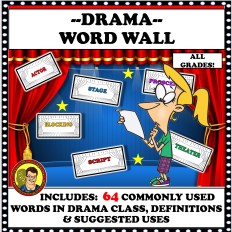
Everything is provided for you.  Check it out at: Word Wall


My Theatre Vocabulary List for the Classroom

The Reasons It’s Important to Learn to Spell

  • It develops reading skills: Knowing how to spell correctly helps children become better readers. If they don’t know how to spell a word, they’re more likely to guess at its meaning, rather than understand its true meaning. Additionally, being able to accurately spell words helps to build fluency and allow kids to read faster.
  • It enhances writing skills: Knowing how to spell words correctly helps children become better writers as well. When they’re able to accurately spell words, they can express their thoughts and feelings more clearly, resulting in stronger writing overall.
  • It builds confidence: Being able to accurately spell words is a great confidence booster for primary school kids. Knowing that they can spell words correctly helps them become more confident readers and writers.
  • It improves vocabulary: Learning how to spell words correctly helps children learn the meanings of unfamiliar words and increase their vocabulary. This can be very beneficial for them in the future as they continue their education.
  • It helps with concentration: Spelling correctly requires focus and concentration, both of which are important skills for primary school children to learn. By mastering spelling, kids will be able to transfer these skills to other areas of their studies as well.
  • Ultimately, spelling is an essential skill for primary school children to learn. Not only does it help them become better readers and writers, but it also boosts their confidence, expands their vocabulary, and helps them develop concentration skills. Therefore, it’s important that primary school kids take the time to practice their spelling regularly.

Instead of copying all of these words and making printables for your students, there are 64 in this product! Check out this WORD WALL:

My Theatre Vocabulary List for the Classroom

First African American to Win National Spelling Bee

Have you heard of Zaila Avant-garde?  The multitalented teenage phenomenon Zaila Avant-garde, became an overnight sensation with her Scripps National Spelling Bee win at the age of fourteen, when she became the first African American contestant to win. Zaila Avant-garde, now sixteen, will add “author” to her already-impressive list of accolades that includes: 2021 Scripps National Spelling Bee champion, 2021 Sports Kid of the Year by Sports Illustrated Kids; and two-time Guinness World Record holder for feats related to her basketball prowess.

Her books, IT’S NOT BRAGGING IF IT’S TRUE: HOW TO BE AWESOME AT LIFE, a non-fiction middle-grade and a picture book, WORDS OF WONDER FROM Z TO A, a children’s picture book, will be published on June 27, 2023, by Doubleday Books for Young Readers and edited by VP, Editor-in-Chief Frances Gilbert.

Pick up my Drama Word Wall.  Everything is provided for you.  Check it out at: Word Wall or you can pick up posters (some are FREE) for your classroom, too!  Growth Mindset Posters and Vocabulary

I hope this helps you.  Please feel free to contact me at DhcBaldwin@gmail.com or DeborahBaldwin.net

Want some more help in the classroom? Check out my FREE Guide and ten page lesson Here 

woman behind DramaMommaSpeaks

Share this:

  • Share on Tumblr (Opens in new window) Tumblr
  • More
  • Share on X (Opens in new window) X
  • Share on Facebook (Opens in new window) Facebook
  • Share on Pinterest (Opens in new window) Pinterest
  • Share on LinkedIn (Opens in new window) LinkedIn
  • Email a link to a friend (Opens in new window) Email
  • Share on Reddit (Opens in new window) Reddit
  • Share on Telegram (Opens in new window) Telegram
  • Share on WhatsApp (Opens in new window) WhatsApp

Like this:

Like Loading...

Filed Under: Arts, arts education, arts integration, creative dramatics, creative movement, drama education, Education, elementary, excellence in teaching, High School, middle grades, Musical Theatre, performing arts, Play, Professional Theatre, Radio Theatre, Teacherspayteachers, Teaching, youth theatre Tagged With: drama terminology, drama terms, drama vocabulary, spelling words, theatre terminology, theatre terms, word wall

Is In the Heights The Next Big Thing in Movie Musicals?

June 9, 2021 By dhcbaldwin Leave a Comment

Pink, yellow and purple streamers about In the Heights

Is In the Heights The Next Big Thing in Movie Musicals

The first time I saw In the Heights on the Tony awards I wasn’t sure I would relate to it and enjoy it.

However, when it toured through Denver we had a chance to grab some last minute tickets to see the production and wow!

I loved it!

Its fresh outlook, fabulous music, incredible dancing and story won me over right from the beginning.

I think we will all be thrilled with the new movie version.  The reviewers are raving about it!  Check out In the Heights on Broadway 

In the Heights

What is the story of In the Heights?

From Broadway.com:

In the Heights tells the universal story of a vibrant community in New York’s Washington Heights neighborhood – a place where the coffee from the corner bodega is light and sweet, the windows are always open, and the breeze carries the rhythm of three generations of music. It’s a community on the brink of change, full of hopes, dreams, and pressures, where the biggest struggles can be deciding which traditions you take with you, and which ones you leave behind.

What makes In the Heights so long awaited?

Where do I begin to answer this question.

I create drama education lessons and In the Heights was one of the first Broadway musicals which I examined. Although I greatly enjoyed the musical, I never thought about the elements which would be terrific to teach in the classroom. Oh. my. gosh!

Five Reasons to See In the Heights


1.Family viewing--First, the show is suitable for your family, ages 11 and up.  That’s a big plus because it means the family could have a special outing and see the film together.  Hooray! (If you parents are okay with just a little language, then you can see it without any trepidations.)

2. Message–An important part of a play or musical is its message.  In the Heights doesn’t disappoint in this manner                with a message of hope and optimism.  Don’t we all need hope?

The Next Big Thing in Movie Musicals

3. Setting–Many areas of New York City are hotbeds of cultural exchange and diffusion, and Washington Heights is no           exception. This neighborhood has transformed drastically over the years as the majority ethnic group in the area                     changes. Today, the large majority of residents are hispanic, and thus, the neighborhood is sometimes referred to as              “Quisqeya Heights,” referring to a municipality in the Dominican Republic. While traces of previous cultures remain such           as the Jewish population and the Irish and Germans, the area is extremely rich in Latino food, religion, events, and                   languages.

4. Diversity--How refreshing to see a musical about a very vibrant and important culture in our country.  The Latino               people deserve some recognition for their presence here and I, for one, am thrilled to see this!

5. Music–How can you beat Lin-Manuel Miranda’s music?  Clever, appropriate, spicey in all the good ways.

6. Dancing--Have you seen the dancing? Chris Scott’s choreography is spot on.  If you aren’t familiar with him,                       Christopher   Scott is a three-time Emmy-nominated choreographer whose bold routines and fearless creativity step             beyond the traditional boundaries of dance. He is most recognized for his innovative hip-hop duets and signature group routines that fuse dance styles on Fox’s SO YOU THINK YOU CAN DANCE.  Here’s an example of his work from the movie trailer:  https://www.youtube.com/watch?v=V4CRPvel2Vc

The Origin of In the Heights

Miranda wrote the earliest draft of In the Heights in 1999 his freshman year of college. After the show was accepted by Wesleyan University’s student theater company Second Stage, Miranda added “freestyle rap … bodegas, and salsa numbers.”[

It played from April 27 to 29, 2000 as an 80-minute, one-act show that reportedly sounded like “A hip-hop version of Rent“. After seeing the play, two Wesleyan seniors and two alumni, John Buffalo Mailer, Neil Patrick Stewart, Anthony Veneziale and Thomas Kail, approached Miranda and asked if the play could be expanded with a view to a Broadway production. In 2002, Miranda worked with director Kail and wrote five separate drafts of In the Heights.Book writer Quiana Alegría Hudes joined the team in 2004.

The rest, as they say, is history….

In the Heights Broadway Musical Lesson

As I mentioned, I have a lesson about In the Heights.  In fact, I have several–one is a PDF, one is digital and one is for the Google classroom.  

This two-day lesson focuses on the Tony award winning In the Heights musical. In the Heights tells the story of a vibrant Hispanic community in New York’s Washington Heights neighborhood. Students have an opportunity to become very familiar with the production itself and its journey to Broadway.

The lesson can stand alone or be combined with one of my Famous Artist Biographies (Lin Manuel Miranda or Sarah Bareilles for example) or other musical lessons (Hamilton or The Wiz)

Wicked the Musical Broadway Musical Lesson

HOW DO I USE THIS LESSON IN MY CLASSROOM? A drama, music, reading or a language arts class would enjoy this lesson. Study its music, story line, elements, cultural references–you name it!

The lesson contains:

  • Letter to Teacher
  • Warm Up–MY Version of a Popular Acting Exercise
  • Teacher’s Script–What I Say and How I Say it!
  • Photos of Lin Manuel Miranda
  • Synopsis of the Musical
  • Plot of the Musical
  • Short Biography about Lin Manuel Miranda, book writer Quiara Alegria Hudes and choreographer Andy Blankenbuehler
  • Separate File of Photos for Teacher’s Use in Lecture
  • History about the Origination of the Production
  • AND a Mini Lesson on: What are the Tony Awards?
  • List of Tony Awards
  • New York City Map with Competing Theaters Labeled
  • Student Note Page
  • Teacher Note Page Key
  • Trivia about Broadway and In the Heights
  • Songs List
  • Pinterest Board Link Specifically about In the Heights
  • Extension Activities– NINE Terrific Suggestions of Ways to Secure the Learning and Enrich the Experience either Individual or Group
  • Sources & Links to Film Clips from the Show
  • And More!

I can’t believe In the Heights first opened on Broadway in 2008!  It just seems like yesterday when my husband and I left singing and dancing our way to the parking lot afterward.  (That’s a great memory for us.)

If you’d like more information about Lin-Manuel Miranda or my Hamilton lesson, check out these posts Hamilton the Musical: A Drama Lesson with a Unique Perspective or want to have your students create their own musical (at least the beginning steps), check out Create Your Own Musical

In the Heights opens in select theaters on June 4, 2021.   It’s full of wonderful elements, themes and messages which we all need to hear. What do you like most about the show?  You know, I’d love to hear your thoughts.  Contact me at DhcBaldwin@gmail.com or DeborahBaldwin.net.

woman behind DramaMommaSpeaks

Wicked the Musical Broadway Musical Lesson


Share this:

  • Share on Tumblr (Opens in new window) Tumblr
  • More
  • Share on X (Opens in new window) X
  • Share on Facebook (Opens in new window) Facebook
  • Share on Pinterest (Opens in new window) Pinterest
  • Share on LinkedIn (Opens in new window) LinkedIn
  • Email a link to a friend (Opens in new window) Email
  • Share on Reddit (Opens in new window) Reddit
  • Share on Telegram (Opens in new window) Telegram
  • Share on WhatsApp (Opens in new window) WhatsApp

Like this:

Like Loading...

Filed Under: Arts, arts education, arts integration, community theater, community theatre, creative dramatics, creative movement, drama education, e-learning, Education, excellence in teaching, middle grades, Musical Theatre, performing arts, plays, Teacherspayteachers, theater, theatre Tagged With: acting, dancing, in the heights, movie musical, musical movies, New York, singing

Happy Super Hero Day!

April 28, 2021 By dhcbaldwin Leave a Comment

Girl dressed as a super hero with her arms outstretched

April 28 is Super Hero Day!

Who established Super Hero Day?

National Superhero Day was founded by Marvel Comics in 1995. Now, every year since its birth on April 28, 1995, people come together annually on this day to celebrate all their favorite heroes. No matter if your fav heroes are fictional or real, this is the day to be thankful for them.

Well, how fun!

When I was a child, Superman wasn’t near as popular as he is today.  Now super heroes are everywhere.

CHILD IN SUPER HERO COSTUME

Why should I teach about Super Heroes?

According to Brittanica.com, during the late 1930’s to 1950’s, the Golden Age of Comic Books were created. Modern comic books were first published and rapidly increased in popularity among the masses. The first Super Hero ever was created in 1936? The superhero was named Phantom, and he started with his own comic strip in a U.S. newspaper. This was the first known beginnings of a published superhero, and now there are hundreds of well-known heroes that everyone loves.

The superhero archetype was created and many well-known characters were introduced, including Superman, Batman, Captain Marvel, Captain America, and Wonder Woman. Most superheroes served as a figure who inspired hope. This hero could save us all from dark and difficult times. Superhero stories promote the ideas of peace, safety and freedom. Some experts consider this message a necessary reassurance in difficult times. The message isn’t about a country succeeding, but recognition that there are others with similar hope for a peaceful future.

Many super heroes grouped together

Students love to design a Super Hero costume.  Here are a few pointers:

  • Figure out the color scheme of the costume. Usually, the whole costume should include 3 or fewer colors/shades only. This helps ensure that the costume does not distract from your superhero. It will also make it easier for you to replicate the look in a comic. Think of your superhero’s powers, motivations, and backstory. Lighter colors tend to indicate heroism, while darker colors indicate a conflicted nature; rich colors point toward sophistication, while bright colors tend to reveal youthful energy. If you’d like to read more about costume design, see my post: Your Secret Teaching Allies–Super Heroes
  • Classic superheroes tend to dress in some combination of red, blue, and yellow, which can denote energy and determination. A mix of black, grey, and green, though, could denote mysterious and naturalistic qualities.
  • Nail down the basic costume before accessorizing it.Design the actual outfit first, before figuring out the logo, or whether it will include a mask, cape, etc. Once you have designed your base costume, it gives you a blank slate to work with. Feel free to take cues from iconic superhero costumes, but be sure to refine them into your own creation. Skin-tight, full-coverage bodysuits tend to be the standard base layer for male superheroes, while female heroes often show a bit more skin. You don’t have to follow in this tradition, but body-hugging base layers do provide a clean palette for accessorizing.

What Color Scheme Should I Use?

  • Figure out the color scheme of the costume. Usually, the whole costume should include 3 or fewer colors/shades only. This helps ensure that the costume does not distract from your superhero. It will also make it easier for you to replicate the look in a comic. Think of your superhero’s powers, motivations, and backstory. Lighter colors tend to indicate heroism, while darker colors indicate a conflicted nature; rich colors point toward sophistication, while bright colors tend to reveal youthful energy.
  • Classic superheroes tend to dress in some combination of red, blue, and yellow, which can denote energy and determination. A mix of black, grey, and green, though, could denote mysterious and naturalistic qualities.

What About a Logo?

  • Nail down the basic costume before accessorizing it. Design the actual outfit first, before figuring out the logo, or whether it will include a mask, cape, etc. Once you have designed your base costume, it gives you a blank slate to work with. Feel free to take cues from iconic superhero costumes, but be sure to refine them into your own creation. Skin-tight, full-coverage bodysuits tend to be the standard base layer for male superheroes, while female heroes often show a bit more skin. You don’t have to follow in this tradition, but body-hugging base layers do provide a clean palette for accessorizing.
  • Consider if a cape is right for your hero. While capes are often considered synonymous with superheroes, plenty of famous ones — like Iron Man and Wolverine, for instance — go without them. Capes can help accentuate motion or indicate flight (think Superman), or add a layer of mystery (as with Batman). However, they can also be an unnecessary complication for a well-designed costume. If you can’t think of a good reason why your hero should have a cape — either for practical (e.g., concealment, protection) or expressive (e.g., flair, royalty) purposes — it may be best to exclude it.
  • Create a memorable logo or other distinctive element. Superman, Batman, and Spider-Man are arguably the three most famous superheroes, and each has a simple chest emblem — the ‘S’ shield, bat, and spider — that immediately identifies them. Don’t obsess over the small details of a totally-awesome costume before you’ve nailed down the iconic logo, symbol, color, etc. Make sure it’s easy to recognize and repeat, and that it can adapt to variations on your design. Brainstorm logo ideas based on the hero’s name, origins, or powers: in the last case, for instance, consider the lightning bolt used for the Flash.

My Super Hero Drama Lessons

If you’d like some drama lessons with super heroes as the focus, I have several here: DramaMommaSpeaks and also in my Payhip store at: Super Heroes

One lesson I developed focuses on storytelling.  Using postcards as a springboard for a story, students take elements from the postcards they randomly choose.  But, there is a secret requirement which is LOADS of Fun.  You can learn about Storytelling with Super Heroes here: Storytelling with Super Heroes Postcards

Another lesson students enjoy is Costume Design with Super Heroes.  In this lesson, students study costume design and learn a bit about the characteristics of a super hero costume.  Then they design one costume plus write a letter explaining their choices.  You can find this lesson here:  Costume Design with Super Heroes

Costume Design Product with Super Hero Assignments on the Front

If you want further study, try movement with Super Heroes! These movement exercises are a great way to begin or end your class celebrating national super hero day.  Word of warning–your student may leave class with a “zap” so if you are okay with that, you are good! Tableau and Movement with Super Heroes

I think Super Heroes  and Super Heroes Day is here to stay.  It does me good to see children imitating them, especially our girls.  Here are my two granddaughters having fun as Super Heroes.  I doubt either of them have seen many television shows or movies with Super Heroes in them since they are so young, but they know enough to understand super heroes protect people and try to make the world a better place.  At this point in their short lives, I think that’s a good start.

Two little girls dressed in super hero capes.

Have you taught with a super hero theme?  How did it go for you?  I’d love to hear about it.  Contact me at DhcBaldwin@gmail.com or DeborahBaldwin.net


Share this:

  • Share on Tumblr (Opens in new window) Tumblr
  • More
  • Share on X (Opens in new window) X
  • Share on Facebook (Opens in new window) Facebook
  • Share on Pinterest (Opens in new window) Pinterest
  • Share on LinkedIn (Opens in new window) LinkedIn
  • Email a link to a friend (Opens in new window) Email
  • Share on Reddit (Opens in new window) Reddit
  • Share on Telegram (Opens in new window) Telegram
  • Share on WhatsApp (Opens in new window) WhatsApp

Like this:

Like Loading...

Filed Under: arts education, arts integration, community theater, community theatre, creative dramatics, creative movement, Creativity, drama education, Education, Education, elementary, excellence in teaching, middle grades, Musical Theatre, performing arts, Teacherspayteachers, Teaching, teaching strategies, theater, theatre, youth theatre Tagged With: Bat Man, National Super Hero Day, Spider Man, Superman, Wonder Woman

« Previous Page
Next Page »

Footer

Follow Us

logo3.png

FOLLOW US

Facebook X-twitter Pinterest Instagram Envelope Rss

Goodreads: read

Malibu Rising
Malibu Rising
by Taylor Jenkins Reid
People We Meet on Vacation
by Emily Henry
The Last Thing He Told Me
by Laura Dave
Faking It
Faking It
by Cora Carmack
Losing It
Losing It
by Cora Carmack

goodreads.com
Copyright © 2024 · Wellness Pro on Genesis Framework · WordPress.com.Log in
 

Loading Comments...
 

    %d