• Skip to primary navigation
  • Skip to main content
  • Skip to footer

Join Me in my new Facebook Group! https://www.facebook.com/groups/417126059784261

Menu
  • Meet Deb – The Heart Behind DramaMommaSpeaks
    • Work with Me! 
    • Photo Gallery of DramaMommaSpeaks
    • Directorial Credits
  • I Give Book Talks! 
    • Book Talk Through Skype
    • Books
  • Freebies!
  • Bumbling Bea
  • Teaching Resume
  • Acting Resume
  • Contact Me
  • Blog
    • Drama Education
    • Arts Education
    • Youth Theatre
    • Middle Grades
    • Musical Theatre
    • Teaching
  • Meet Deb – The Heart Behind DramaMommaSpeaks
    • Work with Me! 
    • Photo Gallery of DramaMommaSpeaks
    • Directorial Credits
  • I Give Book Talks! 
    • Book Talk Through Skype
    • Books
  • Freebies!
  • Bumbling Bea
  • Teaching Resume
  • Acting Resume
  • Contact Me
  • Blog
    • Drama Education
    • Arts Education
    • Youth Theatre
    • Middle Grades
    • Musical Theatre
    • Teaching

drama lessons

So You Are Directing a Musical…Now What?

December 28, 2021 By dhcbaldwin 2 Comments

So You Are Directing a Musical…Now What?

Recently, I was interviewed by Jessica Peresta of the Elementry Musician podcast. Primarily, we spoke about drama integration. However we did speak about the process of directing a play or musical. Today, I’m going to discuss So You Are Directing a Musical…Now What?

Again, I forget not everyone knows the process.

So You Are Directing a Musical...Now What?


What are the steps to producing a musical with youth?

That’s a difficult question for me to answer because it depends upon the grade level of the students and length/complexity of the show.

Let’s pretend you are a fifth grade teacher who wants to direct a musical with your students. First, what musical have you chosen?  How long is it?  Thirty minutes or an hour?  How many songs are there?  The size of the cast matters, too.

Imagine your wonderful principal paid for your class (haha) to produce an MTI Kids musical. You selected Jungle Book, Kids.  Terrific! Now I know what we’ve got to work with.  I can’t say enough good about Musical Theater International musicals, especially all of the junior and kids versions.

So You Are Directing a Musical...Now What?

Jungle Book, Kids (credit Owen Lucas Photography)

So You Are Directing a Musical…Now What?

First, lets discuss the story: Banished by the ferocious tiger, Shere Khan, a human boy named Mowgli and his panther friend, Bagheera, are on the run in the deepest parts of the jungle. On their journey, the two meet a sinister snake named Kaa, a herd of elephants and a giant bear named Baloo, who teaches them the swingin’ musical rhythms of the jungle. After surviving a dangerous encounter with a band of monkeys led by King Louie, Mowgli and Bagheera are forced to run for their lives. When Shere Khan returns, our heroes must rally their fellow animals into battle and restore peace throughout the jungle.

Jungle Book has room for large cast so that’s wonderful for your students.  The show contains twelve songs–all very memorable and gleaned from the animated movie.  This helps you because the students will learn them quicker since they’ve probably heard them a bit.

The length of the musical matters, too. The show runs an hour with an intermission of fifteen minutes.  In other words, you have under sixty pages of material to direct.  (Remember there are twelve songs–that cuts into the scenes and lines quite a bit.)

Want to teach your students the beginning of creating a musical?  Check out:  Creating Your Own Musical

So You Are Directing a Musical...Now What?

Musical Theater Rehearsal Schedule Example

Let’s pretend it’s November 1.  You auditioned your class in October (prior to Halloween of course) and your first rehearsal is November 1, a Monday.  I would organize my rehearsals like this:

November 1–Read thru script, discuss the story, re-tell the story, etc.

November 2 to 4–Sing songs

November 5  Choreograph Song either the first musical number or the most difficult first (I discovered that if I got the toughest musical number out of the way near the beginning of the rehearsal schedule, we didn’t worry ourselves about it. Also, the students would have more time to review it than if we waited until its time in the script, such as near the end.)

So You Are Directing a Musical...Now What?

“Seussical, Jr.”  Fine Arts Guild of the Rockies Summer Theater Camp with my direction

Want to study a Broadway musical with your students?  Check out Broadway Musical Unit Study Guide for Matilda!

Musical Theater Rehearsal Schedule Example

This is an example.  I can’t remember how many scenes or musical numbers Jungle Book, Kids contains.  Usually, I use a building block method with young students, grades 3 to 5th.

Nov. 8–Choreograph Song

Nov. 9–Run Song #1 and Song #2

Nov. 10–Choreograph Song #3

Nov. 11–At this point, the students need a change.  I would block scene 1 and run it with Song #1

Nov. 12–Run Song #2 and #3 and review scene 1 blocking once more

Nov.  13–Choreograph Song #4 and #5 (because they are beginning to know what to expect and they are picking it more quickly than at the beginning)

Nov. 16–Block scene two and three, choreograph song #5

Nov. 17–Block scene four and five, run songs 3 and 4

Nov. 18–Block scenes six and seven, choreograph song #6

Nov. 19–Polish scenes one and two with songs (OFF  BOOK)

Nov. 20–Polish scenes three and four with songs (OFF BOOK)

Nov. 23–Polish scenes five and six with songs (OFF BOOK)

So You Are Directing a Musical...Now What?

“The Secret Garden” Apex Home Enrichment Program with my direction

Musical Theater Rehearsal Schedule Example

Nov. 24–To be Announced (This gives you some wiggle room incase you get behind, there’s a fire drill that causes an up roar or whatever.)

Nov. 25–Run Songs with Choreography

Nov. 26–Run scenes only

Nov. 27–Run thru

Nov. 30–Run thru

Dec. 1–Run thru with props

Dec. 2–Run thru with props and costumes (Notice how I continue to add to the process?)

Dec.3–Dress rehearsal with props, costumes and set

Dec. 4–Dress rehearsal

Dec. 5–Perform!

In 1981 when I began directing youth theater, I over rehearsed and over blocked. I’m sure it was being too conscientious and also too controlling.  Now, I almost under rehearsed them so they’ll have an edge for the show.  THERE IS NOTHING WORSE THAN A SHOW THAT’S WORN OUT BEFORE IT OPENS. (I can always tell.)

So You Are Directing a Musical...Now What?

“On Golden Pond” at Fine Arts Guild of the Rockies with my direction

So You Are Directing a Musical…Now What?

If you are directing older students, the rehearsal schedule is similar to directing adults if you are directing in a community theater.  Check out my post about community theater here: Are You Missing These Kind of People in Your Life?

Usually, my rehearsal calendar follows:

Two weeks of music–chorus numbers first (2 days) , small group (3 days) , solos (3 days) then the second week try practicing the Music in the order in which is appears in the musical (The magic here is to begin with the most difficult or complicated numbers first so they are completed early in the process)

Two weeks of choreography–large group numbers (3 days), small group numbers (3 days), solos (2 days) continuing in this fashion until everything is choreographed.

One week of blocking and/or staging (If you can, ask that everyone be off book at this time. Or at the very least calling for lines.)

Want to be the Cool Teacher?  Check out:  Six, the Broadway Musical Unit or Les Miserables or Sweeney Todd: The Demon Barber of Fleet Street

Musical Theater Rehearsal Schedule Example

Two week of polishing each scene and act.  Usually, I rehearse an act at a time (The magic during this process is rehearsing act one–Monday, act two–Tuesday  THEN beginning the next time with act two–Wednesday  and then act one-Thursday. Friday is your first full run thru)

One week of run thrus (add props and set pieces if possible)

One day of cue to cues, two dress rehearsals and then open!

As the director, you may feel like you aren’t needed very much in this second rehearsal calendar.  You are incorrect.  Your mere presence helps a cast to feel secure and acknowledged for all of their enthusiasm and hard work. Just being present and cheering on your cast means the world to them.

Want more directing advice?  Check out Ten Important Elements to Consider When Directing a Youth Theater Production

Looking for a FREE lesson or two?  Check out Drama Integration for Grades 6 to 8

or Creative Dramatics Lessons for Grades 2 to 5

How do you organize your rehearsals?  I’d love to know. Contact me at DhcBaldwin@gmail.com or DeborahBaldwin.net

woman behind DramaMommaSpeaks

Deb


Share this:

  • Share on Tumblr (Opens in new window) Tumblr
  • More
  • Share on X (Opens in new window) X
  • Share on Facebook (Opens in new window) Facebook
  • Share on Pinterest (Opens in new window) Pinterest
  • Share on LinkedIn (Opens in new window) LinkedIn
  • Email a link to a friend (Opens in new window) Email
  • Share on Reddit (Opens in new window) Reddit
  • Share on Telegram (Opens in new window) Telegram
  • Share on WhatsApp (Opens in new window) WhatsApp

Like this:

Like Loading...

Filed Under: arts education, arts integration, community theater, community theatre, creative dramatics, drama education, Education, Education, Musical Theatre, performing arts, Teacherspayteachers, theater, theatre, youth theatre Tagged With: acting, advice for director, Broadway musicals, director tips, drama lessons, Music Theater International, musical theater, rehearsing musicals, tips for a directing, youth theater

The Reasons I Offer Customized Theatre Lesson Bundles

December 1, 2021 By dhcbaldwin 2 Comments

A FRAZZLED TEACHER

The Reasons I Offer Customized Theatre Lesson Bundles

Recently, I’ve helped several theatre teachers organize their curriculum.  Some states have standards which they press upon their school systems and boy, can you feel it.  Not so for two wonderful teachers I worked with last week. So, let’s talk about the reasons I offer customized theatre lessons bundles. (Ironically, this is the number one mistake people make with me–they don’t ask for customized bundles!)

There’s Amy

One teacher, we will call her Amy,  emailed me desperate for help.  Amy was hired (yes, it’s November) to take over for another theatre teacher who had been out most of the school year. The students survived many substitutes and now finally, they’d have a real theatre teacher. She didn’t really know what she was walking into when she arrived her first day.

Amy knew she’d be teaching middle school students and see them every day for the rest of the year. However, she didn’t know the demographics, number of students in each class (or at least didn’t mention them to me) or seem to know just about anything else you’d like to know when you begin teaching a class.

The Reasons I Offer Customized Theatre Lesson Bundles

The Reasons I Offer Customized Theatre Lesson Bundles

To top it all off, she was given no curriculum or materials.  Now, you would think this was unusual. It isn’t.  You would not believe how many schools I’ve taught for and I began my classes with no school materials having to use only mine instead. (Pssst.  That’s why I have so many prepared.)

I offer customized bundles in my teacherspayteachers.com store (DramaMommaSpeaks) and Amy knew that.  We chatted several times about what she was needing and I put together a bundle specifically for her and I created a plan of teaching them.

Customized Bundles

Customized Bundles are the way to go, friend, irregardless of how many resources you want.  You always receive some sort of discount-10 to 30%.  With large bundles, I give you a free resource I pick especially for you, too.

The Reasons I Offer Customized Theatre Lesson Bundles

(This is not Amy or Joan.)

Then there’s Joan

Another teacher, we will call her Joan, emailed at just about the same time as Amy. Her scenario was different.  She was hired with a provisional license and agreed to take additional college hours to complete the license.  Joan was a mother of two small children as well.

Joan asked to Zoom with me as soon as possible. That’s how much she needed the help.  She used several of my lessons in her classes all ready and the students liked them.

Joan was a bit older, had previously worked as an actress and youth theatre teacher.  She knew her stuff, but in this particular case her materials just weren’t working as well as she’d like them to.  She thought of mine. Want a Creative Dramatics lesson for FREE?

The Reasons I Offer Customized Theatre Lesson Bundles

Joan’s plight

Joan had the most ridiculously disjointed teaching load of which I’ve ever heard.  The core teachers decided how much time their students would spend with the “specials” not the administration. Every teacher wanted a different amount of time. (Can you imagine?)

Her schedule was all over the place.  For instance, at the second level one teacher wanted her once a week, another teacher wanted her twice a week and another three times a week. What is that?

I advised her to speak to her principal about this and request that if she stays next year her schedule needs to be be more uniform. Oh and I forgot to tell you–she starts with kindergarten and first next semester (but of course, only next semester.)

Let’s just make this even more difficult for Joan.

Joan needed materials for second through eighth and she really need my help in organizing the rest of the year for her.  I organized a customized bundle for her with about twenty lessons.  If she follows my plan I included, she can teach all of them the components of theatre before the end of the year and get everyone on the same page.  It sounded like she’d been jumping around and trying different things which may have worked but weren’t very comprehensive.  That’s okay.  It’s not earth shattering.

The students still learn no matter what you teach them.  That’s obvious but man, does that drive a teacher to distraction if they are usually an organized person.

I could write an entire blog post about how the arts are treated in schools, but I’m not going to do so today.  I can say if you are in a similar situation to Joan, either go to your principal and complain about the teaching load or look for another job.  The only way this situation will change is if you are the squeaky wheel.  Also by doing so, you may help the other “specials” teachers in your building.  Maybe you can meet with the principal as a group?

Deborah Baldwin teaching

Some Sage Advice

Amy didn’t know how to begin her first classes. I could help her there, too. There are certain processes you should follow when you begin teaching. In this case, we are obviously teaching theatre so ours are a bit different.

Here are my suggestions for Amy to teach her students:

  1.  Write a teacher’s letter introducing yourself to the students and their parents
  2.  Quiz your students assessing  how much the students all ready knew.
  3.  Begin with a week of theatre games to see how comfortable the students are in front of each other
  4. Post your expectations around the room and discuss them with your class (involve them in writing them if you feel comfortable doing so)
  5.  Give time each day for the students to share about themselves.  Do this while taking roll.  I like to ask one question each day. Require a quick answer.  For instance, possible questions–what is your favorite candy? your favorite movie?
  6. Be consistent!  If you begin the class with a warm-up and end with a cool down, do the same thing every day as much as possible.  Students thrive with consistency.
  7. Remember that you know more than the students do just by the fact that you have life experiences to bring to the lessons you teach.

The Reasons I Offer Customized Theatre Lesson Bundles

Here are some other teaching tips: You Should Use These Effective Teaching Methods, Part One and Part Two 

8. Find out if you have a budget and how much of it is for particular materials if it is allocated (such as textbooks, art supplies, etc.)

9. If you haven’t done so already, ask for any IEPs or 504 plans which are used in core classes with your students.  You have a right to know about a student’s learning challenges and behavior modifications just as much as a core class teacher.

10. Locate the copier–find out if you can copy as much as you need or you have a limit

11.Locate the computer room incase you want to take the students there to do on line quizzes or lessons

12. Find a teacher friend–that takes a bit of time but there should be someone there who you can eat lunch with (not by yourself in your room) and vent to.  Some of my best friends are my teacher friends even after all these year and now retired.

13. Take time for yourself every day when you arrive home.  Take a walk around the block.  Nap, read or paint.  Do something every day which is just for yourself.  Don’t be like my husband (also a teacher) and retire from your career and realize you have no hobbies or leisure skills because you wouldn’t take the time for yourself.  That’s one of his biggest regrets I only recently found out.

I hope these two teacher scenarios and tips help you as you plan your class.   Remember, you can do this–you just need a process, a procedure, to follow and know the steps to follow.

If you want to check out my customized bundles, go to: DramaMommaSpeaks

Or maybe you just want something pre-selected for you?  In that case, pick up: Bundle Set Design and Choice Boards (Theater Around the World)  or pick up my newest bundle of middle school drama lessons. 

The Reasons I Offer Customized Theatre Lesson Bundles

Please feel free to email me at DhcBaldwin@gmail.com if you have any questions or you, too want a customized bundle.

woman behind DramaMommaSpeaks


Share this:

  • Share on Tumblr (Opens in new window) Tumblr
  • More
  • Share on X (Opens in new window) X
  • Share on Facebook (Opens in new window) Facebook
  • Share on Pinterest (Opens in new window) Pinterest
  • Share on LinkedIn (Opens in new window) LinkedIn
  • Email a link to a friend (Opens in new window) Email
  • Share on Reddit (Opens in new window) Reddit
  • Share on Telegram (Opens in new window) Telegram
  • Share on WhatsApp (Opens in new window) WhatsApp

Like this:

Like Loading...

Filed Under: acting, Arts, arts education, creative dramatics, drama education, Education, excellence in teaching, New Teacher, Teacherspayteachers, Teaching, teaching strategies, theater, theatre, youth theatre Tagged With: drama education, drama lessons, drama units, new teacher, school, teacher newbie, Teaching

Frequently Asked Questions the DramaMommaSpeaks List

March 31, 2021 By dhcbaldwin Leave a Comment

Frequently Asked Questions the DramaMommaspeaks List

Frequently Asked Questions the DramaMommaspeaks List

Recently, I had a wonderful opportunity to chat with a first year teacher as he planned the rest of his school year.  He began the year with the students all learning from home, then his school went to hybrid (which means half were at home and half were in the classroom) and soon he’d have them all in the classroom together.

His questions were standard ones I receive which made me think of some other questions which are frequently asked.  Here are some:

1. Do you always warm-up your students? Why?  

Warming-up your students will help in two ways–it gives the student a minute to shake off whatever occurred in the hallway or last class and also helps him to focus on your lesson to come.

2.  What is a good musical for high school students to perform?

The first thing I need to know is how your administration looks at the theater program?  If they are very supportive and want the best for their students (and they TRUST you), then you can take some chances with more adult musicals–with musicals such as West Side Story and Les Mis’ (know that there are very few roles for females in LM, however.)

By and large, I suggest the classics–The Sound of Music, Oklahoma!, Music Man and so forth.  Why?  They are guaranteed crowd pleasers and families will attend because they are familiar with them. Good for everyone’s ego and the box office sales.

3.  Can you recommend a good play for middle school students to perform? 

I like to produce adaptations of classic books such as Anne of Green Gables, Tom Sawyer, The Miracle Worker, Diary of Anne Frank, Bridge to Terabithia or Shakespeare’s Midsummer Night’s Dream. Find out the reasons I suggest Anne of Green Gables here Ten Reasons Why Everyone Produces Anne of Green Gables

4.  What do you think of improvisation exercises?

I was trained as a professional actress and at that time we did not merely improv. for the sake for fun.  Improvisation was used to develop characters or create new art pieces.  I don’t dispense improvistion like candy.  I like it to mean something (a theme) or practice some particular skill like voice and articulation, for instance.

Frequently Asked Questions the DramaMommaspeaks List

5.  My students are learning from home. Can your lessons be used in distance learning?

Yes, many of my lessons can be used in distance learning.  We have this new cool program on Teacherspayteachers.com called Eastl and it will make any lesson into a digital format.

6.  If you could only teach one musical theater unit, which one would you choose?

For obvious reasons, I would teach Hamilton.  I mean, how can you go wrong with it?  My Hamilton musical lesson is fifty pages and includes everything a teacher might need:  procedure, history of the musical, list of song titles, biographies over creative staff, questions and teacher’s key, trivia and ends with enrichment activities which can be done individually or in groups.

7.  If you could only teach one radio theater unit, which one would you choose?

It depends upon my mood, but I’m pleased with how all of them came out.  The most difficult one is The Frozen Pirate which is best for high school students.  It it set in two different ships and has a narrator who is sometimes a character in the story and sometimes merely narrates.

Another one which I’m proud of is my own–Bow Wow Blues.  BWB is about a group of bumbling bank robbers in the 1930’s who are outsmarted by some quick witted detectives and a couple of dogs who help them.  The characters are broad and easy for middle school students to convey.

8.  Do you charge royalties for your scripts?

No, I don’t.  I only ask that the person producing the script send me a recording and/or photos of their production for my personal uses in marketing. Bookeeping who is producing which script would be a nightmare for me to track at this point in my business.

9.  Do you update your resources?

Yes, constantly!  For instance, let’s say it’s announced Lin Manuel Miranda will be performing in a new movie.  I go in to all the products where he is included and update the information to include a mentioned of the new movie.  Or, a link breaks or vanishes–I go in and find a new one.  Or I add a page to a resource which upon second thought makes the produce more useful to the teacher.

10.  On average, how many new lessons do you create a month?

I create about two new lessons a month and several new bundles.

Frequently Asked Questions the DramaMommaspeaks List

11.  I want to follow you. Do you have an email list I could join?

You bet!  I’m getting ready to glam up my newsletter in the near future and I think you’ll want to be a part of it.  You can join here on this page up above on the right.

d

12.  Are you on Instagram?

Yes, I am very active on Instagram.  I speak about different topics there than on the blog.  You can find me at DramaMommaSpeaks on Instagram.

13.  How about Facebook?

Yes, I am.  I share various arts subjects there.  Check me out https://www.facebook.com/Dramamommaspeaks

14.  Are you ever interviewed on podcasts?

You can learn about them here The Top Reasons to Listen to Podcasts

15. I know Clubhouse is a big thing now.  Would I find you there?

Yup!  Just search Deb Baldwin.

16. Where could I see some reviews of your products?

You can find review of my products here Dramamommaspeaks

Frequently Asked Questions the DramaMommaspeaks List

17.  On average, how pages are your lessons?

Most lessons are around 15 pages in length.

18.  On average, how days’ long are your units?

Some units are three days in length and several are three weeks long.

19.  Do you have drama lessons for elementary students?

Yes, although not as many as I’d like.  I create lessons where the interest is–meaning if a lot of products which are purchased for the month seem to be for middle school, I will make another middle school lesson that month.

20.  Do you have drama integration units?

Yes, I have readers theater and play scripts which are perfect for drama integration. Here’s a blog post about drama integration, too.  How Do I Use Arts Integration in the Classroom?

21.  Who writes the music for your short plays?

My husband of thirty-eight years composes the music.  He is an award-winning instrumental music teacher, taught for forty years and composes as well.

22.  What is the price range of your materials?

Some products are $3.50.  The most expensive product I have are bundles which lasts a semester or even a year.  They are around $100.00

23.  Do accept suggestions?

For things to add to a product or if something needs more clarification?  Yes, but I’d rather the person emailed me than put it in a review.  It confuses the next buyer.

24.  If a teacher wants a particular lesson which you have not created, will you develop it for them?

Yes, I create lessons for teachers on occasion.  The lesson becomes my sole property, but I give the person acknowledgement in the lesson for their idea.

25.  How long does it take to create a radio theater script?

It takes about sixty-five hours to write a script. There is no playwriting template for a radio theater script, so I must set up every page by hand.

26.  Do you have any lessons about people of color?

My Famous Theater Artist Biographies and One Pager Assignment include many people of color–Denzel Washington, Audra McDonald, August Wilson, Camille A. Brown, etc. Here is a blog post concerning my thoughts

27.  Do you have lessons about technical theater?

Of course!  Everything from costume to set design. Here is one: Set Design Fairy Tales

28.  What’s next for you?

Oh…..I can’t tell you yet!  Just make sure you join my email list, look for my free products coming out soon and some other great plans.

I hope these answers help you.  Please feel free to contact me at DhcBaldwin@gmail.com or my website at DeborahBaldwin.net

Deborah Baldwin of DramaMommaSpeaks


Share this:

  • Share on Tumblr (Opens in new window) Tumblr
  • More
  • Share on X (Opens in new window) X
  • Share on Facebook (Opens in new window) Facebook
  • Share on Pinterest (Opens in new window) Pinterest
  • Share on LinkedIn (Opens in new window) LinkedIn
  • Email a link to a friend (Opens in new window) Email
  • Share on Reddit (Opens in new window) Reddit
  • Share on Telegram (Opens in new window) Telegram
  • Share on WhatsApp (Opens in new window) WhatsApp

Like this:

Like Loading...

Filed Under: acting, arts education, arts integration, Broadway, community theater, creative dramatics, creative movement, drama education, Education, excellence in teaching, middle grades, Musical Theatre, performing arts, Play, storytelling, Teacherspayteachers Tagged With: drama curriculum, drama lessons, drama units, elementary drama, frequently asked questions, high school drama, middle school drama, play scripts, radio theater srripts, theater biographies

Drama Games for the Introvertive Student

March 16, 2021 By dhcbaldwin 6 Comments

Drama Games for the Introvertive Student

Drama Games for the Introvertive Student

Drama Games for the Introvertive Student

Is that possible?  Drama students can be shy? I know it’s tough to believe, because we are a noisy bunch. So let’s talk about drama games for the introvertive student.

For various reasons, the answer is a resounding “yes!”

Recently, I read a post from a teacher lamenting about this on a Drama Teachers Group Facebook.  Her shy students wouldn’t budge from their seats no matter what she tried–and these were fifth and sixth graders.

Why Drama Games Help Students Feel Safe Enough to Participate

After teaching for thirty-eight some years, as you might imagine, I taught all types of students from the most enthusiastic class to the smallest and most shy. Honestly, I can figure out a class dynamic fairly fast, because of my experiences.

Do you need help?

Like adults, students are primarily afraid of the unknown.  Aren’t we all?  Additionally, I’ve had adults who desperately want to participate in a play but scare themselves off before they even sign up for an audition.  Students might have older siblings telling them embarrassing stories about their experiences in a drama class.

Drama Games for the Introvertive Student

Everyone Makes Mistakes

Or they’ve seen bloopers on Youtube.com and put themselves in place of the performers and suddenly “everyone” sees the mistakes.  Little do they know the performers actually shared their bloopers for the express purpose of getting likes. You never know what your students think a drama class looks like.

My advice is to dispel any myths about drama class which they might have accepted as truth. Myths of drama class are:  we always act, lines must always be memorized, classmates will laugh and ridicule our performance, we will be asked to do something embarrassing, etc.  Generally, students worry about their image at all times whether they are in a drama class or in the hallway.  The last thing the teacher wants to do is feed that anxiety.

The best way to de-mystify their worries is by starting very slowly.  Use drama games and exercises in which everyone can have success. Or if that seems too much for them, start with technical theater lessons first.

Drama Games for the Introvertive Student

Drama Games for Shy Students

Here are a few of my go-to drama games for the introvertive or reluctant student:

  1.  “Alliteration Name” Game--A lot of teachers use this game, however in drama class, we are a bit more expressive.  I expect students to come up with word which describes you realistically or unrealistically.  They must add a gesture of some kind and they can choose the rate of delivery for the line (fast or slow), add an accent and certainly choose some emotion to convey through the line.  I demonstrate first that gives the students an example of what their interpretation should look like.  If a student is stumped when their turn comes up, I direct them and even demonstrate an idea.  Usually, that’s all the reluctant needs.  Once they have a little success with the exercise, they see where they can fit into the class.
  2.  “Copy Me”–I like this game because it’s a simple premise: the student copies the tone, inflection and body position of the person before them.  Then they do their own version of the same line.  Suddenly, the worry about performing is minimized.  How hard is it to imitate someone?  We do it all the time whether we realize it or not.  We pick up vocal inflections, a person’s delivery and even their gestures.  Think you don’t?  Have you ever mocked someone or demonstrated to someone how something was said to you?  Yup.

Drama Games for the Introvertive Student

More Games and Exercises for Shy Students

  1.   “This is not a hanger”-–This exercise relies on a person’s imagination, however the challenge is very focused.  We just come up with something which is the same shape as a hanger.  It could be large (pyramid) or small (earring), used (an iron) or enjoyed (a martini.) You do need a hanger for the students to see.  Go around the class and when they are ready to participate, instruct them to say, “This is not a hanger, it’s a _____________.” There is only one rule– once that thing is suggested, no one can suggest it a second time.

2. “Lean and Leave”—This exercise strengthens the imagination and uses the body for demonstration.  Person A pretends to lean on something such as a wall and must be able to hold the position indefinitely. Person B goes to Person A and leans against Person A in some particular way. (For instance,  if Person A is pretending to lean on a wall with one hand, Person B might rest their elbow on the back of Person A.  Person A asks Person B, “Are you ready?” because Person B must be able to lean indefinitely without Person A there.  Person A steps away.  Person C goes to Person B and leans against them in another unusual way (for instance, they lean with their back against Person B).  Person B asks the same question of Person C and so forth.

 Everyone can participate in this exercise. It’s very engaging and different. I always challenge students to lean on different planes—high, medium or low, or putting their feet up on the other person and so on. I’m known to instruct the new leaning person to turn his head or bend an arm to show the difference in the look—just like those sculpture people.

Using Drama Games to Break Through Student Hesitation

3.”Tableau”—Though not a drama game per se, any student can have success with tableau.  Furthermore, it takes very little investment on the part of the student.  Students work in a group (that’s a real plus), they choose a story to demonstrate (for instance they show the beginning of the story, its middle and end) and there are no spoken lines. Ultimately, they merely freeze in place as part of the tableau. If the students are feeling comfortable, take this exercises a little farther by tapping each student and allowing them to say something as the character.  Again, keep it nice and friendly.

Drama Games for the Introvertive Student

Building Connections Through Play: Mind Meld & Drama Circles

  1. “Mind Meld”—The goal is for two people to say things together until they reach the same word. It begins by one person saying “one,” the second person saying “two,” and then both people counting to three together. They then say anything at all – a person, place, idea, concept, phrase: anything.

Then we think what the common thing between those two things or associated with those two things would be. We repeat the one, two, three and try to use the two previously stated things to arrive at a third, common one. We keep trying each time until we say the same word. When we finally arrive at the same word we sing and dance to “It was a mind meld, it was a mind meld, it happens all the time, it was a mind meld. ” Sometimes it is played with the same pair of people all the way through until they connect on a word. Sometimes the group can opt in and out and it is played between the team.

Warm-Up Games for Quick Engagement

2. Drama Circles—Drama circles are a wonderful way to involve your more shy or reluctant students.     Please your students in a circle (usually we sit on the floor).  Pass out a card to each student.  Each card tells them a           part  of a story.  Their job is to tell it to the rest of the circle.  You can even give one card for a small group who                   dramatize the story with movement, sound or tableaux.  Pick up this resource for an example: Drama Circle 

3. Group Based Improvisation Exercises–Once your students appear comfortable with your class, you might try   these improvisation exercises which are still a type of drama game.  If it were me and this was the beginning of the         year, I would try one the second week of classes.  Grab it here. 

If you are looking for more warm up exercises or games, check out my Instagram page @dramamommaspeaks

Drama Games for the Introvertive Student

Where Do I  Go From Here?

If you are seeking more advice or drama games from an experienced drama teacher and director, check out these posts of mine:

The Ultimate Guide for Drama Teachers: Creative Movement? Are you Kidding Me?

Three Lessons to Engage Your Drama Class Using Differentiation

Drama Lessons for Middle Grades from an Award Winning Drama Teacher

Come join my monthly newsletter!  I give advice, tips, suggestions, announce new drama resources I’ve created in the month and a FREE warm-up exercise.  You can join here  DramaMommaSpeaks newletter

Need a lesson you can use tomorrow, check out this one Drama Class: A Playwriting Unit or How to Help Your Students Feel Seen

Click here:  We’re Live! Radio Theater #101

Share this:

  • Share on Tumblr (Opens in new window) Tumblr
  • More
  • Share on X (Opens in new window) X
  • Share on Facebook (Opens in new window) Facebook
  • Share on Pinterest (Opens in new window) Pinterest
  • Share on LinkedIn (Opens in new window) LinkedIn
  • Email a link to a friend (Opens in new window) Email
  • Share on Reddit (Opens in new window) Reddit
  • Share on Telegram (Opens in new window) Telegram
  • Share on WhatsApp (Opens in new window) WhatsApp

Like this:

Like Loading...

Filed Under: acting, arts education, arts integration, creative dramatics, creative movement, Creativity, drama education, Education, elementary, excellence in teaching, High School, middle grades, performing arts, Teacherspayteachers, Teaching, teaching strategies, theater, theatre Tagged With: arts education, drama class, drama exercises, drama games, drama lessons, drama teaching, imaginative play, improvisation exercises, introvertive student, movement, reluctant student, storytelling, tableau

Five Reasons to Watch The Grinch Live! on NBC

November 11, 2020 By dhcbaldwin Leave a Comment

Five Reasons to Watch The Grinch Live!  on NBC

Happy Holidays (okay, it’s a little early, but covid….)

Pretty soon, all of the holidays special will begin and luckily, this year is no exception.

On December 9, there is going to be a live version on NBC of the Broadway musical, “The Grinch”!

How awesome is that?

How the Grinch Stole Christmas

(Yes, I know this photo is from the movie.)

Five Reasons to Watch The Grinch Live! on NBC

#1  THE PLOT

If you don’t know the musical, (because you’ve been living in a cave or something) the story goes like this:

The action of the musical happens in mysterious Whoville. Christmas is a wonderful holiday, which is adored by all the residents of the fantastic town. Who doesn’t love this time of the year, when everything around is covered with fluffy snow, when we feel a smell of a fir-tree, and people exchange with magnificent gifts? Therefore, on the eve of the holiday, the inhabitants are concerned about purchases of the gifts, decoration of the houses and, of course, preparation of dishes for the holiday table.

Once upon a time, a man lived in a town. His was called Grinch. His body was green and hairy. That’s why nobody in the Whoville loved him. The main hero took offense on the inhabitants and decided to live on the lonely mountain, which was blown by winds. A dog was an only being, who kept his company. On this mountain, he sat in a cave and was angry at the whole world.

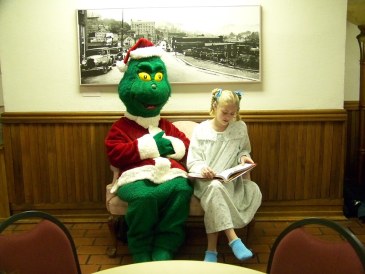
Breakfast with the Grinch 11-2010

Breakfast with the Grinch from vastateparkstaff

Grinch hated Christmas most of all. While the population of a town had fun with all hearts, the indicator of already bad Grinch’s mood expressed something awful. Each Christmas appeared to be a terrible torture for the green hermit. One day, a spiteful inhabitant of the mountain decided to finish a holiday once and for all. While the carefree Whovilleans were sleeping in holiday night with pleasure, perfidious Grinch decided to steal Christmas from the citizens, to make nobody able to have fun anymore.

Now, as well as the residents of the town, Grinch is in cares: he needs to prepare an ideal crime, that nobody could follow his ways. Two teenagers and two girls got on the mountain, where Grinch lived, and it finally angered him. He left the cave, put on a fancy dress and went down to the city, where he began to frighten everyone, who occurred on his path. What to do, if the circumstance, which is hard to cope with, unexpectedly interferes into the plans of Grinch? To speak more precisely, it is the little girl, who even wants to make friends with the character.

Five Reasons to Watch The Grinch Live on NBC

The girl, who helped the father with mail, was frightened so much that she fell in the packing machine, but then, probably, Grinch felt sorry and pulled her out. Cindy thanked him. Being raged by the fact that someone can think that he is kind, Grinch wrapped her with the tinsel. Then the girl thought that, maybe, Grinch is not so bad as everyone speaks about him. She also absolutely cannot understand the sense of Christmas and wants to reconcile him with the residents. However, finally, Grinch realizes that sense of Christmas is not in gifts. The repentant villain decided to return the gifts to the inhabitants, and they accepted him to their society.

#2 MATTHEW MORRISON

Matthew James Morrison will portray Grinch! Morrison is an American actor, dancer, and singer-songwriter. Morrison is known for starring in multiple Broadway and Off-Broadway productions, including his portrayal of Link Larkin in Hairspray  on Broadway, and for his role as Will Schuester on the television show Glee. He received a Tony Award nomination for his featured role as Fabrizio Nacarelli in the musical The Light in the Piazza.

#3 DENIS O’HARE

Denis O’Hare will play his dog, Max.  O’Hare is an American actor, singer, and author noted for his award-winning performances in the plays and musicals such as Sweet Charity,  as well as portraying vampire king Russell Eddington on HBO’s fantasy series True Blood. He has been nominated for an Primetime Emmy for Best Actor.

Five Reasons to Watch The Grinch Live on NBC

#4 THE COSTUMES

Personally, I think the costumes from the film version were exceptional.  I don’t know if they can reach that level of detail, but I’m interested in seeing if they do so.

#5 THE CHOREOGRAPHY

From viewing the snippet on NBC, I can tell the choreography is fun and playful.  That’s got to be a plus, huh? Here’s a trailer for the show:

https://www.today.com/popculture/nbc-bringing-grinch-life-new-musical-holiday-special-t198362

As you may know, several musicals have been performed live in recent years.  In my opinion, some were better than others.  I enjoyed NBC’s Hairspray and Jesus Christmas Super Star the most.  I would hope these production companies are learning how to produce a better product each time they attempt one.  Who knows?

Another was good production was  A Christmas Story.  In case you don’t me, I am a retired drama teacher having taught and directed for thirty-eight years.  You can find my resume here:Teaching Resume

A Christmas Story Broadway Musical Lesson

Now I created drama education resources for my business, Dramamommaspeaks.  I have a lesson about A Christmas Story which would complement the Grinch Live! If you are in a hybrid learning classroom or distance learning, these musicals work well for teachers.

You can find it here: A Christmas Story Broadway Musical Lesson

Five Reasons to Watch The Grinch Live on NBC

Need a quick emergency lesson plan? Or one for a substitute? Everything is provided for the busy teacher.

This Product includes:

  • Letter to Teacher
  • Two Warm Ups–MY Version of Popular Exercises
  • Teacher’s Script–what I say and how I say it!
  • Photos of the Production
  • Separate File of Slides for Teacher to Use to Lecture
  • Plot of the Musical
  • History about the Origination of the Production
  • Information concerning the composer, Pasek and Paul (who also co-wrote Dear Evan Hansen)
  • History about the Film and Musical Helping One Another
  • A Shortened Lesson on : What are the Tony Awards?
  • Tony Awards it Received
  • What are the Tony Awards
  • New York City Map with Competing Theatres Labeled
  • Student Note Page
  • Teacher Note Page Key
  • Trivia
  • Quotes from the Musical–Good for Discussions and Assignments
  • Extension Activities–Five different activities, individual and group
  • Sources & Links to Film Clips from the Show

This lesson works well with any grade level, although it was created for secondary students.  Reading, Language Arts, Vocal Music and Drama classes have success with it!

Or pick up my holiday lesson bundle at: Drama Lessons Holiday Themed 

I hope you’ll check out Grinch on December 9 and think about purchasing my Broadway lesson on A Christmas Story.  If nothing else, both will put you in the holiday spirit!

Which Grinch character is your favorite?  Mine is Max.  I’d love to hear from you.  Contact me at dhcbaldwin@gmail.com or DeborahBaldwin.net

Deborah Baldwin of DramaMommaSpeaks


Share this:

  • Share on Tumblr (Opens in new window) Tumblr
  • More
  • Share on X (Opens in new window) X
  • Share on Facebook (Opens in new window) Facebook
  • Share on Pinterest (Opens in new window) Pinterest
  • Share on LinkedIn (Opens in new window) LinkedIn
  • Email a link to a friend (Opens in new window) Email
  • Share on Reddit (Opens in new window) Reddit
  • Share on Telegram (Opens in new window) Telegram
  • Share on WhatsApp (Opens in new window) WhatsApp

Like this:

Like Loading...

Filed Under: acting, arts education, arts integration, Broadway, Distance Learning, drama education, e-learning, excellence in teaching, High School, middle grades, Musical Theatre, Teacherspayteachers, Teaching, theater, Tony Awards Tagged With: 'tweens, Broadway musicals, DISTANCE LEARNING, drama lessons, Family, family time, live musicals, middle grade books, Middle school, musical theater lessons, teacherspayteachers, VIRTUAL LEARNING, youth theatre

Creative Dramatics Lessons That Kids Love

July 22, 2020 By dhcbaldwin 1 Comment

Creative Dramatics from an Awarding Winning Drama Teache

Creative Dramatics Lessons That Kids Love

Dramamommaspeaks Blog Author Deborah Baldwin

Hello!

Today, I wanted to blog about Creative Dramatics Lessons That Kids Love. You may not know me or be familiar with my work.  I’m Deborah Baldwin (but my friends call me Deb.)  I am a recently retired award-winning drama teacher of thirty-eight years.  In that time, I directed over 250 plays and musicals with students and adults as well.  I taught every grade level, but the bulk of my time was spent with secondary students.

Here is my resume if you’d like to see it:

If you’d like a free guide And lesson plan from me, click here LESSON PLAN

Creative Dramatics Lessons That Kids Love

My Teaching Style

Drama is a hands-on class. To this end, I’m always on my feet, modeling for my students while teaching them a host of concepts. It is not unusual to hear my classroom in chortles of laughter because humor is an outstanding way to gain a student’s attention. I empower students at an early age. Although I am always mindful of my learning objectives, I think it’s vital for students to experiment within the confines of my instruction.

I encourage students to be independent and creative thinkers. Many less confident or reluctant students benefit from my teaching methods as together we hit the challenges they encounter. I am creative, intense, driven and brave–these are qualities I nurture in all my students and generally receive outstanding results.

Creative Dramatics Lessons for Elementary Grades by an Award Winning Drama Teacher

If you need some warm ups for your class, whether a core or drama class check out Theatre Games Guide

Strengthening Reading Comprehension Skills

When I was researching this blog post, I found a wonderful site,  http://www.understood.org.  They discussed the reasons for reading aloud (aka drama class!):

1. Decoding

Decoding is a vital step in the reading process. Kids use this skill to sound out words they’ve heard before but haven’t seen written out. The ability to do that is the foundation for other reading skills.

Decoding relies on an early language skill called phonemic awareness. (This skill is part of an even broader skill called phonological awareness.) Phonemic awareness lets kids hear individual sounds in words (known as phonemes). It also allows them to “play” with sounds at the word and syllable level.

2. Fluency

To read fluently, kids need to instantly recognize words, including ones they can’t sound out. Fluency speeds up the rate at which they can read and understand text. It’s also important when kids encounter irregular words, like of and the, which can’t be sounded out.

Sounding out or decoding every word can take a lot of effort. Word recognition is the ability to recognize whole words instantly by sight, without sounding them out.

3. Vocabulary

To understand what you’re reading, you need to understand most of the words in the text. Having a strong vocabulary is a key component of reading comprehension. Students can learn vocabulary through instruction. But they typically learn the meaning of words through everyday experience and also by reading.

What can help: The more words kids are exposed to, the richer their vocabulary becomes. You can help build your child’s vocabulary by having frequent conversations on a variety of topics. Try to include new words and ideas. Telling jokes and playing word games is a fun way to build this skill.

Creative Dramatics Lessons for Elementary Grades by an Award Winning Drama Teacher

4. Sentence Construction and Cohesion

Understanding how sentences are built might seem like a writing skill. So might connecting ideas within and between sentences, which is called cohesion. But these skills are important for reading comprehension as well.

Knowing how ideas link up at the sentence level helps kids get meaning from passages and entire texts. It also leads to something called coherence, or the ability to connect ideas to other ideas in an overall piece of writing.

What can help: Explicit instruction can teach kids the basics of sentence construction. For example, teachers can work with students on connecting two or more thoughts, through both writing and reading.

Making Connections: Using What They Know to Understand

5. Reasoning and Background Knowledge

Most readers relate what they’ve read to what they know. So it’s important for kids to have background or prior knowledge about the world when they read. They also need to be able to “read between the lines” and pull out meaning even when it’s not literally spelled out.

What can help: Your child can build knowledge through reading, conversations, movies and TV shows, and art. Life experience and hands-on activities also build knowledge.

6. Working Memory and Attention

These two skills are both part of a group of abilities known as executive function. They’re different but closely related.

When kids read, attention allows them to take in information from the text. Working memory allows them to hold on to that information and use it to gain meaning and build knowledge from what they’re reading.

What can help: There are many ways you can help improve your child’s working memory. Skill builders don’t have to feel like work, either. There are a number of games and everyday activities that can build working memory without kids even knowing it.

Creative Dramatics from an Awarding Winning Drama Teacher

Maybe you are researching Back to School lessons. Or you are looking for drama units, lessons and plays for your elementary students. Or you want to save yourself time? 

I can help you. 

Here is my opinion about expectations of our elementary students. My Pet Peeve

Here are a few of my lessons for elementary students:

Birthday cake with puppy wearing a hat

It Could Always Be Worse Readers Theater

  • Tableau, Grades 3 and 4
  • Chanting, Grades 3 to 5
  • Costume Design with Goldilocks and the Three Bears
  • Creative Movement
  • Costume Design with Snow White and the Seven Dwarfs
  • The Little Girl and the Winter Whirlwinds
  • Costume Design with Alice in Wonderland Characters

Each lesson comes with a teacher’s letter, procedure, a warm-up, materials list, teacher’s script and assignments.

Recently, I created fifteen minute radio theater plays for grades 3 to 5.  These are royalty free, too! 

  • Radio Theater Play of The Brave Little Tailor
  • Radio Theater Play of It Could Always Be Worse

Recently, I created fifteen minute radio theater plays for grades 3 to 5.  These are royalty free, too!

I hope you’ll check out my creative dramatics lessons.  My thirty-eight years of teaching drama education serve me well in creating these lessons and/or adapting some which I all ready used in the classroom.

Have you taught creative dramatics with your students?  I’d love to hear about it.  Contact me at DhcBaldwin@gmail.com or DeborahBaldwin.net

Looking for a freebie or two?  Go to:

Free Teaching Resources Blog Hop

Free Stuff!


Share this:

  • Share on Tumblr (Opens in new window) Tumblr
  • More
  • Share on X (Opens in new window) X
  • Share on Facebook (Opens in new window) Facebook
  • Share on Pinterest (Opens in new window) Pinterest
  • Share on LinkedIn (Opens in new window) LinkedIn
  • Email a link to a friend (Opens in new window) Email
  • Share on Reddit (Opens in new window) Reddit
  • Share on Telegram (Opens in new window) Telegram
  • Share on WhatsApp (Opens in new window) WhatsApp

Like this:

Like Loading...

Filed Under: arts education, Back to School, creative dramatics, creative movement, Creativity, DeborahBaldwin.net, drama education, Education, play reading, Radio Theatre, Reading Literacy, reading skills, teaching strategies, theater, youth theatre Tagged With: arts integration, back to school, costume design, creative dramatics lesson for back to school, drama lessons, dramamommaspeaks, elementary level plays, radio plays for elementary, radio theater for elementary, reading comprehension, teaching style, VIRTUAL LEARNING

« Previous Page
Next Page »

Footer

Follow Us

logo3.png

FOLLOW US

Facebook X-twitter Pinterest Instagram Envelope Rss

Goodreads: read

Malibu Rising
Malibu Rising
by Taylor Jenkins Reid
People We Meet on Vacation
by Emily Henry
The Last Thing He Told Me
by Laura Dave
Faking It
Faking It
by Cora Carmack
Losing It
Losing It
by Cora Carmack

goodreads.com
Copyright © 2024 · Wellness Pro on Genesis Framework · WordPress.com.Log in
 

Loading Comments...
 

    %d