• Skip to primary navigation
  • Skip to main content
  • Skip to footer

Join Me in my new Facebook Group! https://www.facebook.com/groups/417126059784261

Menu
  • Meet Deb – The Heart Behind DramaMommaSpeaks
    • Work with Me! 
    • Photo Gallery of DramaMommaSpeaks
    • Directorial Credits
  • I Give Book Talks! 
    • Book Talk Through Skype
    • Books
  • Freebies!
  • Bumbling Bea
  • Teaching Resume
  • Acting Resume
  • Contact Me
  • Blog
    • Drama Education
    • Arts Education
    • Youth Theatre
    • Middle Grades
    • Musical Theatre
    • Teaching
  • Meet Deb – The Heart Behind DramaMommaSpeaks
    • Work with Me! 
    • Photo Gallery of DramaMommaSpeaks
    • Directorial Credits
  • I Give Book Talks! 
    • Book Talk Through Skype
    • Books
  • Freebies!
  • Bumbling Bea
  • Teaching Resume
  • Acting Resume
  • Contact Me
  • Blog
    • Drama Education
    • Arts Education
    • Youth Theatre
    • Middle Grades
    • Musical Theatre
    • Teaching

high school

The Five Reasons Your Students Will Love Set Design

August 10, 2022 By dhcbaldwin 2 Comments

The Five Reasons Your Students Will Love Set Design

The Five Reasons Your Students Will Love Set Design

One of the things I appreciate about the subject I teach is its varied subjects within it. However as we know, not all students think the same way as I. I thought you might appreciate the five reasons your students will love set design–or at least that’s my hope.

If you are teaching theater and have reluctant students, I’d suggest teaching them about set design.  I’ve yet to find a group of students who did not enjoy learning about it.

Many students love theater, but they are unwilling to perform and consequently they quit studying it and take another class instead.  The reason?  They just can’t find a place for themselves within it.  Technical theater is a wonderful place for inclusion!

The Five Reasons Your Students Will Love Set Design

The Five Reasons Your Students Will Love Set Design

Truthfully, I think teaching set design is crucial for a student’s studies in theater arts. Let’s face it–a set design can make or break a production. Understanding its value and encouraging your students to appreciate it too will not only enrich their learning, but make them a more rounded arts person.

Think about it.  The audience sits and looks at the set for the entire performance.  Sometimes the set doesn’t change.  That’s a loooong time to imagine the place.

I could wax poetic about my love for teaching set design.  I am that much of a cheerleader for it.  But here are some reasons your middle and high school students will love set design:

  1.  It’s highly creative–The sky is the limit when one is learning about set design.
  2.  It’s immediately gratifying–When you design a set and create a model of it (either with paper or through a set design software app.) you can watch your idea take shape right in front of you
  3.  Themes and motifs can be explored effortlessly–your ELA teacher will appreciate that you teach these concepts to your students
  4.  It’s a great way to learn cooperatively–If you have your students work in pair or teams, the design process is eye opening to them.  As in life, everyone has an idea. They should all be heard and incorporated into the design if at all possible.  Students learn to listen, adjust their opinions and consider others.
  5.  Set design skills can carry over into other subjects such as math or social studies.  What a terrific way to apply what you learn.  Design a set, measuring, ratios, etc. come into use.  Researching a local such as France for a set design can be a super integration for a social studies or geography class.

The Challenges of Set Design

The Five Reasons Your Students Will Love Set Design

For Your Gifted Students

I used to challenge my students who needed something more difficult to design their set using a turntable in the center.  Wow, that’s a great challenge!  Not only is it tough to build, but will it work sufficiently?

Or what about a staircase?  Students quickly learn that designing a staircase to scale is much more complex than just label a rectangle a set of stairs.  Once a model is built the student sees the error of their measurements and that’s helpful, too.

How about a bridge?  Again, it’s easy to design but difficult to execute.

A Little Trivia Break

  • Did you know Judy Dench wanted to be a set designer when she was young?
  • Or that Maurice Sendak (author of Where the Wild Things Are) became a set designer after his career as an author? (Me neither!)
  • How about the fact that real-life historical locations provided inspiration for the Hamilton musical set design? While the set isn’t literal, it draws inspiration from actual places. “One of the cool things about Hamilton is almost every single location is one that you can research and find actual visual support for, whether it’s on the internet or in history books, or if the actual location still exists,” says David Korins, the set designer. “We did a lot of research in my office, getting everything from what the Schuyler Home actually looked like to what it looked like in New York City in 1781 and 1776. And we put it all up on a big huge board on a wall in my office, and we picked and chose.”
  • If you want more information about the history of set design, check out this blog post, Past Present and Future Set Design 

The Five Reasons Your Students Will Love Set Design

Teaching students that “less is more” can be easily demonstrated through set design.  In the photo above, you see a simple set from the 2018 revival of Carousel.  It contains a cyclorama with a cloudy night sky projected upon it and four miniature sail boats are part of the ground row.  The rest of the set is wood pallets. Students understand this concept that’s why it’s one of the five reasons students love set design.  Isn’t it effective? If you are need advice concerning selecting a production, check out this blog post: Critical Steps in Selecting a Play or Musical: Budget & Royalties

Permit me to brag a little

This is Brandon Davis.  He was a student of mine when he was in middle school.  He’s really made a great name for himself as a set designer.  When I had Brandon in my drama class in sixth grade, he was quiet, creative and loved theater.  You can see his work below and  at www.brandonptdavis.com


If you aren’t aware, I have a store with Teacherspayteachers.com.  In it, I sell drama education resources. In this particular case, let’s discuss my set design unit.

There are two–one for middle school and another a bundle of technical theater units  for high school.


The Five Reasons Your Students Will Love Set Design      The Five Reasons Your Students Will Love Set Design

The Five Reasons Your Students Will Love Set Design

Here is my middle school design unit description:

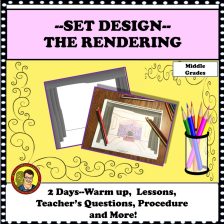
During this eight-day unit over set design students learn about the history of set design, famous designers, develop a critical eye about what makes up an award- winning set design, create a ground plan for a fairy tale story of their choosing and draw a rendering. If you’d like a free lesson concerning set design, click here. Set Design, the Rendering

Here’s a added benefit–the students must work with ratios and measuring. (Hello math class!) The first two assignments are completed individually, but then the fun begins! The students are paired up to create a model working together towards the goal. There is even room for parents to celebrate the end of the unit with your students.

Included in the unit:

  • An overview of the unit for the teacher
  • Rationale for teaching design
  • History of scenic design
  • Set designer’s responsibilities
  • Teacher’s Script–what I say and how I say it!
  • Warm-up for day one
  • Procedures for each day (8)
  • Lecture notes including links
  • Information about the message color conveys
  • Rendering examples
  • Stage curtain sheets for rendering–one vertical, one horizontal
  • Step-by-step directions for model building including photo examples
  • Cheat sheet for various set pieces
  • Assignment sheet for each step of the design process
  • Exit slip prompts for 4 days
  • Grade sheet EDITABLE in a separate folder
  • Source page

The Five Reasons Your Students Will Love Set Design

High School Set Design and Others

As you would expect, my high school unit is more challenging.  It includes studying three styles of theater–modernism, expressionism, surrealism.  After reading a play of their choosing, the students select one style and design the set for that production.   They build a model of their design or use software to design it in three dimensions.

Additionally if you want to take this idea even further, I have a theater artist biography and one pager assignment available. I  have several planned, but for now I can offer you Ming Cho Lee.

The Five Reasons Your Students Will Love Set Design

If you are looking for advice a production’s design, check out this blog post: Critical Steps in Producing a Play or Musical: Set Design

In particular, I appreciate this quote from  George C. Wolfe, playwright and director of Angels in America: Millenium Approaches who said:

“I love working with a set designer because, in many respects, you meet the set designer before you meet the actors. So it’s a chance for me as a director to figure out what I’m thinking and to explore how the space is going to actually be activated.”

I hope I’ve convinced you to teach design to your students.  Maybe your students will become a set designer as mine did!

If you want more advice concerning set design, check out: Critical Steps in Producing a Play or Musical: Set Design

Need something for a substitute?  Check out Exploring Theater Professions Video and Class Discussion Lesson.

What technical theater lessons have your students enjoyed learning?  I’d love to know.  Contact me at DhcBaldwin@gmail.com

The Five Reasons Your Students Will Love Set Design


Share this:

  • Click to share on Tumblr (Opens in new window) Tumblr
  • More
  • Click to share on X (Opens in new window) X
  • Click to share on Facebook (Opens in new window) Facebook
  • Click to share on Pinterest (Opens in new window) Pinterest
  • Click to share on LinkedIn (Opens in new window) LinkedIn
  • Click to email a link to a friend (Opens in new window) Email
  • Click to share on Reddit (Opens in new window) Reddit
  • Click to share on Pocket (Opens in new window) Pocket
  • Click to share on Telegram (Opens in new window) Telegram
  • Click to share on WhatsApp (Opens in new window) WhatsApp

Like this:

Like Loading...

Filed Under: arts education, Creativity, drama education, drama integration, e-learning, Education, excellence in teaching, Teacherspayteachers, teaching strategies, youth theatre Tagged With: high school, Middle school, reluctant performers, set design, technical theater, theater class

How to Teach Play Production to Your Students

April 26, 2022 By dhcbaldwin Leave a Comment

How to Teach Play Production to Your Students

How to Teach Play Production to Your Students
DIRECTING THE MIRACLE WORKER

Let’s consider how to teach play production to your students today.  As I’ve mentioned previously, I was thrown into directing my first production when I was quite young–twenty three years old to be exact. This is how to teach play production to your students.

Ten years and an umpteen amount of me directing productions later, I began producing for the theater company.  Let me tell you, I had NO idea what I was doing but after having directed and experienced that side of it, producing wasn’t all that difficult for me. You can read about my directing experiences here:  Eighteen Ways To Make Your Directing Experience Less Stressful, Part One or Eighteen Ways to Make Your Directing Experience Less Stressful, Part Two

In fact, I discovered I was good at it!

Many times in an educational setting, our students only learn about the “fun stuff”– acting and improvisation.  But there is a whole big world of other facets of theater which are not only essential but interesting! Plus, reluctant performers may find themselves in the other aspects of theater.

How to Teach Play Production to Your Students

How to Teach Play Production to Your Students

By teaching play production to your theater class, students are given an opportunity to dip their toes into various responsibilites.  One responsibility which is largely overlooked is the job of the producer. Check out this resource if you want your students to have a comprehensive look at play production.

If we can give our students opportunities to learn through play production, then by all means let’s do it!

The Ten Steps in Play Production

How to Teach Play Production to Your Students

So, let’s consider this idea for your class. Here are ten steps for play production.

  1.  Class reads several plays (I suggest you check out: Don Zoldis plays.  They are terrific for something like this.)
  2. After discussing the pros and cons, the play is selected
  3. Order the scripts
  4. After scripts arrive, read thru again, students volunteer for the responsibility of which they show most interest
  5. Set a budget
  6. Hold auditions and cast production
  7. Begin rehearsals
  8. Hold several run thrus, a cue to cue (if need be) and dress rehearsals
  9. Perform
  10. Process the experience

Tips and Reminders for Play Production

How to Teach Play Production to Your Students

When setting the budget, you may need to teach your students how to approximate their ticket sales if you are charging for the performance.  Make sure you include any monies the department has ear marked for the play. You are the authority on what needs to be included such as scripts and royalties.  Not all students are aware of these expenditures. Looking for something free to use in your class tomorrow?  Check out:  Lin Manuel Miranda Biography and One Pager Assignment. 

I’d suggest you do everything you can to streamline this learning experience.  Nailing down your expectations for each part of the production is key here.  Create checklists for each responsibility will help with this challenge.

If the student actors aren’t rehearsing their role, they are helping the design chairs to complete their checklists. Need some checklists to de-stress opening night?  Pick up my FREE ones here:  Director’s Helper Checklists

How to Teach Play Production to Your Students

If you are presenting a one-act play, I’d suggest two or three week daily rehearsal period. If a full length play, four or five weeks of daily rehearsal will be needed.  You may need to be more liberal with this rehearsal period, however.

What is a Play Producer?

How to Teach Play Production to Your Students

Although a production would not follow this pattern in the professional world, allow your producer to lead the production.

This term can have many meanings within theater, but it usually refers to a person who manages all aspects of a production, from overseeing the budget to hiring the director and other artists. Producers have to understand both the creative and business sides of theatre.
Who is best to be a producer?  Anyone an learn how, however the students with the leadership qualities are most successful–communicative, diplomatic, fair, “big picture” people.  Do allow your producer to watch over everything–provide feedback, communicate with chairs, oversee the budget, etc.

How to Teach Play Production to Your Students

How to Teach Play Production to Your Students

There is such power in cooperative learning.  Unfamiliar with this phrase? Cooperative learning is the instructional use of small groups so that students work together to maximize their own and each other’s learning.

In a recent study through the Journal of Effective Teaching,  students taught with cooperative learning strategy performed better than those taught with th individualistic learning strategy. The experimental group obtained a higher mean score of 89.91 as compared with the mean of 79.75 for the control group. The difference between the means scores of both groups is significant.

Please know the first time you attempt this, it could be difficult  with lots of starts and stops.  However, over time the students will embrace the experience and ask for more. You may end up stepping in as an actor if someone is conveniently “sick” the day of the performance or maybe the costume designer never comes through.  Who knows?

If you stay engaged with the students as they experience a class production experience, help them navigate the twists and turns while they learn and act as supervisor, this could be the highlight of your year!

My Producer Unit

How to Teach Play Production to Your Students

You may not be aware, but I have a Producer unit.  You can find it here: Drama Producer Unit

This unit includes:

This 7 day unit about the theater producer is suitable for high school students and perhaps gifted middle graders. Students read a play or musical, choose a theater scenario, study the responsibilities of a theater producer, examine style, metaphor, create and set up a budget/income for their production and finish with sharing their ideas on a concept board. Through this unit, students develop a keen eye for what it takes to be a producer and critique their peer’s work as well.

Producer Product Preview


The product includes:

  • Warm-Up Exercise
  • The Rationale Teaching the Unit
  • Teacher Script to Introduce the Unit –what I say and how I say it!
  • Quora article with questions to answer
  • Blog Post about Broadway Tricks of the Trade
  • How to Use Metaphor in Design
  • Questions to Consider when Producing a Production
  • Procedure for Each Day
  • Photocopying List
  • Musical and Play List Titles of Most Popular Productions in High Schools
  • Three Theater Scenarios for the Students to Choose From
  • List of Publishing Companies of Plays and Musicals
  • Sources & Live Video links list including clip suggestions
  • Two Assignments–one a short essay and another creating a concept board
  • Assignment Rubric
  • Peer evaluation activity

I hope you’ll consider planning a class play production in the near future.  I’ve found it to be one of the most gratifying experiences of teaching.  Observing my students as they learned how to work with one another, see their exhilaration when they show finally comes together and listening to their “aha” moments is a wonderful thing. Maybe you just want to start small and teach your students about costume design?

What class play productions have you produced?  I’d love to hear about them.  Contact me at DhcBaldwin@gmail.com!

How to Teach Play Production to Your Students


Share this:

  • Click to share on Tumblr (Opens in new window) Tumblr
  • More
  • Click to share on X (Opens in new window) X
  • Click to share on Facebook (Opens in new window) Facebook
  • Click to share on Pinterest (Opens in new window) Pinterest
  • Click to share on LinkedIn (Opens in new window) LinkedIn
  • Click to email a link to a friend (Opens in new window) Email
  • Click to share on Reddit (Opens in new window) Reddit
  • Click to share on Pocket (Opens in new window) Pocket
  • Click to share on Telegram (Opens in new window) Telegram
  • Click to share on WhatsApp (Opens in new window) WhatsApp

Like this:

Like Loading...

Filed Under: arts education, arts integration, community theater, drama education, excellence in teaching, High School, Producing plays and musicals, Teacherspayteachers, Teaching, youth theatre Tagged With: costume design, drama education, drama lessons, drama units, high school, play production, theater class, youth theater

Nine Drama Lessons for Black History Month Which Increase Student Engagement

January 5, 2021 By dhcbaldwin 2 Comments

Nine Drama Lessons for Black History Month Which Increase Student Engagement

Most of us are aware that February is Black History Month.  I’m so glad we give people of color a spotlight.  They certainly deserve it. Today I’m going to discuss Nine Drama Lessons for Black History Month Which Increase Student Engagement.

What is Black History Month?

Good question.

Black History Month is an annual observance originating in the United States, where it is also known as African-American History Month. It has received official recognition from governments in the United States and Canada, and more recently has been observed in Ireland, the Netherlands, and the United Kingdom.

Black History Month began as a way of remembering important people and events in the history of the African diaspora. Celebrated in February in the United States and Canada, while in Ireland, the Netherlands, and the United Kingdom it is observed in October.

If you are looking for My Black History Month Famous Theatre Artists Biography e-book, go here: Black History Month Famous Theatre Artists Biography


When did February become Black History month?

According to www.history.com, President Gerald Ford officially recognized Black History Month in 1976, calling upon the public to “seize the opportunity to honor the too-often neglected accomplishments of black Americans in every area of endeavor throughout our history.”

Do you need some help in the classroom?  Pick up this FREE guide and Lesson Here 

How Can We Celebrate Black History Month in My  Classroom?

Usually, during this time a drama teacher will read a few plays written about black Americans or playwrights. (Check out:  Concord Theatricals for their offerings.) If you need a list, a group of drama teachers compiled this list.  (I take no responsibility for them other than to share the list. I have not vetted them either.)

  • Intimate Apparel by Lynn Nottage.
  • Anna in the Tropics by Nilo Cruz
  • Vietgone by Qui Nguyen
  • Good Grief by Ngozi Anyanwu,
  • Our Lady of Kibeho by Katori Hall
  • Choir Boy by Tarell Alvin Mccraney
  • BLKS by Aziza Barnes
  • Shoe by Marisela Tevino Orta
  • Disengaged by Milta Ortiz
  • The Thanksgiving Play by Larissa Fasthorse,
  •  Durango by Julia Cho
  • Fade by Tanya Saracho
  • Caught by Christopher Chen
  • Behind the Sheet by Charly Evan Simpson

Powerful Voices: Contemporary Plays Exploring Identity, Culture, and Resilience

  •  Sender by Ike Holte
  • Obama-ology by Aurin Squire
  • Edith Can Shoot Things and Hit Them by A. Rey Pamatmat
  • Anonymous by Naomi Lizuka
  • Middle School Girls or The African Mean Girls Play by Jocelyn Biohazards
  • Saturday Night/Sunday Morning by Dominique Morriseau
  • Hoodoo Love by Dominique Morriseau
  • We are Proud to Present a Presentation About the Herero of Namibia...by Jackie Sibblies Drury.
  • Vietgone by Ngozie Anyanwu
  • Our Lady Kibeho by Kato Hall
  • Choir Boy by Tarrell Alvin Mccraney
  • Listen to Your Parents by Benjamin Zephaniah

Amazing list, huh?

Want a FREE biography lesson about Audra McDonald? Click here: Audra McDonald

Videos to View for Black History Month

Another activity a drama class would appreciate is to view a play or movie with a black cast.  If students are in high school, I first suggest Ma Rainey’s Black Bottom with Viola Davis and Chadwick Boseman.  Just excellent!

I compiled this list of videos as a quick way to give you ideas.  Check out: https://redtri.com for more suggestions.

High School–

  • Harriet 
  • Ragtime, the Musical (I’ve only found a student version of Ragtime on youtube.com)
  • Fences
  • Raisin in the Sun
  • Lilies of the Field

Elementary and Middle Grades– 

  • Akeelah and the Bee
  • And the Children Shall Lead
  • Remember the Titans
  • Harriet
  • Hidden Figures
  • Sounder 
  • The Wiz (P.S.  I have a Broadway musical lesson about this production.  If you are interested, check it out The Wiz Broadway Musical Lesson

Drama Lessons Celebrating Black History Month

If you want something unique, I have famous theater artist biographies available.  First, these are great for a substitute provided you have access to the internet and youtube.com.  Primarily, I developed these short lessons as a way for students to learn about successful theater artists journey to Broadway–a growth mindset sort of lesson.

They include:

I add to this group all the time, so if you don’t follow me you might want to do so.  FOLLOW ME

Here is an example of a product’s description:

This distance learning lesson focuses on actor Oscar, Emmy and Tony award-winning James Earl Jones. The student researches questions about his life, journey to Broadway, and various accolades he’s received while practicing growth mindset. Finally, using a One Pager assignment, the student designs his life.

This lesson takes sixty to ninety minutes to complete. Now they come in a digital book!  Pick them up here!

Need something for a substitute? All is needed is the internet.

A Suggestion for You

HOW DO I USE THIS IN MY CLASSROOM? Many teachers combine these biographies with other DramaMommaSpeaks artists Lin Manuel Miranda, actresses Audra McDonald, Cynthia Erivo, Meryl Streep or designer Ming Cho Lee, composers Tim Minchin, Pasek and Paul. Or they tie it to a lesson about the Tony Awards, Tony Awards Lesson

Now they come as a book!

Have you considered the importance of students reading biographies?  If not, check out Should Students Read Biographies?

I’m hoping that 2023 will be a year of celebrating diversity.  Let’s face it–we have a problem and the only way to fix it is discussions concerning our differences and more importantly, how we all deserve respect and understanding.

Want to better understand drama integration and how to use it in your classroom?  Pick up my FREE guide and lesson Here

 What better place than in our classrooms?

What do you do for Black History Month in your classroom?  I’d love to know about it.  Contact me at dhcbaldwin@gmail.com or DeborahBaldwin.net


Share this:

  • Click to share on Tumblr (Opens in new window) Tumblr
  • More
  • Click to share on X (Opens in new window) X
  • Click to share on Facebook (Opens in new window) Facebook
  • Click to share on Pinterest (Opens in new window) Pinterest
  • Click to share on LinkedIn (Opens in new window) LinkedIn
  • Click to email a link to a friend (Opens in new window) Email
  • Click to share on Reddit (Opens in new window) Reddit
  • Click to share on Pocket (Opens in new window) Pocket
  • Click to share on Telegram (Opens in new window) Telegram
  • Click to share on WhatsApp (Opens in new window) WhatsApp

Like this:

Like Loading...

Filed Under: acting, arts education, arts integration, Broadway, creative dramatics, drama education, Education, excellence in teaching, High School, middle grades, performing arts, Teacherspayteachers, Teaching, teaching strategies, theater, theatre, youth theatre Tagged With: black actors, black history month, black playwrights, diversity, high school, Middle school, people of color, racism

A Playwriting Unit or How to Help Your Students Feel Seen

May 15, 2020 By dhcbaldwin 2 Comments

A Playwriting Lesson or How to Help Your Students Feel Seen

Today, let’s talk about a playwriting unit to help your students feel seen. I’m old enough to remember the days in school when we wrote notes to our friends.  Most of the time they were pretty innocent. Occasionally, they seemed very important–asking a friend to ask a friend to ask if a certain boy liked you.

That kind of stuff.

Row High School Students Sitting Class Lesson — Stock Photo

When I was fifteen, I’d had a crush on a boy for about a year.  He (we will call Boy #2)  had wanted to date me for about a year too, except I was going steady with another boy (we will call Boy #1) at the time. 

Then Boy #1 broke up with me (over the phone!) and  Boy #2  was invited to a party that I was going to be at (you know where this is going, right?).  I wasn’t quite over Boy#1 and not ready just to jump into another relationship (and frankly, I was still reeling from Boy #1 breaking up with me on the phone), so I didn’t go steady with Boy #2. That was a big mistake!

Now, I’m tenacious when I set my mind to something.  I can focus like none other.

I decided I did want to go steady with Boy #2 but by then he had moved on.

Except he hadn’t.  He strung me along for about six months. During those agonizing months, I was laser focused on Boy #2.

I wrote notes to my friend, Connie, lamenting about my problems with Boy #2.

“He’s always staring at me in choir,” I’d write. “Why?  If he doesn’t want to date me, why does he sit there and stare at me all the time?”

Month after month, I’d pour out my feelings in a note (poor Connie.) Then one day something huge occurred.

I lost a note in a crowded hallway about my affection for Boy #2 and someone picked it up. Guess who?  Boy #2!!

I didn’t realize the time, I was writing out my feelings more than writing about the boy. And I was writing more to myself than to my friend.

Playwriting Lessons

This leads me to writing dialogue.

Students really love writing dialogue because they get to say everything they would if they had the chance.

Did you ever have a one way argument with an imaginary parent or sibling?

Yup, just like that.

Why Should I Teach Creating and Writing Dialogue?

I was looking for information for this blog post and found this from American Alliance Theater Education website:

“From learning to read to the in-depth study of Shakespearean literature, drama can play a significant role in the continual development of students’ reading comprehension skills. Studies indicate that not only do the performance of a story and a number of other drama activities in the classroom contribute to a student’s understanding of the work performed, but these experiences also help them to develop a better understanding of other works and of language and expression in general. The results below were gleaned from studies where educators and students alike noticed a difference when drama played a part in their classrooms.

  • A series of studies on the arts and education revealed a consistent causal link between performing texts in the classroom and the improvement of a variety of verbal skills, including especially significant increases in story recall and understanding of written material.
  • Performance of Shakespeare texts helps to improve students’ understanding of other complex texts including science and math material.
  • Drama can improve reading skills and comprehension better than other activities, including discussion.

In addition to building social and communication skills overall, involvement in drama courses and performance has been shown to improve students’ self-esteem as well as their confidence in their academic abilities.

  • High school students who are highly involved in drama demonstrate an elevated self-concept over those who are not involved.
  • Play writing original works and dramatic presentation of existing works can help to build the self-esteem and communication skills of high school students.
  • The act of performing can help students and youth recognize their potential for success and improve their confidence.”

Convincing enough for you?

If you are interested in something thematic for playwriting, check out: St. Patrick’s Day Playwriting Monologue

Help Your Students Feel Seen

I think of it this way–when you write dialogue and someone reads it aloud, a person feels seen.

Think about how many of our students need to feel seen?  That they matter?

That’s enough reason for me to teach students about writing dialogue for a play. 

If you are looking for a play writing lesson, here is mine.

Drama Lesson:  Playwriting Dialogue

This play writing lesson is five days in length and gives students an opportunity to study writing dialogue for a play. Students in seventh (gifted) through tenth grades will learn about the various rules of play dialogue, characterization, voicing and write their own short scenes. Created to be non-threatening, the lessons are set up step by step to give students plenty of time for assimilation.

The product includes:

  • Letter to the Teacher
  • Rationale for Teaching Play Writing
  • Three Warm Up–MY versions
  • Procedure
  • Teacher’s Script for Introducing the Lesson–what I say and how I say it!
  • Teacher’s Script for Teaching the Lesson
  • Slides to Accompany the Teacher’s Script
  • 5 Handouts –Step by Step writing assignments–good for beginners and introducing the lesson
  • 10 Writing Prompts–great for older students
  • 6 Exit Slips
  • Sources

HOW DO I USE THIS LESSON? Use this lesson in a writing workshop, creative writing class, drama class or even a reading class when reading play scripts. Students enjoy writing dialogue because it is something they know!

Comprehensive? You bet.

Needless to say, Boy #2 and I never did date.  We should have; I think we both know that. Or maybe not?  Regardless, what great memories.

What memories do you have of a moment in high school that played out in your life in some way when you were adults?  I’d love to hear about them.

Contact me at dhcbaldwin@gmail.com or DeborahBaldwin.net

If you want something for middle school students concerning writing monologues, try any of these I’ve noted below.

Go to: DramaMommaSpeaks store


Birthday cake with puppy wearing a hat
How to Start a Playwriting C

If you are looking for more information about my drama lessons, check out:

Drama Lessons for Home-Bound Students or During the Corona Virus Quarantine

Distance Learning with Reader’s Theater Scripts

The Reasons to Teach Drama Class with Unique Lessons

Deborah Baldwin, author

Share this:

  • Click to share on Tumblr (Opens in new window) Tumblr
  • More
  • Click to share on X (Opens in new window) X
  • Click to share on Facebook (Opens in new window) Facebook
  • Click to share on Pinterest (Opens in new window) Pinterest
  • Click to share on LinkedIn (Opens in new window) LinkedIn
  • Click to email a link to a friend (Opens in new window) Email
  • Click to share on Reddit (Opens in new window) Reddit
  • Click to share on Pocket (Opens in new window) Pocket
  • Click to share on Telegram (Opens in new window) Telegram
  • Click to share on WhatsApp (Opens in new window) WhatsApp

Like this:

Like Loading...

Filed Under: arts education, DeborahBaldwin.net, Distance Learning, drama education, Education, growing up, plays, Teacherspayteachers, Teaching, theater, youth theatre Tagged With: boy/girl relationships, high school, play writing, school social issues, teens

Drama Lessons for Families Who are Home-Bound

March 25, 2020 By dhcbaldwin Leave a Comment

Drama Lessons for Families Who are Home-Bound


Tick, tock, tick, tock…….

Is it only Wednesday?

Have you worn out the Play-dough, grown frustrated by the board game, broke the new cool toy, gained five pounds by baking chocolate chip cookies and just can’t make one more blanket fort? 

The Joy and Intrigue of Broken Toys

Families:  Have you exhausted your ideas during this pandemic? 

If you’d like a free guide And lesson plan from me, click here LESSON PLAN

Need a little help?

I am here to help you.

Drama Lessons for Families  Who are Home-Bound

If you’d like a free guide And lesson plan from me, click here LESSON PLAN

Many years ago, we lived in Missouri.  I  remember when we’d have a couple of snow days in a row.   Deep snow and ice kept us home.

Of course we didn’t know how long we’d be, but the school district had a rough idea of when we’d return to the classroom.

pexels-photo-3626789

That was fine and it really was fun, but this?

Well, who knows how long this quarantine will last?

When our daughters were children, being very creative beings, they would orchestrate little programs for us.  They’d rehearse for hours, invite us to their concert or play and my husband and I would sit quietly while they gleefully performed for us.

We’d clap at the end as they bowed.  One time they put on their own rendition of Lion King.  Part of the end of the performance included walking around in a circle with a sign which read “Lion King” misspelled to “Loin King.”  We still call the show Loin King to this day…

It was such fun for all of us.  Honestly, I have many fond memories of those performances.  In fact, I remember them more than other times in their young lives.

Drama Lessons for Families  Who are Home-Bound

I say families that do drama together stay together.  (Last Saturday I said “families who Face Time together stay together” so you can see I toss this phrase around as needed.)

When I researched this subject, here was something I found very interesting about families in a research essay, childtrends.org:

Drama Lessons for Families Home-Bound

pexels-photo-1231365
Photo by Yulianto Poitier on Pexels.com

Time Use
Perspectives: Shared parent-child activities are important both because they are intrinsically satisfying and because they can help educate and socialize
children. For example, research has found that children whose homes emphasize learning opportunities and cognitively stimulating activities are more academically motivated than other children. In addition, a positive and enriching family environment can help prevent behavior problems in youth, including delinquent behavior.18 Moreover, sufficient quality time together may be a prerequisite for well-being in
family relationships.

Here are a few ideas for you of ways to provide quality time with your family.

Drama Lessons for Families Home-Bound

Here’s a new one! Drama Choice Boards–keep an eye out for more of these.

Drama Lesson Choice Board

Saturday, Sunday and Monday Unit and Play Distance Learning

SATURDAY, SUNDAY & MONDAY READERS THEATER COVER

This reader’s theater script is perfect for a family to use.  It has many roles and opportunities for younger children to be involved even if they can’t read yet.  Plus, there’s an original song.

Bow Wow Blues Unit and Play Distance Learning

RADIO THEATER IV BLUES COVER 285 dpi

The whole family can learn about radio theater with this gem.  Written in the style of old radio shows, Bow Wow Blues is a silly cops and robbers tale.

Plus, the family can learn about the radio theater of old and where it is most present today.

Set Design Rendering Lesson Distance Learning

SET DESIGN THE RENDERING EDITED

A precursor to my set design unit, this gives a family the chance to learn about set design and draw a rendering for any setting.

Maybe a set design of a child’s classroom? A castle?  The wild west?  The moon?

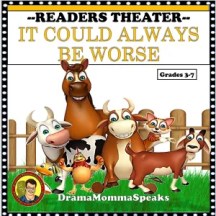
It Could Always Be Worse Reader’s Theater Distance Learning

The title of this reader’s theater is really all anyone needs.  Based on a Jewish folk tale, it is full of humorous moments and roles of animal sounds.

Part of the fun is the chaos that ensues every time the man does another thing that the rabbi suggests.

HINT:  THIS KIND OF PLAY IS RELAXING AND FUN FOR EVERYONE. 

Or how about some beginning playwriting?

Costume Design with Fairy Tale Characters

Costume Design Fairy Square Cover 400 dpi

Does the family enjoy fairy tales?  Here’s a lesson about costume design using fairy tale characters as the focus.

With costume design, a student considers the character from a different perspective or time period. (There is also one for super heroes and one for circus performers.)

It’s important our students learn about growth mindset by learning about successful people.  This series of theater artist biographies include

Idina Menzel, Hugh Jackman, Lin Manuel Miranda and many more.

Famous Theater Artist:  Idina Menzel 

I have several one pager assignments.  One for Idina Menzel and also Lin-Manuel Miranda.

Who am I?

Deborah Baldwin, Dramamommaspeaks

I am a retired drama educator having taught for thirty-eight years in both the public and private sectors. Whew! During this time, I created curriculum for studies in creative dramatics, creative movement, introduction to musical theatre, musical theatre, film making, technical theatre, introduction to Shakespeare, introduction to theatre as well speech and debate. I created seven youth theater companies that continue today in various parts of the midwest, oversaw productions for thirty-eight years, and developed a national playwriting contest for youth theater scripts. In addition, I am an award-winning director who has directed over 250 plays and musicals with children and adults alike. My sister was an elementary teacher for many years as were my aunts. In the late 1800s, my fraternal grandmother was known for her strength in teaching math in the wilds of Kansas. My maternal grandmother established the first kindergarten in Osaka, Japan in the 1890s. In short teaching is in my blood and comes to me joyfully and naturally.

Who’d a thought we’d be practicing social distancing and quarantined?  Not me that’s for sure.

I hope you’ll check out my lessons in my teacherspayteachers store, Dramamommaspeaks.  It’s free to join TpT and there are lots of free lessons to pick up for other interests, too.

In fact, here are a bunch for you: Free Teaching Resources Blog Hop

Take care.  Contact me if you need some advice or just to share how you used the lessons.  I’d love to hear from you.

Contact me at dhcbaldwin@gmail.com or DeborahBaldwin.net

Share this:

  • Click to share on Tumblr (Opens in new window) Tumblr
  • More
  • Click to share on X (Opens in new window) X
  • Click to share on Facebook (Opens in new window) Facebook
  • Click to share on Pinterest (Opens in new window) Pinterest
  • Click to share on LinkedIn (Opens in new window) LinkedIn
  • Click to email a link to a friend (Opens in new window) Email
  • Click to share on Reddit (Opens in new window) Reddit
  • Click to share on Pocket (Opens in new window) Pocket
  • Click to share on Telegram (Opens in new window) Telegram
  • Click to share on WhatsApp (Opens in new window) WhatsApp

Like this:

Like Loading...

Filed Under: arts education, creative dramatics, DeborahBaldwin.net, drama education, Education, elementary, excellence in teaching, Free Products, High School, middle grades, performing arts, Teacherspayteachers, teaching strategies, theater, youth theatre Tagged With: coronavirus, DISTANCE LEARNING, drama lessons, Drama Lessons: Middle Grades, family activities, grade 10, grade 3, grade 4, grade 5, grade 6, grade 7, grade 8, grade 9, high school, home school, quarantine, social distancing

Play Reading and Analysis–An Important Skill for Our Students

January 10, 2020 By dhcbaldwin Leave a Comment

Play Reading and Analysis–an Important Skill for Our Students

Deborah Baldwin teaching

I am a drama teacher.  Consequently, I eat, sleep and breath theater even now that I’m newly retired.

I listen to the Sirius Broadway station all day which keeps me abreast to upcoming productions and tours.

Because of my love for theater, I spend a lot of time on Pinterest.com pinning anything that pertains to theater–plays, musicals, set design, costume design, stage properties do it yourself creations, stage makeup, videos, lighting plots, show posters, etc.

I have A LOT of boards…………….:)

I see theater teachers in Facebook groups looking for play titles to read with their students, especially middle school.  If you are looking for a good one to study,  try Tim Kelly’s dramatization of The Adventures of Tom Sawyer.  Here is a study guide and set design unit for it:  Study Guide and Set Design Units Tom Sawyer

BUNDLE TOM SAWYER STUDY GUIDE AND SET DESIGN

Sorry, I digressed.

Strengthening Literacy through Play Reading

Back to literacy.

I looked for research concerning the reasons our students should read a play script and of course, ran on to balanced literacy.

“When students have a voice in the reading process, they’re learning to contribute to their own knowledge.  Because they can select the books (in my case, plays) they wish to read, they have greater control over what they want to learn. Students are much more likely to view reading as a priority when they have some ownership in the reading process.

However, this doesn’t mean students can make their independent reading choices willy-nilly.  There does have to be some structure involved. First of all, the independent reading selection must be at their reading level.  No “easy” books during independent reading. “At their reading level” means students should be able to read their selections with 95%-100% accuracy.”

I agree with everything mentioned above.

Reading a play can be an amazing, satisfying experience.  Once my students become accustom to reading a script aloud (which takes about one class period), they are invested.

woman reading book

Here are some of the reasons for our students to read a play:

  1.  The dialogue is terrific.  You can’t help but be engaged.  The playwright hones his script to be the most compelling experience he can create.  He certainly doesn’t want an audience member leaving the production.  When an audience members leaves, it’s not the same as turning off the television–EVERYONE sees the bored person leave.  Yikes! Also, if you are teaching students how to write dialogue, reading a script will help them immensely.
  2. There is no narration or superfluous information.  There might be someone who narrates, but again, the narration is short, concise and entices the audience.
  3. For many moments in the plot, stage directions are included.  If the play reader becomes lost, it is easy to find one’s place in the script merely by reading the directions.  The stage directions help a reader to visualize the action. They were either added to the script by the playwright or placed there in honor of the first company who produced it.
  4. Characters are well developed.  A well crafted play can be read without looking at each character’s printed name within the play.  A reader should be able to read down the middle of the script and know who is speaking and why.
  5. Each scene and act follows the traditional plot structure–a beginning (the conflict is unveiled), rising action and some sort of resolution.  Generally, an act is ended like a cliff hanger in a movie or book.  Or, it makes a thought provoking statement which enhances the theme and encourages the audience member to return after intermission.
  6. Generally, the plot concerns a short amount of time in the main character’s life.  If the script becomes too epic, the audience is lost and again they’ll quit listening.
  7. Everything that is published in the script is vitally important to its success on the stage. That means anything mentioned or used has been carefully chosen.
  8. I can’t think of a script I haven’t enjoyed reading.  Sure, I’d rather see the script in a live production but reading the script works for me almost as well.

Strengthening Literacy through Play Reading

So how do you find the scripts your students will enjoy?  I surveyed a group of drama teachers from all over the world and they helped me come up with a list of plays they think students should read.

For High School

  • Harvey
  • Arsenic and Old Lace
  • Still Life With Iris
  • To Kill a Mockingbird
  • Oslo
  • Inherit the Wind
  • Diary of Anne Frank
  • The Giver
  • The Effect of Gamma Rays on Man in the Moon Marigolds
  • Anne of Green Gables
  • Fences
  • Vanities
  • Yellow Boat
  • The Giver
  • Dark Road
  • Children’s Hour
  • Our Town
  • The Crucible
  • Raisin in the Sun
  • Antigone
  • The Doll’s House
  • Glass Menagerie
  • Dancing at Lughnasa
  • Death of a Salesman
  • Doubt
  • Proof
  • Harry Potter and the Cursed Child
  • The Heidi Chronicles
  • Last Night at Ballyhoo
  • The Miracle Worker

Strengthening Literacy through Play Reading

Most of these scripts can be purchased through one of the various script publishers.  If you don’t know where to start, try searching the nae of the script, such as “The Giver, the play version.”

If that gets you nowhere, you can try findaplay.com  This site used to be my favorite, but I’ve noticed not every script is listed there anymore.

Your students may find on-line versions to read, especially of the classics (our Town, The Crucible, Raisin in the Sun, The Doll’s House, etc.)  or check out your school or public library.

Sometimes you’ll find them in anthologies, especially if they were Tony Award Winners.  I believe this list includes only Tony Award winners.

I have a unit (two actually) which can help you teach about play analysis.  It is:  Play Reading and Analysis (PDF) 

and Play Reading and Analysis Google Classroom

Packed with questions and a rubric it contains:

  • Letter to Teacher
  • Project Assignment–What is Expected in the Assignment
  • Play Analysis Questions–as a Producer, Director and Designer
  • Play Titles–Vetted and Compiled from Drama Teachers Around the World
  • Rubric (FULLY EDITABLE)
  • Exit Slip prompts for 5 days–Questions are Provided for Each Day
  • Source Page

I hope you’ll check it out and use it.  It’s very different.


Or, if you’d like to get a heck of a deal, look into this bundle:  Drama Units and Lessons for High School Students

Until next time.

Deborah Baldwin, author

Contact me at dhcbaldwin@gmail.com or DeborahBaldwin.net

Share this:

  • Click to share on Tumblr (Opens in new window) Tumblr
  • More
  • Click to share on X (Opens in new window) X
  • Click to share on Facebook (Opens in new window) Facebook
  • Click to share on Pinterest (Opens in new window) Pinterest
  • Click to share on LinkedIn (Opens in new window) LinkedIn
  • Click to email a link to a friend (Opens in new window) Email
  • Click to share on Reddit (Opens in new window) Reddit
  • Click to share on Pocket (Opens in new window) Pocket
  • Click to share on Telegram (Opens in new window) Telegram
  • Click to share on WhatsApp (Opens in new window) WhatsApp

Like this:

Like Loading...

Filed Under: arts education, drama education, excellence in teaching, play reading, plays, Teacherspayteachers, theater, youth theatre Tagged With: 'tweens, drama education, drama lessons, high school, Middle grade, middle grades, play analysis, play reading, theater education, youth theater

« Previous Page
Next Page »

Footer

Follow Us

logo3.png

FOLLOW US

Facebook X-twitter Pinterest Instagram Envelope Rss

Goodreads: read

Malibu Rising
Malibu Rising
by Taylor Jenkins Reid
People We Meet on Vacation
by Emily Henry
The Last Thing He Told Me
by Laura Dave
Faking It
Faking It
by Cora Carmack
Losing It
Losing It
by Cora Carmack

goodreads.com
Copyright © 2024 · Wellness Pro on Genesis Framework · WordPress.com.Log in
 

Loading Comments...
 

    %d