

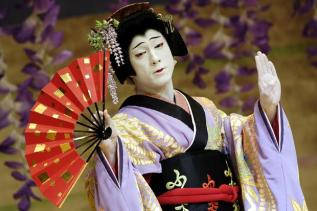
Today, let’s discuss Kabuki Theatre for Girls? Readers ask me why I created a story which included Kabuki theatre. Here is the book:http://tinyurl.com/n5at3oh
Kabuki Theatre for Girls
When I was sixteen years old, my parents and I traveled to Japan for a vacation. My grandparents were missionaries in Japan prior to WWII and my mother wanted to visit the country again. She hadn’t visited her birthplace since attending college in the US in the early 1940’s.
Mr. Tannabe (yes, I used his name in the book to honor him) served as a tour guide showing us around Japan. Mr. Tannabe owed his faith in Christ to my grandfather who baptized him in the ocean. Consequently, he felt indebted to my grandfather’s extended family as well. He wined and dined us and showered us with many gifts. Nearing the end of the trip, Mr. Tannabe treated us to seats at the National Kabuki Theatre in Tokyo to attend a play.
Mr. Tannabe knew I loved theatre. I will be forever grateful to him for this experience, because the impetus for Bumbling Bea sprung from this performance. I was struck by its pageantry, spectacle, story, movement and style. Then I found out that women originally portrayed all the characters.

You are kidding me, right? Why aren’t women performing Kabuki Theatre today?
The History of Kabuki Theatre
Here’s a quick history lesson for you:
It’s possible Kabuki Theatre was first created by a woman named Okuni of Izumo in the 1590’s (around the time of Shakespeare). She was thought to be an iron worker’s daughter in service to a shrine of Izumo.
From An Outline Drama of Japanese Theatre written in 1928 (I’m paraphrasing here) the supposed Okuni may have been on a tour seeking contributions for the shrine. Okuni’s dance was one of worship in praise of a Shinto god. Her dance met with such welcome in Kyoto that she remained, to be identified with a new dramatic movement rising from the midst of the common people. Okuni was beautiful and graceful which appealed to the people regardless of the religious reasons.

From Sacred Steps to Center Stage
A young man was sent by his parents to become trained as a priest. He saw Okuni dance and admired her beauty and poise. This gentleman came from a military family and wasn’t interested in the priesthood, but more focused on social aspects. However, he found her dances too restricting. Over time, he convinced Okuni to adapt her dance movements to the music of the day (some of which he wrote). Later, this form became known as Kabuki–the art of song and dance.
More time goes by…
Okuni becomes the Beyoncé of the time. Her dances were sensual and exciting.
The Plot Twist That Changed Kabuki Forever
She was invited at least once to perform for the royalty of Japan. As in many circumstances in the entertainment business, imitators sprang up. Both people were performing some form of Kabuki. These were men who were otherwise unemployed or women of ill repute (sex workers) and considered lower class citizens. Plus, those sexy dances, you know? Kabuki gained a poor reputation.
Here’s the twist!
Well gosh. Now, the women weren’t allowed on the stage (you know, because they are females and acting all sexy like). There were lots of young unemployed men willing to take their places. The stories involved male and female characters, so the men took up playing the female characters as well.
To this day, men portray all the roles in Kabuki Theatre.
There is lots more to the history of Kabuki Theatre, but this gives you a very quick story explaining why a woman from the Midwest would craft such a story.

Kabuki Theatre has a style all its own.
🎭 Do Women Perform Kabuki Today?
Traditionally, women were banned from Kabuki in the 1600s—and that rule stuck for centuries. To this day, male actors still perform all roles in official Kabuki productions, including the female ones.
But times are changing. In recent years, women have begun reclaiming space in Kabuki through all-female troupes, academic training, and modern reinterpretations. While they may not yet dominate the traditional stage, women are finding powerful ways to honor and evolve this historic art form.
Carrying the Torch—Even When You’re Not Supposed To
I think one of most unusual aspects of it is a character could be passed from one generation of actors to the next. Sort of like your grandfather was a Kabuki actor who played John Smith. Then, your dad becomes a Kabuki actor and he inherits your grandfather’s role of John Smith PLUS whatever celebrated movement your grandfather created in the part.
Now it’s your turn. Not only are you portraying the role your grandfather and father portrayed, you are sharing your family’s legacy.
Except you are a girl named Michiko. You want to honor your grandfather, and in your case, your uncle. But heck. You are a girl and the only family member interested or willing to train in the Kabuki Theatre.
Kabuki theatre for girls–that’s Michiko’s challenge and it was mine, too.
After attending only one Kabuki Theatre performance when I was a sixteen year old, forty-four years later, I give you Bumbling Bea.

If you are interested in reading Bumbling Bea, check it out here: http://tinyurl.com/n5at3oh
Got a question? Feel free to write to me at Dhcbaldwin@gmail.com