• Skip to primary navigation
  • Skip to main content
  • Skip to footer

Join Me in my new Facebook Group! https://www.facebook.com/groups/417126059784261

Menu
  • Meet Deb – The Heart Behind DramaMommaSpeaks
    • Work with Me! 
    • Photo Gallery of DramaMommaSpeaks
    • Directorial Credits
  • I Give Book Talks! 
    • Book Talk Through Skype
    • Books
  • Freebies!
  • Bumbling Bea
  • Teaching Resume
  • Acting Resume
  • Contact Me
  • Blog
    • Drama Education
    • Arts Education
    • Youth Theatre
    • Middle Grades
    • Musical Theatre
    • Teaching
  • Meet Deb – The Heart Behind DramaMommaSpeaks
    • Work with Me! 
    • Photo Gallery of DramaMommaSpeaks
    • Directorial Credits
  • I Give Book Talks! 
    • Book Talk Through Skype
    • Books
  • Freebies!
  • Bumbling Bea
  • Teaching Resume
  • Acting Resume
  • Contact Me
  • Blog
    • Drama Education
    • Arts Education
    • Youth Theatre
    • Middle Grades
    • Musical Theatre
    • Teaching

reading aloud

Three Interactive Ways to Teach The Play Tom Sawyer To Your Students

December 26, 2019 By dhcbaldwin Leave a Comment

A white washed fence indicative of Mark Twain's book, The Adventures of Tom Sawyer

Three Interactive Ways to Teach The Play Tom Sawyer To Your Students

Today’s post is Three Interactive Ways to Teach Tom Sawyer To Your Students.  Several years ago, (for thirteen years) I taught sixth graders an introduction to theater class in a middle school. All the sixth graders–almost 500 of them each year. If you’d like to know more about that experience, check out this blog post: How to Make Your Drama Class More Successful

Mark Twain's Purpose for Writing The Adventures of Tom Sawyer

As any drama teacher worth her weight would tell you, it’s important for students to read fiction about kids around their age.  Now, I’m like anyone.  I like pop culture, but I happen to think our students need to still read classics.

In addition, I also like to include interactive instruction if at all possible.  Interactive instruction is when students learn through social interaction. Interactive instruction is just about everything we do in a theater class!

Meet Tim Kelly, Playwright

Three Interactive Ways to Teach The Play Tom Sawyer To Your Students

Thirty-one years ago, I co-developed a play writing contest for youth theater plays.  One of the winners was a prolific playwright, Tim Kelly.

When Tim entered the competition, I was aghast!  I only knew his plays as hokey.  They were silly, kind of awkward parodies of other plays, books, or television shows.

Shortly afterward, Tim discovered writing for middle school students and finally found his home, at least in my opinion.

We produced his play, It’s a Howl! and it was such fun.  I know, I said I didn’t like to do superficial stuff but It’s a Howl! is really clever–sort of Frankenstein meets the Werewolf.

Over several years, Tim and I would talk about other plays he wanted to enter in the contest.  He mentioned his Tom Sawyer script to me as well.

Three Interactive Ways to Teach The Play Tom Sawyer To Your Students

Three Interactive Ways to Teach The Play Tom Sawyer To Your Students

I don’t know why, but he never entered it in the competition.  But I read it and loved it!

Check out a synopsis of it here:   Dramatic Publishing Company

Back to the middle school with the gazillion students…Since seventy-five new students entered my drama classroom every twenty-five days, I had to come up with a variety of lessons for them.

Enter The Adventures of Tom Sawyer

Tom Sawyer fit two purposes for me.  One–it was a classic and abbreviated which was perfect especially for the classroom.  Two–it was a story about students around the ages of my students.  Three–it was a wonderful jumping off point for additional lessons about theater (set, costume, props, etc.)


Three Interactive Ways to Teach The Play Tom Sawyer To Your Students

Recently, I created two units using Tom Sawyer as my inspiration. Here is the production description:

Mark Twain’s classic novel, The Adventures of Tom Sawyer is an excellent story for our middle grade students to study. Here is study guide for a play version of the book. Questions for a read-aloud are included as well as questions to study the play from a theatrical perspective. Playwright, Tim Kelly was a prolific playwright and this script is a perfect example of his body of work. His plays are especially suited for middle grade students.

This product includes:

  • A Letter to the Teacher
  • Short Bio. on Mark Twain
  • Information about the novel, The Adventures of Tom Sawyer
  • Procedure
  • Warm Up
  • Teacher’s Script–What I say and How I say it!
  • Discussion Questions from a Theatrical Perspective
  • Discussion Questions for a Class Read-Aloud
  • Theater Vocabulary Words–34 In Total
  • Theater Words Definitions
  • Source Page

Three Interactive Ways to Teach The Play Tom Sawyer To Your Students

Study Set Design 

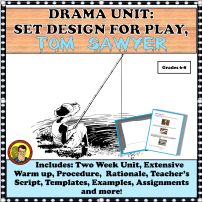
The second unit concerns set design.

This set design unit (48 page, 10 days) focuses on a play version of Mark Twain’s The Adventures of Tom Sawyer by Tim Kelley. This is great interaction! Students learn about the history of set design, famous set designers, develop a critical eye about what makes up an award winning set design, create a ground plan for a room in a school of their choosing and draw a rendering. In addition, the students must work with ratios and measuring. The first two assignments are completed individually, but then the fun begins! The students are paired up to create a model working together towards the goal. There is even room for parents to celebrate the end of the unit with your students.

Note: If a teacher chooses to use this particular set design unit, I would suggest purchasing a class set of Tom Sawyer by Tim Kelley at: https://www.dramaticpublishing.com/tom-sawyer-tr5000.

Included in the unit:

  • An overview of the unit for the teacher
  • Rationale for teaching set design
  • History of set design
  • Set designer’s responsibilities
  • Teacher’s Script–what I say and how I say it!
  • Extensive warm up
  • Procedures for each day (8 to 10) including exit prompts
  • Lecture notes including links
  • Information about the message color conveys
  • Rendering examples
  • Stage curtain sheets for rendering–one vertical, one horizontal
  • Step by step directions for model building including photo examples
  • Cheat sheet for various set pieces
  • Assignment sheet for each step of the design process
  • Grade sheet EDITABLE in a separate file
  • Source Page

Now I have a costume design unit to go with these two as well.  Talk about comprehensive!

Of course, there’s a bundle of the three together.  Check those out at:  Bundle Tom Sawyer Study Guide and Set Design Unit 

Three Interactive Ways to Teach The Play Tom Sawyer To Your Students

Honestly, I don’t know if The Adventures of Tom Sawyer is taught in the classroom anymore.  I could understand the reasons not to teach it.  However, Mr. Kelly’s script is well adapted and deletes any words which might be difficult for our students to accept in this day and age.

Three Interactive Ways to Teach The Play Tom Sawyer To Your Students

I hope you’ll consider ordering a perusal copy of the script. Perhaps you’ll use these two products in your drama classroom or at least study it in the language arts classroom.  It fits the “balanced reading” benchmark, too!

Mr. Twain wrote the book for all of us.   Of course, I think Mark Twain says it the best, “Although my book is intended mainly for the entertainment of boys and girls, part of my plan has been to pleasantly remind adults of what they once were themselves, and what they felt and thought.”

What young adult novels have you studied in play form?  I’d love to hear about them.  Contact me at dhcbaldwin@gmail.com or DeborahBaldwin.net

Woman behind DramaMommaSpeaks

Share this:

  • Click to share on Tumblr (Opens in new window) Tumblr
  • More
  • Click to share on X (Opens in new window) X
  • Click to share on Facebook (Opens in new window) Facebook
  • Click to share on Pinterest (Opens in new window) Pinterest
  • Click to share on LinkedIn (Opens in new window) LinkedIn
  • Click to email a link to a friend (Opens in new window) Email
  • Click to share on Reddit (Opens in new window) Reddit
  • Click to share on Pocket (Opens in new window) Pocket
  • Click to share on Telegram (Opens in new window) Telegram
  • Click to share on WhatsApp (Opens in new window) WhatsApp

Like this:

Like Loading...

Filed Under: arts education, drama education, excellence in teaching, middle grades, performing arts, play reading, plays, teaching strategies, theater Tagged With: cooperative learning, drama lessons, Mark Twain, play, play read aloud, reading aloud, script reading, set design, study guide, The Adventures of Tom Sawyer, Tom Sawyer

A Secret of a Highly Successful Drama Teacher-Litpick Article no. 2

August 27, 2016 By dhcbaldwin Leave a Comment

My Litpick article no. 2.

I hope you enjoy it.

Deborah Baldwin teaching

Strengthening Reading Skills Through Drama

Teaching has its up and downs, but one of the most rewarding experiences of teaching is seeing a student’s eyes light up once some learning connects with them. I like to teach ‘magically’ if I can. I don’t wear a wizard’s robe and pull out a magic wand —I have no idea how that is done. I mean when a student learns something when they don’t think they are doing anything but having fun.

Teaching and learning become effortless and almost enchanting! I use many drama games and exercises in my classroom. I’m especially fond of Viola Spolin’s book Improvisation in the Classroom. But that’s not today’s subject…. (my right brained-ness kicked in there for a moment). Sorry.

I find that when I am teaching a concept that a student is focused upon and I am using a particular activity to demonstrate the concept, the learning becomes ‘like butter’—smooth, enriching, and tasty. (Okay, I do have a fondness for butter I will admit, but you get the point.)

Reading skills can be strengthened through drama. No joke! Sometimes students don’t realize when they enroll in my classes that we will read aloud in class—that’s a given. And we read A LOT. Of course we read the occasional theatre textbook chapter, but mostly we read plays. I mean, obviously we read plays, right? Also, we perform the readings, so the words become memorized easily.

Families can do this at home, too! The benefits of reading plays aloud are varied, but suffice to say that if a group gets together and reads a play, a child’s reading skills will be honed.

DIALOGUE

Oh my gosh, play dialogue is so fun to read aloud! It’s far better to read a play aloud than to read it silently. That’s because it was created to be spoken. A playwright depends upon his characters’ dialogue to tell a story. That’s the whole point. Playwrights work for months, maybe years, to find and create just the right meaning in a sentence.

Presently, I am preparing to direct a summer youth theater camp production of Tams Witmark’s Music Library version of The Wizard of Oz musical. Here is a tidbit of dialogue from the production:

WICKED WITCH:

They’re gone! The ruby slippers! What have you done with them?

Give them back to me, or I’ll—

GLINDA:

It’s too late! There they are, and there they’ll stay!

Awesome, don’t you think? The dialogue is precise, rhythmical, and exciting. A playwright’s goal is to express a particular message, right? She wants the audience to continue listening to her play. Her dialogue must be excellent. There can be no excess words, very few challenging words or word pronunciations that an audience member must struggle to understand. Since theatre is live, it is essential that the play is engaging right from the first word. When one is not enjoying a book that she is reading, she can put the book down. But at a play? The confused person might just walk out of the performance. Eeek!

FORM

Young readers love to read scripts aloud once they understand the form. It’s a little daunting, you must admit. There are no markers—no ‘he said’ or ‘she yelled.’ In particular moments, emotions are written in for the actor to use. Generally, a playwright leaves it up to the director and actors to convey the required emotion. That’s more interesting for everyone involved. It allows the director to create her own concept of the play—sort of like painting a picture using her own thoughts about the story. That’s more interesting for everyone involved.

Usually, I read aloud the stage directions so the students can create the atmosphere or plot in their minds. The plot of a play must be very clear to understand, although surprises are always welcome. That’s what makes for excellent theatre, I think.

Once when my class of middle school students read aloud the ‘Tom Sawyer’ play, I purposely stopped us at an exciting moment—scary Injun Joe hid behind a tree and overheard Tom and Huck discussing the big bag of money they found. Many of the students were reluctant readers. I heard groans of ‘Oh man, Mrs. B. can’t we continue reading?’ But instead, I handed out paper and pencils and asked them to draw what they thought would occur next. I’m a tricky teacher….

RESEARCH

In researching this article, I came upon a tremendous website–Readingrockets.org that says it much better than I can.

1. Listening to others read develops an appreciation for how a story is written and familiarity with book conventions, such as “once upon a time” and “happily ever after.”

2. Reading aloud demonstrates the relationship between the printed word and meaning – children understand that print tells a story or conveys information – and invites the listener into a conversation with the author.

3. Listening to others read develops key understanding and skills. Reading aloud demonstrates the relationship between the printed word and meaning – children understand that print tells a story or conveys information – and invites the listener into a conversation with the author (Bredekamp, Copple, & Neuman, 2000).

4. Reading aloud makes complex ideas more accessible and exposes children to vocabulary and language patterns that are not part of everyday speech. It exposes less able readers to the same rich and engaging books that fluent readers read on their own and entices them to become better readers. (Fountas & Pinnell, 1996).

LIBRARIES

How does a family select the right play to read together? I’d suggest checking out a public library. They have a fountain of plays to read including many versions of classics such as Anne of Green Gables, Peter Pan, Charlotte’s Web, or Huckleberry Finn. If reading an entire play script seems overwhelming, look into reader’s theatre scripts. They are short, concise, edited well and give the ‘nugget’ of the story. They are a great stepping off point for young readers to pique their interest, giving them a feeling of success before they tackle the complete novel.

READING EXPERTS

Children’s literature consultant Susie Freeman states, “If you’re searching for a way to get your children reading aloud with comprehension, expression, fluency, and joy, reader’s theater is a miracle. Hand out a photocopied play script, assign a part to each child, and have them simply read the script aloud and act it out. That’s it. And then magic happens.”

AARON SHEPHERD

One of my favorite authors of reader’s theatre scripts is Aaron Shepherd. Check him out at http://www.aaronshep.com/rt/. He has adapted a treasure trove of stories, many multicultural, including original ones of his own. I have used a host of his scripts including Legend of Lightning Larry with an ESL drama club, The Legend of Slappy Hooper with a creative dramatics class, and the beloved Casey at the Bat with an introduction to theatre class plus various other scripts.

So, the next time on a really hot summer day your family is stuck indoors and has exhausted every other avenue of entertainment or learning, pick up a play script! I promise you a magical and great time of reading

Share this:

  • Click to share on Tumblr (Opens in new window) Tumblr
  • More
  • Click to share on X (Opens in new window) X
  • Click to share on Facebook (Opens in new window) Facebook
  • Click to share on Pinterest (Opens in new window) Pinterest
  • Click to share on LinkedIn (Opens in new window) LinkedIn
  • Click to email a link to a friend (Opens in new window) Email
  • Click to share on Reddit (Opens in new window) Reddit
  • Click to share on Pocket (Opens in new window) Pocket
  • Click to share on Telegram (Opens in new window) Telegram
  • Click to share on WhatsApp (Opens in new window) WhatsApp

Like this:

Like Loading...

Filed Under: drama education, excellence in teaching, litpick, play reading, Teaching, Uncategorized Tagged With: Aaron Shepherd, family time, reading aloud, ReadingRockets.org, reasers theatre

Footer

Follow Us

logo3.png

FOLLOW US

Facebook X-twitter Pinterest Instagram Envelope Rss

Goodreads: read

Malibu Rising
Malibu Rising
by Taylor Jenkins Reid
People We Meet on Vacation
by Emily Henry
The Last Thing He Told Me
by Laura Dave
Faking It
Faking It
by Cora Carmack
Losing It
Losing It
by Cora Carmack

goodreads.com
Copyright © 2024 · Wellness Pro on Genesis Framework · WordPress.com.Log in
 

Loading Comments...
 

    %d