• Skip to primary navigation
  • Skip to main content
  • Skip to footer

Join Me in my new Facebook Group! https://www.facebook.com/groups/417126059784261

Menu
  • Meet Deb – The Heart Behind DramaMommaSpeaks
    • Work with Me! 
    • Photo Gallery of DramaMommaSpeaks
    • Directorial Credits
  • I Give Book Talks! 
    • Book Talk Through Skype
    • Books
  • Freebies!
  • Bumbling Bea
  • Teaching Resume
  • Acting Resume
  • Contact Me
  • Blog
    • Drama Education
    • Arts Education
    • Youth Theatre
    • Middle Grades
    • Musical Theatre
    • Teaching
  • Meet Deb – The Heart Behind DramaMommaSpeaks
    • Work with Me! 
    • Photo Gallery of DramaMommaSpeaks
    • Directorial Credits
  • I Give Book Talks! 
    • Book Talk Through Skype
    • Books
  • Freebies!
  • Bumbling Bea
  • Teaching Resume
  • Acting Resume
  • Contact Me
  • Blog
    • Drama Education
    • Arts Education
    • Youth Theatre
    • Middle Grades
    • Musical Theatre
    • Teaching

creative dramatics

The Reasons I Offer Customized Theatre Lesson Bundles

December 1, 2021 By dhcbaldwin 2 Comments

A FRAZZLED TEACHER

The Reasons I Offer Customized Theatre Lesson Bundles

Recently, I’ve helped several theatre teachers organize their curriculum.  Some states have standards which they press upon their school systems and boy, can you feel it.  Not so for two wonderful teachers I worked with last week. So, let’s talk about the reasons I offer customized theatre lessons bundles. (Ironically, this is the number one mistake people make with me–they don’t ask for customized bundles!)

There’s Amy

One teacher, we will call her Amy,  emailed me desperate for help.  Amy was hired (yes, it’s November) to take over for another theatre teacher who had been out most of the school year. The students survived many substitutes and now finally, they’d have a real theatre teacher. She didn’t really know what she was walking into when she arrived her first day.

Amy knew she’d be teaching middle school students and see them every day for the rest of the year. However, she didn’t know the demographics, number of students in each class (or at least didn’t mention them to me) or seem to know just about anything else you’d like to know when you begin teaching a class.

The Reasons I Offer Customized Theatre Lesson Bundles

The Reasons I Offer Customized Theatre Lesson Bundles

To top it all off, she was given no curriculum or materials.  Now, you would think this was unusual. It isn’t.  You would not believe how many schools I’ve taught for and I began my classes with no school materials having to use only mine instead. (Pssst.  That’s why I have so many prepared.)

I offer customized bundles in my teacherspayteachers.com store (DramaMommaSpeaks) and Amy knew that.  We chatted several times about what she was needing and I put together a bundle specifically for her and I created a plan of teaching them.

Customized Bundles

Customized Bundles are the way to go, friend, irregardless of how many resources you want.  You always receive some sort of discount-10 to 30%.  With large bundles, I give you a free resource I pick especially for you, too.

The Reasons I Offer Customized Theatre Lesson Bundles

(This is not Amy or Joan.)

Then there’s Joan

Another teacher, we will call her Joan, emailed at just about the same time as Amy. Her scenario was different.  She was hired with a provisional license and agreed to take additional college hours to complete the license.  Joan was a mother of two small children as well.

Joan asked to Zoom with me as soon as possible. That’s how much she needed the help.  She used several of my lessons in her classes all ready and the students liked them.

Joan was a bit older, had previously worked as an actress and youth theatre teacher.  She knew her stuff, but in this particular case her materials just weren’t working as well as she’d like them to.  She thought of mine. Want a Creative Dramatics lesson for FREE?

The Reasons I Offer Customized Theatre Lesson Bundles

Joan’s plight

Joan had the most ridiculously disjointed teaching load of which I’ve ever heard.  The core teachers decided how much time their students would spend with the “specials” not the administration. Every teacher wanted a different amount of time. (Can you imagine?)

Her schedule was all over the place.  For instance, at the second level one teacher wanted her once a week, another teacher wanted her twice a week and another three times a week. What is that?

I advised her to speak to her principal about this and request that if she stays next year her schedule needs to be be more uniform. Oh and I forgot to tell you–she starts with kindergarten and first next semester (but of course, only next semester.)

Let’s just make this even more difficult for Joan.

Joan needed materials for second through eighth and she really need my help in organizing the rest of the year for her.  I organized a customized bundle for her with about twenty lessons.  If she follows my plan I included, she can teach all of them the components of theatre before the end of the year and get everyone on the same page.  It sounded like she’d been jumping around and trying different things which may have worked but weren’t very comprehensive.  That’s okay.  It’s not earth shattering.

The students still learn no matter what you teach them.  That’s obvious but man, does that drive a teacher to distraction if they are usually an organized person.

I could write an entire blog post about how the arts are treated in schools, but I’m not going to do so today.  I can say if you are in a similar situation to Joan, either go to your principal and complain about the teaching load or look for another job.  The only way this situation will change is if you are the squeaky wheel.  Also by doing so, you may help the other “specials” teachers in your building.  Maybe you can meet with the principal as a group?

Deborah Baldwin teaching

Some Sage Advice

Amy didn’t know how to begin her first classes. I could help her there, too. There are certain processes you should follow when you begin teaching. In this case, we are obviously teaching theatre so ours are a bit different.

Here are my suggestions for Amy to teach her students:

  1.  Write a teacher’s letter introducing yourself to the students and their parents
  2.  Quiz your students assessing  how much the students all ready knew.
  3.  Begin with a week of theatre games to see how comfortable the students are in front of each other
  4. Post your expectations around the room and discuss them with your class (involve them in writing them if you feel comfortable doing so)
  5.  Give time each day for the students to share about themselves.  Do this while taking roll.  I like to ask one question each day. Require a quick answer.  For instance, possible questions–what is your favorite candy? your favorite movie?
  6. Be consistent!  If you begin the class with a warm-up and end with a cool down, do the same thing every day as much as possible.  Students thrive with consistency.
  7. Remember that you know more than the students do just by the fact that you have life experiences to bring to the lessons you teach.

The Reasons I Offer Customized Theatre Lesson Bundles

Here are some other teaching tips: You Should Use These Effective Teaching Methods, Part One and Part Two 

8. Find out if you have a budget and how much of it is for particular materials if it is allocated (such as textbooks, art supplies, etc.)

9. If you haven’t done so already, ask for any IEPs or 504 plans which are used in core classes with your students.  You have a right to know about a student’s learning challenges and behavior modifications just as much as a core class teacher.

10. Locate the copier–find out if you can copy as much as you need or you have a limit

11.Locate the computer room incase you want to take the students there to do on line quizzes or lessons

12. Find a teacher friend–that takes a bit of time but there should be someone there who you can eat lunch with (not by yourself in your room) and vent to.  Some of my best friends are my teacher friends even after all these year and now retired.

13. Take time for yourself every day when you arrive home.  Take a walk around the block.  Nap, read or paint.  Do something every day which is just for yourself.  Don’t be like my husband (also a teacher) and retire from your career and realize you have no hobbies or leisure skills because you wouldn’t take the time for yourself.  That’s one of his biggest regrets I only recently found out.

I hope these two teacher scenarios and tips help you as you plan your class.   Remember, you can do this–you just need a process, a procedure, to follow and know the steps to follow.

If you want to check out my customized bundles, go to: DramaMommaSpeaks

Or maybe you just want something pre-selected for you?  In that case, pick up: Bundle Set Design and Choice Boards (Theater Around the World)  or pick up my newest bundle of middle school drama lessons. 

The Reasons I Offer Customized Theatre Lesson Bundles

Please feel free to email me at DhcBaldwin@gmail.com if you have any questions or you, too want a customized bundle.

woman behind DramaMommaSpeaks


Share this:

  • Share on Tumblr (Opens in new window) Tumblr
  • More
  • Share on X (Opens in new window) X
  • Share on Facebook (Opens in new window) Facebook
  • Share on Pinterest (Opens in new window) Pinterest
  • Share on LinkedIn (Opens in new window) LinkedIn
  • Email a link to a friend (Opens in new window) Email
  • Share on Reddit (Opens in new window) Reddit
  • Share on Telegram (Opens in new window) Telegram
  • Share on WhatsApp (Opens in new window) WhatsApp

Like this:

Like Loading...

Filed Under: acting, Arts, arts education, creative dramatics, drama education, Education, excellence in teaching, New Teacher, Teacherspayteachers, Teaching, teaching strategies, theater, theatre, youth theatre Tagged With: drama education, drama lessons, drama units, new teacher, school, teacher newbie, Teaching

The Pros and Cons of Producing Disney’s Alice in Wonderland, Jr.

November 17, 2021 By dhcbaldwin 2 Comments

The Pros and Cons of Producing Disney’s Alice in Wonderland, Jr.

MTI junior Alice in Wonderland

Life has a way of making its mark on you.  Don’t you agree?

When I was entering college,  I really had no idea what career I wanted to pursue.  Loving the arts as I did was a challenge, because I came from a family of business owners and teachers and studying something like the arts was considered frivolous and a waste of time.  (I think that’s what they thought. I honestly don’t know.)

How would my arts interest sit with them?  I know that doesn’t sound like an important thing to consider when you are starting out in your life as an adult, but I did care that my family approved of my future career pursuits.

Ironically, as things would have it, I ended up getting my teaching certification in English and later in Speech and Theater.  I loved to perform. However, when I graduated from college in 1977 New York City was not somewhere I wanted to move and pound the pavements for a possible job.  I was more practical than that.  I admire anyone who makes it on Broadway.  That has to be a tough road to go.

I had high hopes of ending up in a large high school.  At the time, jobs teaching theater at the high school level were scarce. I taught English for three years then stayed home with our daughters for eleven. Instead of teaching theater in a high school, I developed and administrated several youth theater companies for community theaters. Once our daughters were in elementary school and I no longer needed to stay home with them, I went back to teaching.

For many years, I taught at the same time as I ran the youth programs (my last teaching position included teaching students in second through twelfth) with all of these other responsibilities. It was a crazy busy time, and grueling but it was necessary and I enjoyed it.

Thirty-eight plus years later, I see my talents and knowledge were best used with students of every grade level. Because I taught many classes over the years for several different school systems, I discovered where the holes were in the curriculum and took note of them.

The Pros and Cons of Producing Disney’s Alice in Wonderland, Jr.

Musical Theater Academy presentation of Alice In Wonderland - YouTube

Part of my mission is to provide guidance and advice selecting a musical for a school or youth theater program.  I’ve directed over 250 plays and musicals through the years.

I’ve recommended Willy Wonka, Jr. in another blog post.  You can read about it HERE.

Another junior musical I recommend is Disney’s Alice in Wonderland.

A quick synopsis—

In the most perfect day of summer, children play in a park, Alice dreams of a world of her own while her sister Mathilda lectures her on the books she is reading until Alice falls asleep. She wakes and finds a White Rabbit talking about how late he is. Alice follows the White Rabbit down a rabbit hole where strange creatures offer her advice. Finally, at the end of her fall, Alice encounters a talking doorknob which tells her that a place called “Wonderland” is on the other side. If you are familiar with the Disney movie version, you’ll love this script!   It follows the movie version completely.

Characters–

One of the most important reasons I recommend this musical to teachers and youth theater directors is the number of           roles available. Whoever adapted this script, did a very clever thing–wrote it so there are three Alices (one of average             size, one taller and another even larger)  That’s great from the stand point of giving more students opportunities to                 perform. Some roles can be gender fluid such as the White Rabbit and the Catepillar.

I’ve even switched the genders of the Queen and King of Hearts and cast a male as the Queen and a female as the King.  Audiences LOVED it!

Here is Marshall portraying the Queen of Hearts!

Costumes, Sets and Props–One of the most worrisome parts of directing in amateur theater is the technical aspects.  I’ve had the incredible luck to find a school where I could rent the lead characters’ costumes.  However, you can produce this show with a limited budget, too.  If you can only afford tee shirts, then use different colored shirts for each character.  For example, Alice could be in bright blue, King and Queen in red, her court in white, etc.

A set design can be as simple as perioktois painted with three different scenes to denote locations.  Or use a unit set and merely change a few set pieces for each scene.

Here’s a secret–an audience will believe anything you believe first.  Direct the show in your school cafetorium or library or outside on the playground. Now there’s a thought! Be creative and step out of the norm.  I have and it’s worth it!

The Pros and Cons of Producing Disney’s Alice in Wonderland, Jr.

Alice in Wonderland Jr • All About Theatre

Audience appeal–Lewis Carroll’s classic is still popular with children. Coupled with the availability of the Disney movie, it isn’t difficult to fill your theater with an enthusiastic audience. Whole families can attend without any worry about subject matter or language. The lines are quotable and well loved.  Some of the best lines are delivered by minor characters and let me tell you, a young person feels so special when the audience laughs at his few lines.

Music–Oh my gosh, it’s so clever!  It’s written in key signatures young voices can reach and sing strongly.  No trying to reach notes which are completely out of their range. Students pick it up quickly, plus Music Theater International provides rehearsal CDs for your students to use. Personally, I think the rehearsal cd is worth its weight in gold.  Students become very confident singing because they learn the music right along with the CD. If you’ve never used the MTI rehearsal CDs, you will not believe how much it helps the students.

If you are considering double casting, Alice in Wonderland works well double casted.  Check out Double Casting a Show? 

Having directed Alice in Wonderland, Jr. four times, I know it very well.  It never grows old.

 One complaint

Length–The show is a little long. The problem is the number of reprises.  There are simply too many of them, although I understand the reasons for including them–it gives more students opportunities to perform.   If you have students which can sustain their energy for ninety minutes, then great!  It’s my experience that the length drains their energy.  I mean, they are only kids, you know?

DramaMommaSpeaks Broadway Musical Units and Lessons

You may be unaware of it, but now that I’m retired I create theater ed. units and lessons for the classroom.  Some of my most popular are my Broadway musical units.

Here are a few:

Hamilton
Cover of a unit about The Music Man musical
Each unit is different, although I include several of the same details in every unit:

  • letter to the teacher explaining the unit
  • teacher’s script to begin the lesson
  • a warm up
  • plot
  • synopsis
  • list of songs
  • creative staff biographies
  • Tony awards the production has won
  • Trivia
  • Student’s note and Teacher’s Key (yay!)
  • Lastly, an enrichment activity page which is customized for each musical.

Irregardless of the musical you select for your students, just know that if you consider the students first you will succeed. It’s really that simple.

What is your favorite musical to direct with your students?  I’d love to hear about it.  Contact me at DhcBaldwin@gmail.com or DeborahBaldwin.net

woman behind DramaMommaSpeaks


Share this:

  • Share on Tumblr (Opens in new window) Tumblr
  • More
  • Share on X (Opens in new window) X
  • Share on Facebook (Opens in new window) Facebook
  • Share on Pinterest (Opens in new window) Pinterest
  • Share on LinkedIn (Opens in new window) LinkedIn
  • Email a link to a friend (Opens in new window) Email
  • Share on Reddit (Opens in new window) Reddit
  • Share on Telegram (Opens in new window) Telegram
  • Share on WhatsApp (Opens in new window) WhatsApp

Like this:

Like Loading...

Filed Under: Arts, arts education, community theater, community theatre, creative dramatics, directing experiences, drama education, Education, excellence in teaching, High School, Producing plays and musicals, Teacherspayteachers, theater, theatre, youth theatre Tagged With: Alice in Wonderland, Jr., MTI Shows, Music Theater International, youth theater musicals

Ten Important Elements to Consider When Directing a Youth Theater Production

October 20, 2021 By dhcbaldwin 7 Comments

Ten Important Elements to Consider When Directing a Youth Theater Production

When becoming a drama teacher, I had high hopes of ending up in a large high school.  But life didn’t work that way.Instead, I developed and administrated several youth theater companies for community theaters. Once our daughters were in elementary school and I no longer needed to stay home with them, I went back to teaching. Today, I’m going to discuss Ten Important Elements to Consider When Directing a Youth Theater Production.

For many years, I taught at the same time as I ran the youth programs (my last teaching position included teaching students in second through twelfth) with all of these other responsibilities. It was a crazy busy time, but It was necessary and I enjoyed it.

Thirty-eight plus years later, I can see my talents and knowledge were best used with students of every grade level. Surprisingly, I enjoyed teaching middle school students the most, but I liked directing the high school ones.  Frankly, it was just easier.

Middle School Students Versus High School Students

Although as I write this, that isn’t really factual either.  Let me put it this way–middle school students are fresh, accepting and diligent.  High school students are quick, discerning and trusting if they think you know your stuff.

I do.

From time to time, teachers email me asking for advice on selecting a musical for their school or youth theater program.  I’ve directed over 250 plays and musicals through the years. I’m glad I can help others.

Do you need some guidance? Here are my thoughts on the subject.

Ten Important Elements to Consider When Directing a Youth Theater Production

  1. Talent pool--Of course, we’d all like our talent pool to be large.  Middle school students voices begin to change (especially boys) and if you cast the show in September it’s likely by the time you open in November your male lead’s voice may have dropped.  That’s okay.  Teach him how to talk sing his lyrics and he’ll be fine.
  2. Number of Students–More important than the talent pool is the number of students which are interested and the number of roles available if the show you’ve selected.  Can you cast everyone?  Do you want to involved everyone?  I wouldn’t recommend using a particular show as a recruitment tool.  Start small if your department is new at your school and over tie you can produce large cast shows.  There’s nothing wrong with tempting interested students who have never acted to have to wait until the second production.  It makes the experience all the more special.
  3. Funds for producing–Can your budget afford the production you selected?  Musicals are notoriously expensive, but they usually bring in the larger audiences.
  4. Costumes and Set Requirements–What about the needs of the costumes and the set?  Are the costumes something you can rent or build?  Do you have volunteers to sew them?  Do characters change costumes many times?  Does the set have anything that is crucial to it?  Can you design a set which is inexpensive, but gets across the setting?  Or do you have a technical theater director and students to build it?

Here’s one show I think is great for middle school–Willy Wonka, Jr.

Updated Version of Roald Dahl's Willy Wonka JR. Now Available! | Music Theatre International

Ten Important Elements to Consider When Directing a Youth Theater Production

  1. A quick synopsis—Roald Dahl’s Willy Wonka JR. follows enigmatic candy manufacturer Willy Wonka as he stages a contest by hiding golden tickets in five of his scrumptious candy bars. Whomever comes up with these tickets will win a free tour of the Wonka factory, as well as a lifetime supply of candy. Four of the five winning children are insufferable brats, but the fifth is a likeable young lad named Charlie Bucket, who takes the tour in the company of his equally amiable grandfather. The children must learn to follow Mr. Wonka’s rules in the factory — or suffer the consequences.
  2. Characters–I love the characters in Willy Wonka, Jr. Plus, students enjoy them, too!  What’s easiest for students to portray?  Characters near their age.  There’s Verua Salt, Charlie Bucket, August Gloop, Violet Beauregarde and Mike Teevee.  Plus, there are the roles of the parents, the Oompa Loompas,Charlie’s grandparents and of course Willy Wonka.  (Several times, I’ve cast Willy Wonka with a female.)
  3. Costumes, Sets and Props--I’ve been lucky enough to have parent volunteers who create the stage properties for me.  Some of these props can be collected easily, but a few need more attention–the chocolate bars, the fizzing lifting drink, etc.  But a warning if you are new to producing a musical:  they notoriously have many stage properties.
  4. Audience appeal–Roald Dahl’s book of Charlie and the Chocolate Factory or which the musical was adapted is quite popular with children to read and the title has word recognition.  Whole families can attend without any worry about subject matter or language. Everyone can relate to the story–from the children contestants to the parents.  Some of the best lines are Willy Wonka’s asides to the audience.  They come across as private jokes and that’s such fun.
  5. Music–Oh my gosh, it’s so clever!  It’s written in key signatures young voices can reach and sing strongly.  No trying to reach notes which are completely out of their range. Students pick it up quickly, plus Music Theater International provides rehearsal CDs for your students to use. Personally, I think the rehearsal cd is worth its weight in gold.  Students become very confident singing because they learn the music right along with the CD. If you’ve never used the MTI rehearsal cds, you will not believe how much it helps the students.

If you are considering double casting, check out Double Casting a Show? 

Having directed Willy Wonka, Jr. four times, I know it very well.  It never grows old.

 I have one complaint

  1. Length–The show is a little long (In the past, I’ve cut reprises near the end. I even gave one of the Oompa Loompa reprises to the contestants in the Willy Wonka contest.) If you have students which can sustain their energy for ninety minutes, then great!  It’s my experience that the length drains their energy.  I mean, they are only kids, you know?

If you would like more information about directing a production, check out Critical Steps in Selecting a Play or Musical: Budget & Royalties or Critical Steps in Producing a Play or Musical: Costumes 

Create Your Own Musical Lesson

Are you looking for a lesson to engage your students which teaches about writing a musical? Here is one.

Create Your Own Musical

Teach your students the process of creating a musical of their own! This lesson gives your students an opportunity to work cooperatively and become playwrights and lyricists by adapting a portion of a children’s book. It is most successful with students in sixth through eighth grade, especially students new to theater class or in a Language Arts class. In addition, a teacher could use this lesson with students who are distance learning #DistanceLearningTPT

Please note: To teach this lesson, you will need to check your school library or purchase several children’s books. I used a Berenstain Bears book for the example.

This product includes:

  • a letter to the teacher
  • warm up—MY version of this popular exercise
  • teacher’s script–what I say and how I say it!
  • procedure for the entire lesson
  • outline assignment
  • example of outline
  • detailed assignment sheet for students
  • storyboard template
  • rubric–FULLY EDITABLE
  • links
  • sources

I hope this helps you and gives you a nice start to selecting a musical to produce with students.  If you need any more help, please feel free to contact me at DhcBaldwin@gmail.com or DeborahBaldwin.net

Want a FREE guide and lesson plan to help you teach creative dramatics in your classroom?  Go to https://dramamommaspeaks.respond.ontraport.net/

woman behind DramaMommaSpeaks


Share this:

  • Share on Tumblr (Opens in new window) Tumblr
  • More
  • Share on X (Opens in new window) X
  • Share on Facebook (Opens in new window) Facebook
  • Share on Pinterest (Opens in new window) Pinterest
  • Share on LinkedIn (Opens in new window) LinkedIn
  • Email a link to a friend (Opens in new window) Email
  • Share on Reddit (Opens in new window) Reddit
  • Share on Telegram (Opens in new window) Telegram
  • Share on WhatsApp (Opens in new window) WhatsApp

Like this:

Like Loading...

Filed Under: arts education, community theater, community theatre, creative dramatics, drama education, middle grades, Musical Theatre, plays, Producing plays and musicals, Production Questions, Teacherspayteachers, theater, theatre, youth theatre Tagged With: Broadway musicals, Charlie and the Chocolate Factory, drama education, Music Theater International, Roald Dahl, theatrical production elements, Willy Wonka Junior, youth theater

Ten Facts About Radio Theater That Will Blow Your Mind

October 6, 2021 By dhcbaldwin 1 Comment

TEN FACTS ABOUT RADIO THEATER

Ten Facts About Radio Theater That Will Blow Your Mind

Radio Theater is near and dear to my heart. Having been involved in it for most of my life, I understand it well.  I’ve performed in radio theater, directed many productions and even adapted and written several of my own. I have ten facts about radio theater that will blow your mind.

It’s such a wonderful combination which incorporating one’s skills in reading, speaking, cooperative learning, listening and using one’s imagination.  In my opinion, it’s one of the best ways to reach students and engage them.

Here are some interesting facts about radio theater scripts. They did mine and I’ve been teaching radio theater for at least twenty-five years. While searching for information to share in this post, I found these fascinating facts through wikipedia.com.

Ten Facts About Radio Theater That Will Blow Your Mind

Ten Facts about Radio Theater

Number One–This first fact really surprised me, because honestly I’d never heard it before researching this topic. The Roman playwright Seneca was claimed as a forerunner of radio drama because his plays were performed by readers as sound plays, not by actors as stage plays; but in this respect Seneca had no significant successors until 20th-century technology made possible the widespread dissemination of sound plays.

Number Two–Again, I thought radio theater did not originate until the early 1900s. However, radio theater has been around for many years.  Its roots began back to the 1880s.  In 1881 French engineer Clement Ader had filed a patent for ‘improvements of Telephone Equipment in Theatres'”

Number Three–Did you know entire musicals with original casts aired on the radio?  It began in February of 1922 airing from the  WJZ’s Newark studios.

Want some more help in the classroom? Check out my FREE Guide and lesson Here

First True Radio Drama

Number Four–What is considered the first true radio drama?  The credit goes to Wyllis Cooper’s Lights Out radio show which ran from 1934-47.  An American writer and producer, Arch Oboler suggested Lights Out was the first true radio drama to make use of the unique qualities of radio.  If you’d like to here it, listen here: https://youtu.be/J39pzN1eBm0

Ten Facts About Radio Theater That Will Blow Your Mind

Though the series is often remembered solely for its gruesome stories and sound effects, Cooper’s scripts for Lights Out were later recognized as well written and offered innovations seldom heard in early radio dramas, including multiple first-person narrators, stream of consciousness monologues and scripts that contrasted a character’s internal monologue and his spoken words.

Number Five–Probably one of the most famous radio drama broadcasts in the United States is  Orson Welles’ The War of the Worlds (a 1938 version of H. G. Wells’ novel), which convinced large numbers of listeners that an actual invasion from Mars was taking place.  (Thinking of using radio theater as a student engagement tool?  Look no further.  Check out: The Canterville Ghost and Radio Theater Unit.

Radio Drama Flops

Number Six–There were several flops, however.  Producers of radio drama soon became aware that adapting stage plays for radio did not always work, and that there was a need for plays specifically written for radio, which recognized its potential as a distinct and different medium from the theatre.

A page of my original radio theater script, Bow Wow Blues.

Number Seven–Nonetheless, several famous works were created for radio, including Dylan Thomas’s Under Milk Wood (1954), Samuel Beckett’s All That Fall (1957), Harold Pinter’s A Slight Ache (1959), and Robert Bolt’s A Man for All Seasons (1954).

Number Eight–On certain occasions television series have been revived as radio series. For example, a long-running but no longer popular television series can be continued as a radio series because the reduced production costs make it cost-effective with a much smaller audience.

Looking for a list of live sound effects and how to make them?  Pick up this FREE Checklist!

Ten Facts About Radio Theater That Will Blow Your Mind

When an organization owns both television and radio channels, such as the BBC, the fact that no royalties have to be paid makes this even more attractive. Radio revivals can also use actors reprising their television roles even after decades as they still sound roughly the same. A good example is the Dr. Who show.

Number Nine–The lack of visuals also enable fantastical settings and effects to be used in radio plays where the cost would be prohibitive for movies or television. The Hitchhiker’s Guide to the Galaxy was first produced as radio drama, and was not adapted for television until much later, when its popularity would ensure an appropriate return for the high cost of the futuristic setting.

And Lastly…

Number Ten--You may think radio theater went the wayside once television became popular.  I’m glad to report radio theater is alive and well on the internet!  I ran on to a wonderful radio show, Wooden Overcoats (Season 1, Episode 1).  You simply must listen. Wooden Overcoats

Bonus Fact–Check out Podcast Festivals which are another home to radio dramas.  Here’s a calendar for 2021-2022 Podcast Conferences 

DramaMommaSpeaks Store Radio Theater Products

In case you are not familiar with my store, I create drama education units and lessons. Some of my most popular lessons are radio theater! I offer units in radio theater for grades third to twelve.

Ten Facts About Radio Theater That Will Blow Your Mind

This BIG bundle includes a TEN DAY unit, nearly 30 pages in length, which is suitable for middle and high school drama classes and includes:

  •  a lesson on the history of radio theater
  •  information about Foley engineers
  • three links to video clips of Foleys
  • student created sound effect project
  • five links to radio play performances (some vintage and some recent)
  •  a lesson in writing and producing radio commercials
  •  links to four commercials and two acting exercises focused on sound effects
  • procedure plan to follow throughout the unit
  • teacher’s questions–what I say and how I say it!
  • a sound effects quiz
  • a student group example of a radio commercial
  • trivia about radio theater stars
  • a page demonstrating how to direct a radio play
  • a floor plan for blocking and an explanation of the floor plan
  • a page advising what certain stage directions mean which are specific to radio plays
  • a page with synopses of three radio play adaptations

The radio play products include:

  • note for the teacher/director
  • brief biographies on the author of the books or stories– H.G. Welles, William Clark Russell, Edgar Allen Poe and Oscar Wilde
  • radio play, including sound and music cues
  • The Frozen Pirate contains an original song reminiscent of a sea shanty of the time period & sound byte

These plays are royalty free! Perform them for the school, a parent open house or the end of the semester. You can spend one day studying radio theater or several days. Either way, they are ready to go–just copy and start in on the fun!

My most popular radio theater unit is my play, Bow Wow Blues.

Ten Facts About Radio Theater That Will Blow Your Mind

Check out my post where I give my thoughts about studying different cultures through drama integration: 370 Million Indigenous People Want You to Know About Their Cultures

Which of the ten facts shocked you the most?  I’d love to know.  Contact me at DhcBaldwin@gmail.com or DeborahBaldwin.net and share your thoughts with me.

Until next time.

woman behind DramaMommaSpeaks

Share this:

  • Share on Tumblr (Opens in new window) Tumblr
  • More
  • Share on X (Opens in new window) X
  • Share on Facebook (Opens in new window) Facebook
  • Share on Pinterest (Opens in new window) Pinterest
  • Share on LinkedIn (Opens in new window) LinkedIn
  • Email a link to a friend (Opens in new window) Email
  • Share on Reddit (Opens in new window) Reddit
  • Share on Telegram (Opens in new window) Telegram
  • Share on WhatsApp (Opens in new window) WhatsApp

Like this:

Like Loading...

Filed Under: acting, arts education, arts integration, community theater, community theatre, creative dramatics, drama education, Education, excellence in teaching, plays, Radio Theatre, Teacherspayteachers, theatre, youth theatre Tagged With: cooperating learning, history of radio theater, how to strengthen reading skills, listening skills, Seneca, speaking skills

My Theatre Vocabulary List for the Classroom

June 23, 2021 By dhcbaldwin 4 Comments

My Theatre Vocabulary List for the Classroom

My Theatre Vocabulary List for the Classroom

My theater vocabulary list for the classroom

Let’s talk about my theatre vocabulary list for the classroom.  I apologize. It never occurred to me that teachers needed a list of vocabulary for their theatre classes.

Theatre is such a major part of my life, I’d forgotten not everyone comes into teaching theatre classes as knowledgeable as I was. However, as I think about it, I remember what it’s like getting started teaching a theatre class.

It’s tough to get started.  Although there are colleagues who will advise you, sometimes you need someone sort of “at your finger tips” to help you.  That’s me!

Why teach vocabulary words?

This seems this would have an obvious answer.  But just as in every other subject students teach, theater students need to know the words and phrases you will use in your classroom.  We can’t expect out students to be good communicators if we don’t help them, yes?

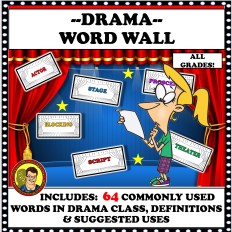
There are many processes students can  use to learn these words.  If you pick up my Word Wall product, I’ve included several different ways to learn the vocabulary words.

Teach by osmosis!  What’s that, you say?  Learning by proxy, or being exposed to someone, can naturally achieve an unconscious assimilation of ideas, vocabulary, knowledge and even technical skills. It’s called osmosis.

A teacher could share a vocabulary word each day. Start the day with the word and even demonstrate it.  Honestly, you will be surprised how quickly the students will learn them using osmosis. Just by seeing, demonstrating themselves and writing them, they’ll learn many of these words as if by magic.

++++++++ I am sorry there aren’t more words and their definitions listed here. I think students were coming here and filling out their vocabulary and definition sheet list and not finding the words and their definitions on their own.

Tsk, tsk. So, I edited the list to give you a basic idea..

My theater vocabulary list for the classroom

Actor to Choreography:

Actor    A male  person who performs a role in a play, work of theatre, or movie

Actress     A female person who performers in a role in a play, work of theatre, or movie.

Apron    The section of the stage floor which projects towards or into the auditorium. In proscenium theatres, it’s the part of the stage in front of the house tabs, or in front of the proscenium arch, above the orchestra pit

My Theatre Vocabulary List for the Classroom (Example)

Cast       A set of actors in a play

Catharsis    A moment of high tragedy at the emotional climax of a play is followed by an emotional cleansing for the characters and the audience

Chanting     A word or phrase repeated for an effect

Character   A person in a novel, play, or movie

Are you considering becoming a teacher?  Check out this blog post Why is it Important to Create a Lesson Plan?

My theater vocabulary list for the classroom

If you are a student, sorry.  You are going to have to look up these words yourself to attain the rest of the defintions.

Looking for a lesson for tomorrow?  Pick up this one about Lin Manuel Miranda.

My Theatre Vocabulary List for the Classroom

My theatre vocabulary list for the classroom

I was looking around the internet and found this great blog post about the reasons it is important to know how to spell.

Everything is provided for you.  Check it out at: Word Wall


My Theatre Vocabulary List for the Classroom

The Reasons It’s Important to Learn to Spell

  • It develops reading skills: Knowing how to spell correctly helps children become better readers. If they don’t know how to spell a word, they’re more likely to guess at its meaning, rather than understand its true meaning. Additionally, being able to accurately spell words helps to build fluency and allow kids to read faster.
  • It enhances writing skills: Knowing how to spell words correctly helps children become better writers as well. When they’re able to accurately spell words, they can express their thoughts and feelings more clearly, resulting in stronger writing overall.
  • It builds confidence: Being able to accurately spell words is a great confidence booster for primary school kids. Knowing that they can spell words correctly helps them become more confident readers and writers.
  • It improves vocabulary: Learning how to spell words correctly helps children learn the meanings of unfamiliar words and increase their vocabulary. This can be very beneficial for them in the future as they continue their education.
  • It helps with concentration: Spelling correctly requires focus and concentration, both of which are important skills for primary school children to learn. By mastering spelling, kids will be able to transfer these skills to other areas of their studies as well.
  • Ultimately, spelling is an essential skill for primary school children to learn. Not only does it help them become better readers and writers, but it also boosts their confidence, expands their vocabulary, and helps them develop concentration skills. Therefore, it’s important that primary school kids take the time to practice their spelling regularly.

Instead of copying all of these words and making printables for your students, there are 64 in this product! Check out this WORD WALL:

My Theatre Vocabulary List for the Classroom

First African American to Win National Spelling Bee

Have you heard of Zaila Avant-garde?  The multitalented teenage phenomenon Zaila Avant-garde, became an overnight sensation with her Scripps National Spelling Bee win at the age of fourteen, when she became the first African American contestant to win. Zaila Avant-garde, now sixteen, will add “author” to her already-impressive list of accolades that includes: 2021 Scripps National Spelling Bee champion, 2021 Sports Kid of the Year by Sports Illustrated Kids; and two-time Guinness World Record holder for feats related to her basketball prowess.

Her books, IT’S NOT BRAGGING IF IT’S TRUE: HOW TO BE AWESOME AT LIFE, a non-fiction middle-grade and a picture book, WORDS OF WONDER FROM Z TO A, a children’s picture book, will be published on June 27, 2023, by Doubleday Books for Young Readers and edited by VP, Editor-in-Chief Frances Gilbert.

Pick up my Drama Word Wall.  Everything is provided for you.  Check it out at: Word Wall or you can pick up posters (some are FREE) for your classroom, too!  Growth Mindset Posters and Vocabulary

I hope this helps you.  Please feel free to contact me at DhcBaldwin@gmail.com or DeborahBaldwin.net

Want some more help in the classroom? Check out my FREE Guide and ten page lesson Here 

woman behind DramaMommaSpeaks

Share this:

  • Share on Tumblr (Opens in new window) Tumblr
  • More
  • Share on X (Opens in new window) X
  • Share on Facebook (Opens in new window) Facebook
  • Share on Pinterest (Opens in new window) Pinterest
  • Share on LinkedIn (Opens in new window) LinkedIn
  • Email a link to a friend (Opens in new window) Email
  • Share on Reddit (Opens in new window) Reddit
  • Share on Telegram (Opens in new window) Telegram
  • Share on WhatsApp (Opens in new window) WhatsApp

Like this:

Like Loading...

Filed Under: Arts, arts education, arts integration, creative dramatics, creative movement, drama education, Education, elementary, excellence in teaching, High School, middle grades, Musical Theatre, performing arts, Play, Professional Theatre, Radio Theatre, Teacherspayteachers, Teaching, youth theatre Tagged With: drama terminology, drama terms, drama vocabulary, spelling words, theatre terminology, theatre terms, word wall

Is In the Heights The Next Big Thing in Movie Musicals?

June 9, 2021 By dhcbaldwin Leave a Comment

Pink, yellow and purple streamers about In the Heights

Is In the Heights The Next Big Thing in Movie Musicals

The first time I saw In the Heights on the Tony awards I wasn’t sure I would relate to it and enjoy it.

However, when it toured through Denver we had a chance to grab some last minute tickets to see the production and wow!

I loved it!

Its fresh outlook, fabulous music, incredible dancing and story won me over right from the beginning.

I think we will all be thrilled with the new movie version.  The reviewers are raving about it!  Check out In the Heights on Broadway 

In the Heights

What is the story of In the Heights?

From Broadway.com:

In the Heights tells the universal story of a vibrant community in New York’s Washington Heights neighborhood – a place where the coffee from the corner bodega is light and sweet, the windows are always open, and the breeze carries the rhythm of three generations of music. It’s a community on the brink of change, full of hopes, dreams, and pressures, where the biggest struggles can be deciding which traditions you take with you, and which ones you leave behind.

What makes In the Heights so long awaited?

Where do I begin to answer this question.

I create drama education lessons and In the Heights was one of the first Broadway musicals which I examined. Although I greatly enjoyed the musical, I never thought about the elements which would be terrific to teach in the classroom. Oh. my. gosh!

Five Reasons to See In the Heights


1.Family viewing--First, the show is suitable for your family, ages 11 and up.  That’s a big plus because it means the family could have a special outing and see the film together.  Hooray! (If you parents are okay with just a little language, then you can see it without any trepidations.)

2. Message–An important part of a play or musical is its message.  In the Heights doesn’t disappoint in this manner                with a message of hope and optimism.  Don’t we all need hope?

The Next Big Thing in Movie Musicals

3. Setting–Many areas of New York City are hotbeds of cultural exchange and diffusion, and Washington Heights is no           exception. This neighborhood has transformed drastically over the years as the majority ethnic group in the area                     changes. Today, the large majority of residents are hispanic, and thus, the neighborhood is sometimes referred to as              “Quisqeya Heights,” referring to a municipality in the Dominican Republic. While traces of previous cultures remain such           as the Jewish population and the Irish and Germans, the area is extremely rich in Latino food, religion, events, and                   languages.

4. Diversity--How refreshing to see a musical about a very vibrant and important culture in our country.  The Latino               people deserve some recognition for their presence here and I, for one, am thrilled to see this!

5. Music–How can you beat Lin-Manuel Miranda’s music?  Clever, appropriate, spicey in all the good ways.

6. Dancing--Have you seen the dancing? Chris Scott’s choreography is spot on.  If you aren’t familiar with him,                       Christopher   Scott is a three-time Emmy-nominated choreographer whose bold routines and fearless creativity step             beyond the traditional boundaries of dance. He is most recognized for his innovative hip-hop duets and signature group routines that fuse dance styles on Fox’s SO YOU THINK YOU CAN DANCE.  Here’s an example of his work from the movie trailer:  https://www.youtube.com/watch?v=V4CRPvel2Vc

The Origin of In the Heights

Miranda wrote the earliest draft of In the Heights in 1999 his freshman year of college. After the show was accepted by Wesleyan University’s student theater company Second Stage, Miranda added “freestyle rap … bodegas, and salsa numbers.”[

It played from April 27 to 29, 2000 as an 80-minute, one-act show that reportedly sounded like “A hip-hop version of Rent“. After seeing the play, two Wesleyan seniors and two alumni, John Buffalo Mailer, Neil Patrick Stewart, Anthony Veneziale and Thomas Kail, approached Miranda and asked if the play could be expanded with a view to a Broadway production. In 2002, Miranda worked with director Kail and wrote five separate drafts of In the Heights.Book writer Quiana Alegría Hudes joined the team in 2004.

The rest, as they say, is history….

In the Heights Broadway Musical Lesson

As I mentioned, I have a lesson about In the Heights.  In fact, I have several–one is a PDF, one is digital and one is for the Google classroom.  

This two-day lesson focuses on the Tony award winning In the Heights musical. In the Heights tells the story of a vibrant Hispanic community in New York’s Washington Heights neighborhood. Students have an opportunity to become very familiar with the production itself and its journey to Broadway.

The lesson can stand alone or be combined with one of my Famous Artist Biographies (Lin Manuel Miranda or Sarah Bareilles for example) or other musical lessons (Hamilton or The Wiz)

Wicked the Musical Broadway Musical Lesson

HOW DO I USE THIS LESSON IN MY CLASSROOM? A drama, music, reading or a language arts class would enjoy this lesson. Study its music, story line, elements, cultural references–you name it!

The lesson contains:

  • Letter to Teacher
  • Warm Up–MY Version of a Popular Acting Exercise
  • Teacher’s Script–What I Say and How I Say it!
  • Photos of Lin Manuel Miranda
  • Synopsis of the Musical
  • Plot of the Musical
  • Short Biography about Lin Manuel Miranda, book writer Quiara Alegria Hudes and choreographer Andy Blankenbuehler
  • Separate File of Photos for Teacher’s Use in Lecture
  • History about the Origination of the Production
  • AND a Mini Lesson on: What are the Tony Awards?
  • List of Tony Awards
  • New York City Map with Competing Theaters Labeled
  • Student Note Page
  • Teacher Note Page Key
  • Trivia about Broadway and In the Heights
  • Songs List
  • Pinterest Board Link Specifically about In the Heights
  • Extension Activities– NINE Terrific Suggestions of Ways to Secure the Learning and Enrich the Experience either Individual or Group
  • Sources & Links to Film Clips from the Show
  • And More!

I can’t believe In the Heights first opened on Broadway in 2008!  It just seems like yesterday when my husband and I left singing and dancing our way to the parking lot afterward.  (That’s a great memory for us.)

If you’d like more information about Lin-Manuel Miranda or my Hamilton lesson, check out these posts Hamilton the Musical: A Drama Lesson with a Unique Perspective or want to have your students create their own musical (at least the beginning steps), check out Create Your Own Musical

In the Heights opens in select theaters on June 4, 2021.   It’s full of wonderful elements, themes and messages which we all need to hear. What do you like most about the show?  You know, I’d love to hear your thoughts.  Contact me at DhcBaldwin@gmail.com or DeborahBaldwin.net.

woman behind DramaMommaSpeaks

Wicked the Musical Broadway Musical Lesson


Share this:

  • Share on Tumblr (Opens in new window) Tumblr
  • More
  • Share on X (Opens in new window) X
  • Share on Facebook (Opens in new window) Facebook
  • Share on Pinterest (Opens in new window) Pinterest
  • Share on LinkedIn (Opens in new window) LinkedIn
  • Email a link to a friend (Opens in new window) Email
  • Share on Reddit (Opens in new window) Reddit
  • Share on Telegram (Opens in new window) Telegram
  • Share on WhatsApp (Opens in new window) WhatsApp

Like this:

Like Loading...

Filed Under: Arts, arts education, arts integration, community theater, community theatre, creative dramatics, creative movement, drama education, e-learning, Education, excellence in teaching, middle grades, Musical Theatre, performing arts, plays, Teacherspayteachers, theater, theatre Tagged With: acting, dancing, in the heights, movie musical, musical movies, New York, singing

« Previous Page
Next Page »

Footer

Follow Us

logo3.png

FOLLOW US

Facebook X-twitter Pinterest Instagram Envelope Rss

Goodreads: read

Malibu Rising
Malibu Rising
by Taylor Jenkins Reid
People We Meet on Vacation
by Emily Henry
The Last Thing He Told Me
by Laura Dave
Faking It
Faking It
by Cora Carmack
Losing It
Losing It
by Cora Carmack

goodreads.com
Copyright © 2024 · Wellness Pro on Genesis Framework · WordPress.com.Log in
 

Loading Comments...
 

    %d