• Skip to primary navigation
  • Skip to main content
  • Skip to footer

Join Me in my new Facebook Group! https://www.facebook.com/groups/417126059784261

Menu
  • Meet Deb – The Heart Behind DramaMommaSpeaks
    • Work with Me! 
    • Photo Gallery of DramaMommaSpeaks
    • Directorial Credits
  • I Give Book Talks! 
    • Book Talk Through Skype
    • Books
  • Freebies!
  • Bumbling Bea
  • Teaching Resume
  • Acting Resume
  • Contact Me
  • Blog
    • Drama Education
    • Arts Education
    • Youth Theatre
    • Middle Grades
    • Musical Theatre
    • Teaching
  • Meet Deb – The Heart Behind DramaMommaSpeaks
    • Work with Me! 
    • Photo Gallery of DramaMommaSpeaks
    • Directorial Credits
  • I Give Book Talks! 
    • Book Talk Through Skype
    • Books
  • Freebies!
  • Bumbling Bea
  • Teaching Resume
  • Acting Resume
  • Contact Me
  • Blog
    • Drama Education
    • Arts Education
    • Youth Theatre
    • Middle Grades
    • Musical Theatre
    • Teaching

creative movement

Middle School Drama Success: Choice Boards in Action

October 18, 2023 By dhcbaldwin Leave a Comment

Students studying with an ipad

Middle School Drama Success: Choice Boards in Action

If you are like me, you like to make choices for yourself.  That’s one of the cool things about being an adult, don’t you think? We make a lot of choices for ourselves. However, our students don’t have the opportunity to make decisions for themselves very often.  Let’s help them learn how to do so while learning from the subjects that interested them.  Today I’m going talk about setting the Stage for Success: Middle School Drama Meets Choice Boards.

Middle School Students are the Best

Middle School Drama Success: Choice Boards in Action

Middle school students are my favorite grades to teach.  In particular, they are vibrant, still curious and resilient.  Personally, I believe that teaching  middle school theater is the door to nurturing young talents. I find they are intensely interested in many subjects at this age.  Plus, creativity knows no bounds, and their self-expression takes center stage.

Middle school students can be engaged far faster than high school students.  They are just young enough to remember their beloved elementary teachers who they trusted.  Consequently, they quickly trust you when you propose an concept to them. Read this post, if you’d like more of my reflections about middle school students: Striking a Balance with Students in Their Middle School Years

In the heart of this theatrical journey lies a powerful tool – choice boards. Imagine giving your students the freedom to explore and make decisions in their drama education. First, let’s dive into how these versatile tools can breathe life into your drama classroom.

Setting the Stage for Success: Middle School Drama Meets Choice Boards

What Are Choice Boards?

Choice boards are visual organizers that present students with a variety of options for how they can engage with and demonstrate their learning. Consequently, they empower students to take ownership of their education by allowing them to choose activities that resonate with their interests, learning styles, and abilities.

Why Do Teachers Use Choice Boards in Drama?

  1. Individualized Learning: Middle school students are at an age where they’re discovering their unique talents and interests. Choice boards offer a range of activities, catering to diverse learning styles and abilities.
  2. Enhanced Engagement: When students have a say in their learning, they’re more invested in the process. Drama is all about passion and expression, and choice boards can ignite that spark.
  3. Creativity Unleashed: Drama thrives on creativity. Choice boards encourage students to think outside the box, explore different aspects of theater, and come up with fresh ideas.
  4. Differentiated Instruction: Drama classrooms often have a mix of skill levels. Choice boards allow the teacher to provide activities that cater to both beginners and experienced performers. Additionally, it’s effortless for the teacher to do so.

Did you know I have the secret to boosting student engagement?  My new book, “We’re Live! Radio Theater #101” explains my journey to implementing this unique tool in the classroom. Check it out here

Middle School Drama Success: Choice Boards in Action

Benefits for Drama Students

Implementing choice boards in your middle school drama classroom can lead to:

  • Increased Confidence: Students gain confidence as they engage in activities that align with their interests and strengths. It is far easier to be successful when learning something new if you are interested in the subject.  What a plus!
  • Broadened Horizons: Exposure to a variety of drama aspects can help students discover new passions within the world of theater.  As a matter of fact, my Choice Board products receive many 5 star reviews. In addition, teachers express their excitement to have taught something unique to their students which they would not have the time to study in depth.
  • Ownership of Learning: Empowering students to make choices fosters a sense of ownership over their education. Here’s that choice thing again.  By making choices for themselves, students see themselves as independent and capable.  Aren’t those attributes we want for them?
  • Joy in Learning: Drama should be fun! Choice boards infuse a sense of joy and excitement into the classroom. I think we’d all agree it’s difficult to compete with fun, yes?

Middle School Drama Success: Choice Boards in Action

My Choice Board Resources

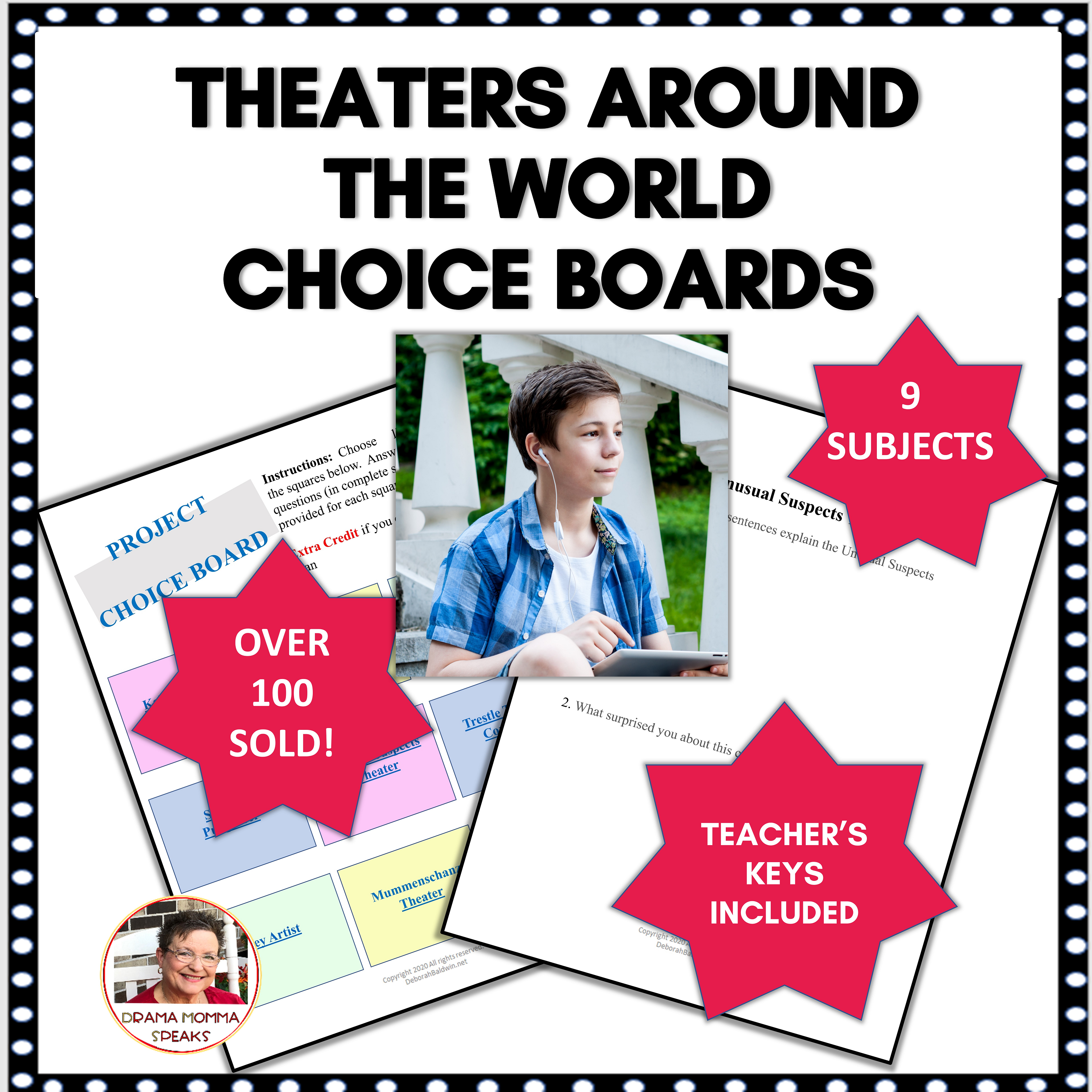
I have three choice board resources ready for you to use.  One pertains to theaters around the world.  This low prep- high student engagement lesson gives students an opportunity to learn about various theater companies such as Mummenschanz, Deaf West, Trestle Theatre, Kabuki Theater,Marcel Marceau or what is means to be a Foley Engineer. Additionally, they are excellent for gifted learners or students who need independent study or an alternative assignment.

Got some introverted students in your class?  Check out: Drama Games for the Introvertive Student 

The resource includes:

  • Teachers Letter
  • 9 Choices on a colorful board which can be displayed on a white board
  • 21 Questions–no sets of questions are alike
  • Teacher’s Key–hooray! (many possible answers are included for each clip)
  • Live Links– ready to go

Middle School Drama Success: Choice Boards in Action

Another choice board product concerns technical theater. This product is wildly popular!

This resource includes:

  • Teacher’s Letter
  • 9 Choices on a colorful board which can be displayed on a white board
  • 48 Questions–no two set of questions are alike (shows–Wicked, Hamilton, Spongebob Squarepants, War Horse, School of Rock)
  • Teacher’s Key–hooray!
  • Live Links– ready to go

The third is brand new.  You know how your students become chatty when you are focused on a small group and their rehearsal?  This is the answer to your problem.  Students learn about virtually every aspect of play or musical production from designing poster, drawing a costume or creating a movement piece concerning one of the themes of the production.  Students can be assigned to complete every choice or only a few.

Play production choice board cover

This board has 16 engaging assignments to keep everyone interested and busy creating.  There is plenty of room for individuality and some group work, too.  You can find it at:  Drama Class Production Choice Board

Looking for something free?  Pick up this one.

Middle School Drama Success: Choice Boards in Action

An Alternative Choice Board Format

If your students do not have I-pads,  access to the computer or WIFI, a teacher can use these resources instead. They are basically the same as the Choice Boards, however a student receives the link from the teacher. These are excellent for a substitute to use, too.

Middle School Drama Success: Choice Boards in Action        Middle School Drama Success: Choice Boards in Action

Students could vote on the subject they’d like to learn about and view the video clips which pertain to that subject.  Accordingly,  students are assigned to watch the video clips on their own at home.  You will find these products here.

Incorporating choice boards in your middle school drama classroom is like handing the spotlight to your students. It allows them to explore, express, and create in ways that resonate with their unique personalities. So, go ahead and embrace this dynamic tool to ignite the passion for drama in your middle school students’ hearts. The stage is set, and the choice is theirs!

Have you used Choice Boards in your classroom?  I’d love to hear how you have used them.  Feel free to email me at DhcBaldwin@gmail.com
Woman behind DramaMommaSpeaks


Share this:

  • Click to share on Tumblr (Opens in new window) Tumblr
  • More
  • Click to share on X (Opens in new window) X
  • Click to share on Facebook (Opens in new window) Facebook
  • Click to share on Pinterest (Opens in new window) Pinterest
  • Click to share on LinkedIn (Opens in new window) LinkedIn
  • Click to email a link to a friend (Opens in new window) Email
  • Click to share on Reddit (Opens in new window) Reddit
  • Click to share on Pocket (Opens in new window) Pocket
  • Click to share on Telegram (Opens in new window) Telegram
  • Click to share on WhatsApp (Opens in new window) WhatsApp

Like this:

Like Loading...

Filed Under: arts education, arts integration, creative dramatics, creative movement, drama education, drama integration, Education, middle grades, Teacherspayteachers, Teaching, teaching strategies Tagged With: choice boards, Deaf West, differentation, Hamilton, Kabuki Theater, Marcel Marceau, Mummenschanz, School of Rockical, spongebob squarepants, Trestle Theatre, War Horse, Wicked

Unlocking the Secrets of Elementary Theater Class: A Comprehensive Guide

June 14, 2023 By dhcbaldwin Leave a Comment

two boys making funny faces for the camera

Unlocking the Secrets of Elementary Theater Class: A Comprehensive Guide

At this time of year, many newly employed teachers are perusing the internet for lessons for their classes.  Today I’m going to discuss unlocking the secrets of elementary theater class: a comprehensive guide.

A little history about me–My first job was as an English teacher in a junior high school.  Bear in mind that I was certified to teach English, but had never taught it or even experienced teaching it as a student teacher. My student teaching was in theater which in the 1970s was almost unheard of in the mid-west.

Anyway,  I remember they gave me this HUGE book with all of the benchmarks or objectives I was to reach.  It was so full of jargon, I had to sit and translate it into layman’s English.  Finally, I got the hang of it.

My Teaching Journey

When I began teaching middle school theater in the mid 90s (yikes), no one seemed to be clear on what they wanted me to cover.  I came into the position with twenty years of teaching and directing experience outside the classroom, so I knew what to do in those circumstances. Continuing in this position for thirteen years, we then moved to Estes Park, CO which was a dream we never thought would occur.  We loved it!

While in Colorado for six years,  I taught a creative dramatics class to second through fifth  grade students in a home school enrichment program called Apex Home School Enrichment.   The classes were fifty-five minutes in length, once a week.  I saw around 175 students a week over three days. Because I came to the position with so much teaching experience, it was very easy for me to create a curriculum , because I knew what worked and what didn’t.  I hope I can pass along some of this experience to you now.

Unlocking the Secrets of Elementary Theater Class: A Comprehensive Guide

Unlocking the Secrets of Elementary Theater Class: A Comprehensive Guide

To be frank, there are good and not-so-good parts of being the only theater teacher in a school.  The good is that you can make your own decisions as to the content you teach without having to go through a department chair for their approval.  The greatest challenge I believe is that because you are alone in teaching the subject, you don’t have anyone to bounce ideas off of who truly understands what you are teaching.

I know what that’s like.  Having taught for over thirty-eight years, I’ve felt alone many times in my career.  Plus, when you are just starting out its easy to become overwhelmed by all the necessary details.  You probably say to yourself, do I have to create all these lessons all by myself.  The answer is no.

Unlocking the Secrets of Elementary Theater Class: A Comprehensive Guide

Where can I find creative dramatics lessons?

You can join some fancy membership website and spend a lot of money buying lessons you may ever need. Maybe you purchase the membership at the beginning of the year because it sounded like a really good deal.  And maybe it is.  Perhaps you discover after assessing your students for a week or so that this website doesn’t offer what you need. You feel stuck because you paid your money and well, the lessons will suffice.

There is nothing worse than the nagging feeling that you are not doing something especially useful for your students. I’ve been there and I understand.  I bet deep in your soul you know these are not the lessons your students need and really, you need to work ala carte! You want to pick and choose what you cover with your students, planning a month or two at a time.  Check out my latest article in One Classroom Over magazine.

Many times when teaching elementary students, in my opinion, there is too much emphasis placed on the wrong aspects of theater. The secret to unlocking curriculum is go right to ala carte! 

Unlocking the Secrets of Elementary Theater Class: A Comprehensive Guide

Here are some things you do not need to cover:

  1.  Scene study
  2.  Monologues
  3.  Writing a play
  4.  A comprehensive study of the history of theater
  5.  Memorizing large quantities of lines
  6.  Performing in a play longer than fifteen minutes
  7.  Performing in a musical longer than 30 minutes
  8.  Stock characters–Greek and Roman theater helped flesh out stock characters as a concept, but many of the ones we have now would  not originate until much, much later.

When I taught these creative dramatics  lessons in this particular order I began with the easiest concepts and progressed to the most challenging. This was a pass/fail course.  I gave a daily participation grade as well.

Unlocking the Secrets of Elementary Theater Class: A Comprehensive Guide

Here are some concepts they do need to study:

  1. Tableau (1 day)–Tableau is a staple of theater and a non-threatening concept which beginning theater students can learn. Students learn how to make stage pictures (which is one of the basic of directing as well), however they don’t have to say anything. You can find my tableau lessons here:
  2. . Chanting (1 day)–Chanting, (in my TPT store) or a repeated word or phrase used to illicit an effect is the second component I teach novices. Got some questions about teaching middle school? You can also find it in my Made by Teachers store at: Chanting
  3. Movement (2 days)–Just like tableau, students enjoy creative movement because there is no speaking.  Plus, it does a great job of giving students some physical exercise which they sorely need.
  4. Storytelling–(3 days) To learn to tell a story with all of its parts (beginning, middle and end, etc.) is an important skill. You can also find it in my Payhip store at: Storytelling Unit 
  5.  Parts of the stage–(1 day) Students have a difficult time understanding these labels unless they are learned right along with performing. So, keep that in mind.
  6. Improvisation (2 days)–Some advice for you: never begin your year by throwing students into improvisation.  It’s terribly difficult for the novice actor or those who are reluctant about the class.  Build up their trust for at least a month. Take it in baby steps. Try this drama circle for Halloween!
  7. Mask making (2 days)–Students enjoy creating masks and using them in movement pieces or to create a character. My advice?  Use animal masks which are premade or they can create their own.
  8. Costume Design (2 days)–Who doesn’t like costume design?  Depending upon the time of year, I like to teach about costume design with a thematic approach. In this case, it’s Halloween characters or teach with fairy tale characters.
  9. Components of a Stage (1 day) –It’s best to teach these positions as students study set design so they can apply the information you give them.
  10. Set Design (2 days)– Teaching how to draw a rendering of a set is super useful and fun!
  11. Stage Properties (4 days)–Creating and making a stage prop is a magnet for student engagement.  Maybe you can make a prop which is used in the class play, such as snowflakes for a play, Ojisan and the Grateful Statues which is set in winter.
  12. Performance (1 week) You can choose to direct your students in a short one act class play, readers theater or a radio theater play-I liked to switch it up every now and then using something different.   Word of caution–don’t have one class performing a play while the others are studying radio theater.  You will make yourself crazy.
  13. Audience etiquette (weekly)–You can teach how to be a good audience member every day if you like.  Reminding students of what a quiet, attentive audience looks like goes a long way with them.
  14. Warm up Exercises–You can never go wrong with a good warm-up exercise.  Here is one which always works–Firecracker Freeze Tag

If you’d like you can purchase a bundle of them at a discounted cost right here: Theater Arts Lessons for Grades 3 to 5

Unlocking the Secrets of Elementary Theater Class: A Comprehensive Guide

Unlocking the Secrets of Elementary Theater Class: A Comprehensive Guide

In 2018, I opened my store on Teacherspayteachers.com.  My plan was to recoup the pension I lost by staying home with our daughters when they were very young.  I understood that I would lose half of my pension at the time of my retirement, but to this day I have no regrets.  This was a real privilege and I’m aware that many educators don’t have the luxury to do the same.  To this day, I know our daughters almost as well as they do themselves because I was with them when they were young. I treasure that. The aforementioned words in blue are links to my resources which you are welcome to use in your classroom.

If you need defenses for your lessons, check out National Core Arts Standards: A Conceptual Framework for Arts Learning

Do you have any questions?  One feature of my business is that I am available for any teacher who needs a bit of advice or direction for their theater class, no matter the grade level.  You can find me at DhcBaldwin@gmail.com

Unlocking the Secrets of Elementary Theater Class: A Comprehensive Guide


Share this:

  • Click to share on Tumblr (Opens in new window) Tumblr
  • More
  • Click to share on X (Opens in new window) X
  • Click to share on Facebook (Opens in new window) Facebook
  • Click to share on Pinterest (Opens in new window) Pinterest
  • Click to share on LinkedIn (Opens in new window) LinkedIn
  • Click to email a link to a friend (Opens in new window) Email
  • Click to share on Reddit (Opens in new window) Reddit
  • Click to share on Pocket (Opens in new window) Pocket
  • Click to share on Telegram (Opens in new window) Telegram
  • Click to share on WhatsApp (Opens in new window) WhatsApp

Like this:

Like Loading...

Filed Under: arts education, arts integration, creative dramatics, creative movement, drama education, drama integration, Education, elementary, performing arts, Radio Theatre, readers theater, storytelling, Teacherspayteachers, Teaching, youth theatre Tagged With: chanting, costume design, movement, mulicultural plays, readers theaterplay production, set design, storytelling

9 Compelling Reasons Why You Need Lessons Using Super Heroes

April 18, 2023 By dhcbaldwin Leave a Comment

9 Compelling Reasons Why You Need Lessons Using Super Heroes

Have you ever experienced a “Eureka” moment while teaching?  You know those moments where everything just clicks and everyone is surprised, especially you? In this case it was super heroes. Let’s talk about 9 compelling reasons why you need lessons using super heroes.

I’ve shared several times that I taught a pre-elective drama class to sixth graders for thirteen years.  If you’d like more information about that time, check out: How to Make Your Drama Class More Successful –Lessons Learned from 38 Years of Teaching-Middle School.  One of the most exhausting parts of it was the constant lesson planning.

If you are at all like me, you know that the “lesson planning monkey” on your back is demanding. And relentless.  Finally, in desperation one week, I took a stab and did something completely spontaneous with my students.  I used super heroes in all my lessons for a week.  The students were thrilled and I was, too!

Many super heroes grouped together

Did you know that super heroes have been a part of our world for nearly one hundred years?

During the late 1930’s to 1950’s, the Golden Age of Comic Books were created. Modern comic books were first published and rapidly increased in popularity among the masses. The superhero archetype was created and many well-known characters were introduced, including Superman, Batman, Captain Marvel, Captain America, and Wonder Woman. Most superheroes served as a figure who inspired hope. This hero could save us all from dark and difficult times. Superhero stories promote the ideas of peace, safety and freedom. Some experts consider this message a necessary reassurance in difficult times. The message isn’t about a country succeeding, but recognition that there are others with similar hope for a peaceful future

If I’ve convinced you to consider utilizing super heroes in your teaching, read on!

9 Compelling Reasons Why You Need Lessons Using Super Heroes

When I began writing this blog post, I ran on to a wonderful website, Momjunction.com who stated:

Reason #1: Superhero play gives kids the chance to pretend to be strong and invincible,

Reason #2: They encourage students to make new friends and helps them develop an identity outside of real life.

Reason #3: Super heroes  help children explore moral values and dilemmas and to establish what they and others perceive as right and wrong.

Reason #4: They help children build their confidence. Exposing students to the fantastic world of superheroes may help them come out of the shell and encourage them to face the world with renewed confidence.

Reason #5: Also, they act as role models. Superheroes can be good role models as they teach children various attributes such as courage, honesty, humility, fighting spirit, sense of responsibility, and leadership.

Reason #6: Super heroes instill compassion. Because they are aware of their superiority, it gives the a different perspective on others.  They know that they could destroy most everything and everyone.  Consequently, they understand their actions–both physical and emotional are not only necessary but need to be governed at all times.

What Superheroes Teach Us About Strength, Teamwork, and Joy

Reason #7: They teach willpower and courage.  Super heroes don’t give up at the first failure.  They keep trying until they read their goal.

Reason #8: As you might expect, they  model teamwork.  When super heroes work together they know they must share the burden of the challenge and employ the best in each other. All team members respect each other’s opinions and capabilities while collectively working towards the common goal.

Reasons #9 They are just plain fun.  Super Heroes and their quests take us to a different place in our imaginations where anything is possible. Pick up some fun supplies for your super hero week here: Super Hero Teaching Supplies

Have I convinced you yet to use super heroes in your teaching?

This is How I Can Help You

Maybe you need some ready-made lessons?  I have a brand new Dramamommaspeaks store where you can purchase a few lessons with a superhero theme.

Each lessons focuses on a different theme–playwriting (the monologue), tableau and movement, costume design and storytelling.

A teacher could use them as is in their drama classroom or a reading teacher could integrate them into a unit about super heroes.  Usually students in grades 5 to 8 enjoy them the most, but you know your students the best so you decide.  You can purchase them at Payhip.com or Teacherspayteacher.com.

My Teaching Style

You may find my lessons to be quite unique–there’s a reason.  Since I taught theater classes for nearly forty years, I had the rare opportunity to watch theater subjects unfold and change over many years.  I got to see first hand what worked and what wasn’t so successful.  For instance, there was a time when we didn’t even try to teach technical theater, but now we have lots of units about them.

During this time, I noticed that middle and elementary teachers were using themed units to teach particular concepts or objectives. The students appeared very excited by them.  Hence, when I was exhausted from planning I turned to using themes to teach theater concepts and it worked wonderfully. Here is one for Halloween: Halloween Drama Lessons and Units 

If you want to learn more about how to integrate drama into your classroom, check out: How to Excite Students With Drama Integration

What are some themed units you’ve taught?  I’d love to hear about them.  Email me at DhcBaldwin@gmail.com and let’s chat!

Woman behind DramaMommaSpeaks

Share this:

  • Click to share on Tumblr (Opens in new window) Tumblr
  • More
  • Click to share on X (Opens in new window) X
  • Click to share on Facebook (Opens in new window) Facebook
  • Click to share on Pinterest (Opens in new window) Pinterest
  • Click to share on LinkedIn (Opens in new window) LinkedIn
  • Click to email a link to a friend (Opens in new window) Email
  • Click to share on Reddit (Opens in new window) Reddit
  • Click to share on Pocket (Opens in new window) Pocket
  • Click to share on Telegram (Opens in new window) Telegram
  • Click to share on WhatsApp (Opens in new window) WhatsApp

Like this:

Like Loading...

Filed Under: arts education, arts integration, community theater, community theatre, creative dramatics, creative movement, drama education, Education, Education, elementary, English Language Learners, excellence in teaching, High School, middle grades, Teacherspayteachers, teaching strategies, theater, theatre, youth theatre Tagged With: costume design, movement, playwriting, Spider Man, storytelling, super hero lessons, super heroes, super man, tableau, Wonder Woman

8 Must-Haves for Your Middle School Theater Scope & Sequence

September 21, 2022 By dhcbaldwin Leave a Comment

A group of middle school kids looking down at the camera.

8 Must-Haves for Your Middle School Theater Scope & Sequence

Today I’m going to talk about the eight things you should include in your Middle School Theater Scope and Sequence. Obviously, this is my point of view on the subject. If you are new to my blog, welcome! I’m quite flattered that you’d check me out.

8 Must-Haves for Your Middle School Theater Scope & Sequence

My First Teaching Experience with Middle School 

My first job was as an English teacher in a junior high school.  Bear in mind that I was certified in English, but had never taught it or even had any time as a student teacher. My student teaching was in theater which in the 1970s was almost unhear of in the mid-west.

Anyway,  I remember they gave me this HUGE book with all of the benchmarks or objectives I was to reach.  It was so full of jargon, I had to sit and translate it into layman’s English.  Finally, I got the hang of it.

When I began teaching middle school theater in the mid 90s (yikes), no one seemed to clear on what they wanted me to cover.  I came into the position with twenty years of teaching and directing outside the classroom, so I knew what to do in those circumstances.

However, teaching theater in a school was different than that. In the particular school I taught theater all those many years ago, I spent about a year trying out ideas until I perfected what I thought would be successful with the students. Looking for a free biography and one pager assignment about Lin Manuel Miranda?


8 Must-Haves for Your Middle School Theater Scope & Sequence

A Thirteen Year Middle School Teaching Adventure

For thirteen years,  I taught a pre-elective theater class to sixth grade students–all 450 of them.  (Yes you read that correctly.) I had twenty-five days to fill with the many subjects of theater which was great fun but also rather challenging.  My tendency was to perfect something when we found it to work, but the students and I just didn’t have the time to do so since they moved to the next pre-elective class.

After thirteen years of this teaching load, I had completely topped out on what I could teach them.  At this point, we moved to Colorado and I took a part time speech and theater middle school job–completely different and chaotic. But that’s a blog post for another day.

In 2017, I began my store on Teacherspayteachers.com.  My plan was to recoup the pension I lost by staying home with our daughters when they were very young.  I lost half of my pension when I made that decision, but to this day I have no regrets.  I know our daughters almost as well as they do themselves.

8 Must-Haves for Your Middle School Theater Scope & Sequence

My Middle School Scope and Sequence Curriculum

People purchase my middle school drama curriculum a lot.  I’m very glad I can help them, but it never dawned on me that maybe I should include a scope and sequence with the units. Here I am today providing that guidance for you.

I taught these lessons in this particular order beginning with the easiest concepts and progressing to the most challenging. This was a pass/fail course.  I gave a daily participation grade as well.

1. Tableau (1 day)–Tableau is a staple of theater and a non-threatening concept which beginning theater students can learn. Students learn how to make stage pictures (which is one of the basic of directing as well), however they don’t have to say anything. You can find my tableau lessons here: Tableau Lesson

2. Chanting (1 day)–Chanting, or a repeated word or phrase used to illicit an effect is the second component I teach novices.

Engaging Activities to Inspire Creativity and Collaboration

3. Costume Design (2 days)–Who doesn’t like costume design?  Depending upon the time of year, I like to teach about costume design with a thematic approach.  You’ll have to check out my Halloween Costume Design Lesson here.

4. Movement (2 days)–Just like tableau, students enjoy movement because there is no speaking.  Plus, it does a great job of giving students some physical exercise which they sorely need. You can find my lesson for movement here:  Movement

5.Kamishibai Storytelling (1 week)–Depending upon your assessments of you students and what they appear to engage with in your teaching, I like to use Kamishibai storytelling from time to time.  Have you never heard of Kamishibai?  Check it out here: Kamishibai Storytelling

8 Must-Haves for Your Middle School Theater Scope & Sequence
https://theconversation.com

6. Set Design (1 week)–Set Design units are super useful.  They incorporate not only designing the set, but building a model of it.  In addition, students work with a partner which is so good for teaching cooperative learning.

7. Performance (1 week) You can choose to direct your students in a short class play or a short radio theater play-I liked to switch it up every now and then with one or the other.  Word of caution–don’t have one class performing a play while the others are studying radio theater.  You will make yourself crazy.

8. Enrichment (1 day) If you need a substitute, or your school is having a day of shortened class periods, watching a video clip of theaters around the world or studying about a famous theater artist such as Lin Manuel Miranda does an excellent job of changing the pace or giving everyone a breather.

If you want a bundle of technical theater units for middle school, click here.

Or you want a REALLY BIG BUNDLE  of middle school drama units, click here.

Sometimes I’d throw in components such as stage properties or sound effects because quite frankly, I needed the change.

8 Must-Haves for Your Middle School Theater Scope & Sequence

Objectives I Met with This Scope and Sequence Theater Curriculum

Here are the National Core Arts Standards which I used.

Connecting

Conceiving and developing new artistic ideas and work.

  • Anchor Standard #1. Generate and conceptualize artistic ideas and work.
    Anchor Standard #2. Organize and develop artistic ideas and work.
    Anchor Standard #3. Refine and complete artistic work.

Performing

Performing (dance, music, theatre): Realizing artistic ideas and work through interpretation and presentation.

  • Anchor Standard #4. Select, analyze and interpret artistic work for presentation.
    Anchor Standard #5. Develop and refine artistic techniques and work for presentation.
    Anchor Standard #6. Convey meaning through the presentation of artistic work.

Responding

Understanding and evaluating how the arts convey meaning.

  • Anchor Standard #7. Perceive and analyze artistic work.
    Anchor Standard #8. Interpret intent and meaning in artistic work.
    Anchor Standard #9. Apply criteria to evaluate artistic work.

Objectives I Met with This Scope and Sequence Continued

8 Must-Haves for Your Middle School Theater Scope & Sequence

If you need Common Core Standards, here are a few of them which my guide completes.:

Grade 6

Key Ideas and Details:

CCSS.ELA-LITERACY.RL.6.1

CCSS.ELA-LITERACY.RL.6.2

CCSS.ELA-LITERACY.RL.6.3

Craft and Structure:

CCSS.ELA-LITERACY.RL.6.4

CCSS.ELA-LITERACY.RL.6.5

CCSS.ELA-LITERACY.RL.6.6

Integration of Knowledge and Ideas:

CCSS.ELA-LITERACY.RL.6.7
CCSS.ELA-LITERACY.RL.6.8
CCSS.ELA-LITERACY.RL.6.9

Range of Reading and Level of Text Complexity:

CCSS.ELA-LITERACY.RL.6.10

Are you looking for some information about how to design a lesson plan?  Check out this post: Why is it Important to Create a Lesson Plan?

Grade 7

Key Ideas and Details:

CCSS.ELA-LITERACY.RL.7.1.

CCSS.ELA-LITERACY.RL.7.2
CCSS.ELA-LITERACY.RL.7.3

Craft and Structure:

CCSS.ELA-LITERACY.RL.7.4.

CCSS.ELA-LITERACY.RL.7.5
CCSS.ELA-LITERACY.RL.7.6
CCSS.ELA-LITERACY.RL.7.7
CCSS.ELA-LITERACY.RL.7.8
CCSS.ELA-LITERACY.RL.7.9:

CCSS.ELA-LITERACY.RL.7.10

Did you know I have an Instagram account with virtually different information than my blog?  You can find it at: DramamommaSpeaks Instagram

Multicultural Folk Tales

A Word of Caution

In an effort to do a exemplary job at teaching, sometimes we teachers go overboard on what our students should learn. I’m not a big fan of scene study when students are in middle school or lower. Or even monologues. They simply do not understand it nor appreciate it. Unfamiliar with creative dramatics? Check out: Learn How to Teach Creative Dramatics in Your Lunch Hour

What I do encourage theater teachers of elementary and middle school to teach is using creative dramatics’ many facets. One could teach the components above, number one to five, and then apply them to a readers theater or short class play.  Here is one of my which would work well for this plan:  Inca Story The Magic Lake Readers Theater or The Brave Little Tailor play. 

I hope my guide helps you in your teaching of middle school theater class.  What do you like to include in your teaching? I’ve love to hear about it.  You can email me at DhcBaldwin@gmail.com.  Let’s chat!

Woman behind DramaMommaSpeaks

Share this:

  • Click to share on Tumblr (Opens in new window) Tumblr
  • More
  • Click to share on X (Opens in new window) X
  • Click to share on Facebook (Opens in new window) Facebook
  • Click to share on Pinterest (Opens in new window) Pinterest
  • Click to share on LinkedIn (Opens in new window) LinkedIn
  • Click to email a link to a friend (Opens in new window) Email
  • Click to share on Reddit (Opens in new window) Reddit
  • Click to share on Pocket (Opens in new window) Pocket
  • Click to share on Telegram (Opens in new window) Telegram
  • Click to share on WhatsApp (Opens in new window) WhatsApp

Like this:

Like Loading...

Filed Under: Arts, arts education, arts integration, creative dramatics, creative movement, drama education, drama integration, excellence in teaching, middle grades, reading skills, storytelling, Teacherspayteachers, theater, theatre Tagged With: common core standards, lesson plans, middle school drama, middle school theater, national core arts standards, scope and sequence, upper elementary theater

Learn How to Teach Creative Dramatics in Your Lunch Hour

March 30, 2022 By dhcbaldwin Leave a Comment

A male teacher having lunch and looking at another person in the foreground.

Learn How to Teach Creative Dramatics in Your Lunch Hour!

I’m worried about our teachers and you should be too.

Recently, I read an article from http://www.nea.org that approximately fifty-five per cent of our teachers are seriously considering quitting teaching at the end of this year.  That’s up from thirty-seven per cent last year.  Yikes!

You can imagine the reasons they are considering leaving–exhaustion, demoralized, uninspired, understaff and underappreciated. Not to mention, the global pandemic! (That doesn’t even include underpaid which has been an ongoing problem for year and really a sad statement about the country, in my opinion.)

I can’t fix the schools, but I can help teachers.

Learn How to Teach Creative Dramatics in Your Lunch Hour!

Year 5~Day 45 +16/365 AND Day 1506: Eating Sunday Lunch

Let’s say you and I are eating lunch together in the teacher’s lounge.

I say to you, “How’s the day going?”

“Terrible!” you say.

“What seems to be the problem” I ask.

“The students are not engaged.  They are rowdy, disrespectful and negative.”

At this point, that I nod and say, “I can help you.”

You look at me with an expression of disbelief. “How, Deb?  You can’t be in there with me.”

I answer, “No, but I can give you some drama integration ideas which will help.  In fact, my masters in education is focused on creative arts learning.”

Turning, I dive into my files and pull out several lessons which I tailored specifically for the classroom.

You take one look at them and say, “But I’m not a creative dramatics teacher. I can’t do this.”

“Oh yes, you can.  Using creative dramatics to teach your class is nothing more than making a few changes in your perspective and teaching methods. Let me show you how.”

We talk for a few minutes, you smile and say “Okay, I’ll try it!”

As we leave the lounge, we hug. I watch you walk down the hallway with a little spring in your step because you know how to turn your unhappy class into a happy one in an afternoon.

Note:  This is an actual conversation I had with a teacher on IG in the last week. Her students were being impossible.  I suggested she try doing a lot of physical movement with them and it worked!

The Benefits of Creative Dramatics in the Classroom

I found this wonderful website, The Gaiety School of Acting, which explains the benefits of creative dramatics:

“Of all the arts, drama involves the participant the most fully: intellectually, emotionally, physically, verbally, and socially. As players, children assume the roles of others, and they learn about becoming more sensitive to the problems and values of persons different from themselves. At the same time, they are learning to work cooperatively, for drama is a communal art; each person is necessary to the whole.”

When integrating creative dramatics, we are not concerned with what an audience receives from a performance but what the child does. In fact, it would be best if you and your students are the only people in your classroom when you integrate drama.

This is Easier than You Think

These five lessons will engage them right from the beginning.  It’s all in the approach you take to presenting them. (I can help you here.  I include a teacher’s script with most of my lessons.)

  1.  Warm-ups–warm-up exercises can be adapted to the subject you are teaching or you can use them as they are.
  2.   Creative Movement–students need a lot of physical exercise.
  3.   Storytelling–if you are teaching a particular book, use Kamishibai storytelling as a way to check your students’ understanding of  the plot
  4.  Tableau–a frozen stage picture is a fantastic way to demonstrate a math problem, moment in history, show something in science such as a volcano and its stage before errupting, etc.
  5.  Readers’ Theater–this is a powerful teaching method which can be adapted for a particular lesson about social studies, science or a story in reading.

Learn How to Teach Creative Dramatics in Your Lunch Hour!

Want a FREE lesson you can use tomorrow?  Click here: Creative Dramatics Lesson

Pick up a copy of this blog post at: FarrahHenleyEducation.

Do I need a lot of extra materials?

19 Essential Materials that Every Teacher Needs in the Classroom | Teach For America

Most teachers probably have the materials they’d need to integrate drama in your classroom.  But beware! Try to avoid being a purist about this–a scarf can work as a belt, a box can be a trunk or three students’ desk chairs can make a bridge.  It’s all in how you look at it.

I suggest:  construction paper, paper plates, glue, scissors, colored pencils, markers, aluminum foil, newspapers, masks (you can purchase them at S and S Art Supply )

Collect clothing such as hats, caps, scarves, capes, eye glasses, pillow cases, masks, etc.  A large plastic bin can hold all of these pieces. A trip to a local thrift store will have a lot of these items for an inexpensive price.

How do I Assess my Students’ Learning?

Talk about outcome education!  Using creative dramatics in your teaching gives you an opportunity to model for your students and them to demonstrate right back to you.

Here’s an example for you– your objective today is to teach Common Core Standard L4.1e “Form the use of prepositional phrases”.

Easy!  Make up a bunch of cards with prepositional phrases on them with phrases such as “on the, over the, around the”.  Hand out a card to each student to physically demonstrate the phrase.

Learn How to Teach Creative Dramatics in Your Lunch Hour

Maybe you are teaching Next Generation Science stanDard concerning gravitational force.  Would it be so difficult as to have two students tell a story about  gravitational force and how it affects us on earth? Maybe you’d give them particular facts to use in the story? This blog post might help too! How Do I Use Arts Integration in the Classroom?

As you can see, using drama integration in your class is a no brainer.  Word to the wise–refrain from using it every day as it will lose its uniqueness.  I know it takes many teaching methods to engage your students.  This is just one method.

But it’s a good one. 😉

Want a free drama integration lesson?  Check out:  Hire Me for Your Classroom Tomorrow! 

Have you used drama integration in the past?  How did it go for you?  Do you have any questions I can answer? Contact me at DhcBaldwin@gmail.com or check out my website at DeborahBaldwin.net

woman behind DramaMommaSpeaks


Share this:

  • Click to share on Tumblr (Opens in new window) Tumblr
  • More
  • Click to share on X (Opens in new window) X
  • Click to share on Facebook (Opens in new window) Facebook
  • Click to share on Pinterest (Opens in new window) Pinterest
  • Click to share on LinkedIn (Opens in new window) LinkedIn
  • Click to email a link to a friend (Opens in new window) Email
  • Click to share on Reddit (Opens in new window) Reddit
  • Click to share on Pocket (Opens in new window) Pocket
  • Click to share on Telegram (Opens in new window) Telegram
  • Click to share on WhatsApp (Opens in new window) WhatsApp

Like this:

Like Loading...

Filed Under: acting, Arts, arts education, arts integration, community theater, community theatre, creative dramatics, creative movement, drama education, Education, elementary, excellence in teaching, middle grades, Teacherspayteachers, Teaching, teaching strategies, youth theatre Tagged With: drama education, drama lessons, drama units, elementary, middle grades, successful teaching methods

Teacher Burned Out: How to Fix and Avoid An Expert Guide

January 12, 2022 By dhcbaldwin Leave a Comment

Teacher Burned Out: How to Fix and Avoid An Expert Guide

Teacher Burned Out: How to Fix and Avoid (An Expert Guide)

They say you should write about what you know.  Hmmmm. What do I know? I know this subject well–Teacher Burned Out: How to Fix and Avoid

I bet you do, too.

Here’s a quote that sums it up perfectly, “Burnout is nature’s way of telling you, you’ve been going through the motions your soul has departed; you’re a zombie, a member of the walking dead, a sleepwalker. False optimism is like administrating stimulants to an exhausted nervous system.” Anais Nin

I’ve lived this quote.

Teacher Burned Out: How to Fix and Avoid (An Expert Guide)

Teacher Burned Out: How to Fix and Avoid (An Expert Guide)

Before we begin, let me tell you a little story.

About eight years ago, I taught in a wonderful home school enrichment program (with around 800 students,grades k to 12) which was part of the St. Vrain School system in Longmont, CO. In my first year, I directed three musicals (I used the MTI juniors) and taught six classes (at three different locations.)

As is typical of me, I am sort of a create-a-monster kind of person; I have a tendency to keep improving something until I’m satisfied with it.

In my sixth year of teaching for Apex, I was directing FOUR different musicals (all MTI juniors) as well as FOUR children’s musicals (MTI kids) as well as teaching twenty-four classes. Yes, you read that correctly.  Each location offered a bit of a different curriculum so of course that meant different preps. for me. (One school wanted a film class.  Another an intro. to Shakespeare, etc.)

My health began to deteriorate.  I was frustrated, sarcastic, short fused, tired all the time and very stressed.

Teacher Burned Out: How to Fix and Avoid (An Expert Guide)

Teacher Burned Out: How to Fix and Avoid (An Expert Guide)

Consequently, in my seventh year I dropped two schools and just taught Thursday and Friday. But my inspiration was  waning. At this point, I’d directed around 350 plays and musicals over the thirty-eight years I’d taught (both schools and an excellent community theater).

Finally, I taught one more year and retired at age sixty. I was totally ready.

You see, I care more about what the students gain from my teaching than my own sanity and obvious health. I was willing to exhaust myself if more students came away with feeling being a part of a group, increased self-esteem and confidence.  That’s really all I cared about.

No one told me to take care of myself.  If they did, I was too stubborn and proud to do so very much.

I nearly ruined my health learning the lesson to do so, however.

Teacher Burned Out: How to Fix and Avoid (An Expert Guide)

Three Major Teacher Burnout Symptoms

According to the website prodigygame.com, there are three major teacher burnout symptoms:

  • Cynicism — a sense of detachment from work or life, loss of enjoyments, pessimism and isolation.
  • Feelings of ineffectiveness — Apathy, hopelessness, increased irritability, lack of productivity and poor performance.
  • Physical and emotional exhaustion — Always tired, unable to sleep, forgetfulness or trouble concentrating, anxiety, depression and anger.

Here’s another thing no one thinks about–there are after school activities like plays or musical rehearsals, marching band, ball practices, , study help, cheerleading, the chess club.  All of these extracurriculars are fun to do, but they do take a toll on a teacher’s energy.

Don’t get me started talking about the hours a theatre teacher puts into directing a play or worse yet, a musical! It’s staggering.  As the teacher/director, you not only direct the show but you also design the costumes, set, lights, sound, create stage props,  handle the tickets, advertising and let’s not forget your teaching load! If you’d like some advice concerning directing youth theater check out this post Ten Important Elements to Consider When Directing a Youth Theater Production

Teacher Burned Out: How to Fix and Avoid (An Expert Guide)


What’s the Answer to Burnout?

I wish I could say there is one way to handle the burn out.  But there just isn’t.  Here are a few things I learned over time:

  1.  I didn’t grade every paper which sat on m desk.  Some can be given a participation grade (I used a check, check plut and check minus) especially when the students are just learning a concept.
  2.  Planning my calendar to give myself breaks within the week was essential.  For instance, if my Creative Dramatics class had a performance for their parents, I made sure my Intro. to Theater class worked by themselves and I was merely over seeing.
  3. If one class was doing something physical, I planned so the next class was doing something more sedentary.
  4.  I found my students learned the best Tuesday, Wednesday and Thursday.  Because of this, I kept Monday and Friday’s lessons lighter.  I wouldn’t introduce a new unit until Tuesday (hoping to catch everyone and those who took a long weekend and missed Friday and Monday).
  5. Fridays were fun days for all of us.  I made sure that my Fridays were my best lessons to teach or those most engaging. Sometimes the students would view part of a video on a Friday.  That kept my teacher-to-student contact low and my maintained my energy.
  6. If I could work it out, I’d go out for lunch at least once a week.  Or, I’d bring in something special from the grocery store–like a deli sandwich or fancy salad.  It lifted the monotony.

Teacher Burned Out: How to Fix and Avoid (An Expert Guide)

More Answers to Burn out

  1. I’d plan for the next Monday on Friday and get everything copied and ready to go on Friday.  That way, when I came to school on Monday I wasn’t frazzled.  I even wrote the Monday date on the board and the objectives on Friday.😊
  2. Organizing everything for the next week by the Friday of the following week helped me a lot.
  3. I did not take home papers to grade every night.  Do NOT do it!
  4. This may sound odd, but I’d get my feet elevated for a portion of the day and sit down for heaven’s sake!
  5.  I made a little nest for myself in my classroom (my office was attached to the classroom) and I’d keep fun stuff such as an inspirational quote, a colorful coffee cup, etc.  It was my little space just for me.
  6.  Although I make friends easily, I’m choosey.  My friends and I would plan some social time outside of school or maybe a private party.  They needed it too!
  7. When I was bored with my lessons, chances are my students felt it.  So, I’d teach something new I’d learned about.
  8.  Walking for exercise and to de-stress was another thing I still do.  It helps wonders.
  9. I used every one of my personal days.  Use your personal days.  Did I say to use your personal days?????

I hope these suggestion help you.  Just know that you are not alone.  Before you know it, you’ll have spring break and feel better. Pick up my FREE Director’s Helper Checklist–It will help you too.

How do you deal with exhaustion from your job?  I’d love to hear from you.  Contact me at DhcBaldwin@gmail.com or check out my website at DeborahBaldwin.net

woman behind DramaMommaSpeaks


Share this:

  • Click to share on Tumblr (Opens in new window) Tumblr
  • More
  • Click to share on X (Opens in new window) X
  • Click to share on Facebook (Opens in new window) Facebook
  • Click to share on Pinterest (Opens in new window) Pinterest
  • Click to share on LinkedIn (Opens in new window) LinkedIn
  • Click to email a link to a friend (Opens in new window) Email
  • Click to share on Reddit (Opens in new window) Reddit
  • Click to share on Pocket (Opens in new window) Pocket
  • Click to share on Telegram (Opens in new window) Telegram
  • Click to share on WhatsApp (Opens in new window) WhatsApp

Like this:

Like Loading...

Filed Under: acting, arts education, community theater, community theatre, creative dramatics, creative movement, drama education, Education, elementary, High School, middle grades, Musical Theatre, performing arts, Teaching, theater, theatre, youth theatre Tagged With: teacher burned out, teacher exhaustion, teacher morale, teacher self care, teaching exhaustion, teaching experience

« Previous Page
Next Page »

Footer

Follow Us

logo3.png

FOLLOW US

Facebook X-twitter Pinterest Instagram Envelope Rss

Goodreads: read

Malibu Rising
Malibu Rising
by Taylor Jenkins Reid
People We Meet on Vacation
by Emily Henry
The Last Thing He Told Me
by Laura Dave
Faking It
Faking It
by Cora Carmack
Losing It
Losing It
by Cora Carmack

goodreads.com
Copyright © 2024 · Wellness Pro on Genesis Framework · WordPress.com.Log in
 

Loading Comments...
 

    %d