• Skip to primary navigation
  • Skip to main content
  • Skip to footer

Join Me in my new Facebook Group! https://www.facebook.com/groups/417126059784261

Menu
  • Meet Deb – The Heart Behind DramaMommaSpeaks
    • Work with Me! 
    • Photo Gallery of DramaMommaSpeaks
    • Directorial Credits
  • I Give Book Talks! 
    • Book Talk Through Skype
    • Books
  • Freebies!
  • Bumbling Bea
  • Teaching Resume
  • Acting Resume
  • Contact Me
  • Blog
    • Drama Education
    • Arts Education
    • Youth Theatre
    • Middle Grades
    • Musical Theatre
    • Teaching
  • Meet Deb – The Heart Behind DramaMommaSpeaks
    • Work with Me! 
    • Photo Gallery of DramaMommaSpeaks
    • Directorial Credits
  • I Give Book Talks! 
    • Book Talk Through Skype
    • Books
  • Freebies!
  • Bumbling Bea
  • Teaching Resume
  • Acting Resume
  • Contact Me
  • Blog
    • Drama Education
    • Arts Education
    • Youth Theatre
    • Middle Grades
    • Musical Theatre
    • Teaching

Education

Stage Makeup and Its Transformative Power for Students

July 19, 2023 By dhcbaldwin Leave a Comment

Theater student in stage makeup

I’m mentioned this in the past, but thought I’d reiterate it if you’ve not heard it. Let’s talk about Stage Makeup and Its Transformative Power for Students.

The Transformative Power When Students Apply Stage Makeup

Stage Makeup and Its Transformative Power for Students

This is a true story.

When I was in seventh grade, I wanted to wear makeup. Of course, that was about 100 years ago, so let’s keep it in perspective…My mother wasn’t ready for that step in my life quite yet, but I was.  Boy, was I ready.
I read in a Seventeen magazine that I could make my own “home made” mascara using charcoal and petroleum jelly.  I went to work!
Now I’m not known to be very patient (although I am better now that I have grown older), so I looked around our house for the two ingredients I needed.  Hmmm.  I found a jar of petroleum jelly  in my bathroom cabinet, but charcoal? The only charcoal I knew of was charcoal briquettes.

My Makeup Journey

Briquette - Wikipedia
Being my impulsive self as well and not taking into account that perhaps a charcoal briquette was the wrong kind of charcoal for my DIY mascara, I mixed it into the petroleum jelly anyway.  Yes. I. Used. A. Charcoal. Briquette. No kidding. Needless to say, it was a flop.
Upon entering our dining room for dinner that evening while modeling my  “homemade mascara”, my mother let out an “Oh my!” Not surprisingly, soon after she drove to a Merle Norman store and enrolled me in a class about makeup.

Stage Makeup and Its Transformative Power for Students

Luckily, I learned to apply makeup and in later years discovered in college that I really enjoyed designing stage makeup or theatrical makeup. It seems obvious that students would enjoy studying about stage makeup.  Additionally, it helps so much for novice actors to “see” what their character will look like.  Coupled with a costume, some actors come to life as the character for the first time.  It is really that magical.

Did you know I have the secret to boosting student engagement?  My new book, “We’re Live! Radio Theater #101” explains my journey to implementing this unique tool in the classroom. Check it out here

The Transformative Power When Students Apply Stage Makeup

Reasons To Study Theatrical Makeup

  1. Character Transformation: Stage makeup is a powerful tool that allows actors to transform their appearance and effectively portray a wide range of characters. By studying stage makeup, theater students learn how to use makeup techniques to enhance facial features, create age, gender, or ethnic-specific looks, and convey emotions. This skill helps them bring their characters to life and make them more believable on stage.
  2. Visual Communication: In theater, makeup serves as a visual language that communicates important information to the audience. Different makeup techniques can convey specific time periods, social statuses, or cultural backgrounds of characters. By understanding the principles of stage makeup, theater students learn how to use color, shading, highlighting, and contouring to visually communicate the desired message and enhance storytelling.
  3.  Versatility: Stage makeup is not limited to traditional theater productions. Various performing arts disciplines such as film, television, opera, and dance use stage makeup as well.  Students can study to become a professional stage makeup artist and they’ve got themselves a job!

Reasons to Study Theatrical Makeup

4.  Collaboration and Teamwork: For particular productions using a certain style or concept, stage makeup involves collaboration with other artists, such as costume designers, lighting designers, and directors. One of the most   important skills our students can learn is how to work with others because in the professional world of theater, it’s a team effort for certain. Learn more about how theater skills help in careers here: Why Theater Education Matters: Developing Key Life Skills

5.  Self-Sufficiency: In many theater companies (particularly those with small budget), actors are often responsible for applying their own makeup depending upon the budget of the show. By studying, designing and applying  stage makeup theater students gain the ability to create their own character looks.  Accordingly, this can be particularly beneficial in smaller productions, when working on independent projects. This independence allows actors to take more control over their creative process and in bringing their characters to life. What a terrific differentiation! 

6.   Understanding Lighting and Stage Effects: By studying stage makeup, theater students gain an understanding of how makeup interacts with stage lighting.  Thus, ensuring that their character’s features remain visible and expressive even under different lighting conditions. Having this information helps actors develop  makeup techniques to the specific requirements of a production.  Consequently, this results  in a more polished and professional performance.

A Bundle of Stage Makeup Units

You may be unaware, but I create theater education resources.  You can purchase them here.

I have a bundle of stage makeup units. Here’s its description for you:

SAVE 30%! This bundle contains 4 lessons on stage makeup (old age, neutral, circus, zombie and fantasy) and gives your students a chance to be makeup artists. They’ll view, study, take notes on concepts, apply the knowledge, design and apply their own ideas. These are great for an upper middle school ( a little challenging) or high school drama class.

Each Stage Makeup Lesson includes:

  • Warm-Up Exercises
  • The History of Stage Makeup (separate file of PowerPoint slides & teacher’s lecture notes)
  • Theatre Quote page–great to use for discussion and/or bell ringers
  • Teacher’s Script–what I say and how I say it!
  • Procedures
  • Materials List
  • Source & Video link list ( old age, basic and circus and fantasy makeup tutorials, etc.)
  • Pinterest board links with examples for some lessons
  • Female Makeup Design Template
  • Male Makeup Design Template

My stage makeup studies include entire lessons for you. If you still need some persuading, check out this blog post: Critical Steps in Producing a Play or Musical: Stage Makeup

The Transformative Power When Students Apply Stage Makeup

Choice Boards for Differentiation

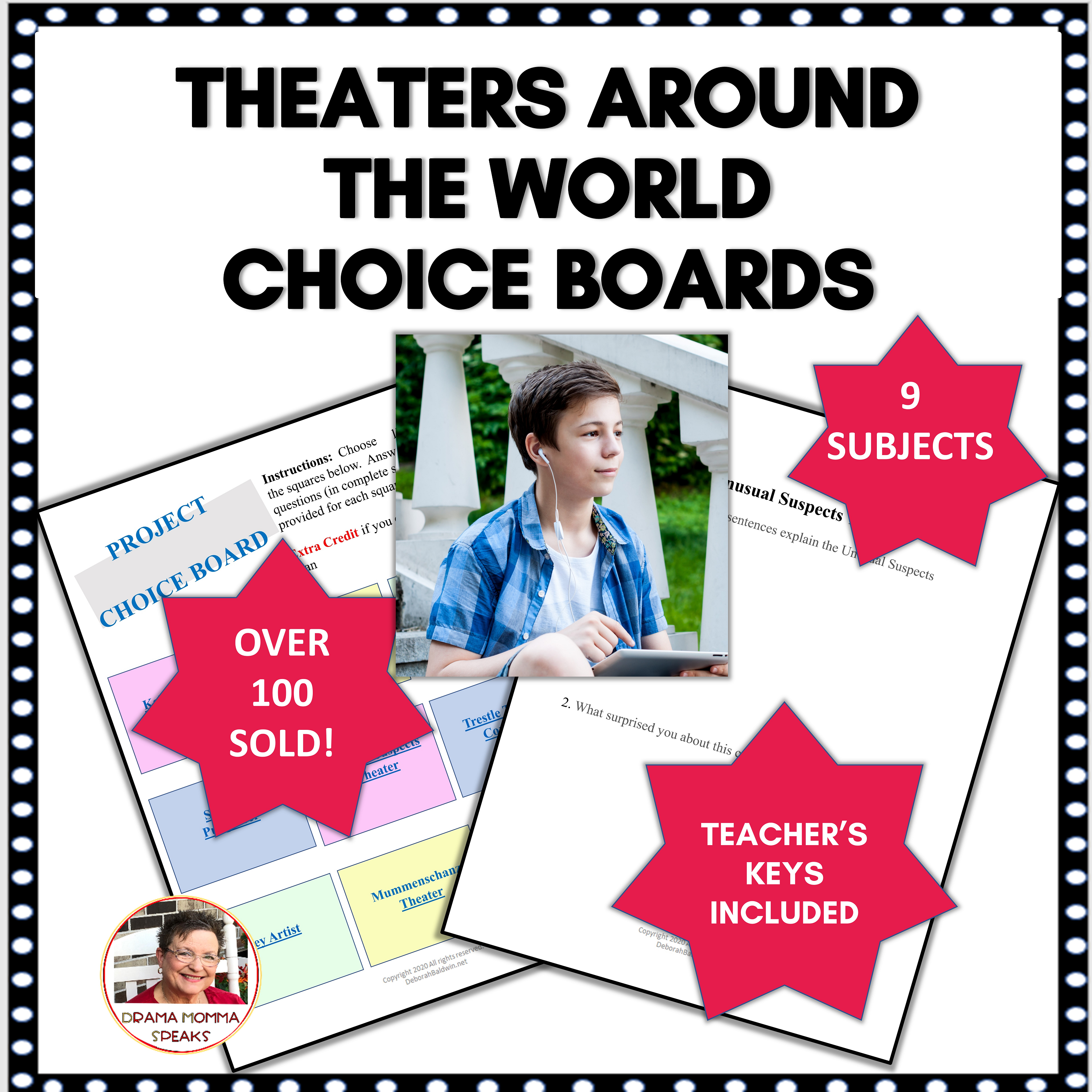
If you are looking for a way to teach students about theaters around the world, check out these Choice Boards. 

What are Choice Boards, you ask?  In this case, my choice boards are a collection of links which lead to video clips.  Students select the subjects they are most interested in, view the video clips and answer the questions.  This is super differentiation! By tailoring instruction to meet individual needs. through content, process, products, the learning environment,  ongoing assessment or  flexible grouping, differentiation creates a successful approach to instruction.

I hope you’ll considering teaching about stage makeup with your students.  It’s so important.  Just watch the transformation of your students as they apply it! Suddenly, you’ll see a student transform into a character.  Costumes do the same thing for them. As I mentioned above, these skills contribute to students’ overall artistic development and enable them to deliver compelling performances that captivate and engage audiences.
What styles of stage makeup design have you taught your students?  Did they enjoy it?  I’d love to learn about it.  Contact me at DhcBaldwin@gmail.com
Woman behind DramaMommaSpeaks

Share this:

  • Share on Tumblr (Opens in new window) Tumblr
  • More
  • Share on X (Opens in new window) X
  • Share on Facebook (Opens in new window) Facebook
  • Share on Pinterest (Opens in new window) Pinterest
  • Share on LinkedIn (Opens in new window) LinkedIn
  • Email a link to a friend (Opens in new window) Email
  • Share on Reddit (Opens in new window) Reddit
  • Share on Telegram (Opens in new window) Telegram
  • Share on WhatsApp (Opens in new window) WhatsApp

Like this:

Like Loading...

Filed Under: arts integration, community theater, drama education, drama integration, Education, excellence in teaching, middle grades, Teacherspayteachers, Teaching, theater, youth theatre Tagged With: choice boards, cooperative learning, differentiation, high school drama class, middle school drama class, stage makeup, stage makeup design, theater profession

An Amazing Play That Most Theater Teachers Never Produce

May 2, 2023 By dhcbaldwin Leave a Comment

An Amazing Play That Most Theater Teachers Never Produce

An Amazing Play That Most Theater Teachers Never Produce

There’s an amazing play written by Playwight Aurand Harris that most theater teachers never produce. It’s name?  Orphan Train. Busy theater teachers/directors have no time to consider plays other than those from their past successes. They simply don’t have the brain space left to do so. That’s where I come in.

The Orphan Train published by Dramatic Publishing.

An Amazing Play That Most Theater Teachers Never Produce

An Amazing Play That Most Theater Teachers Never Produce

Synopsis

The play tells the story of nine orphans on an “orphan train” that left New York City on May 28, 1914. The train travels to Midwestern towns in search of homes, any homes, anywhere for the orphaned and unwanted children. There’s Mary, Evie, spunky Pegeen, Annie and Little Lucy, a quiet one.
Other orphans include Frank (who later becomes Frankie, a small girl), Raymond, Lucky and Danny the song-and-dance boy. And there are the men and women hoping for children. The lonesome whistle wails as the train chugs between encounters of anxiety, laughter, wistfulness, rejection and acceptance. Eight stories unfold, each a memorable surprise.  Cast size: 6m., 7w., 6 boys, 6 girls, or 11 (1m., 1w., 3 boys, 6 girls) with doubling.
An Amazing Play That Most Theater Teachers Never Produce

An Amazing Play That Most Theater Teachers Never Produce

Probably the first reason a teacher/director might not consider The Orphan Train is the size of the cast–13. There is a way around this issue.  Have you ever double cast a production?  Although it appears as extra work for you, long term it is a Godsend.  Usually, one of the two actors double cast in a role will always be in attendance so you can progress through your rehearsal calendar as planned. Also, if you are short on males, a female can portray one of the male characters. Or vice versa.
If you’d like more information about double casting, check out: Double Casting a Show? Here’s Advice
or help with directing– Ten Important Elements to Consider When Directing a Youth Theater Production.

Technical Requirements of The Orphan Train

I directed The Orphan Train with middle school students.  One reason I selected it is that there is no need for a set.  We legged several platforms and placed them together making different levels. Stage pieces consisted of black boxes and several wooden chairs.
The necessary stage properties are minimal as I recall.  That’s another plus to selecting this production for your season.
An Amazing Play That Most Theater Teachers Never Produce

Costume Design for The Orphan Train

Usually, I designed the costumes for my middle school plays partly because I have an intense interest in costume design. However, I took a chance with this play and did something completely different–I asked the students to find their own costumes. My budget paid for those students who could not afford it.

My color palette for the production was black and white hopefully denoting a black and white photograph.  To this end, I asked the students to bring in costume pieces for their character of either black, white or even gray. I guessed that most of the students could find what they needed quite easily and I was correct.  It worked great!  When they created a tableaux at the end of the show, they looked like a vintage photograph.

Did you know I have the secret to boosting student engagement?  My new book, “We’re Live! Radio Theater #101” explains my journey to implementing this unique tool in the classroom. Check it out here

An Amazing Play That Most Theater Teachers Never Produce

(We used this photo as a template for our show tee shirts! )

Light Design for The Orphan Train

I was fortunate.  My principal at the time was very supportive of the arts (in fact, all of the principals I worked for were supportive of the arts), and purchased lighting equipment for us.  Lighting the show was fairly simple–I used the stage lights (on little dimmers if you can imagine) and then our light board, trees and several ellipsoidal and fresnel.


Sound Design for The Orphan Train

My husband and I are avid music lovers.  We listen to all types of music.  Consequently, we knew of music which would be perfect for pre-show, intermission and post show.  We used period music such as Popular Roaring 1920s Music from the Year 1926.  The sound of trains was another thing we used between scenes–steam engines puffing, rolling around, train whistles, etc.

An Amazing Play That Most Theater Teachers Never Produce

Historical Significance of The Orphan Train

When I began researching the play, I found this entry in Wikipedia.com, “The Orphan Train Movement was a supervised welfare program that transported children from crowded Eastern cities of the United States to foster homes located largely in rural areas of the Midwest. The orphan trains operated between 1854 and 1929, relocating from about 200,000 children.

The co-founders of the Orphan Train movement claimed that these children were orphaned, abandoned, abused, or homeless, but this was not always true. They were mostly the children of new immigrants and the children of the poor and destitute families living in these cities. Criticisms of the program include ineffective screening of caretakers, insufficient follow-ups on placements, and that many children were used as strictly slave farm labor.

Charitable Institutions Aid to Orphans

Three charitable institutions, Children’s Village (founded 1851 by 24 philanthropists ), the Children’s Aid Society (established 1853 by Charles Loring Brace) and later, New York Foundling Hospital, endeavored to help these children. The institutions were supported by wealthy donors and operated by professional staff. The three institutions developed a program that placed homeless, orphaned, and abandoned city children, who numbered an estimated 30,000 in New York City alone in the 1850s, in foster homes throughout the country.

The children were transported to their new homes on trains that were labeled “orphan trains” or “baby trains”. This relocation of children ended in 1930 due to decreased need for farm labor in the Midwest. The phrase “orphan train” was first used in 1854 to describe the transportation of children from their home area via the railroad. However, the term “Orphan Train” was not widely used until long after the Orphan Train program had ended.

An Amazing Play That Most Theater Teachers Never Produce

Interviewing An Orphan 

We lived in Missouri at the time in which I directed the play. We’d heard there were several people still alive who rode the Orphan train many years prior.  With a little extra work, a parent volunteer found one of the children (now adult) who was an orphan and traveled by Orphan Train.  

This lovely lady came and spoke to our cast about what it was like to ride the train.  Although that was many years ago, I recall she said that the family she ended up with were not very nice to her but she grew up with them.

You always want a story like this to have a happy ending, don’t you?  However, it’s important that our students see life as it can be sometimes, especially in a case such as this one.

An Amazing Play That Most Theater Teachers Never Produce

Maybe you found this blog because you are interested in integrating drama into your core class.  I found a terrific site with plenty of information and teaching suggestions–The Orphan Train.  Start here to build your unit around The Orphan Train.  

Additionally, you could purchase a class set of this play to use as a read aloud. (Make sure you check it out before you purchase for your entire class–you don’t just want to take my word for it.  I remember there are several swear words which you may want to switch out with others not as flowery.)

The cover of a costume design lesson.

Use the script to study set or costume design.  This particular lesson would be helpful to you if you study costume design accompanying the play.  Or use this unit to study set design to accompany the play.

Have I convinced you to check out The Orphan Train play?  If hope so.  If you have any questions about directing this play or any other questions, please feel free to email me.  I receive emails every week from teachers needing a veteran teacher to give them advice.  That’s what I’m here for. Want a FREE lesson great for middle grade students?  Go here:  Lin Manuel Miranda


Share this:

  • Share on Tumblr (Opens in new window) Tumblr
  • More
  • Share on X (Opens in new window) X
  • Share on Facebook (Opens in new window) Facebook
  • Share on Pinterest (Opens in new window) Pinterest
  • Share on LinkedIn (Opens in new window) LinkedIn
  • Email a link to a friend (Opens in new window) Email
  • Share on Reddit (Opens in new window) Reddit
  • Share on Telegram (Opens in new window) Telegram
  • Share on WhatsApp (Opens in new window) WhatsApp

Like this:

Like Loading...

Filed Under: acting, arts education, arts integration, community theater, directing experiences, drama education, drama integration, Education, Education, middle grades, plays, Production Questions, Teacherspayteachers, Teaching, teaching strategies, theater, theatre, youth theatre Tagged With: double casting, early 1900s, historical events, Middle school, orphan trains, orphans

9 Compelling Reasons Why You Need Lessons Using Super Heroes

April 18, 2023 By dhcbaldwin Leave a Comment

9 Compelling Reasons Why You Need Lessons Using Super Heroes

Have you ever experienced a “Eureka” moment while teaching?  You know those moments where everything just clicks and everyone is surprised, especially you? In this case it was super heroes. Let’s talk about 9 compelling reasons why you need lessons using super heroes.

I’ve shared several times that I taught a pre-elective drama class to sixth graders for thirteen years.  If you’d like more information about that time, check out: How to Make Your Drama Class More Successful –Lessons Learned from 38 Years of Teaching-Middle School.  One of the most exhausting parts of it was the constant lesson planning.

If you are at all like me, you know that the “lesson planning monkey” on your back is demanding. And relentless.  Finally, in desperation one week, I took a stab and did something completely spontaneous with my students.  I used super heroes in all my lessons for a week.  The students were thrilled and I was, too!

Many super heroes grouped together

Did you know that super heroes have been a part of our world for nearly one hundred years?

During the late 1930’s to 1950’s, the Golden Age of Comic Books were created. Modern comic books were first published and rapidly increased in popularity among the masses. The superhero archetype was created and many well-known characters were introduced, including Superman, Batman, Captain Marvel, Captain America, and Wonder Woman. Most superheroes served as a figure who inspired hope. This hero could save us all from dark and difficult times. Superhero stories promote the ideas of peace, safety and freedom. Some experts consider this message a necessary reassurance in difficult times. The message isn’t about a country succeeding, but recognition that there are others with similar hope for a peaceful future

If I’ve convinced you to consider utilizing super heroes in your teaching, read on!

9 Compelling Reasons Why You Need Lessons Using Super Heroes

When I began writing this blog post, I ran on to a wonderful website, Momjunction.com who stated:

Reason #1: Superhero play gives kids the chance to pretend to be strong and invincible,

Reason #2: They encourage students to make new friends and helps them develop an identity outside of real life.

Reason #3: Super heroes  help children explore moral values and dilemmas and to establish what they and others perceive as right and wrong.

Reason #4: They help children build their confidence. Exposing students to the fantastic world of superheroes may help them come out of the shell and encourage them to face the world with renewed confidence.

Reason #5: Also, they act as role models. Superheroes can be good role models as they teach children various attributes such as courage, honesty, humility, fighting spirit, sense of responsibility, and leadership.

Reason #6: Super heroes instill compassion. Because they are aware of their superiority, it gives the a different perspective on others.  They know that they could destroy most everything and everyone.  Consequently, they understand their actions–both physical and emotional are not only necessary but need to be governed at all times.

What Superheroes Teach Us About Strength, Teamwork, and Joy

Reason #7: They teach willpower and courage.  Super heroes don’t give up at the first failure.  They keep trying until they read their goal.

Reason #8: As you might expect, they  model teamwork.  When super heroes work together they know they must share the burden of the challenge and employ the best in each other. All team members respect each other’s opinions and capabilities while collectively working towards the common goal.

Reasons #9 They are just plain fun.  Super Heroes and their quests take us to a different place in our imaginations where anything is possible. Pick up some fun supplies for your super hero week here: Super Hero Teaching Supplies

Have I convinced you yet to use super heroes in your teaching?

This is How I Can Help You

Maybe you need some ready-made lessons?  I have a brand new Dramamommaspeaks store where you can purchase a few lessons with a superhero theme.

Each lessons focuses on a different theme–playwriting (the monologue), tableau and movement, costume design and storytelling.

A teacher could use them as is in their drama classroom or a reading teacher could integrate them into a unit about super heroes.  Usually students in grades 5 to 8 enjoy them the most, but you know your students the best so you decide.  You can purchase them at Payhip.com or Teacherspayteacher.com.

My Teaching Style

You may find my lessons to be quite unique–there’s a reason.  Since I taught theater classes for nearly forty years, I had the rare opportunity to watch theater subjects unfold and change over many years.  I got to see first hand what worked and what wasn’t so successful.  For instance, there was a time when we didn’t even try to teach technical theater, but now we have lots of units about them.

During this time, I noticed that middle and elementary teachers were using themed units to teach particular concepts or objectives. The students appeared very excited by them.  Hence, when I was exhausted from planning I turned to using themes to teach theater concepts and it worked wonderfully. Here is one for Halloween: Halloween Drama Lessons and Units 

If you want to learn more about how to integrate drama into your classroom, check out: How to Excite Students With Drama Integration

What are some themed units you’ve taught?  I’d love to hear about them.  Email me at DhcBaldwin@gmail.com and let’s chat!

Woman behind DramaMommaSpeaks

Share this:

  • Share on Tumblr (Opens in new window) Tumblr
  • More
  • Share on X (Opens in new window) X
  • Share on Facebook (Opens in new window) Facebook
  • Share on Pinterest (Opens in new window) Pinterest
  • Share on LinkedIn (Opens in new window) LinkedIn
  • Email a link to a friend (Opens in new window) Email
  • Share on Reddit (Opens in new window) Reddit
  • Share on Telegram (Opens in new window) Telegram
  • Share on WhatsApp (Opens in new window) WhatsApp

Like this:

Like Loading...

Filed Under: arts education, arts integration, community theater, community theatre, creative dramatics, creative movement, drama education, Education, Education, elementary, English Language Learners, excellence in teaching, High School, middle grades, Teacherspayteachers, teaching strategies, theater, theatre, youth theatre Tagged With: costume design, movement, playwriting, Spider Man, storytelling, super hero lessons, super heroes, super man, tableau, Wonder Woman

Top Reasons Teachers Succeed With Teaching Radio Theater

March 2, 2023 By dhcbaldwin Leave a Comment

two girls performing a radio theater play

Top Reasons Teachers Succeed With Teaching Radio Theater

Let’s discuss the top reasons teachers succeed when teaching with radio theater. If you follow my blog, then you know this is a subject I speak about quite frequently. Why?  First and foremost, teaching with radio theater is a marvelous teaching tool! When you really like something do you tell a lot of people? So let’s talk about the top reasons teachers succeed when teaching with radio theater!

The Top Reasons Teachers Succeed Teaching with Radio Theater Performing Arts
Temple Theater/Caroline’s Center for the Performing Arts

My Journey with Radio Theater

I taught a pre-elective drama class to 500 sixth graders every year for thirteen years.  Ending the six weeks with a performance was a challenge for me.  I’m a creative being and just can’t do the same thing over and over (as my good friend, a Home Economics teacher, could make cookies and sew pillow cases ad infinitum).  Yikes! Consequently, after about a year I ran dry on ideas of short class plays. To solve the problem, I began adapting multicultural folk tales into short class plays.  You can read about it here. The Reasons Teaching Multiculturalism in the Classroom is Vitally Important

Although this was a terrific answer to my problem and the students were happy, it wasn’t working enough for me. I remembered that I once participated in a radio theater performance. I loved the format!   When the performance ended, I realized it would be a terrific unit to create for my class. Yet, I had questions.  Could radio theater work in my classroom as well?  Would the students enjoy it?  Could I locate radio theater scripts for this purpose?  Plato said, “Necessity is the mother of invention.”  He was spot on, huh?

Photo Gallery of DramaMommaSpeaks
Me directing the radio play, It’s a Wonderful Life

Desperate to find scripts, I scoured the internet (which was brand new at the time BTW) and ran on to the Museum or Radio and Television website.  They offered family workshops producing a radio play.  Excitedly, I wrote them begging for guidance about my teaching plan and they were very generous sending me six radio theater scripts.  I’ll never be able to repay them for helping me to start my program.

Did you know I have the secret to boosting student engagement?  My new book, “We’re Live! Radio Theater #101” explains my journey to implementing this unique tool in the classroom. Check it out here

Immediate Success

The first time I directed a radio theater play, I noticed the students were immediately engaged!  Even the reluctant students or those with severe learning challenges who were accompanied by an aid. Everyone talked about them outside of my class.  Even their core teachers mentioned the students shared with them their excitement and anticipation of their public performance.

Had I run on to something which could make all of us happy?

After several years of using those scripts and adapting other short stories I found, I took a chance and wrote my own.  That’s when Bow Wow Blues was born. Check it out here: Bow Wow Blues Play Script and Unit

In 2017, at the encouragement of a good friend, I uploaded my script Bow Wow Blues in my TPT store.  I guess teachers and students really like it– I’m flattered.  To date I’ve sold over 500 copies.  If you’d like to learn more about Bow Wow Blues, go to:  Bow Wow Blues Script and Radio Theater Unit

creative dramatics lesson plans

Utilizing Radio Theater in the Classroom

Having ate, slept and breathed radio theater for over thirty years, it is very easy for me to defend its use in the classroom.

  1.  It’s creative–Talk about using your imagination!  Admittedly, I’m a stickler for using live sound effects.  It’s not enough to honk a bicycle horn.  Sometimes the sounds are difficult to duplicate.  That is where the creativity comes in.  Supporting creativity and problem solving is a natural part of radio theater. Ever heard of “complicating the sound?”
  2.  It’s a perfect example of differentiated instruction–Because a teacher gives students choices as to where they’d like to serve in the cast or sound effects team, it gives them an opportunity to learn at the pace in which they are comfortable.
  3.  Listening skills are strengthened–Everyone’s listening becomes more attuned to one another. Plus, listening for one’s cues and creating sound effects teaches students to focus their attention.
  4. Speaking skills are polished–There is nothing worse than a “mush mouth” actor.  Radio theater reinforces one’s enunciation, rate of delivery, and diction which all come in to play when a student reads aloud. Additionally, a teacher can strengthen students’ intonation, vocal flexibility and breath support.
  5. Reading skills are cultivated–Because a teacher spends many days rehearsing a radio theater script, and a reader reads something repeatedly, they can’t help but become a better reader!
  6. Language skills are honed–Students become better communicators as they work together giving suggestions for the sound effects, discussing the play with their classmates as well as acting their role
  7. Interpersonal Skills are buffed up. Verbal and nonverbal communication, the ability to handle conflict, teamwork, empathy, listening, and a positive attitude. Also, being flexible and positive, able to listen, and communicating well are important criteria for success at work.

The Top Reasons Teachers Succeed When Teaching with Radio Theater

Why Radio Theater Belongs in Your Classroom

8.  Cooperative and collaborative learning are such a necessary part of this experience–This is a perfect example             of   working together to learn something. For example, everyone must put aside their differences and work together                   toward   the performance.

9.  Additionally, radio theater is adaptable. Many of the radio theater play scripts I taught with are from previous                 eras– what a super way for students to learn about  the past? A history teacher could use a radio play in their                classroom. I know that several  Language Arts teachers have used several of my plays, in particular The Monkey’s                  Paw and The Frozen Pirate.

10.  Learn marketable skills–Being proficient in speaking through a microphone and familiar with running sound                  equipment  has valuable skill that makes them employable in the outside world.  Ever wondered about sound design?                Check out this  post: There’s a Place for Everyone in Theater

11. Lastly, it’s just plain fun  and engaging! I like to teach students in a manner which they don’t even know they are           learning.  I  strive to make each lesson so enjoyable that students remember the experience and keep coming back                        for  more!

These students performed radio theater during the Covid quarantine!  Many teachers found radio theater to be a life saver during the quarantine. Maybe you want a collection of scripts to choose from? Check out this: Radio Theater Bundle 

Preview of Radio Drama Script Very Popular Four Radio Plays and Unit High Engagement! 1

What’s holding you back?

Fear does frightening things to our psyche, yes?  Sometimes we are anxious and we don’t even know what about!

If you are like me, you like to be well informed on something you teach. That’s understandable.  If you’ve never even seen a radio play performed let alone a radio script, you will need to trust me on this.  Do you trust me? 

Essential Questions for Teaching Radio Theater

  • Do I need to be a teacher?
  • Is there a rationale in place before I teach radio theater?
  • Do I need to know what to say when I begin each lesson?
  • Do I  present the information in a particular order?
  • Should I require the students to take notes as I teach them?
  • Would trivia about particular radio shows or famous movie stars who got their start on RT pique my students’ curiosity and urge them to dig deeper in their study?
  • Should my students make a sound effect and be required to share it with the class?
  • What about a cooperative learning assignment?  Would that be helpful? Could they create a commercial for radio?
  • Would a group of theater games and exercises be helpful in teaching the concepts of radio theater? 
  • Should I collect several audio clips of actual radio shows of which the students can listen and learn?
  • Should I include enrichment in the unit, such as history about a famous radio show broadcast like War of the Worlds?
  • Do I need to find a floor plan that shows me how to set up the stage or in my classroom for a performance?
  • What sound effects should I collect to use? Do I need to purchase any or would some everyday objects suffice to create the sounds?

The answer to these questions is resounding YES. 

Pick up a FREE sample of my book, We’re Live! Radio Theater #101 here. 

Save Yourself Time and Work

Would it be nice not to have to spend countless hours creating this unit? For instance, what if instead of spending your free time and weekends researching, collecting materials and organizing your lessons you could purchase a veteran theater teacher’s unit and to learn about it as you taught it to your students?

You’ve heard me say this before, but I’ll say it again–Remember, I’ve been you.  As you would expect, I know the struggles and challenges, the sleepless nights, the knot in your stomach on Sunday night, the students who need a little extra “somethin’ somethin'” to tease their interests. Also, your worry to address their need for novelty in your lessons.

Proof That Radio Theater Works

Recently a theater teacher and I were chatting on Instagram about her use of radio theater in her classroom. You can read it here: Struggling with Your Students Engagement?

Furthermore, I’m not the only person who thinks radio theater is useful. Here is professor using radio theater in her college classroom. Theatre Students use Zoom to Create Old School Radio Drama
The Top Reasons Teachers Succeed Teaching with Radio Theater
In conclusion, I  believe that having this work done for you means I’m paying it forward to a busy teacher who already has a lot on on their plate for a fraction of the price your precious time is worth.
Do you have any questions or concerns?  Please feel free to email me atDhcBaldwin@gmail.com. I’d love to hear from you.
Woman behind DramaMommaSpeaks


Share this:

  • Share on Tumblr (Opens in new window) Tumblr
  • More
  • Share on X (Opens in new window) X
  • Share on Facebook (Opens in new window) Facebook
  • Share on Pinterest (Opens in new window) Pinterest
  • Share on LinkedIn (Opens in new window) LinkedIn
  • Email a link to a friend (Opens in new window) Email
  • Share on Reddit (Opens in new window) Reddit
  • Share on Telegram (Opens in new window) Telegram
  • Share on WhatsApp (Opens in new window) WhatsApp

Like this:

Like Loading...

Filed Under: arts education, arts integration, community theater, community theatre, Creativity, drama education, drama integration, Education, elementary, excellence in teaching, High School, middle grades, Reading Literacy, reading skills, Teacherspayteachers, Teaching, teaching strategies, theater, theatre, youth theatre Tagged With: differentiated instruction, language skills, lesson plans, nurturing creativity, procedure, radio theater, rationale, reading skills, speaking skills, student engagement, teaching advice, teaching tips, theater games

The Importance of Shakespeare in Theater Education

February 8, 2023 By dhcbaldwin Leave a Comment

Students actors performing a Shakespeare play

Occasionally, I receive emails from people wanting to post on my blog.  Usually, the subjects do not jibe with theater education whatsoever (the last one was about gambling sites). Not this time, however! This is a guest blog post by Reed Jayla  concerning The Importance of Shakespeare in Theater Education.


Shakespeare in Theater Education

Theater education and drama have been integral to school curricula worldwide, and their impact goes beyond the stage. A study from the University of California on highlights that drama’s effectiveness spans across subjects and grades.

Enhancing creativity, collaboration, communication, and overall academic performance are just some of the ways theater education guides students to navigate today’s media-rich world. But even though it benefits us in the modern world, students and teachers alike may be baffled as to why drama instruction is rooted in classic works like those produced by William Shakespeare.

Shakespeare’s work is essential to any theater teacher’s canon, and for a good reason. Shakespeare’s influence is owed to him being a pioneer in the field of literature and theatre. He is credited with inventing various words and phrases still used in literature and everyday speech today. His works have also contributed to modern storytelling, with themes and concepts still seeping into today’s media.

Up to now, his plays are regularly performed in theaters worldwide. Outdoor festivals also feature the Bard’s productions in what is known as Shakespeare in the Park, where theater companies stage Shakespearean plays for free to the general public. Through these avenues, Shakespeare’s work is made accessible to people from all walks of life and can be instrumental in building an appreciation for theater, playwriting, and the arts as a whole.

Did you know I have the secret to boosting student engagement?  My new book, “We’re Live! Radio Theater #101” explains my journey to implementing this unique tool in the classroom. Check it out here

Shakespeare in Theater Education

Even though Shakespeare is long gone, there are reasons why his work remains essential reading and acting materials for any theater student. Here’s why:

The Importance of Shakespeare in Theater Education

It provides an understanding of modern works

As mentioned, Shakespeare popularized many themes and stories; despite their age, they’ve remained prominent in film, TV, books, and other art forms we enjoy now.

Many of his famous plays have been made into various adaptations. For instance, films such as 10 Things I Hate About You, West Side Story, and The Lion King are movies based on the English playwright’s works, but many people may not be aware that they’re consuming Shakespeare at all, as these were reworked to suit modern audiences of the time.

Tales of love, death, and power are as relevant today as they were back in Shakespeare’s day, so it’s no wonder his plays  remain a relevant and persistent part of today’s cultural zeitgeist.

Shakespeare in Theater Education

Understanding his plays and their themes provides a strong foundation for comprehending and executing modern works. For instance, reading or acting in Romeo & Juliet gives students a good sense of how to portray a tragic romance in another production, even in one that isn’t entirely related to the Shakespearean play.

Studying Hamlet or Othello could allow students to practice darker roles such as that of Claudius and Iago. Without an appreciation for the origins of the popular plots and themes still being used today, students lack a deeper connection and understanding of the roles they wish to play.

It challenges aspiring actors

The Importance of Shakespeare in Theater Education


The work of The Bard can be daunting to learn, primarily because most people aren’t comfortable with the language or the iambic pentameter utilized in his works. Research from Lancaster University published in the Sage Journals perceived that difficulty with Shakespeare was commonly due to the use of “archaic words, borrowings from other languages, coinages, and false friends” — the latter referring to words in one language that look similar to words in another. But these are all the more reasons his plays are essential for students to learn and act out. Starting with something more challenging can make future endeavors seem like a breeze in comparison.

Depending on the production, Shakespearean actors need to analyze the nuance behind every character, including the unique historical context in which they were written. Maryville University’s insights on English and history majors acknowledges how these two branches of liberal arts can be combined to get a well-rounded worldview.

Shakespeare in Theater Education

Although English majors and dramatists focus on the language and literature, interest in political and cultural events that have influenced or continue to inspire the staging of Shakespearean plays is essential for young actors. They are challenged to communicate complex ideas from different periods of history to a wider audience in a unique format.

Shakespeare’s plays push learners out of their comfort zone and allow them to develop acting techniques they may not have been able to obtain without a knowledge of his works. Actors must interpret and deliver lines effectively and naturally while staying in character. There is also little to no room for improvising in his plays, so memorizing all the lines is a must. These things may seem like a challenge for students just starting in the craft, but it is necessary for building experience that can take them far in the industry.

It equips students with important skills

The Importance of Shakespeare in Theater Education

Shakespearean plays are complex, which can enrich a student or actor’s skill development. As mentioned, attention to detail is required to convey every line properly and truly set the scene. An actor must practice proper vocalization, breath control, and the ability to enunciate so that viewers will understand what is going on.

Directness and intention are also important elements in Shakespearean line delivery—an actor cannot “sing” the words and phrases but must be clear when speaking. This access to know-how can be a strong foundation for developing more skills; once students know the rules and the basics, they can start bending them in the future.

Shakespeare in Theater Education

Shakespeare’s works also require a lot of strong emotion from the characters being portrayed, which aspiring actors will need to take control of should they want to deliver a good performance. Shakespeare’s comedies depict mood and feeling in a unique manner. They touch on human emotions stemming from love, pain, and mystery—using a variety of tones that enrich the plays’ genuine portrayals of life. Understanding the complexities and nuances of the characters and scenes can help students harness their feelings in a way that makes dialogue powerful but not over-the-top or underwhelming.

Considering the archaic language, being able to deliver emotional lines and scenes in a masterful way that captures the character and situation well is an impressive feat in itself. Students bring this confidence with them in other productions and will vastly improve their performance, no matter the script used. These skills are invaluable for any other work, and having them in one’s toolkit heightens the chances of success for a student.

Finding success through Shakespeare

The Importance of Shakespeare in Theater Education

Some students may find studying the Bard’s plays an unnecessary endeavor, but there is proof that experience with his work can yield much success in the theater and acting industry as a whole. Backstage highlights how any prolific actors and actresses have gotten their start through Shakespeare, and students who want to emulate their career paths can do the same.

Actor Sir Patrick Stewart started off his impressive career in the 1960s by performing in some of the Bard’s works. Sir Ian McKellen also studied his plays during his days in Cambridge and went on to perform in many of these all over the world. James Earl Jones made his acting debut in a production of Othello and has been involved in more Shakespeare plays over the course of his career.

An Integral Part of Theater Education

The works of William Shakespeare will continue to remain an integral part of the world of theater education. The advantages of studying and acting out his work go beyond the opening night and extend further in a student’s other acting ventures. If you’re considering putting on a Shakespeare production, your young actors will need all the practice they can get. Check out my post “Ten Steps in a Play Rehearsal in Youth Theater” for a comprehensive guide on conducting rehearsals for youth theater, from auditions to read-throughs to blocking and more.

Looking for some resources for teaching Shakespeare?  Check out:  Shakespeare Card Games

Thank you, Reed for writing this blog post for me.  I know everyone will enjoy it!

What’s your opinion of teaching theater students about Shakespeare?  I’d love to hear your opinion.  You can contact me at DhcBaldwin@gmail.com.

Woman behind DramaMommaSpeaks

Author bio: Reed Jayla is a freelance writer and aspiring author, whose work spans topics of all kinds. She is interested in the arts, from theater and film to art and music. When she isn’t writing, Nancy enjoys cooking and baking for friends and family.


Share this:

  • Share on Tumblr (Opens in new window) Tumblr
  • More
  • Share on X (Opens in new window) X
  • Share on Facebook (Opens in new window) Facebook
  • Share on Pinterest (Opens in new window) Pinterest
  • Share on LinkedIn (Opens in new window) LinkedIn
  • Email a link to a friend (Opens in new window) Email
  • Share on Reddit (Opens in new window) Reddit
  • Share on Telegram (Opens in new window) Telegram
  • Share on WhatsApp (Opens in new window) WhatsApp

Like this:

Like Loading...

Filed Under: arts education, arts integration, drama education, drama integration, Education, Education, excellence in teaching, plays, Teaching, theater, theatre, youth theatre Tagged With: acting, Patrick Stewart, playwright, Romeo and Juliet, Shakespeare, Shakespeare in the Park, student acting, theater class

Twelve Best Theater Class Apps. in 2023

January 4, 2023 By dhcbaldwin Leave a Comment

Computer monitor burst with apps.

Twelve Best Theater Class Apps. in 2023

Okay, I’ll admit it.  I wanted to research the twelve best theater class apps. in 2023 for selfish reasons.  I’m sitting here working with a bunch of apps., sites, software and whatever else I need. I learn new skills nearly everyday from blogging to product creation to social media marketing.

They say I’m “old school.” I chuckle when I hear this, because it reminds me of the school “marm” of the 1800s. My defense is that old school works.  However, I’m aware of the fact that some teachers want to use technology in their classrooms as much as possible.  Let’s face it–that’s where the students are most engaged.

Friends, this post took a lot of research and reading to find apps. which can assist the theater class teacher.  Honestly, there aren’t many apps. specifically for a theater class.  (Hmmmm.  That gives me an idea.) I scoured the web and found around twelve apps. and websites which I think will be useful to you.  See what you think and if you want something a little more “O.G.”, check out my Set Design with Fairy Tales Unit.

Twelve Best Theater Class Apps. in 2022

Twelve Best Theater Class Apps. in 2023

  • My Lines lets you have your script with you on a mobile device anytime, anywhere. You can rehearse and memorize your lines without a scene partner, by either looking at or listening to your lines. You can also see or hear cue lines when you’re ready to be off-book.
  • Rehearsal Pro is perhaps the most well-known of all the apps to help you learn your lines. You can record your lines and play them back, watching the script scroll by like a teleprompter, or you can even put your lines in “blackout mode” to test yourself. The app works with short audition sides and feature-length scripts and is useful for actors in theater, commercials, voiceover, television, and film.

Twelve Best Theater Class Apps. in 2022


  • Line Learner This app is a great way to learn lines for a play or speech. You simply speak each line into the iPhone (or iPod with microphone), pressing a button to specify whether it is another character’s line or one that you will speak. Once you have read a few lines you can start practicing. Simply switch to playback and you can hear the other characters’ lines to cue you in. . You can record each scene separately and have as many different scripts as you like. It is easy to edit or re-record lines if you need to.

Did you know I have the secret to boosting student engagement?  My new book, “We’re Live! Radio Theater #101” explains my journey to implementing this unique tool in the classroom. Check it out here

We're Live! Radio Theater #101 book concerning radio theater in the classroom

Twelve Best Theater Class Apps. in 2023

Probably one of the most useful apps a theater person would appreciate is playwriting software!  When I began writing plays, there was none (that’s how long ago I started writing). Without them, you nearly lose your mind trying to use the expected play form.  However, here are several which I think are good.

  • Trelby is a free playwriting software program.  It is basically a screenwriting software using which you can create theater plays, scripts, movie screenplays, etc. In it, you can find all necessary tools which ease out the process of writing a play. Let’s see what are the features you must look forward in this playwriting software.
  • Celtx is a free playwriting software program, too.  Celtx is a media pre-production tool designed to ease the work of those who work in the media production industry by providing a simple desktop utility for organizing the project information and making stories come alive. The application comes with all the necessary tools for writing scripts, plays, novels without using the pen and the paper.

Sound Effects and Costume Design Apps.

  • FashionDesignFlatSketch–This app. is a great place to start if you don’t have time for students to design costumes, but you want them to go through the process.
  • Freeform–Create quick sketches, mockups, or diagrams with this powerful tool. Export your drawings via email in JPG, PNG, or PDF formats, or save to your photo library. Create new designs whenever or wherever inspiration strikes!There is nothing quite like the experience of interacting with your drawings with your fingers.
  • Belfry is an iPad sound effects player for schools, small scale theatre venues and small touring companies. It allows for the simultaneous playback of up to sixty sound effects stored in iTunes. This means a whole production can be run through the app. The interface is easy to use – just add tracks in the order that you want them. There are separate tabs for each act and you can save up to 60 cues as a film.
  • Index Card is great for scriptwriting, workshop planning, researching or for any creative task which requires organization. This works just as well as real index cards with the advantage that they look neat and can be exported to edit in a word processor. It is incredibly easy to use – just touch the cards to move them around or edit them. You can see a screenshot for a workshop that I am planning (above). It means you can concentrate on coming up with ideas then easily organize them. You can create as many different projects as you like and swap cards between them. This is one of those apps that does one thing, really well.

For Our Younger Students

Twelve Best Theater Class Apps. in 2022

  • Sock Puppet–How fun is this?  Students can re-create a scene from history by scripting a play and recording their voice! This app allows students to  make the actions with the characters they have chosen – record and play back, save their play or performance. It’s a fun way to evaluate their understanding of a concept! You can also have students give their book report using the sock puppets!
  • ToontastickjrPirates–This is a fun app which allows children to create an animated story based on the theme of Pirates. Students choose a beginning, middle and end and can then extend the story by moving the characters, adding voices and recording the animation.
  • Telestory–Children can choose to be a TV Reporter, Weather Presenter, Spy and more and can create and record their own TV clip. Children can choose from a variety of fun backgrounds and costumes and can read from pre-loaded prompt cards which can also be edited to suit the topic where necessary. This app could be used to share Weekend News, to engage in role play and for developing communication skills.

I hope these help you in your classroom.  As I mentioned before I’m old school, but this old dog is always willing to learn new tricks!  If you know of some apps. I should include, please comment here.  Thanks!

Twelve Best Theater Class Apps. in 2022

Share this:

  • Share on Tumblr (Opens in new window) Tumblr
  • More
  • Share on X (Opens in new window) X
  • Share on Facebook (Opens in new window) Facebook
  • Share on Pinterest (Opens in new window) Pinterest
  • Share on LinkedIn (Opens in new window) LinkedIn
  • Email a link to a friend (Opens in new window) Email
  • Share on Reddit (Opens in new window) Reddit
  • Share on Telegram (Opens in new window) Telegram
  • Share on WhatsApp (Opens in new window) WhatsApp

Like this:

Like Loading...

Filed Under: arts education, creative dramatics, drama education, Education, elementary, High School, middle grades, Teacherspayteachers, Teaching, teaching strategies, youth theatre Tagged With: Belfry, Celtex, FashionDesignSketch, Freeform, Indexcard, Line Learner, My Lines, Rehearsal Pro, Sockpuppet, telestory, toontastickjrpirates, Trelby

« Previous Page
Next Page »

Footer

Follow Us

logo3.png

FOLLOW US

Facebook X-twitter Pinterest Instagram Envelope Rss

Goodreads: read

Malibu Rising
Malibu Rising
by Taylor Jenkins Reid
People We Meet on Vacation
by Emily Henry
The Last Thing He Told Me
by Laura Dave
Faking It
Faking It
by Cora Carmack
Losing It
Losing It
by Cora Carmack

goodreads.com
Copyright © 2024 · Wellness Pro on Genesis Framework · WordPress.com.Log in
 

Loading Comments...
 

    %d