• Skip to primary navigation
  • Skip to main content
  • Skip to footer

Join Me in my new Facebook Group! https://www.facebook.com/groups/417126059784261

Menu
  • Meet Deb – The Heart Behind DramaMommaSpeaks
    • Work with Me! 
    • Photo Gallery of DramaMommaSpeaks
    • Directorial Credits
  • I Give Book Talks! 
    • Book Talk Through Skype
    • Books
  • Freebies!
  • Bumbling Bea
  • Teaching Resume
  • Acting Resume
  • Contact Me
  • Blog
    • Drama Education
    • Arts Education
    • Youth Theatre
    • Middle Grades
    • Musical Theatre
    • Teaching
  • Meet Deb – The Heart Behind DramaMommaSpeaks
    • Work with Me! 
    • Photo Gallery of DramaMommaSpeaks
    • Directorial Credits
  • I Give Book Talks! 
    • Book Talk Through Skype
    • Books
  • Freebies!
  • Bumbling Bea
  • Teaching Resume
  • Acting Resume
  • Contact Me
  • Blog
    • Drama Education
    • Arts Education
    • Youth Theatre
    • Middle Grades
    • Musical Theatre
    • Teaching

e-learning

What No One Tells You About Creating An On-Line Course

December 2, 2022 By dhcbaldwin Leave a Comment

Woman sitting on a sofa filming herself like she is teaching an on-line class

What No One Tells You About Creating An On-Line Course

Woman behind DramaMommaSpeaks

Today I want to talk about what no one tells you about creating an on-line course. I can’t believe I am finally to a place where I can blog about this subject. I’m not kidding when I say I’ve been creating an on-line course for nearly a year.

In September of 2021, an idea to create an on-line course crept into my mind and I couldn’t shake it.  I happened to put it out there that I’d like to create a course which would complement a particular category of units in my Teacherspayteachers store. Building an on-line course seemed the next step in my business and I still think this was a good idea.

I’m fortunate in that I’m a student in a wonderful company called SBZ Enterprises. They taught me how to amplify my presence in social media through their course focused on Instagram.  If you don’t know much about the Instagram and how to market on it, I’d suggest you take this course. You can find it at: SBZ Enterprises

What No One Tells You About Creating An On-Line Course

Ironically, at the time I was considering this on-line course idea, SBZ was offering an affiliation with Digital Course Academy owned by Amy Porterfield.  Would I be interested in taking the course with them?  I excitedly agreed to do so, but really I had no idea what in the world I got myself into.

Persevering as I often do when I learn outside of my comfort zone, I enrolled with Morgan Sutton, CEO of SBZ as my mentor through the training. Morgan has been invaluable help in many ways and I will always be grateful for her support and confidence in me.

What No One Tells You About Creating An On-Line Course

What is Digital Course Academy?

DCA is an on line course which teaches you how to create a webinar for an on-line course you are selling.  At the same time I began creating my course, I studied DCA’s trainings.  Talk about information overload! I mean, I’m not going to quit just because I’m in deeper than I meant to be. I finished the DCA course in December and decided that although I understood the concepts of webinar development, I needed to concentrate on my own on-line course before I could create a webinar for it.

Some people create the course as they develop their email list.  In DCA you are encouraged to develop your course through the help of your email followers, gaining their insights and suggestions as you create it.

What No One Tells You About Creating An On-Line Course

My ideal client is a teacher who teaches theater or a core subject who wants to sharpen their teaching skills.  I all ready knew teachers don’t have time to give me feedback, especially over several months as we fleshed out the course. Nonetheless, I was advised to survey my email list and make the first three modules of my course, so I did so.

I had seven beta testers for the course back in August.  Not one of them completed the three module course.  Not one.  That disturbed me to say the least because personally I finish commitments even if I don’t want to. Morgan assured me it happens a lot in a situation like this.  Cray cray is all I can say.

I was naïve

I planned to unveil my course ready by January of 2022.  Oh my gosh, that was a ridiculous goal I could never accomplish.  However, I didn’t know that at the time.  In March I decided I’d hold my first webinars for the course.  As the days and weeks wore on, I realized I needed another month to make ready everything. Again, I was so clueless.

It took me eight more months. Course creation can be a time suck, so if you are considering creating a course you need lots.of.time. 

During those months, I built up my email list, put out more lead magnets for said email list, built sales pages for the webinar, created ten modules with guides for each and tried to hold three webinars.  I followed the launch sequence for the webinar, too.

Everything appeared ready to go.  What a flop!

Looking for a few free lessons from me? Or maybe a radio theater checklist?  Check out this Free Stuff!


What No One Tells You About Creating An On-Line Course

What No One Tells You About Creating An On-Line Course

You know how sometimes in your life, something stops you in your tracks and you can’t move on?  These webinars were a failure because of reasons some of which I can’t control.  My advice?  Only use Zoom to hold your webinars and no one else.  The company I selected for the first webinars completely messed up the dates and times of my webinars so the thirty people who signed up thought the webinars were cancelled. And you know, once your customer is confused they are leery to attend another webinar or buy your product.

Course Creation Takes More Time Than You Think

Licking my wounds for a couple of months I sat on the course. I wasn’t disillusioned but disappointed.  I hoped that my webinars would attract teachers and I wouldn’t have to spend any more time on the course creation. I was so wrong. At that point, I cared more about people attending than any money I could make.  In fact, I’m still of this belief.  Money comes if it’s supposed to–that much I know.

In September I finished creating the course--all ten modules and ten guides. We (my dear husband and I) completed the recordings in early November, tweaking everything as time progressed.  In the meantime, several hundred teachers joined my email list and I think I’m getting the right audience for the course.

What No One Tells You About Creating An On-Line Course

Course Creation is Expensive

When you consider creating a course, there are expenses that no one tells you about for reasons unknown to me. Some of the expenses I never considered before beginning my course creation because I had no idea of all the details of doing this.  In hindsight I guess I should have researched the idea more fully before I began.

I use these platforms

  • course creation (Canva)
  • platform to hold course (Samcart)
  • payment page  (Samcart)
  • payment processing platform (Stripe)
  • sales page (Ontraport)
  • emails    (Ontraport)
  • recording equipment (I was lucky here, as we owned good recording equipment from a previous project.)

Webinar Building is Expensive Too

Building a webinar has its expenses, too.  Honestly, I didn’t know if Digital Course Academy is expensive, but there are extra (though optional) expenses involved if you use it. (Such as a course about email list building, for example.) These courses  really do help you.  Once the dust settles on this experience, I plan to re-enroll in some of Amy’s courses so I can pick up more tips. She’s really a gold mine of help!

Another expense–you need a platform for on-line meetings such as webinars and meetings with your students. I use Zoom because it’s the most respected and reliable.

Getting the word out about your course is a must–social media helps with that.  You need to publicize both the webinar and the course.  In my case, I use every available free platform–Instagram, Facebook, Pinterest. Linkedin.

If you have a blog and website as I do some of their costs play into this.  So, I must count WordPress and Wix for my blog and website and being seen on Linktree,etc.

What’s the Course?

What No One Tells You About Creating An On-Line Course

My course is titled,  “We’re Live! Radio Theater 101”–a step by step blueprint using a unique teaching tool to engage students when you’ve tried everything else. Interested? Email me at DhcBaldwin@gmail.com

This week I announced the course is open and available for purchase.  To be honest, I hate this part because I can’t control the outcome. I could wax philosophical and discuss how I don’t think we actually control anything, but you get the idea.

What No One Tells You About Creating An On-Line Course

One of the most difficult challenges is making a paradigm shift in teachers who think they can’t possibly use this in their classroom. They worry that they are expected to be a theater teacher and director, but I can assuage their worries. My guess is that I will probably spend a lot of time for the next month convincing teachers.

As of this writing, the webinars are planned for January when the teachers’ brains are rested and more apt to be open to new ideas. I know one thing for certain–it’s the cheapest it is every going to be. Once I begin the webinars, the course will cost more than it does at present.

I hope this helps you.  It’s been good for me to write down my thoughts about it–that’s for sure.  Have you created an on- line course?  How did it go for you?  Would you do it again?  Feel free to email me at DhcBaldwin@gmail.com

Woman behind DramaMommaSpeaks


Share this:

  • Click to share on Tumblr (Opens in new window) Tumblr
  • More
  • Click to share on X (Opens in new window) X
  • Click to share on Facebook (Opens in new window) Facebook
  • Click to share on Pinterest (Opens in new window) Pinterest
  • Click to share on LinkedIn (Opens in new window) LinkedIn
  • Click to email a link to a friend (Opens in new window) Email
  • Click to share on Reddit (Opens in new window) Reddit
  • Click to share on Pocket (Opens in new window) Pocket
  • Click to share on Telegram (Opens in new window) Telegram
  • Click to share on WhatsApp (Opens in new window) WhatsApp

Like this:

Like Loading...

Filed Under: Arts, arts education, e-learning, Education, Education, Radio Theatre, Teaching, teaching strategies, theater, theatre, youth theatre Tagged With: digital course academy, on line course, radio theater, suebenterprises

The Five Reasons Your Students Will Love Set Design

August 10, 2022 By dhcbaldwin 2 Comments

The Five Reasons Your Students Will Love Set Design

The Five Reasons Your Students Will Love Set Design

One of the things I appreciate about the subject I teach is its varied subjects within it. However as we know, not all students think the same way as I. I thought you might appreciate the five reasons your students will love set design–or at least that’s my hope.

If you are teaching theater and have reluctant students, I’d suggest teaching them about set design.  I’ve yet to find a group of students who did not enjoy learning about it.

Many students love theater, but they are unwilling to perform and consequently they quit studying it and take another class instead.  The reason?  They just can’t find a place for themselves within it.  Technical theater is a wonderful place for inclusion!

The Five Reasons Your Students Will Love Set Design

The Five Reasons Your Students Will Love Set Design

Truthfully, I think teaching set design is crucial for a student’s studies in theater arts. Let’s face it–a set design can make or break a production. Understanding its value and encouraging your students to appreciate it too will not only enrich their learning, but make them a more rounded arts person.

Think about it.  The audience sits and looks at the set for the entire performance.  Sometimes the set doesn’t change.  That’s a loooong time to imagine the place.

I could wax poetic about my love for teaching set design.  I am that much of a cheerleader for it.  But here are some reasons your middle and high school students will love set design:

  1.  It’s highly creative–The sky is the limit when one is learning about set design.
  2.  It’s immediately gratifying–When you design a set and create a model of it (either with paper or through a set design software app.) you can watch your idea take shape right in front of you
  3.  Themes and motifs can be explored effortlessly–your ELA teacher will appreciate that you teach these concepts to your students
  4.  It’s a great way to learn cooperatively–If you have your students work in pair or teams, the design process is eye opening to them.  As in life, everyone has an idea. They should all be heard and incorporated into the design if at all possible.  Students learn to listen, adjust their opinions and consider others.
  5.  Set design skills can carry over into other subjects such as math or social studies.  What a terrific way to apply what you learn.  Design a set, measuring, ratios, etc. come into use.  Researching a local such as France for a set design can be a super integration for a social studies or geography class.

The Challenges of Set Design

The Five Reasons Your Students Will Love Set Design

For Your Gifted Students

I used to challenge my students who needed something more difficult to design their set using a turntable in the center.  Wow, that’s a great challenge!  Not only is it tough to build, but will it work sufficiently?

Or what about a staircase?  Students quickly learn that designing a staircase to scale is much more complex than just label a rectangle a set of stairs.  Once a model is built the student sees the error of their measurements and that’s helpful, too.

How about a bridge?  Again, it’s easy to design but difficult to execute.

A Little Trivia Break

  • Did you know Judy Dench wanted to be a set designer when she was young?
  • Or that Maurice Sendak (author of Where the Wild Things Are) became a set designer after his career as an author? (Me neither!)
  • How about the fact that real-life historical locations provided inspiration for the Hamilton musical set design? While the set isn’t literal, it draws inspiration from actual places. “One of the cool things about Hamilton is almost every single location is one that you can research and find actual visual support for, whether it’s on the internet or in history books, or if the actual location still exists,” says David Korins, the set designer. “We did a lot of research in my office, getting everything from what the Schuyler Home actually looked like to what it looked like in New York City in 1781 and 1776. And we put it all up on a big huge board on a wall in my office, and we picked and chose.”
  • If you want more information about the history of set design, check out this blog post, Past Present and Future Set Design 

The Five Reasons Your Students Will Love Set Design

Teaching students that “less is more” can be easily demonstrated through set design.  In the photo above, you see a simple set from the 2018 revival of Carousel.  It contains a cyclorama with a cloudy night sky projected upon it and four miniature sail boats are part of the ground row.  The rest of the set is wood pallets. Students understand this concept that’s why it’s one of the five reasons students love set design.  Isn’t it effective? If you are need advice concerning selecting a production, check out this blog post: Critical Steps in Selecting a Play or Musical: Budget & Royalties

Permit me to brag a little

This is Brandon Davis.  He was a student of mine when he was in middle school.  He’s really made a great name for himself as a set designer.  When I had Brandon in my drama class in sixth grade, he was quiet, creative and loved theater.  You can see his work below and  at www.brandonptdavis.com


If you aren’t aware, I have a store with Teacherspayteachers.com.  In it, I sell drama education resources. In this particular case, let’s discuss my set design unit.

There are two–one for middle school and another a bundle of technical theater units  for high school.


The Five Reasons Your Students Will Love Set Design      The Five Reasons Your Students Will Love Set Design

The Five Reasons Your Students Will Love Set Design

Here is my middle school design unit description:

During this eight-day unit over set design students learn about the history of set design, famous designers, develop a critical eye about what makes up an award- winning set design, create a ground plan for a fairy tale story of their choosing and draw a rendering. If you’d like a free lesson concerning set design, click here. Set Design, the Rendering

Here’s a added benefit–the students must work with ratios and measuring. (Hello math class!) The first two assignments are completed individually, but then the fun begins! The students are paired up to create a model working together towards the goal. There is even room for parents to celebrate the end of the unit with your students.

Included in the unit:

  • An overview of the unit for the teacher
  • Rationale for teaching design
  • History of scenic design
  • Set designer’s responsibilities
  • Teacher’s Script–what I say and how I say it!
  • Warm-up for day one
  • Procedures for each day (8)
  • Lecture notes including links
  • Information about the message color conveys
  • Rendering examples
  • Stage curtain sheets for rendering–one vertical, one horizontal
  • Step-by-step directions for model building including photo examples
  • Cheat sheet for various set pieces
  • Assignment sheet for each step of the design process
  • Exit slip prompts for 4 days
  • Grade sheet EDITABLE in a separate folder
  • Source page

The Five Reasons Your Students Will Love Set Design

High School Set Design and Others

As you would expect, my high school unit is more challenging.  It includes studying three styles of theater–modernism, expressionism, surrealism.  After reading a play of their choosing, the students select one style and design the set for that production.   They build a model of their design or use software to design it in three dimensions.

Additionally if you want to take this idea even further, I have a theater artist biography and one pager assignment available. I  have several planned, but for now I can offer you Ming Cho Lee.

The Five Reasons Your Students Will Love Set Design

If you are looking for advice a production’s design, check out this blog post: Critical Steps in Producing a Play or Musical: Set Design

In particular, I appreciate this quote from  George C. Wolfe, playwright and director of Angels in America: Millenium Approaches who said:

“I love working with a set designer because, in many respects, you meet the set designer before you meet the actors. So it’s a chance for me as a director to figure out what I’m thinking and to explore how the space is going to actually be activated.”

I hope I’ve convinced you to teach design to your students.  Maybe your students will become a set designer as mine did!

If you want more advice concerning set design, check out: Critical Steps in Producing a Play or Musical: Set Design

Need something for a substitute?  Check out Exploring Theater Professions Video and Class Discussion Lesson.

What technical theater lessons have your students enjoyed learning?  I’d love to know.  Contact me at DhcBaldwin@gmail.com

The Five Reasons Your Students Will Love Set Design


Share this:

  • Click to share on Tumblr (Opens in new window) Tumblr
  • More
  • Click to share on X (Opens in new window) X
  • Click to share on Facebook (Opens in new window) Facebook
  • Click to share on Pinterest (Opens in new window) Pinterest
  • Click to share on LinkedIn (Opens in new window) LinkedIn
  • Click to email a link to a friend (Opens in new window) Email
  • Click to share on Reddit (Opens in new window) Reddit
  • Click to share on Pocket (Opens in new window) Pocket
  • Click to share on Telegram (Opens in new window) Telegram
  • Click to share on WhatsApp (Opens in new window) WhatsApp

Like this:

Like Loading...

Filed Under: arts education, Creativity, drama education, drama integration, e-learning, Education, excellence in teaching, Teacherspayteachers, teaching strategies, youth theatre Tagged With: high school, Middle school, reluctant performers, set design, technical theater, theater class

How Boom Cards Can Make Learning Fun in Music Class

November 3, 2021 By dhcbaldwin Leave a Comment

How Boom Cards can Make Learning Fun in Music Class

This blost post is by my husband, Tim.  Tim is a retired an award-winning instrumental music teacher having taught for forty years in all grade levels.  I asked him if he’d like to discuss this cool learning tool he is creating and he said, “sure!”

From Tim:

Hello Everybody.  I’m not very familiar with this blogging thing, but I’m going to try to explain my reasons for my Boom cards and why they work so efficiently in the classroom.  I hope it helps you.

When the pandemic closed our schools, teachers scrambled for digital lessons.  Folks, they were amazing!

Did anyone even notice how quickly, smoothly and expertly the teachers pivoted to on-line learning? I even shifted gears in record time and I’m not in the classroom.

Check out Deb’s post: Drama Lessons for Home-Bound Students or During the Corona Virus Quarantine

Teachers are rock stars!

What are Boom Cards?

Boom cards are self-grading digital flash cards that are gamified and provide teachers and parents the data they want. A teacher can use them for remedial instruction, review for a test or direct instruction.  They are awesome.  If you haven’t seen Boom Cards, check them out here: Boomcards.com

What are their strengths?

  • Digital task cards (in this case Boom Cards) build a skill base for the twenty-first century learning tools.
  • Digital task cards are flexible.
  • They can be used on a wide variety of devices.
  • They are a paperless resource–save those trees and ink.
  • They are similar to all other digital task cards or digital apps.–they are easy to use and understand.
  • Digital task cards are easy to share, give feedback and grade.

The Origin of My Boom Cards

It was the summer of 2020.  During a FaceTime call with Diana, a fellow music teacher and coworker of my wife, we were discussing the challenges of trying to teach music classes virtually during the COVID pandemic.  One of her frustrations was trying to teach rhythms to her students.

When teaching in person she usually used flash cards to drill note values and a counting system. Trying to do this through a computer or iPad screen was more than difficult.  Before this conversation my wife had been creating some interactive task cards on a site called Boom™ Learning and suggested I create something that would be helpful.

Since I had been a music teacher and band director since the invention of dirt I had a few ideas and methods I had used, usually using a chalk or white board. After some experimentation on the Boom™ site, making examples on a music writing software program and several hit and misses I eventually came up with a format that I thought might work.

We visited Diana that following October and I showed her the few examples.  After her enthusiastic response I then went to work and created several rhythm units for her specific needs.  I shared these with her so she could try them with her students virtually and they seemed to work.

Recently Diana used these with her “in person” class by projecting the rhythms on a white board and working with her students on counting and clapping rhythms. To quote her after using my Boom™ Cards during a recent class, “…. It was magic….. It was truly amazing….they all stayed focused ……”  I’m thinking I might be on to something.

Teaching with Games

While I was researching this post, I found this rationale for teaching with games from ACD.org a website for administrators, principals and teachers says:

In classrooms showing the greatest gains, teachers did specific things. To get similar results, teachers should games for these reasons.

Use inconsequential competition. In general, students like to compete as long as the stakes are not high. During a two-week unit of instruction, a teacher might organize students into teams of four students each. Teams might play games four or five times during that unit. Each time they play, the first three teams to complete the game receive points (for example, 3 points for the first team to finish, 2 points for the second team, and 1 point for the third team).

At the end of the unit, the teacher adds up the points for each team, and the three teams with the highest number of points get some inconsequential but fun reward, such as coupons to buy juice from the vending machines in the cafeteria.
Throughout the year, the teacher should reorganize the teams so all students have the experience of winning and losing. However, teachers must not factor game points into students’ grades for the unit. The points and rewards are simply for fun.

Target essential academic content. If games do not focus on important academic content, they will have little or no effect on student achievement and waste valuable classroom time. The most efficient way to maintain an academic focus is to organize games around important terms and phrases. For example, during a unit on dance moves, a dance teacher might identify terms and phrases such as axial movement, line of gravity, movement phrase, and nonlocomotor movement. Questions and answers would involve information important to these terms and phrases.

How Do I Use Boom Cards in My Music Class

Debrief the game. The most common error teachers make when using games is to add up team points and move on. The whole point of playing academic games in the classroom is to provide opportunities for students to examine important content in a lively and enjoyable venue. To stimulate analysis of important terms and phrases, a teacher can ask students which questions were difficult to answer and why.
For example, suppose that during a game of Pictionary in a mathematics class, students had difficulty drawing an image to represent the Fibonacci sequence. At the conclusion of the game, the teacher would ask students about their difficulties with this item. The discussion would serve as a brief review of the defining characteristics of a Fibonacci sequence.

Have students revise their notes. One generalization that applies to learning all types of content is that students must have opportunities to revise their understanding of the content as time goes by. When a game has ended and the class has discussed difficult terms and concepts related to the content, the teacher should give students time to revise their notes. A teacher might ask students to look over what they have previously written about this content in their notes and make any necessary changes. This might involve correcting misconceptions or adding new information that the students were unaware of.

Pretty wonderful, huh? Here is another post about using games in the classroom: Games + Teaching Method= Our Students Win!

HOW DO I USE BOOM CARDS IN MY MUSIC  CLASSROOM?  If I were you, I’d assign Boom Cards for distance learning or use them as differentiated instruction in the classroom.  You could introduce a unit with the Boom Cards, assign them as homework for those with WiFi access or make them part of the lesson for the day.

As of this writing, I have 50 decks of Boom Cards.

My Boom deck contains:

  • Twenty–five digital flash cards
  • Colorful and easy to read

I have created rhythm boom cards in just about as many ways to learn as possible–rhythm question/counting answer, counting question/rhythm answer, audio question/rhythm answer, rhythm question/audio answer, audio question/counting answers. Whew!

A teacher can:

  • use them in group instruction or individual student drill/ assessment
  • use at home or in the classroom
  • view student’s progress
  • Use in elementary music theory, ear training and ensemble performance techniques

My Boom cards are true outcome based learning–if an incorrect answer is selected, the student is able to select from the remaining answers

I hope you’ll take a look at my Boom Cards at: TBMusic

or in my teacherspayteachers.com store at TBMusic

Tim

This is Deb again.  I hope you enjoyed learning about Tim’s Boom cards.  He has a bunch of music ideas up his sleeve which he’ll unveil in time. Come back and see what’s new soon!

Deb


Share this:

  • Click to share on Tumblr (Opens in new window) Tumblr
  • More
  • Click to share on X (Opens in new window) X
  • Click to share on Facebook (Opens in new window) Facebook
  • Click to share on Pinterest (Opens in new window) Pinterest
  • Click to share on LinkedIn (Opens in new window) LinkedIn
  • Click to email a link to a friend (Opens in new window) Email
  • Click to share on Reddit (Opens in new window) Reddit
  • Click to share on Pocket (Opens in new window) Pocket
  • Click to share on Telegram (Opens in new window) Telegram
  • Click to share on WhatsApp (Opens in new window) WhatsApp

Like this:

Like Loading...

Filed Under: Arts, arts education, Distance Learning, e-learning, Education, Education, elementary, excellence in teaching, Teacherspayteachers, Teaching, teaching strategies Tagged With: Boom Cards, music counting, music education, music education in our schools, music rhythm

Doing Broadway Musicals the Right Way

September 29, 2021 By dhcbaldwin Leave a Comment

Red pencil on a piece of music, close up

Doing Musicals the Right Way

Doing Broadway Musicals the Right Way
The musical Hamilton

Let’s talk about doing musicals the right way. I watched the Tony awards last night.  Although it was shortened version on CBS, it was a lovely tribute to Broadway and theater. So exciting to know Broadway is back in business again.

But I have to say…as always they did musicals the right way.

What do I mean by that remark?  Often, I’ve thought about what makes a musical a classic.  Who makes the decisions whether a theatrical piece is or is not a classic?

According to one website, any musical written between 1920 and 1959 is considered a classic.  When I think about classic musicals, certain ones come to mind–South Pacific, Sound of Music, Oliver!, Peter Pan, The Music Man, Hello Dolly! My Fair Lady and Oklahoma! to name a few.

However, there are recent musicals which should be added to this category of Tony award winners.

I believe they become classics when they are endowed with strong plots, well defined characters, spectacle, universal themes and tremendous scores.  Consequently,  one could argue that most musicals which make it to Broadway should become classics, right? Maybe and maybe not.

However to me, the brilliance of the musical transcends all other productions and that is what sets is apart from others.

Doing Musicals the Right Way: The Phantom of the Opera

Let’s consider The Phantom of the Opera for example.

Doing Broadway Musicals the Right Way
Phantom of the Opera photo by Johan Perss

Phantom of the Opera

First, the plot: Based on the 1910 horror novel by Gaston Leroux, The Phantom of the Opera is a thrilling and romantic account of the legendary Phantom, a musical genius who dwells deep beneath a majestic opera house in Paris.

Shunned by society for his horrible facial deformity, he takes a promising young soprano, Christine, under his wing and grooms her for operatic fame, all the while falling deeply in love with her.

As Christine grows ever more successful, and a handsome young man from her past begins to successfully court her, the Phantom descends into a jealous rage and terrorizes the opera company with increasingly dangerous threats.

The plot takes twists and turns.  That’s a clear cut identifier of a classic.

Secondly, let’s consider the spectacle of the production.  A person could watch this one scene from Phantom of the Opera (in photo above) and have a good idea of the plot. Have you wondered about how to direct a musical? Check out: So You Are Directing a Musical…Now What?

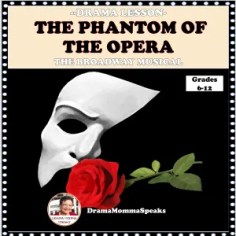
phantom of the opera mask and red rose

In addition, the characters are well rounded with moments of which we can relate.  Another quality of a good musical.  One moment we hate the Phantom and another we pity him.  That tug at our heart strings makes him all the more compelling. Although Phantom of the Opera has less dialogue that most musicals, what dialogue it does have is well crafted.

The mere fact that Phantom of the Opera recently closed after a run of  35 years should tell us something, yes?  Staying power.

Doing Broadway Musicals the Right Way

Andrew Lloyd Weber’s music score is magnificent.  Perusing the internet researching this blog topic, I ran on to The Guardian’s review of Phantom of the Opera:

“Andrew Lloyd Webber has a true pop sensibility, ladling on the hooks. There are reprises and motifs everywhere, and even similar melodies in two of the big songs. Essentially, never take the unexpected route when the note you want to hear is right there.

That famous descending organ riff and its synth-rock bass may scream 1980s camp, but this is a show committed to bombast, the grisly gothic tale of the murderous phantom menacing a 19th-century Paris theatre unashamedly embraces high drama, backed by a wall of sound when Lloyd Webber’s more dense writing contrasts with the hit melodies.”

Doing Broadway Musicals the Right Way

Doing Musical the Right Way: Les Miserables

Les Miserables should be included the list of modern classic musicals.

First, let’s talk about the plot:  After 19 years as a prisoner, Jean Valjean is freed by Javert, the officer in charge of the prison workforce. Valjean promptly breaks parole but later uses money from stolen silver to reinvent himself as a mayor and factory owner. Javert vows to bring Valjean back to prison. Eight years later, Valjean becomes the guardian of a child named Cosette after her mother’s  death, but Javert’s relentless pursuit means that peace will be a long time coming.

Staging of Les Miserables

Secondly, the staging is magnificent! When I taught students about set design, I described the spectacle of the production. The revolving stage, the use of lighting and simple set pieces gives the production a feeling of fluidity and pace.  In particular, the scene when when Javert ends his life is powerful and raw.

Additionally, the use of fog and a simple bridge hoisted right at the moment Javert jumps to his death is breath taking. This moment of spectacle is tremendously engaging. Consequently, we are transported to the moment of impact as if we were jumping with him. The revolving stage turns as Javert sinks to the floor of the river, rolls in the current and slowly dies as the stage stops its revolve.  That’s powerful theater!

Doing Musicals the Right Way

Like Phantom of the Opera, Les Miserables has a long life on Broadway and London where it originated.  Forty-two countries have enjoyed the touring company shows. If that isn’t enough, it has been translated into 21  languages: English, Japanese, Hebrew, Hungarian, Icelandic, Norwegian, German, Polish, Swedish, Dutch, Danish, French, Czech, Castillian, Mauritian Creole, Flemish, Finnish, Argentinian, Portuguese, Estonian and Mexican Spanish. Pick up a copy of my Broadway musical unit of Les Miserables here.

What’s a Sung Thru Opera?

Les Miserables is considered a “sung-thru” opera. Because particular moments are sung rather than spoken and vice versa it demands our attention at all times.  I can’t say that about every production.

Salesmanship Cedes to Love in 'The Music Man' | Chicago News | WTTW

The Music Man

A third “should-be” classic, is The Music Man.

Again, let’s look at the plot: The Music Man is concerns con man Harold Hill, who poses as a boys’ band organizer and leader and sells band instruments and uniforms to naïve Iowa townsfolk, promising to train the members of the new band. Harold is no musician, however, and plans to skip town without giving any music lessons. Prim librarian and piano teacher Marian sees through him, but when Harold helps her younger brother overcome his lisp and social awkwardness, Marian begins to fall in love. Harold risks being caught to win her.

Every classic musical contains universal themes.  In this case, The Music Man demonstrates that music heals, redemption, risk romance and authenticity.

Doing Broadway Musicals the Right Way

A Crowd Pleaser

When teachers ask for my recommendation of a crowd pleaser musical which has opportunities for a large cast, first on my list is The Music Man.  The characters are charming, fun to portray and there’s room for many ages and grade levels. The dialogue is humorous when it needs to be and poignant in other moments.  My favorite line is, “He’s been the raspberry seed in my wisdom tooth long enough.”

With a blend of music indicative of the setting of the story, many of a plot takes twists and turns which is an identifier of a classic, too. For instance, The Music Man has such captivating music it’s used in other genres such as  by marching bands (Seventy-six Trombones)  and barbershop quartets (Lida Rose.)

Having directed it four times, I can say without a doubt it is one I can depend upon to be successful every time I direct it. Want some advice about directing? Check out: So You Are Directing a Musical…Now What?

Broadway Musical Units

As you may be aware, I create drama education resources for teachers through my store, DramaMommaSpeaks also on MadebyTeachers and my personal store on Payhip. 

I have a new bundle of “Classic Musicals”.

It includes:  Les Miserable, The Music Man, Peter Pan, Phantom of the Opera and West Side Story, South Pacific (new)

Each musical can be purchased separately, but if you buy them in a bundle you save up to 20%.  And guess what?  This is a growing bundle so as I create more Classic Musicals I’ll include include more productions.  (Get it at the beginning of the growing bundle and you get all of the rest of the musicals for FREE)

Doing Broadway Musicals the Right Way

These products include:

  • Letter to Teacher
  • Two Warm Ups–My Own Version of this Popular Exercise–
  • Teacher’s Script–What I Say and How I Say it!
  • Photos of the production
  • Synopsis of the Musical
  • Plot of the Musical–comprehensive and detailed
  • Short Biography about the creative team–composer, lyricist, playwright, producer or director
  • Biography focused on the author of the novel if it inspired the production
  • Why is this musical considered an opera and not a musical?
  • Separate File of Photos for Teacher’s Use in Lecture
  • History about the Origination of the Production
  • AND a Mini-Lesson on What are the Tony Awards?
  • List of Tony Awards
  • New York City Map with Competing Theaters Labeled
  • Student Note Page
  • Teacher Note Page Key
  • Fascinating Trivia about Broadway
  • Equally fascinating trivia about the particular musical
  • Songs List
  • Extension Activities–Ten Terrific Assignment Suggestions to Secure the Learning and Enrich the Experience either Individual or Group
  • Sources & Links to Film Clips from the Show
  • And More!

There are many musicals, too numerous to mention, which your students will appreciate exploring.  Have you considered Come From Away? Still so timely.  It’s an excellent production!

Doing Broadway Musicals the Right Way

Here’s another Broadway musical, West Side Story 

Doing Broadway Musicals the Right Way

Today, I added Oklahoma!

Doing Broadway Musicals the Right Way

And Here’s South Pacific

Doing Broadway Musicals the Right Way

And now The Sound of Music

Doing Broadway Musicals the Right Way

What other musicals do you think should be labeled as classics?  I’d love to know.  Contact me at DhcBaldwin@gmail.com or DeborahBaldwin.net

woman behind DramaMommaSpeaks


Share this:

  • Click to share on Tumblr (Opens in new window) Tumblr
  • More
  • Click to share on X (Opens in new window) X
  • Click to share on Facebook (Opens in new window) Facebook
  • Click to share on Pinterest (Opens in new window) Pinterest
  • Click to share on LinkedIn (Opens in new window) LinkedIn
  • Click to email a link to a friend (Opens in new window) Email
  • Click to share on Reddit (Opens in new window) Reddit
  • Click to share on Pocket (Opens in new window) Pocket
  • Click to share on Telegram (Opens in new window) Telegram
  • Click to share on WhatsApp (Opens in new window) WhatsApp

Like this:

Like Loading...

Filed Under: acting, Arts, arts education, arts integration, Broadway, community theater, community theatre, drama education, e-learning, Education, music education, Musical Theatre, performing arts, theater, Tony Awards, youth theatre Tagged With: Come From Away, Hamilton, musical theater, musical theatre, Phantom of the Opera, revivals of musicals, The Music Man, West Side Story

The Essential Drama Integration Guide for Come From Away the Broadway Musical

September 15, 2021 By dhcbaldwin 3 Comments

Twin towers fencing with notes stuck to it after 911

The Essential Drama Integration Guide to Come From Away the Broadway Musical

The Essential Drama Integration Guide for Come From Away the Broadway Musical

Have you used drama integration to reach your students? This would be a good place to begin. Use my drama integration Come From Away the Broadway Musical.

What is Drama Integration?

Through participation in theatre, students develop speaking and listening skills. Students collaborate with others in accomplishing common goals. Though many classroom teachers do not have a drama teacher to collaborate with, drama is a natural place to begin arts integration.

The story behind Come From Away is one which can easily be used in any classroom studying September 11th. Rather than just studying the story, how about teaching the historical moment through a theatrical production?

Why is The Musical Titled “Come From Away”?

“Come from away” is a term used in Canada’s Atlantic provinces for someone who has moved to the area from somewhere else. I’m a come from away myself, from Ontario, though my mother was born here.

The first reason to teach with this musical, and foremost in my opinion, if the story. It is just plain fascinating and begins with an explanation of  Operation Yellow Ribbon.

The Essential Drama Integration Guide for Come From Away the Broadway Musical News - Mirror Online

Operation Yellow Ribbon was commenced by Canada to handle the diversion of civilian airline flights in response to the September 11 attacks in 2001 on the United States. Canada’s goal was to ensure that potentially destructive air traffic be removed from United States airspace as quickly as possible, and away from potential U.S. targets.

Instead of U.S. soil, those aircraft headed into the U.S. were place on the ground in Canada, at military and civilian airports in the Canadian provinces of Newfoundland, Newfoundland and Labrador, and British Columbia (and also several in New Brunswick, Alberta, Manitoba, Ontario and Quebec) where any destructive potential could be better contained and neutralized. None of the aircraft proved to be a threat, and Canada and Canadians hosted thousands of passengers stranded in Canada until U.S. airspace was reopened.

The Essential Drama Integration Guide to Come From Away the Broadway Musical

Canada began the operation after the U.S. Federal Aviation Administration (FAA), implementing Security Control of Air Traffic and Air Navigation Aids (SCATANA), grounded all aircraft across the United States, an unprecedented action. The FAA then worked with Transport Canada to reroute incoming international flights to airports in Canada.

During the operation, departing flights—with the exception of police, military, and humanitarian flights—were cancelled, marking the first time that Canadian airspace had been shut down. In total, as a result of Operation Yellow Ribbon, 255 aircraft were diverted to 17 different airports across the country. 45,000 people were displaced.

I told you it was fascinating! Come From Away is placed in Gander, Newfoundland.

The Essential Drama Integration Guide for Come From Away the Broadway Musical

Gander is a town located in the northeastern part of the island of Newfoundland in the province of Newfoundland and Labrador.  Located on the northeastern shore of Gander Lake, it is the site of Gander International Airport, once an important refueling stop for transatlantic aircraft, and still a preferred emergency landing point for aircraft facing on-board medical or security issues. At the time of the 911 attack, its population was 6,000.

Most of the streets in Gander are named after famous aviators, including Alcock and Brown, Amelia Earhart, Charles Lindbergh, Eddie Rickenbacker, Marc Garneau and Chuck Yeager.

The Essential Drama Integration Guide for Come From Away the Broadway Musical

Come From Away the Broadway Musical

Some musicals are developed with each creative team member responsible for particular parts of the show from playwriting to directing to choreography.  Others are more collaborative in nature.  The path of the musical, Come from Away  to  becoming a Broadway musical was fairly traditional once it was conceived.

However, its conception was the unique aspect and perhaps that why audiences love it so much.  In this particular case, the composer and lyricists are also the playwrights.  This doesn’t occur very often.

The Essential Drama Integration Guide to Come From Away the Broadway Musical

What is equally fascinating is the creative team’s personal connection to the story.  The setting is in their home province of  Newfoundland, Canada.  The team didn’t realize there was a story to be told until ten years later when they were approached to write the show.

The musical has been received by audiences and critics as a cathartic reminder of the capacity for human kindness in even the darkest of times and the triumph of humanity over hate.

DID YOU KNOW ONLY 14 STATES TEACH ABOUT 911?

Fourteen.

That’s a crying shame, but I’m out to change all that!

DramaMommaSpeaks Come From Away Drama Integration Guide

The Essential Drama Integration Guide for Come From Away the Broadway Musical

My Drama Resources

As you may be aware, I create drama education resources for teachers in my store, DramaMommaSpeaks.  Currently, my Come From Away unit is very popular with vocal music, language arts and theater teachers.

This 46 page, two-day product includes:

  • Letter to Teacher
  • Warm Up–MY Version of a Popular Physical Warm Up
  • Teacher’s Script–What I Say and How I Say it!
  • Photos of Gander, Newfoundland where the story takes place and the airstrip which became the connector between strangers
  • Plot of the Musical
  • Synopsis of the Musical
  • A Brief Description of the Operation Yellow Ribbon and 9/12, what occurred the day after the 9/11 attacks
  • Separate File of Photos for Teacher’s Use in Lecture
  • History about the Origination of the Production
  • Information on the Director, Christopher Ashley
  • Information on the Writing Team co-composers & playwrights David Hein and Irene Sankuff
  • A Shortened Lesson on: What are the Tony Awards?
  • List of Tony Awards
  • New York City Map with Competing Theaters Labeled
  • Student Note Page
  • Teacher Note Page Key
  • Trivia about Come From Away and Broadway Musicals with Some Surprising Facts!
  • Lyrics from “Welcome to the Rock”–Good for Class Discussions or as a Jumping Off Point
  • Extension Activities–Terrific Suggestions of Ways to Secure the Learning and Enrich the Experience, Individual and Group
  • Sources & Links to Video Clips from the Show
  • And More!

Looking for a Theater Curriculum Scope and Sequence  for Middle School?  Check out mine:  Drama Units Scope and Sequence. 

Comprehensive? You bet. If this interests you, perhaps my Hamilton lesson will too.  Check out this blog post here.

The Essential Drama Integration Guide for Come From Away the Broadway Musical

The Essential Drama Integration Guide for Come From Away the Broadway Musical

Come From Away Movie

The Come From Away movie was released recently.  You can find it on Apple TV.  Of course, it would be wonderful if your students could view the movie.  If not, you’ve got my complete lesson to answer any and all questions pertaining to this terrific musical.

It isn’t often that a historical moment is still pertinent twenty years later, but here we are. 

If you direct productions, you’ll enjoy this musical for its ensemble feel. The story is told by every character with most playing more than one role. That’s always a nice challenge for performers and such fun, too.  The set is simple, containing chairs, a table or two and few stage properties.  The music is clever and sounds a bit like Irish folk music to me.

DramaMommaSpeaks Come From Away Drama Integration Guide

I think once its released to amateurs, every community theater, in the country will produce it.  Wow!

A note to social studies and language arts teachers–don’t shy away from this musical because it is just that. Integrate drama into your classroom and your students will love you for it, I promise. Some of the best teaching is done when you break out of your routine and teach through a different medium.

I hope you’ll consider teaching your students about the musical, Come From Away.  As I said, it’s one of most popular products (in the top four!) so there is some reason everyone desires this lesson.  See for yourself.

Where were you when 911 occurred?  I was the first person in my school building to hear the news.  What an unforgettable experience to be sure.

phantom of the opera mask and red rose

Interested in another Broadway musical?  Check out: Phantom of the Opera

I’d love to hear about your memories of 911.  Contact me at DhcBaldwin@gmail.com or DeborahBaldwin.net

Want a FREE guide and drama integration lesson for grades 6 to 8?  Go here: FREE guide and drama integration

woman behind DramaMommaSpeaks


Share this:

  • Click to share on Tumblr (Opens in new window) Tumblr
  • More
  • Click to share on X (Opens in new window) X
  • Click to share on Facebook (Opens in new window) Facebook
  • Click to share on Pinterest (Opens in new window) Pinterest
  • Click to share on LinkedIn (Opens in new window) LinkedIn
  • Click to email a link to a friend (Opens in new window) Email
  • Click to share on Reddit (Opens in new window) Reddit
  • Click to share on Pocket (Opens in new window) Pocket
  • Click to share on Telegram (Opens in new window) Telegram
  • Click to share on WhatsApp (Opens in new window) WhatsApp

Like this:

Like Loading...

Filed Under: American experiences, arts education, arts integration, community theater, drama education, e-learning, Education, excellence in teaching, Musical Theatre, performing arts, Teacherspayteachers, youth theatre Tagged With: 911, Broadway, Come From Away, drama integration, Gander, language arts project, musical theater, Newfoundland, operation yellow ribbon, social studies project, theater class project, Tony award winning

How to Be the Cool Theater Teacher When Broadway Re-opens

August 18, 2021 By dhcbaldwin Leave a Comment

Two theater masks and a red curtain with a blog post about being the cool theater teacher

How to Be the Cool Theater Teacher When Broadway Re-opens

Every teacher wants to be popular. Personally,  I think it’s an unfulfilled desire from our high school days when maybe we weren’t the coolest and our pick of friends, though loyal, wasn’t exactly a large number.

Today, I’m going to talk about how to be the cool teacher….at least for a day or two.

People ask what is my favorite musical. This is a difficult question to answer, because I love many.

If I have to pick one for today, I’ll say Hadestown. (Tomorrow it will probably be something else.)

This is a glorious show filled with everything which makes a great one– memorable music, tremendous lyrics, terrific plot and unique message.

Hadestown review – musical Orpheus myth is a beguiling fable for today | Theatre | The Guardian

All About Hadestown

If you don’t know much about Hadestown, here is a quick synopsis from Broadway.com:

Hadestown intertwines two mythic tales—that of young dreamers Orpheus and Eurydice, and that of King Hades and his wife Persephone—as it invites you on a hell-raising journey to the underworld and back. Mitchell’s beguiling melodies and Chavkin’s poetic imagination pit industry against nature, doubt against faith, and fear against love. Performed by a vibrant ensemble of actors, dancers and singers, Hadestown is a haunting and hopeful theatrical experience that grabs you and never lets go.

Hadestown is a 2016 stage musical adaptation of the 2010 folk opera concept album by Anais Mitchell.  As in the 2010 album, Hadestown adapts the myth of Orpheus and Eurydice to a Great Depression-era inspired post-apocalyptic setting.

One of the production’s messages defends beauty and the importance of music and love to the soul, even in an increasingly commercialized world.

I can’t count how many times someone has suggested a song which makes them feel better (especially in light of the pandemic.)  Music speaks to people. I don’t know about you, but I couldn’t live without music in my life.  See what I mean in my post, How Enriched is Life Without Music?

How to Be the Cool Theater Teacher When Broadway Re-opens

Hadestown Broadway review: An epic musical journey to the underworld | EW.com

What is the origin of Hadestown?

Scrolling around the internet, I found this post from Vulture, “To use the appropriate organic metaphors, Hadestown started as a seed with a community-theater project that Mitchell, a songwriter, first performed in Vermont in 2006. That grew into a concept album in 2010, which she recorded along with folk musicians like Bon Iver’s Justin Vernon. By 2013, Mitchell started working with Chavkin — who had been directing The Great Comet Off Broadway — to plant Hadestown back onstage.

They took it to New York Theatre Workshop in 2016 and then to Edmonton’s Citadel Theatre and London’s National Theatre before returning to Broadway, where the show began performances on March 22. Along the way they experimented with everything from the set design, to the size of the cast, to their way of thinking about the main characters’ roles in the story.”

How to Be the Cool Theater Teacher When Broadway Re-opens


 Hades and Persephone

Two mythological tales were combined to create the plot of Hadestown.  It’s important to understand the two myths separately in order to appreciate them being woven together for this musical.

Hades is the Ancient Greek god of the Underworld, the place where human souls go after death. In time, his name became synonymous with his realm. It has to be said unsurprisingly – since he barely left it. Appropriately, the most significant myth related to Hades concerns one of the very few times he did – to abduct Demeter’s daughter, Persephone.

As the ruler of the dead, Hades was a grim and ghastly figure, inspiring awe and terror in everybody. Consequently, he was rarely depicted in art. When he was, he was most commonly portrayed with a beard, and a solemn, mournful look. He frequently wears a helmet, named the Helm of Darkness or the Cap of Invisibility. Cerberus, the three-headed dog which guarded the entrance to the Underworld, is usually beside him. Every so often he carries a scepter or holds the key to his kingdom. At a later stage, he became associated with his weapon of choice, the bident, a two-pronged fork modeled after Poseidon’s trident.

How to Be the Cool Theater Teacher When Broadway Re-opens

Persephone, the daughter of Demeter and Zeus, became the wife of Hades and the Queen of the Underworld. She was a dual deity, since, in addition to presiding over the dead with intriguing autonomy, as the daughter of Demeter, she was also a goddess of fertility. The myth of her abduction by Hades was frequently used to explain the cycle of the seasons.

Who Wrote Hadestown? 

Anaïs Mitchell is an American singer-songwriter, musician, and playwright. Mitchell has released seven albums, including Hadestown (2010), Young Man in America (2012), and Child Ballads (2013). She developed Hadestown (together with director Rachel Chavkin) into a stage show which received its US debut at New York Theatre Workshop in summer 2016, and its Canadian debut at the Citadel Theatre, Edmonton the following year. In 2018 it was announced that the show would open at London’s National Theatre later in the year before transferring to Broadway.

Hadestown began as a DIY community theater project in Vermont in 2006. In 2013 Anais began the process of expanding and adapting the work into a full-length professional theatrical production. She worked closely with director Rachel Chavkin.


Rachel Chavkin on 'Hadestown,' female directors and her dream of a TV miniseries - Los Angeles Times

Who directed Hadestown?

Director Rachel Chavkin  (has a BFA from New York University’s Tisch School of the Arts and an MFA from Columbia University School of the Arts (2008). Chavkin directed Dave Malloy’s Natasha, Pierre & The Great Comet of 1812, which ran Off-Broadway in 2013-2014. Natasha, Pierre & The Great Comet of 1812 received the 2013 Obie Award, Special Citation. Under her direction, the musical opened on Broadway at the Imperial Theatre on November 14, 2016.

At the 71st Tony Awards, the musical received twelve nominations, the highest number for the 2016-17 season, including a nomination for Chavkin for Best Director of a Musical.

How to Be the Cool Theater Teacher When Broadway Re-opens

In an article in American Theatre, it was noted that she has a “diverse slate of work” united with “a distinctively multisensory sensibility…. When she staged Meg Miroshnik’s The Fairytale Lives of Russian Girls at Yale Repertory Theatre, she included a live female punk band; her work with the TEAM routinely blends text, video, and pervasive sound design. ‘She can squeeze a lot into a small space, and yet it feels epic and sprawling,’ said Ars Nova artistic director Jason Eagan.

I’m Here to Help You! 

In case you aren’t aware, I create drama education and resources. I have a unit for Hadestown which you might appreciate.

This Product includes:

  • Letter to Teacher
  • Warm Up–MY Version of a Popular Physical Warm Up
  • Teacher’s Script–What I Say and How I Say it! (No need to worry about what to say)
  • Photos of the Statues of Greek Gods or Persephone & Hades
  • Paintings of the Statues of Greek Gods of Eurydice & Orpheus
  • Plot of the Musical
  • Synopsis of the Musical
  • A Brief Description of the Four Mythological Characters to Help Your Students Understand the Musical More Fully
  • Separate File of Photos for Teacher’s Use in Lecture
  • History about the Origination of the Production
  • Information on the Director, Rachel Chavkin
  • Information on the composer, Anais Mitchell
  • Information about the music arranger and orchestrator, Michael Chorney
  • A Shortened Lesson on: What are the Tony Awards?
  • List of Tony Awards
  • New York City Map Link with Competing Theaters Labeled
  • Student Note Page
  • Teacher Note Page Key
  • Trivia about Broadway Musicals with Some Surprising Facts!
  • Partial lyrics from “Why We Build a Wall”–Good for Class Discussions or as a Jumping Off Point
  • Extension Activities–Terrific Suggestions of Ways to Secure the Learning and Enrich the Experience, Individual and Group
  • Sources & Hot Links to Video Clips from the Show!

Hadestown Preview 

If this sounds interesting to you, check out my store at Dramamommaspeaks to learn more about the unit.

How to Be the Cool Theater Teacher When Broadway Re-opens

I’ve found most students are familiar with the music from a musical and the plot. However they never have an opportunity to learn about its origin, trivia and creative team.  I create units the way I would use them.

Review: The Metamorphosis of 'Hadestown,' From Cool to Gorgeous - The New York Times

Want to impress your students?  Hadestown reopens on Broadway on September 2.  Your students will be impressed that you keep up with the hubbub of Broadway by teaching Hadestown.

When Broadway reopens its doors, there is going to be so much excitement we will hear the cheers in every theater classroom in the country, much less the world. What a fabulous image and sound that will be!

What musical is your favorite (at least today)? I’d love to hear about it.  Contact me at DhcBaldwin@gmail.com or DeborahBaldwin.net.

Want some free lessons?  Check out: Free Stuff! (Check this often because I add lessons as I have time to do so.)

woman behind DramaMommaSpeaks

Share this:

  • Click to share on Tumblr (Opens in new window) Tumblr
  • More
  • Click to share on X (Opens in new window) X
  • Click to share on Facebook (Opens in new window) Facebook
  • Click to share on Pinterest (Opens in new window) Pinterest
  • Click to share on LinkedIn (Opens in new window) LinkedIn
  • Click to email a link to a friend (Opens in new window) Email
  • Click to share on Reddit (Opens in new window) Reddit
  • Click to share on Pocket (Opens in new window) Pocket
  • Click to share on Telegram (Opens in new window) Telegram
  • Click to share on WhatsApp (Opens in new window) WhatsApp

Like this:

Like Loading...

Filed Under: acting, Arts, arts education, arts integration, Broadway, e-learning, Education, Education, excellence in teaching, High School, middle grades, Musical Theatre, Teacherspayteachers, theater, Tony Awards, youth theatre Tagged With: Broadway musical fan favorites, drama resources, drama teacher, Hadestown, musical theater units, mythology, theater education, theater teacher

Next Page »

Footer

Follow Us

logo3.png

FOLLOW US

Facebook X-twitter Pinterest Instagram Envelope Rss

Goodreads: read

Malibu Rising
Malibu Rising
by Taylor Jenkins Reid
People We Meet on Vacation
by Emily Henry
The Last Thing He Told Me
by Laura Dave
Faking It
Faking It
by Cora Carmack
Losing It
Losing It
by Cora Carmack

goodreads.com
Copyright © 2024 · Wellness Pro on Genesis Framework · WordPress.com.Log in
 

Loading Comments...
 

    %d