• Skip to primary navigation
  • Skip to main content
  • Skip to footer

Join Me in my new Facebook Group! https://www.facebook.com/groups/417126059784261

Menu
  • Meet Deb – The Heart Behind DramaMommaSpeaks
    • Work with Me! 
    • Photo Gallery of DramaMommaSpeaks
    • Directorial Credits
  • I Give Book Talks! 
    • Book Talk Through Skype
    • Books
  • Freebies!
  • Bumbling Bea
  • Teaching Resume
  • Acting Resume
  • Contact Me
  • Blog
    • Drama Education
    • Arts Education
    • Youth Theatre
    • Middle Grades
    • Musical Theatre
    • Teaching
  • Meet Deb – The Heart Behind DramaMommaSpeaks
    • Work with Me! 
    • Photo Gallery of DramaMommaSpeaks
    • Directorial Credits
  • I Give Book Talks! 
    • Book Talk Through Skype
    • Books
  • Freebies!
  • Bumbling Bea
  • Teaching Resume
  • Acting Resume
  • Contact Me
  • Blog
    • Drama Education
    • Arts Education
    • Youth Theatre
    • Middle Grades
    • Musical Theatre
    • Teaching

e-learning

Five Reasons to Watch The Grinch Live! on NBC

November 11, 2020 By dhcbaldwin Leave a Comment

Five Reasons to Watch The Grinch Live!  on NBC

Happy Holidays (okay, it’s a little early, but covid….)

Pretty soon, all of the holidays special will begin and luckily, this year is no exception.

On December 9, there is going to be a live version on NBC of the Broadway musical, “The Grinch”!

How awesome is that?

How the Grinch Stole Christmas

(Yes, I know this photo is from the movie.)

Five Reasons to Watch The Grinch Live! on NBC

#1  THE PLOT

If you don’t know the musical, (because you’ve been living in a cave or something) the story goes like this:

The action of the musical happens in mysterious Whoville. Christmas is a wonderful holiday, which is adored by all the residents of the fantastic town. Who doesn’t love this time of the year, when everything around is covered with fluffy snow, when we feel a smell of a fir-tree, and people exchange with magnificent gifts? Therefore, on the eve of the holiday, the inhabitants are concerned about purchases of the gifts, decoration of the houses and, of course, preparation of dishes for the holiday table.

Once upon a time, a man lived in a town. His was called Grinch. His body was green and hairy. That’s why nobody in the Whoville loved him. The main hero took offense on the inhabitants and decided to live on the lonely mountain, which was blown by winds. A dog was an only being, who kept his company. On this mountain, he sat in a cave and was angry at the whole world.
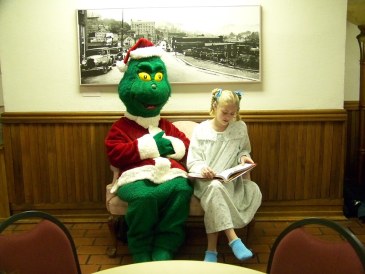
Breakfast with the Grinch 11-2010

Breakfast with the Grinch from vastateparkstaff

Grinch hated Christmas most of all. While the population of a town had fun with all hearts, the indicator of already bad Grinch’s mood expressed something awful. Each Christmas appeared to be a terrible torture for the green hermit. One day, a spiteful inhabitant of the mountain decided to finish a holiday once and for all. While the carefree Whovilleans were sleeping in holiday night with pleasure, perfidious Grinch decided to steal Christmas from the citizens, to make nobody able to have fun anymore.

Now, as well as the residents of the town, Grinch is in cares: he needs to prepare an ideal crime, that nobody could follow his ways. Two teenagers and two girls got on the mountain, where Grinch lived, and it finally angered him. He left the cave, put on a fancy dress and went down to the city, where he began to frighten everyone, who occurred on his path. What to do, if the circumstance, which is hard to cope with, unexpectedly interferes into the plans of Grinch? To speak more precisely, it is the little girl, who even wants to make friends with the character.

Five Reasons to Watch The Grinch Live on NBC

The girl, who helped the father with mail, was frightened so much that she fell in the packing machine, but then, probably, Grinch felt sorry and pulled her out. Cindy thanked him. Being raged by the fact that someone can think that he is kind, Grinch wrapped her with the tinsel. Then the girl thought that, maybe, Grinch is not so bad as everyone speaks about him. She also absolutely cannot understand the sense of Christmas and wants to reconcile him with the residents. However, finally, Grinch realizes that sense of Christmas is not in gifts. The repentant villain decided to return the gifts to the inhabitants, and they accepted him to their society.

#2 MATTHEW MORRISON

Matthew James Morrison will portray Grinch! Morrison is an American actor, dancer, and singer-songwriter. Morrison is known for starring in multiple Broadway and Off-Broadway productions, including his portrayal of Link Larkin in Hairspray  on Broadway, and for his role as Will Schuester on the television show Glee. He received a Tony Award nomination for his featured role as Fabrizio Nacarelli in the musical The Light in the Piazza.

#3 DENIS O’HARE

Denis O’Hare will play his dog, Max.  O’Hare is an American actor, singer, and author noted for his award-winning performances in the plays and musicals such as Sweet Charity,  as well as portraying vampire king Russell Eddington on HBO’s fantasy series True Blood. He has been nominated for an Primetime Emmy for Best Actor.

Five Reasons to Watch The Grinch Live on NBC

#4 THE COSTUMES

Personally, I think the costumes from the film version were exceptional.  I don’t know if they can reach that level of detail, but I’m interested in seeing if they do so.

#5 THE CHOREOGRAPHY

From viewing the snippet on NBC, I can tell the choreography is fun and playful.  That’s got to be a plus, huh? Here’s a trailer for the show:

https://www.today.com/popculture/nbc-bringing-grinch-life-new-musical-holiday-special-t198362

As you may know, several musicals have been performed live in recent years.  In my opinion, some were better than others.  I enjoyed NBC’s Hairspray and Jesus Christmas Super Star the most.  I would hope these production companies are learning how to produce a better product each time they attempt one.  Who knows?

Another was good production was  A Christmas Story.  In case you don’t me, I am a retired drama teacher having taught and directed for thirty-eight years.  You can find my resume here:Teaching Resume

A Christmas Story Broadway Musical Lesson

Now I created drama education resources for my business, Dramamommaspeaks.  I have a lesson about A Christmas Story which would complement the Grinch Live! If you are in a hybrid learning classroom or distance learning, these musicals work well for teachers.

You can find it here: A Christmas Story Broadway Musical Lesson

Five Reasons to Watch The Grinch Live on NBC

Need a quick emergency lesson plan? Or one for a substitute? Everything is provided for the busy teacher.

This Product includes:

  • Letter to Teacher
  • Two Warm Ups–MY Version of Popular Exercises
  • Teacher’s Script–what I say and how I say it!
  • Photos of the Production
  • Separate File of Slides for Teacher to Use to Lecture
  • Plot of the Musical
  • History about the Origination of the Production
  • Information concerning the composer, Pasek and Paul (who also co-wrote Dear Evan Hansen)
  • History about the Film and Musical Helping One Another
  • A Shortened Lesson on : What are the Tony Awards?
  • Tony Awards it Received
  • What are the Tony Awards
  • New York City Map with Competing Theatres Labeled
  • Student Note Page
  • Teacher Note Page Key
  • Trivia
  • Quotes from the Musical–Good for Discussions and Assignments
  • Extension Activities–Five different activities, individual and group
  • Sources & Links to Film Clips from the Show

This lesson works well with any grade level, although it was created for secondary students.  Reading, Language Arts, Vocal Music and Drama classes have success with it!

Or pick up my holiday lesson bundle at: Drama Lessons Holiday Themed 

I hope you’ll check out Grinch on December 9 and think about purchasing my Broadway lesson on A Christmas Story.  If nothing else, both will put you in the holiday spirit!

Which Grinch character is your favorite?  Mine is Max.  I’d love to hear from you.  Contact me at dhcbaldwin@gmail.com or DeborahBaldwin.net

Deborah Baldwin of DramaMommaSpeaks


Share this:

  • Click to share on Tumblr (Opens in new window) Tumblr
  • More
  • Click to share on X (Opens in new window) X
  • Click to share on Facebook (Opens in new window) Facebook
  • Click to share on Pinterest (Opens in new window) Pinterest
  • Click to share on LinkedIn (Opens in new window) LinkedIn
  • Click to email a link to a friend (Opens in new window) Email
  • Click to share on Reddit (Opens in new window) Reddit
  • Click to share on Pocket (Opens in new window) Pocket
  • Click to share on Telegram (Opens in new window) Telegram
  • Click to share on WhatsApp (Opens in new window) WhatsApp

Like this:

Like Loading...

Filed Under: acting, arts education, arts integration, Broadway, Distance Learning, drama education, e-learning, excellence in teaching, High School, middle grades, Musical Theatre, Teacherspayteachers, Teaching, theater, Tony Awards Tagged With: 'tweens, Broadway musicals, DISTANCE LEARNING, drama lessons, Family, family time, live musicals, middle grade books, Middle school, musical theater lessons, teacherspayteachers, VIRTUAL LEARNING, youth theatre

370 Million Indigenous People Want You to Know About Their Cultures

October 28, 2020 By dhcbaldwin 4 Comments

370 MILLION INDIGENOUS PEOPLE WANT YOU TO KNOW ABOUT THEIR CULTURE

370 Million Indigenous People Want You to Know About Their Cultures

Today I want to speak about 370 million Indigenous people want you to know about their cultures. That’s a heady number–370 million people.

370 Million Indigenous People Want You to Know About Their Cultures

“Navajo Rug” by teofilo

My Navajo Rug

When I was a child, I contracted pneumonia at the beginning of a vacation while we traveled in the southwest.  Instead of going home early, my parents bedded me down in the car to sleep at night to get out of the cold while they slept in a very primitive tent trailer. During that unusual vacation I learned how to swallow huge pills for the pneumonia.  Because of this adventure, I can still take lots of pills all at once because of that fateful vacation.

While we traveled on that trip, we stopped somewhere in New Mexico and purchased a Navajo rug.  Many years later, when my dad died, my mother gave it to me because they used it to keep me warm in the car during the pneumonia.  I will never forget that.

To this day, that Navajo rug lays in our cedar chest protected from the elements.  It occurred to me as I worked on this blog post that I have never learned much about the Navajo nation.  Why didn’t I learn about them when I was in school?

I’m a Trailer Blazer

I am a person who sees a problem and sets out to fix it in some way. Whenever I see the need, I set to it.  Generally, I started youth theater programs for community theaters.  I’ve also co-created a national playwriting contest for youth theater plays, developed an ESL drama club and a few programs. My friend said I’m a trail blazer–I create, get the program up and running and then I’m ready to move on.  Yup, that’s me! Want to learn about my ESL Drama Club:  go to Overcoming Fear and Anxiety When Speaking English As A Second Language

Four years ago, I opened a drama education store (Dramamommaspeaks at TeacherspayTeachers.com)  to provide drama education resources for grades three to twelve.  I teach differently, not staying with the tried and true, because there are many opinions about what a student should learn about theater arts. In general, my teacher’s lessons or units are supplemental.

370 Million Indigenous People Want You to Know About Their Cultures

370 Million Indigenous People Want You to Know About Their Cultures

Recently I saw the movie,  Hunt for the Wilder People.  If you have seen it yet, I strongly suggest that you do.  It’s marvelous in so many ways. As I watching this funny and bittersweet story about a Maori boy in New Zealand and his unique relationship to his foster father, I realized I knew very little about the Maori culture.

Who are Indigenous People?

I can’t be the only person who thinks this way.  Truth be told, as children we never studied various cultures in social studies.  I was a student in the 1960s.  I’m sure our current social studies education includes learning about other cultures, but I don’t know how much they are studied.

The world is a mess right now.  We have lost our sense of compassion for people who are different from ourselves.  Could I help? Maybe a teeny bit.

My research began by seeking information about indigenous people.  Looking for facts and details about indigenous people, I found the UnitedNations.org website.

How many people identify as indigenous?

“It is estimated that there are more than 370 million indigenous people spread across 70 countries worldwide.
Practicing unique traditions, they retain social, cultural, economic and political characteristics that are distinct
from those of the dominant societies in which they live. Spread across the world from the Arctic to the South
Pacific, they are the descendants – according to a common definition – of those who inhabited a country or a
geographical region at the time when people of different cultures or ethnic origin. ”

370 Million Indigenous People Want You to Know About Their Cultures

Should I call them Indigenous People? 

The UnitedNations.org post continues, “The term ‘indigenous’ has prevailed as a generic term for many years. In some countries, there may be preference for other terms including  first peoples/nations, aboriginals, ethnic groups, adivasi,
janajati. Occupational and geographical terms like hunter-gatherers, nomads, peasants, hill people, etc.,
also exist and for all practical purposes can be used interchangeably with “indigenous peoples”.

My masters in education focused on arts integration infused in core subjects.  Nothing makes me happier than to discover a way to integrate drama into a core subject classroom.

Because arts integration reaches and engages students, I am always on the hunt for learning opportunities using drama integration to support the core subjects.

370 Million Indigenous People Want You to Know About Their Cultures

370 Million Indigenous People Want You to Know About Their Cultures

Enter Indigenous People Units

I collect international folk tales to use in drama class or arts integration lessons.  To date, my plays and readers theater units concern about China, Mexico, Peru,  the Cherokee Indian, Italy, Pakistan, Germany, Romania, Alaska, Japan and a Jewish story.  I believe multiculturalism is very important.  See what I mean.  The Reasons Teaching Multiculturalism in the Classroom is Vitally Important If you are interested in any of these units below, please check them out in my Teacherspayteachers.com store, or my store at Payhip.com or my store at MadebyTeachers.


SEDNA UPDATED
MAGIC LAKE READERS THEATER COVER UPDATED
HOW THE HONEY BEE GOT ITS STINGER COVER YDP 1.9
LEGEND OF THE SUNFLOWER COVER YDP UPDATED 1.9
MAIDENS OF THE CORN COVER

370 Millions People

In light of the world and the racial conflicts which have come to the forefront, I’ve turned my attention people of different cultures–namely indigenous people and their legend and folk tales.  I hope social studies, language arts, reading and drama teachers will appreciate the lessons and use them in their classroom.  They are enjoying the above mentioned ones I’ve developed.

Here’s a video preview of Sedna, An Inuit Tale

Indigenous People Units

As of this writing, I have two lessons available.  I’m hoping in time to have around ten, but of course I can create as many as I can find to share.


The products include some of the following depending upon the resource:

  • Two warm ups–one physical and one imaginative, both boost energy
  • Original version of the Legend of Corn Maidens or Magic Lake–great for comparison and contrast
  • Teacher’s script–what I say and how I say it!
  • Advice in directing reader’s theater
  • Blocking plot for performance
  • Kachina Dolls or Machu Picchu Information
  • Vocabulary and pronunciation
  • Who are the Zuni or Inca people?
  • Eleven to Thirteen page scripts with roles for 20+
  • Original song reminiscent of the Zuni music
  • Sheet music (optional for performance)
  • Sound bytes of music
  • Enrichment activities–designing a costume, designing a set, study of other Native American creation myths or a drama exercise using tableaux

As you can see, there is plenty of material for a lesson or two.

I hope you’ll check out these lessons and the rest to come.  Honestly, I don’t know what will be next, but I know one thing–I’m going to help educate our students about indigenous people through dramatic arts. If you are interested in the reasons for using readers theater as a way to integrate drama into your classroom, go to  The Reasons Reader’s Theater is Successful with Our Students or  How to Excite Students With Drama Integration

What arts integration lessons are your favorite?  I’d love to hear.  Contact me at DhcBaldwin@gmail.com or DeborahBaldwin.net

370 Million Indigenous People Want You to Know About Their Cultures

Share this:

  • Click to share on Tumblr (Opens in new window) Tumblr
  • More
  • Click to share on X (Opens in new window) X
  • Click to share on Facebook (Opens in new window) Facebook
  • Click to share on Pinterest (Opens in new window) Pinterest
  • Click to share on LinkedIn (Opens in new window) LinkedIn
  • Click to email a link to a friend (Opens in new window) Email
  • Click to share on Reddit (Opens in new window) Reddit
  • Click to share on Pocket (Opens in new window) Pocket
  • Click to share on Telegram (Opens in new window) Telegram
  • Click to share on WhatsApp (Opens in new window) WhatsApp

Like this:

Like Loading...

Filed Under: acting, arts education, arts integration, creative dramatics, creative movement, DeborahBaldwin.net, Distance Learning, drama education, e-learning, Education, elementary, excellence in teaching, High School, middle grades, reading skills, storytelling, Teacherspayteachers, Teaching, teaching strategies, youth theatre Tagged With: aboriginal, ethnic groups, first people, hill people, indigenous people, native americans, nomads, social studies, tribes, Unitednations.org

The Top Reasons to Listen to Podcasts

October 13, 2020 By dhcbaldwin 6 Comments

The Top Reasons to Listen to Podcasts

Today, I want to discuss the top reasons to listen to podcasts.  Recently, I bought a treadmill.  It is my first exercise contraption of this kind.  What with winter approaching, I think it’s a good idea to have one since the pandemic keeps our community’s recreation center ( and exercise equipment) closed.  I’m enjoying it and the opportunity to learn while I exercise. For the first time, I’ve really gotten into podcasts!

The Top Reasons to Listen to Podcasts

My youngest daughter is an avid podcast listener.  She likes them because not only does it keep her mind busy and focused, but helps her not feel isolated as she quarantines with our granddaughter with special needs.

I know podcasts work with learners of a certain kind (aural), but not every knows the value of them.  When I was researching this topic, I found keepinspiriringme.com a website focused on personal development.  One of the reasons I enjoy blogging is researching new topics to learn about and share with others. I’d never heard of Keepinspiringme.com  Awesome.

Podcasting is a business avenue I’ve considered for myself, but as yet I haven’t taken it up. I have all the equipment necessary. I even have video trainings for podcasting, but that’s as far as I’ve reached in my journey. I guess I’m just not ready yet.  Right now, I’m learning about marketing with Instagram (and that’s a different blog post all together.) Here’s my most recent podcast interview: “I have a big heart.  I’m just intense.” with Jeff King of The Narrative Enneagram. 

The Top Reasons to Listen to Podcasts

If you haven’t ever listened to a podcast, I highly recommend it! Here are reasons to listen to podcasts from keepinspiringme.com.

  • They are free entertainment–whoa!  That’s enough reason for me to listen, how about you?
  • You can listen to them anywhere–while exercising like I do, driving, shopping or merely hanging out at home.
  • A person can become bored with their music library.  Variety is the spice of life.  Podcasts give you a breather from your go-to music which can become a little tired sometimes.
  • They are usually conversations instead of stories.  Because podcasts are generally between several people  and not just a story,  the listener gets more off hand, spontaneous moments which make for lively discussions! If you like the non-fiction genre, podcasts are the place for you.
  • Podcasts are perfect for mindless chores–folding laundry? cleaning the bathroom? making dinner? You get my point.
  • A person can even learn about a subject or an industry.  That’s cool!  Sometimes I am interested in a particular education tip and I search the topic plus podcasts and learn about it through a podcast rather than taking the time to read yet another article or book.  (I don’t know about you, but I read all day, every day.)

A Podcast Worth Following

A wonderful fellow named Dr. Jimmy Chrismon podcasts concerning drama education, Thedtalks.com.  If you haven’t listened to him, I suggest you do.  He has developed his podcast into something very useful to educators.  Check it out at:  https://thedtalks.com

Dr. Jimmy Chrismon is a theatre educator with 17 years of experience in the public schools of North and South Carolina.  Mr. Chrismon currently teaches full time as an Assistant Professor of Theatre Teacher Education at Illinois State University.  He was an adjunct theatre faculty member at Winthrop University and Central Piedmont Community College.  In addition, he has acted, directed, designed, and produced professionally for 21 years.  He received his Bachelor of Arts Degree in Theatre Education from The University of North Carolina at Charlotte where he was a North Carolina Teaching Fellow.

Jimmy Chrismon Educator

Mr. Chrismon received his Master of Education Degree in Theatre Education from The University of North Carolina at Greensboro and he most recently completed his Doctor of Education Degree in Curriculum and Instruction from Gardner-Webb University. In the past, he has also worked for The Children’s Theatre of Charlotte and The Lake Norman School of the Arts.  Mr. Chrismon currently resides in Bloomington, Illinois.

Here’s a recent podcast interview of m, LISTEN!  Or this one, LISTEN

Want to know about my experience as a female entrepreneur who started her business after the age of sixty?  LISTEN. 

Dr. Chrismon’s Resume

Moreover, Dr. Chrismon’s acting credits include: Lonely Planet, Doubt: A Parable, Company, The History Boys, Godspell, Shadow Box, The Baltimore Waltz, Tick, tick…Boom!, The Little Shop of Horrors, The Odd Couple, Children of Eden, Candide, The Miser, You’re a Good Man, Charlie Brown, The Crucible, Dracula, The Lion, the Witch, and The Wardrobe, and others.

His directing credits include: Seussical: The Musical, Godspell, Miss Nelson Is Missing, Rent, Spring Awakening, The Importance of Being Earnest, Children of Eden, Tarzan, Aida, All Shook Up, Grease, The Odd Couple, Lonely Planet, Interrupting Vanessa, Medea, the Wizard of Oz, A Raisin in the Sun, A Very Common Procedure, Geography Club, You’re a Good Man, Charlie, Brown, The Laramie Project, and others.

He’s worth listening to, huh?

the top reasons to listen to a podcast

My Thedtalk podcast interview!

Since I’ve taught since 1979, I’ve been interviewed many times by people in the arts.  Jimmy was very refreshing to speak to one hot day in August.

In light of the passing of George Floyd and a well justified focus on Black Lives Matter, many people are writing about the subject of white privilege.  My interview with Jimmy includes discussion of a blog post I penned concerning my light bulb moment about white privilege on the stage.  The blog post was inspired by this meme.

Check out the post here: Facts You Never Knew about White Theatrical Privilege on the Stage. 

Second Podcast Interview

Also, I was interviewed a second time by Dr. Patricia Dickenson from Teacher Prep from Dr. D. She interviewed me about my TPT business.  You can listen here: Teacher Side Hustle Turn Your  Passion Into Profit.   I am the second interview at about 22 minutes.

Here’s another one Drama Education with Deb Baldwin

Podcasting is here to stay.  According to https://podcasthosting.org podcasting is a big business!

In the United States alone:

  • 75% of the US population is familiar with the term “podcasting”
  • 50% of all US homes are podcast fans
  • 55% (155 million) of the US population has listened to a podcast
  • 37% (104 million) listen to podcasts at least every month
  • 24% (68 million) listen to podcasts weekly
  • 16 million people in the US are “avid podcast fans”–WHAT?!?
  • Age of listeners:
    • 12-34: 48%
    • 35-54: 32%
    • 55+: 20%

Okay friends, I had NO idea it was so popular.

In conclusion,  I hope you’ll listen to http://www.Thedtalks.com and the October 14, 2020 broadcast about DramaMommaSpeaks.  If you’d like to listen to another podcast interview of mine, go to: https://dramamommaspeaks.com/2018/04/06/10788  It focuses on my middle grade award winning book, Bumbling Bea.

Do you listen to podcasts? What are you top reasons to listen to podcasts?  I’d love to know about it.  Contact me at Dhcbaldwin@gmail.com or DeborahBaldwin.net


Deborah Baldwin of DramaMommaSpeaks

Share this:

  • Click to share on Tumblr (Opens in new window) Tumblr
  • More
  • Click to share on X (Opens in new window) X
  • Click to share on Facebook (Opens in new window) Facebook
  • Click to share on Pinterest (Opens in new window) Pinterest
  • Click to share on LinkedIn (Opens in new window) LinkedIn
  • Click to email a link to a friend (Opens in new window) Email
  • Click to share on Reddit (Opens in new window) Reddit
  • Click to share on Pocket (Opens in new window) Pocket
  • Click to share on Telegram (Opens in new window) Telegram
  • Click to share on WhatsApp (Opens in new window) WhatsApp

Like this:

Like Loading...

Filed Under: Arts, arts education, arts integration, community theater, Distance Learning, drama education, e-learning, Education, Teacherspayteachers, Teaching, teaching strategies, theater, youth theatre Tagged With: drama education interview, drama education podcast, listening to podcasts, podcasts, Teacher Prep from Dr. D, thedtalk.com, white priviledge on the stage

How Do I Use Boom Cards in My Drama Class?

August 3, 2020 By dhcbaldwin 1 Comment

How Do I Use Boom Cards in My Drama Class?

Teachers are creative beings and love an intriguing teaching method.  They are busy searching out new ways to reach students on a day-to-day basis. “To build a better mouse trap.” I always say. 

When the pandemic closed our schools, teachers scrambled for digital lessons.  Folks, they were amazing!  While everyone is extolling the virtues of our front line workers (and they are amazing), teachers should almost be included with them!

Did anyone even notice how quickly, smoothly and expertly the teachers pivoted to on-line learning? I even shifted gears in record time and I’m not in the classroom.  See how: Drama Lessons for Home-Bound Students or During the Corona Virus Quarantine

Teachers are rock stars!

What are Boom Cards?

Boom cards are self-grading that are gamified and provide teachers and parents the data they want. A teacher can use them for remedial instruction, review for a test or direct instruction.  They are awesome.  If you haven’t seen Boom Cards, check them out here: Boomcards.com

What are their strengths?

  • Digital task cards (in this case Boom Cards) build a skill base for the twenty-first century learning tools.
  • Digital task cards are flexible.
  • They can be used on a wide variety of devices.
  • They are a paperless resource–save those trees and ink.
  • They are similar to all other digital task cards or digital apps.–they are easy to use and understand.
  • Digital task cards are easy to share, give feedback and grade.

Teaching with Games

How Do I Use Boom Cards in My Drama Class?

How Do I Use Boom Cards in My Drama Class?

While I was researching this post, I found this rationale for teaching with games from ACD.org a website for administrators, principals and teachers says:

In classrooms showing the greatest gains, teachers did specific things. To get similar results, teachers should games for these reasons.

Use inconsequential competition. In general, students like to compete as long as the stakes are not high. During a two-week unit of instruction, a teacher might organize students into teams of four students each. Teams might play games four or five times during that unit. Each time they play, the first three teams to complete the game receive points (for example, 3 points for the first team to finish, 2 points for the second team, and 1 point for the third team). At the end of the unit, the teacher adds up the points for each team, and the three teams with the highest number of points get some inconsequential but fun reward, such as coupons to buy juice from the vending machines in the cafeteria.
Throughout the year, the teacher should reorganize the teams so all students have the experience of winning and losing. However, teachers must not factor game points into students’ grades for the unit. The points and rewards are simply for fun.

Target essential academic content. If games do not focus on important academic content, they will have little or no effect on student achievement and waste valuable classroom time. The most efficient way to maintain an academic focus is to organize games around important terms and phrases. For example, during a unit on dance moves, a dance teacher might identify terms and phrases such as axial movement, line of gravity, movement phrase, and nonlocomotor movement. Questions and answers would involve information important to these terms and phrases.

How Do I Use Boom Cards in My Drama Class?

How Do I Use Boom Cards in My Drama Class

Debrief the game. The most common error teachers make when using games is to add up team points and move on. The whole point of playing academic games in the classroom is to provide opportunities for students to examine important content in a lively and enjoyable venue. To stimulate analysis of important terms and phrases, a teacher can ask students which questions were difficult to answer and why.
For example, suppose that during a game of Pictionary in a mathematics class, students had difficulty drawing an image to represent the Fibonacci sequence. At the conclusion of the game, the teacher would ask students about their difficulties with this item. The discussion would serve as a brief review of the defining characteristics of a Fibonacci sequence.

Have students revise their notes. One generalization that applies to learning all types of content is that students must have opportunities to revise their understanding of the content as time goes by. When a game has ended and the class has discussed difficult terms and concepts related to the content, the teacher should give students time to revise their notes. A teacher might ask students to look over what they have previously written about this content in their notes and make any necessary changes. This might involve correcting misconceptions or adding new information that the students were unaware of.

Pretty wonderful, huh? Here is another post about using games in the classroom: Games + Teaching Method= Our Students Win!

HOW DO I USE BOOM CARDS IN MY DRAMA CLASSROOM?  If I were you, I’d assign Boom Cards for distance learning or use them as differentiated instruction in the classroom. These are suitable for middle grade students.  You could introduce the unit with the Boom Cards, assign them as homework for those with WiFi access or make them part of the lesson for the day.

As of this writing, I have nine sets of Boom Cards and hybrid blended classroom lessons.


Boom Cards
Drama Vocabulary

Each set includes:

  • 20-40 Cards
  • Questions for Each Section

The hybrid boom cards PDF include:

  • Letter to Teacher
  • Rationale
  • Warm up
  • Procedure
  • Links
  • Enrichment Activities and more!

I was a little hesitant to embark on the digital task card wagon.  Theater is usually taught in real time on a stage.  Plus, it’s very experiential.  We learn on our feet so to speak.

When I discovered Boom Cards I really had to think outside of the box and consider how a drama teacher could use digital card instruction.  Honestly, it wasn’t difficult to see how to use them–there are a myriad of ways as I mentioned above.

As a student, I would have enjoyed and appreciated learning through Boom Cards, especially with math concepts.  Beginning at about third grade, I was rotten at math. Our teacher became sick and the substitute who finished the school year took over.  When I didn’t understand multiplication, she left me in the dust pretty fast.  I understand why, though.  She was overwhelmed with the responsibility of finishing the year for someone.

Just think what these Boom Cards might have done for me?

Bookmark this post, because if you know me, you know I’ll add more sets as I have time.  

Have you taught with Boom Cards?  I’d love to hear about it.  Contact me DhcBaldwin@gmail.com or DeborahBaldwin.net

Share this:

  • Click to share on Tumblr (Opens in new window) Tumblr
  • More
  • Click to share on X (Opens in new window) X
  • Click to share on Facebook (Opens in new window) Facebook
  • Click to share on Pinterest (Opens in new window) Pinterest
  • Click to share on LinkedIn (Opens in new window) LinkedIn
  • Click to email a link to a friend (Opens in new window) Email
  • Click to share on Reddit (Opens in new window) Reddit
  • Click to share on Pocket (Opens in new window) Pocket
  • Click to share on Telegram (Opens in new window) Telegram
  • Click to share on WhatsApp (Opens in new window) WhatsApp

Like this:

Like Loading...

Filed Under: arts education, Boom Cards, Broadway, creative dramatics, Distance Learning, drama education, e-learning, Education, middle grades, reading skills, Teacherspayteachers, youth theatre Tagged With: blended classroom, Boom Cards, costume design, digital task cards, DISTANCE LEARNING, Drama Lessons for Distance Learning, grade 7, grade 8, Grade6, Halloween Costume Design, History of Set Design, hybrid blended classroom, hybrid drama lessons, Middle Grade Boom Cards, set design

How to Use a Hybrid Lesson in Your Drama Classroom Tomorrow

May 31, 2020 By dhcbaldwin Leave a Comment

How to Use a Hybrid Lesson in Your Drama Classroom Tomorrow

Brain, Mind, Psychology, Idea, Hearts, Love, Drawing

I’m a creative and imaginative person.  If you follow my blog, you’ll know that when I was ten years old I decided I would direct Mary Poppins in my backyard and have my father hire a helicopter to fly me into the yard near the forsythia.

Yes, I’m that kind of creative.

I get an itch in my fingers if I’m not creating something.  Usually, I can appease this creative itch by cooking something new or coloring in a coloring book or developing a new product for drama teachers.

Author Susan Vreeland thinks, “Painting feeds the eye just as poetry feeds the ear, which is to say that both feed the soul.”

I agree. Without being creative and imaginative, I am pretty unhappy.

Yet, even with this new interest of mine in developing drama education resources, I was becoming a bit stale.

I’ve been making drama lessons and adapting some of my former lessons for two years.  Two years and 220 products later, I have created quite a library for the busy drama teacher to use.  If you are interested in checking them out, grades second to twelve, go here:  Dramamommaspeaks Store

Enter Boom Learning

Among the many resources I used in my classroom in the past, recently I’ve learned how to make word walls,  growth mindset posters, one pager assignments, word searches, short biographies, Broadway musicals units, Google slides, etc.

Lately, I’ve been interested in digital task cards.  These puppies are HOT in the education market.  There’s great interest in using them in the classroom because I think we all know our students are going to have at least six months to a year of distance learning.

Because of this, I thought about what I could create for distance learning in particular hybrid learning.

Boom Learning is a website of digital task cards for all subjects and grade levels.  They are called Boom Cards.  Here is their description,

“Boom Cards are interactive lessons created by teachers like you. Using our platform, you can easily create Boom Cards to use in your class, or sell them in our marketplace. made for teachers and parents Teachers can use Boom Cards in the classroom or parents can use them at home.”

I have to say these digital task cards are really cool.  Teachers assign the cards and the students work through a set. Without them realizing it, the students grasp a concept (through short games) or practice a skill.

Hybrid Learning and Differentiation

As I mentioned, I’m a creative person.  I got to thinking………………is there some way to teach both through digital task cards AND through instruction from the teacher?

Of course!

As usual  whenever I blog, I searched the internet and found this helpful definition of Hybrid Blended Instruction from Schoology.com says:

“Beyond differentiation in terms of content, process, product, or modifying the traditional learning environment, blended hybrid learning combines face-to-face instruction with some form of “computer-mediated instruction.” Blended hybrid learning “has the opportunity to provide personalized instruction with some element of student control over path, pace, time, and place.” Thus, it is a mode of instruction that adds a significant amount of student agency to learning that is not otherwise possible through in-person differentiation, which still occurs synchronously and, in practice, largely at the direction of the teacher.”

How do I use hybrid blended instruction in my drama classroom?  

Primarily, this hybrid blended instruction could be used with drama subjects which could be best taught with limited but not limited to topics such as the  history of scenic design, stage properties, lights, costumes, etc.

The first hybrid  lesson I developed was my Costume Design with Fairy Tale Characters. I adapted parts of my PDF lesson to make it.

Drama Lesson:  Costume Design with Boom Cards!

COSTUME DESIGN MIDDLE GRADE BOOM CARDS COVER400 (1)

For Distance Learning–

It’s a three-step process. First, the teacher assigns the student to view a portion of a video which demonstrates the costume design concepts. Next, she assigns the Boom Cards! for the student to study prior to the assignments. Finally, the teacher charges the student to design a costume for a fairy tale character and complete the creative writing assignment. This lesson can last one or two days.

Included in the PDF product:

  • Letter to Teacher
  • Rationale for Teaching Costume Design
  • Costume Design Template (Female)
  • Costume Design Template (Male)
  • Writing Assignment Sheet
  • Writing Assignment Sheet Examples
  • Sources
  • Video Links

Included in the Boom Cards! product:

  • 16 Boom Cards which include the history of costume design
  • True/false questions to secure the learning as the student progresses through them

For the Blended Classroom

This is a definite paradigm shift for a drama teacher.  We are used to doing all the teaching ourselves. However, if other teachers in a school are using digital learning  in their classes the students may adapt quickly to our use of them.

What are the benefits for the teacher?

  • It frees up your time to take attendance, speak to individual students about their progress in class, take a break for! a few minutes!
  • The digital task cards are self grading. A teacher checks the students’ knowledge on a subject without having to grade another set of papers.  Yet, they are continuing to teach the students.

What are the cons to the Hybrid Blended Classroom?

According to Schoology.com

“….the blended hybrid classroom must bring true computer-mediated instruction into the mix, creating learning outcomes that aren’t possible through traditional methods. It takes technology infrastructure, planning, and hard work to make that ideal a reality.”

In other words it is going to take some time to prepare the lesson, accept the paradigm shift and conquer! In the long run, I think you’ll be glad you did. Until then, lean on me for help.

Hey, if I can do it then so can you?

If you would rather use just the digital task cards without the hybrid lesson, you can find them here:

Here are three sets of digital task cards which may come in handy for you.  (Tap on them to see their entire description.)

BUNDLE DRAMA VOCAB. COVER      ROMEO AND JULIET BOOM CARDS TPT COVER300 (1)

COSTUME DESIGN MIDDLE GRADE BOOM CARDS COVER

Here is my newest hybrid lesson. Costume Design Halloween Characters and Boom Cards!

COSTUME DESIGN HALLOWEEN LESSON PLUS BOOM CARDS400


What lessons have you created which lend themselves to Hybrids?  I’d love to hear about them?  Contact me at DhcBaldwin@gmail.com or DeborahBaldwin.net


Share this:

  • Click to share on Tumblr (Opens in new window) Tumblr
  • More
  • Click to share on X (Opens in new window) X
  • Click to share on Facebook (Opens in new window) Facebook
  • Click to share on Pinterest (Opens in new window) Pinterest
  • Click to share on LinkedIn (Opens in new window) LinkedIn
  • Click to email a link to a friend (Opens in new window) Email
  • Click to share on Reddit (Opens in new window) Reddit
  • Click to share on Pocket (Opens in new window) Pocket
  • Click to share on Telegram (Opens in new window) Telegram
  • Click to share on WhatsApp (Opens in new window) WhatsApp

Like this:

Like Loading...

Filed Under: arts education, Boom Cards, creative dramatics, Distance Learning, drama education, e-learning, Education, excellence in teaching, Teaching, teaching strategies, theater, youth theatre Tagged With: Boom Learning, costume design, DISTANCE LEARNING, drama class, drama vocabulary, e-learning, hybrid blended classroom, middle grades, Middle school

« Previous Page

Footer

Follow Us

logo3.png

FOLLOW US

Facebook X-twitter Pinterest Instagram Envelope Rss

Goodreads: read

Malibu Rising
Malibu Rising
by Taylor Jenkins Reid
People We Meet on Vacation
by Emily Henry
The Last Thing He Told Me
by Laura Dave
Faking It
Faking It
by Cora Carmack
Losing It
Losing It
by Cora Carmack

goodreads.com
Copyright © 2024 · Wellness Pro on Genesis Framework · WordPress.com.Log in
 

Loading Comments...
 

    %d