• Skip to primary navigation
  • Skip to main content
  • Skip to footer

Join Me in my new Facebook Group! https://www.facebook.com/groups/417126059784261

Menu
  • Meet Deb – The Heart Behind DramaMommaSpeaks
    • Work with Me! 
    • Photo Gallery of DramaMommaSpeaks
    • Directorial Credits
  • I Give Book Talks! 
    • Book Talk Through Skype
    • Books
  • Freebies!
  • Bumbling Bea
  • Teaching Resume
  • Acting Resume
  • Contact Me
  • Blog
    • Drama Education
    • Arts Education
    • Youth Theatre
    • Middle Grades
    • Musical Theatre
    • Teaching
  • Meet Deb – The Heart Behind DramaMommaSpeaks
    • Work with Me! 
    • Photo Gallery of DramaMommaSpeaks
    • Directorial Credits
  • I Give Book Talks! 
    • Book Talk Through Skype
    • Books
  • Freebies!
  • Bumbling Bea
  • Teaching Resume
  • Acting Resume
  • Contact Me
  • Blog
    • Drama Education
    • Arts Education
    • Youth Theatre
    • Middle Grades
    • Musical Theatre
    • Teaching

Middle school

An Amazing Play That Most Theater Teachers Never Produce

May 2, 2023 By dhcbaldwin Leave a Comment

An Amazing Play That Most Theater Teachers Never Produce

An Amazing Play That Most Theater Teachers Never Produce

There’s an amazing play written by Playwight Aurand Harris that most theater teachers never produce. It’s name?  Orphan Train. Busy theater teachers/directors have no time to consider plays other than those from their past successes. They simply don’t have the brain space left to do so. That’s where I come in.

The Orphan Train published by Dramatic Publishing.

An Amazing Play That Most Theater Teachers Never Produce

An Amazing Play That Most Theater Teachers Never Produce

Synopsis

The play tells the story of nine orphans on an “orphan train” that left New York City on May 28, 1914. The train travels to Midwestern towns in search of homes, any homes, anywhere for the orphaned and unwanted children. There’s Mary, Evie, spunky Pegeen, Annie and Little Lucy, a quiet one.
Other orphans include Frank (who later becomes Frankie, a small girl), Raymond, Lucky and Danny the song-and-dance boy. And there are the men and women hoping for children. The lonesome whistle wails as the train chugs between encounters of anxiety, laughter, wistfulness, rejection and acceptance. Eight stories unfold, each a memorable surprise.  Cast size: 6m., 7w., 6 boys, 6 girls, or 11 (1m., 1w., 3 boys, 6 girls) with doubling.
An Amazing Play That Most Theater Teachers Never Produce

An Amazing Play That Most Theater Teachers Never Produce

Probably the first reason a teacher/director might not consider The Orphan Train is the size of the cast–13. There is a way around this issue.  Have you ever double cast a production?  Although it appears as extra work for you, long term it is a Godsend.  Usually, one of the two actors double cast in a role will always be in attendance so you can progress through your rehearsal calendar as planned. Also, if you are short on males, a female can portray one of the male characters. Or vice versa.
If you’d like more information about double casting, check out: Double Casting a Show? Here’s Advice
or help with directing– Ten Important Elements to Consider When Directing a Youth Theater Production.

Technical Requirements of The Orphan Train

I directed The Orphan Train with middle school students.  One reason I selected it is that there is no need for a set.  We legged several platforms and placed them together making different levels. Stage pieces consisted of black boxes and several wooden chairs.
The necessary stage properties are minimal as I recall.  That’s another plus to selecting this production for your season.
An Amazing Play That Most Theater Teachers Never Produce

Costume Design for The Orphan Train

Usually, I designed the costumes for my middle school plays partly because I have an intense interest in costume design. However, I took a chance with this play and did something completely different–I asked the students to find their own costumes. My budget paid for those students who could not afford it.

My color palette for the production was black and white hopefully denoting a black and white photograph.  To this end, I asked the students to bring in costume pieces for their character of either black, white or even gray. I guessed that most of the students could find what they needed quite easily and I was correct.  It worked great!  When they created a tableaux at the end of the show, they looked like a vintage photograph.

Did you know I have the secret to boosting student engagement?  My new book, “We’re Live! Radio Theater #101” explains my journey to implementing this unique tool in the classroom. Check it out here

An Amazing Play That Most Theater Teachers Never Produce

(We used this photo as a template for our show tee shirts! )

Light Design for The Orphan Train

I was fortunate.  My principal at the time was very supportive of the arts (in fact, all of the principals I worked for were supportive of the arts), and purchased lighting equipment for us.  Lighting the show was fairly simple–I used the stage lights (on little dimmers if you can imagine) and then our light board, trees and several ellipsoidal and fresnel.


Sound Design for The Orphan Train

My husband and I are avid music lovers.  We listen to all types of music.  Consequently, we knew of music which would be perfect for pre-show, intermission and post show.  We used period music such as Popular Roaring 1920s Music from the Year 1926.  The sound of trains was another thing we used between scenes–steam engines puffing, rolling around, train whistles, etc.

An Amazing Play That Most Theater Teachers Never Produce

Historical Significance of The Orphan Train

When I began researching the play, I found this entry in Wikipedia.com, “The Orphan Train Movement was a supervised welfare program that transported children from crowded Eastern cities of the United States to foster homes located largely in rural areas of the Midwest. The orphan trains operated between 1854 and 1929, relocating from about 200,000 children.

The co-founders of the Orphan Train movement claimed that these children were orphaned, abandoned, abused, or homeless, but this was not always true. They were mostly the children of new immigrants and the children of the poor and destitute families living in these cities. Criticisms of the program include ineffective screening of caretakers, insufficient follow-ups on placements, and that many children were used as strictly slave farm labor.

Charitable Institutions Aid to Orphans

Three charitable institutions, Children’s Village (founded 1851 by 24 philanthropists ), the Children’s Aid Society (established 1853 by Charles Loring Brace) and later, New York Foundling Hospital, endeavored to help these children. The institutions were supported by wealthy donors and operated by professional staff. The three institutions developed a program that placed homeless, orphaned, and abandoned city children, who numbered an estimated 30,000 in New York City alone in the 1850s, in foster homes throughout the country.

The children were transported to their new homes on trains that were labeled “orphan trains” or “baby trains”. This relocation of children ended in 1930 due to decreased need for farm labor in the Midwest. The phrase “orphan train” was first used in 1854 to describe the transportation of children from their home area via the railroad. However, the term “Orphan Train” was not widely used until long after the Orphan Train program had ended.

An Amazing Play That Most Theater Teachers Never Produce

Interviewing An Orphan 

We lived in Missouri at the time in which I directed the play. We’d heard there were several people still alive who rode the Orphan train many years prior.  With a little extra work, a parent volunteer found one of the children (now adult) who was an orphan and traveled by Orphan Train.  

This lovely lady came and spoke to our cast about what it was like to ride the train.  Although that was many years ago, I recall she said that the family she ended up with were not very nice to her but she grew up with them.

You always want a story like this to have a happy ending, don’t you?  However, it’s important that our students see life as it can be sometimes, especially in a case such as this one.

An Amazing Play That Most Theater Teachers Never Produce

Maybe you found this blog because you are interested in integrating drama into your core class.  I found a terrific site with plenty of information and teaching suggestions–The Orphan Train.  Start here to build your unit around The Orphan Train.  

Additionally, you could purchase a class set of this play to use as a read aloud. (Make sure you check it out before you purchase for your entire class–you don’t just want to take my word for it.  I remember there are several swear words which you may want to switch out with others not as flowery.)

The cover of a costume design lesson.

Use the script to study set or costume design.  This particular lesson would be helpful to you if you study costume design accompanying the play.  Or use this unit to study set design to accompany the play.

Have I convinced you to check out The Orphan Train play?  If hope so.  If you have any questions about directing this play or any other questions, please feel free to email me.  I receive emails every week from teachers needing a veteran teacher to give them advice.  That’s what I’m here for. Want a FREE lesson great for middle grade students?  Go here:  Lin Manuel Miranda


Share this:

  • Click to share on Tumblr (Opens in new window) Tumblr
  • More
  • Click to share on X (Opens in new window) X
  • Click to share on Facebook (Opens in new window) Facebook
  • Click to share on Pinterest (Opens in new window) Pinterest
  • Click to share on LinkedIn (Opens in new window) LinkedIn
  • Click to email a link to a friend (Opens in new window) Email
  • Click to share on Reddit (Opens in new window) Reddit
  • Click to share on Pocket (Opens in new window) Pocket
  • Click to share on Telegram (Opens in new window) Telegram
  • Click to share on WhatsApp (Opens in new window) WhatsApp

Like this:

Like Loading...

Filed Under: acting, arts education, arts integration, community theater, directing experiences, drama education, drama integration, Education, Education, middle grades, plays, Production Questions, Teacherspayteachers, Teaching, teaching strategies, theater, theatre, youth theatre Tagged With: double casting, early 1900s, historical events, Middle school, orphan trains, orphans

Overcoming Fear and Anxiety When Speaking English As A Second Language

March 16, 2023 By dhcbaldwin Leave a Comment

English language learners posing after a theater performance

Overcoming Fear and Anxiety When Speaking English As A Second Language

Overcoming Fear and Anxiety When Speaking English As A Second Language

One of the most valuable aspects of theater class is how it can be integrated into core subjects.  Today, I want to speak about overcoming fear and anxiety when speaking English as a second language. Personally, I think the best way is by taking a theater class. Let me explain.

If you are unfamiliar with the term, “ESL”, simply put it means English as a second language learner.  “ELL’ means the same thing, but we also have World language learner. 

Since I taught theater classes for over thirty-eight years, my teaching experience is vast.  Not only have I taught middle school students for a large portion of my career, but I worked with elementary and high school as well.

However, my favorite grade level is middle school.  If you’d like more information about my reasons, go to: Striking a Balance with Students in Their Middle School Years. 

When I taught a pre-elective drama class in Missouri, the ELL students were integrated into my class. There are many funny experiences of these sweet students trying valiantly to learn English and still be a child.  (Sometime ask me about the time I sat two girls together from warring tribes, the Tsuti and Hutus, without understanding their tribes were mortal enemies. Yikes!)

Did you know I have a new book, We’re Live! Radio Theater #101 which teaches you how to engage students with a unique tool?  Check it out here.

Overcoming Fear and Anxiety When Speaking English As A Second Language

Overcoming Fear and Anxiety When Speaking English As A Second Language

A sidenote:  My grandparents were missionaries in Japan where my mother was raised until she was eighteen years old.  When I was a child, my mother gave free boarding to international college students because she said, “They make me feel like I’m home in Japan.” Because I was raised around these people, I am very comfortable with people of all different nationalities and find them extremely interesting and generally quite friendly.

Being the observant person that I am, I noticed the ELL students were petrified to speak in front of their peers and did not fraternize with the native speakers.  I thought this was sad, but understandable.  Neither knew each other and neither was willing to be the first to extend a friendly hand. (Truly, it should be the native speaker.)

One year, I was looking for something different to offer after school as part of my career ladder responsibilities.  Remembering the native speakers and the ELL students sitting apart in the cafeteria not speaking to one another, I approached the ELL teacher about me sponsoring an after-school drama club specifically for them.  She jumped at the idea!

It seemed simple enough, right?

Three ELL Drama Club Problems to Overcome

Overcoming Fear and Anxiety When Speaking English As A Second Language

I planned to have six weeks of drama club and then a performance at the end.

The first problem:  The students would need transportation to take them home from school since they had no other means of travel.  We applied for money from the state for this and they came through handsomely.

The second problem:  How do inform the students and their parents about the club?  Easy.  Mrs. Zumwalt would take care of that for me.  (I must say, co-teaching with another teacher from my school was fabulous.) She took care of communication with parents and the students, while I planned the weekly activities.

The third problem:  What were my goals for the club? I knew that ELL students needed to overcome their fear and anxiety about speaking aloud.  The best way I knew to do this was by integrating drama.  Obviously, I wanted to strengthen their speaking of English.  But what else?  Drama games are always a hit with all of my students and I noticed the ELL students enjoyed them when we played them in class.  For particular games I used, see: Drama Games for the Introvertive Student, but I needed many more.

Readers Theater Resources on the Internet

Overcoming Fear and Anxiety When Speaking English As A Second Language

I took to the internet and looked for websites that shared particular games that ELL teachers used in their classroom, hoping to find some which integrated drama. Although this was many years ago, I looked at sites such as Fluentu.com.  I ran on to several books which were helpful, too–Enlivening Instruction with Drama and Improv: A Guide for Second Language and World Language Teachers . The ESL / ELL Teacher’s Survival Guide: Ready-to-Use Strategies, Tools, and Activities for Teaching English Language Learners of All Levels.

Generally, I relied on my go-to drama games and exercises that are successful with all students.  I always suggest to new teachers that they purchase a copy of Viola Spolin‘s book, Theatre Games for the Classroom.  IIt is an excellent source for creative dramatics exercises to use in any elementary and middle school classroom.

My plan included ending the club with a production of some sort.  I turned to Aaron Shepherd’s readers theater website, Aaron Shepard’s RT page as I was familiar with his work. His script, The Legend of Lightning Larry which is still one of my favorites.

I selected readers theater because students read from a script rather than memorize lines and sit together when they perform (safety in numbers, you know). Both attributes would help the students as they slowly overcame their fear and anxiety when speaking English.

If you are unfamiliar with the strengths of using readers theater in your classroom, check out: The Reasons Reader’s Theater is Successful with Our Students.

Overcoming Fear and Anxiety When Speaking English As A Second Language

The day arrived to perform the play.  I was very excited, but very naïve.  I thought the students’ parents and siblings would attend.  Parents attended every other time my students performed in my class.  We sent out invitations both through email and hard copies. We baked cookies, had punch ready and decorated.

No one attended.

Why?  Transportation issues.  I never occurred to me that transportation could be an issue, but of course it could be!

The important thing, however, is that the students had a blast doing the play.  The local newspaper came out and photographed the students performing.  Just think of how wonderful that would be for an immigrant to be acknowledged in their community’s newspaper!

The next year, we participated in the school’s diversity celebration. Using a book titled All the Colors of the Earth  and a song from the movie, Making an American quilt,  the students performed a movement piece to it using multi-color flags.  I narrated most of the poem and one student echoed me in several places in the poem.  It was a tremendous success! The student body and teachers applauded for them.  It makes me cry just to think about it now.

ESL Drama Club of Smithton Middle School

My Advice

If you are on the hunt for drama activities for ELL, ENL or World Languages students, I hope you’ll check out the materials I’ve mentioned above.  However, if you want to purchase from someone who is a veteran teacher and has first hand experience teaching creative dramatics to students, I’m your gal.

Earlier I mentioned readers theater scripts.  I have adapted several multicultural folk tales into readers theater scripts. Here are a few.  You can check them all out at: Dramamommaspeaks Readers Theater Units

I hope my experiences are helpful to you. If you have any questions or need advice, please don’t hesitate to email me. You can find me at DhcBaldwin.net or DhcBaldwin@gmail.com

Dramamommaspeaks Blog Author Deborah Baldwin

Share this:

  • Click to share on Tumblr (Opens in new window) Tumblr
  • More
  • Click to share on X (Opens in new window) X
  • Click to share on Facebook (Opens in new window) Facebook
  • Click to share on Pinterest (Opens in new window) Pinterest
  • Click to share on LinkedIn (Opens in new window) LinkedIn
  • Click to email a link to a friend (Opens in new window) Email
  • Click to share on Reddit (Opens in new window) Reddit
  • Click to share on Pocket (Opens in new window) Pocket
  • Click to share on Telegram (Opens in new window) Telegram
  • Click to share on WhatsApp (Opens in new window) WhatsApp

Like this:

Like Loading...

Filed Under: acting, American experiences, arts education, arts integration, creative dramatics, drama education, drama integration, Education, elementary, English Language Learners, excellence in teaching, foreign students, immigrants, middle grades, readers theater, Reading Literacy, reading skills, Teacherspayteachers, Teaching, teaching strategies, theater, world language, youth theatre Tagged With: creative dramatics, elementary, english as second language, immigrants, Middle school, Teaching, We're Live! Radio Theater #101

Ten Ways to Teach Reluctant Students in Your Theater Class

October 5, 2022 By dhcbaldwin 1 Comment

At least once a week, I read of a teacher asking help with, “My beginning theater class is open to all students in the school. However, it has become a dumping ground with students completely disinterested in theater and the study of it. At the same time, I have students who are sincerely interested in the subject in the same class.  What do I do?” Today, I’m going to talk about Ten Ways to Teach Reluctant Students in Your Theater Class.

I know this challenge all too well myself.  Several times in my career, I had students placed in my classroom because the administration thought I demonstrated skill in reaching all students and could reach these students as well.

Do you have any idea how heavy the weight of responsibility for teaching to reluctant students is? Teaching is difficult enough and a theater class poses its own challenges that not everyone is aware of. For instance, when one acts they must share their feelings, real feelings.  That’s can be scary for even the most ardent theater student.

Ten Ways to Engage Reluctant Students in Your Theater Class

Simply put, you need to outsmart your reluctant students.  Remember, you are the professional here.  You’ve got what it takes to be successful (albeit tiring). Wonder how I got to where I am today? Check out: How Theatre Saved My Life

Teach Reluctant Students

  •  You need to survey each and every class to discover whether they are interested in theater or not.  This is true of anyone who teaches any electives from industrial education to art as well as theater. By surveying the students (through a questionnaire on-line or hard copy) you’ll find out their interest level (because you will ask it) and what they hope to learn in the class.
  • After you’ve studied the students’ questionnaire, you can now shape your lessons accordingly. Does this take more time than what you would usually do?  Yes.  Is it worth it?  Yes!  It is better to know your audience (because that’s what they are, essentially) than not and spend most of the year frustrated with their lack of engagement.
  • Use a game as a warm-up. Most students love a game so I recommend playing one at the beginning of each class.  For some students, it is the delight of their day (although they may never share this with you) and it lifts the burden for you always having to teach a concept.  Let the game teach them.  Also, playing a game makes class fun no matter the outcome.  Start with something simple like the Ball Game (Don’t know it? pick it up here).  The Ball Game can be played with students of any grade level. Games give students an opportunity to get to know one another without the stress of a face to face conversation. As the quarter progresses the games you can select games which are more difficult. By the last month of the semester, you should have no problem using an improvisation exercise as a warm-up.
  • Minimize your students’ worries.  Through the questionnaire, you should have a better grasp about what they think theater is as opposed to what it actually is. They may think theater is standing on a stage, wearing a costume (the student may dislike), wearing makeup (even the boys), memorizing gobs of lines and speaking at a volume for the entire class to hear. 

         Let’s not start there if that’s the case.  Let’s do some theater appreciation instead.  Show them video clips of theaters  around the world and either have a class discussion of each theater or give them questions to answer. Here is what I  mean:  Theaters Around the World.

Ten Ways to Engage Reluctant Students in Your Theater Class

Teaching Reluctant Students

  • Study technical theater with them--set, sound, stage properties, stage makeup or costume design.  Many students just need a backdoor into the subject. Technical theater is nonthreatening.  Most assignments are meant to be completed individually and not with a group.  This helps those students who do not speak English as their first language, especially.  I really enjoy teaching technical theater. Through its study, I usually find a student who no one knew very well that turns out to be a fabulous artist! Their creativity and talent can shine in technical theater and suddenly the other student take note of them.  It’s awesome. Here are a few technical theater units which may help you: Technical Theater Units or begin with Set Design, the Rendering
  • Reader’s theater is a good choice for your class.  Readers theater is successful in a class with various levels of interest, because there is no line memorization, no costumes, etc. Everyone sits together on the stage, so there’s that “safety in numbers” thing. Plus, if you wait until near the end of the second quarter, readers theater should not be difficult for your reluctant ones.  (Read my article in One Classroom Over about reader’s theater) You’ve given them plenty of time to adjust to the class. Here’s a funny script for them:  The Brave Little Tailor Unit.  Great for grades 5 to 7.
  • Radio theater is a super choice, too. Personally, I think radio theater has everything a play does!  That’s the reason I suggest it to teachers. Radio theater is highly imaginative from the many character voices actors create to the sound effects. Plus, it is a super tool for strengthening reading skills! It is easy to keep everyone involved, because they are on the stage the entire length of the piece. It can be as simple or as theatrical as you like.  And yet again–no line memorization! This is another unit I would teach near the end of the semester or year. If you are interested in radio theater, check out: Radio Theater Units and Lessons  Don’t know how to direct one?  Go here and pick up all of the training you need: How to Direct Radio Theater
  • Use movement exercises instead of acting ones.  Movement takes no sound and no verbal reaction.  Students like the physical activity, too. The Magic Circle is a good exercise to use for movement.  (Don’t know it?  Pick it up here)
  • Turn down your classroom lights. You won’t believe how dimming the lights will ease students’ anxieties. You just want the classroom light to be dim–light enough you can everyone but no so dark you can’t keep an eye out for any inappropriate behavior.
  • Play some classical music in the background.  Classical music works because there are no lyrics for the students to notice. It can express mood without anyone saying anything.  I think of it like a comforting blanket. In those awkward moments in a game, acting exercise or lesson they can help ease any anxiety that rears its ugly head.

Want some additional tips from me?  Check out Double Casting a Show? Here’s Advice

Ten Ways to Engage Reluctant Students in Your Theater Class

Advice for the Core Subject Teachers

Many of the suggestions I’ve made above work strictly in a theater classroom. Some of them will work for you as well.

Here are a couple of other suggestions for you:

Sometimes our students just need space away from others.  Offer that space in your classroom if a student needs it.  You want them to feel safe and accepted in your classroom. I say as long as they are focused on their work, this is acceptable.

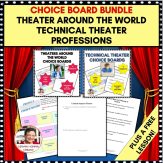
Giving students choices is always a great idea, too.  Remember you have worked out the choices ahead of time so you are comfortable with whether they select once choice over another.  Choice Boards are super for this.  Here are some of mine as an example. This bundle is very popular with teachers: Choice Boards

Ten Ways to Teach Reluctant Students in Your Theater Class

You can even pick up a sample of them right here.

Or pick up a technical theater unit for high school students here: Technical Theater Units, High School

So, there you have it!  Teaching is a wonderful profession when everyone is treated with respect. Even the reluctant students can learn that respecting your art form is possible and believe it or not–enjoyable!  I discovered that once my students knew I had their back and understood them feigning disinterest in theater, I could work with them.  Lots of times, it’s just noise on their part.  Remember that–it’s just noise.

I’d love to know what you’ve found is successful with reluctant students in your classroom?  Contact me at DhcBaldwin@gmail.com.


Share this:

  • Click to share on Tumblr (Opens in new window) Tumblr
  • More
  • Click to share on X (Opens in new window) X
  • Click to share on Facebook (Opens in new window) Facebook
  • Click to share on Pinterest (Opens in new window) Pinterest
  • Click to share on LinkedIn (Opens in new window) LinkedIn
  • Click to email a link to a friend (Opens in new window) Email
  • Click to share on Reddit (Opens in new window) Reddit
  • Click to share on Pocket (Opens in new window) Pocket
  • Click to share on Telegram (Opens in new window) Telegram
  • Click to share on WhatsApp (Opens in new window) WhatsApp

Like this:

Like Loading...

Filed Under: acting, arts education, arts integration, drama education, drama integration, Education, elementary, excellence in teaching, High School, middle grades, reading skills, theater, youth theatre Tagged With: acting exercises, classroom behavior management, elementary school, ELL student, engaging students, high school, Middle school, movement exercises, radio theater, readers theater, reluctant student, Teaching, warm ups and games

The Five Reasons Your Students Will Love Set Design

August 10, 2022 By dhcbaldwin 2 Comments

The Five Reasons Your Students Will Love Set Design

The Five Reasons Your Students Will Love Set Design

One of the things I appreciate about the subject I teach is its varied subjects within it. However as we know, not all students think the same way as I. I thought you might appreciate the five reasons your students will love set design–or at least that’s my hope.

If you are teaching theater and have reluctant students, I’d suggest teaching them about set design.  I’ve yet to find a group of students who did not enjoy learning about it.

Many students love theater, but they are unwilling to perform and consequently they quit studying it and take another class instead.  The reason?  They just can’t find a place for themselves within it.  Technical theater is a wonderful place for inclusion!

The Five Reasons Your Students Will Love Set Design

The Five Reasons Your Students Will Love Set Design

Truthfully, I think teaching set design is crucial for a student’s studies in theater arts. Let’s face it–a set design can make or break a production. Understanding its value and encouraging your students to appreciate it too will not only enrich their learning, but make them a more rounded arts person.

Think about it.  The audience sits and looks at the set for the entire performance.  Sometimes the set doesn’t change.  That’s a loooong time to imagine the place.

I could wax poetic about my love for teaching set design.  I am that much of a cheerleader for it.  But here are some reasons your middle and high school students will love set design:

  1.  It’s highly creative–The sky is the limit when one is learning about set design.
  2.  It’s immediately gratifying–When you design a set and create a model of it (either with paper or through a set design software app.) you can watch your idea take shape right in front of you
  3.  Themes and motifs can be explored effortlessly–your ELA teacher will appreciate that you teach these concepts to your students
  4.  It’s a great way to learn cooperatively–If you have your students work in pair or teams, the design process is eye opening to them.  As in life, everyone has an idea. They should all be heard and incorporated into the design if at all possible.  Students learn to listen, adjust their opinions and consider others.
  5.  Set design skills can carry over into other subjects such as math or social studies.  What a terrific way to apply what you learn.  Design a set, measuring, ratios, etc. come into use.  Researching a local such as France for a set design can be a super integration for a social studies or geography class.

The Challenges of Set Design

The Five Reasons Your Students Will Love Set Design

For Your Gifted Students

I used to challenge my students who needed something more difficult to design their set using a turntable in the center.  Wow, that’s a great challenge!  Not only is it tough to build, but will it work sufficiently?

Or what about a staircase?  Students quickly learn that designing a staircase to scale is much more complex than just label a rectangle a set of stairs.  Once a model is built the student sees the error of their measurements and that’s helpful, too.

How about a bridge?  Again, it’s easy to design but difficult to execute.

A Little Trivia Break

  • Did you know Judy Dench wanted to be a set designer when she was young?
  • Or that Maurice Sendak (author of Where the Wild Things Are) became a set designer after his career as an author? (Me neither!)
  • How about the fact that real-life historical locations provided inspiration for the Hamilton musical set design? While the set isn’t literal, it draws inspiration from actual places. “One of the cool things about Hamilton is almost every single location is one that you can research and find actual visual support for, whether it’s on the internet or in history books, or if the actual location still exists,” says David Korins, the set designer. “We did a lot of research in my office, getting everything from what the Schuyler Home actually looked like to what it looked like in New York City in 1781 and 1776. And we put it all up on a big huge board on a wall in my office, and we picked and chose.”
  • If you want more information about the history of set design, check out this blog post, Past Present and Future Set Design 

The Five Reasons Your Students Will Love Set Design

Teaching students that “less is more” can be easily demonstrated through set design.  In the photo above, you see a simple set from the 2018 revival of Carousel.  It contains a cyclorama with a cloudy night sky projected upon it and four miniature sail boats are part of the ground row.  The rest of the set is wood pallets. Students understand this concept that’s why it’s one of the five reasons students love set design.  Isn’t it effective? If you are need advice concerning selecting a production, check out this blog post: Critical Steps in Selecting a Play or Musical: Budget & Royalties

Permit me to brag a little

This is Brandon Davis.  He was a student of mine when he was in middle school.  He’s really made a great name for himself as a set designer.  When I had Brandon in my drama class in sixth grade, he was quiet, creative and loved theater.  You can see his work below and  at www.brandonptdavis.com


If you aren’t aware, I have a store with Teacherspayteachers.com.  In it, I sell drama education resources. In this particular case, let’s discuss my set design unit.

There are two–one for middle school and another a bundle of technical theater units  for high school.


The Five Reasons Your Students Will Love Set Design      The Five Reasons Your Students Will Love Set Design

The Five Reasons Your Students Will Love Set Design

Here is my middle school design unit description:

During this eight-day unit over set design students learn about the history of set design, famous designers, develop a critical eye about what makes up an award- winning set design, create a ground plan for a fairy tale story of their choosing and draw a rendering. If you’d like a free lesson concerning set design, click here. Set Design, the Rendering

Here’s a added benefit–the students must work with ratios and measuring. (Hello math class!) The first two assignments are completed individually, but then the fun begins! The students are paired up to create a model working together towards the goal. There is even room for parents to celebrate the end of the unit with your students.

Included in the unit:

  • An overview of the unit for the teacher
  • Rationale for teaching design
  • History of scenic design
  • Set designer’s responsibilities
  • Teacher’s Script–what I say and how I say it!
  • Warm-up for day one
  • Procedures for each day (8)
  • Lecture notes including links
  • Information about the message color conveys
  • Rendering examples
  • Stage curtain sheets for rendering–one vertical, one horizontal
  • Step-by-step directions for model building including photo examples
  • Cheat sheet for various set pieces
  • Assignment sheet for each step of the design process
  • Exit slip prompts for 4 days
  • Grade sheet EDITABLE in a separate folder
  • Source page

The Five Reasons Your Students Will Love Set Design

High School Set Design and Others

As you would expect, my high school unit is more challenging.  It includes studying three styles of theater–modernism, expressionism, surrealism.  After reading a play of their choosing, the students select one style and design the set for that production.   They build a model of their design or use software to design it in three dimensions.

Additionally if you want to take this idea even further, I have a theater artist biography and one pager assignment available. I  have several planned, but for now I can offer you Ming Cho Lee.

The Five Reasons Your Students Will Love Set Design

If you are looking for advice a production’s design, check out this blog post: Critical Steps in Producing a Play or Musical: Set Design

In particular, I appreciate this quote from  George C. Wolfe, playwright and director of Angels in America: Millenium Approaches who said:

“I love working with a set designer because, in many respects, you meet the set designer before you meet the actors. So it’s a chance for me as a director to figure out what I’m thinking and to explore how the space is going to actually be activated.”

I hope I’ve convinced you to teach design to your students.  Maybe your students will become a set designer as mine did!

If you want more advice concerning set design, check out: Critical Steps in Producing a Play or Musical: Set Design

Need something for a substitute?  Check out Exploring Theater Professions Video and Class Discussion Lesson.

What technical theater lessons have your students enjoyed learning?  I’d love to know.  Contact me at DhcBaldwin@gmail.com

The Five Reasons Your Students Will Love Set Design


Share this:

  • Click to share on Tumblr (Opens in new window) Tumblr
  • More
  • Click to share on X (Opens in new window) X
  • Click to share on Facebook (Opens in new window) Facebook
  • Click to share on Pinterest (Opens in new window) Pinterest
  • Click to share on LinkedIn (Opens in new window) LinkedIn
  • Click to email a link to a friend (Opens in new window) Email
  • Click to share on Reddit (Opens in new window) Reddit
  • Click to share on Pocket (Opens in new window) Pocket
  • Click to share on Telegram (Opens in new window) Telegram
  • Click to share on WhatsApp (Opens in new window) WhatsApp

Like this:

Like Loading...

Filed Under: arts education, Creativity, drama education, drama integration, e-learning, Education, excellence in teaching, Teacherspayteachers, teaching strategies, youth theatre Tagged With: high school, Middle school, reluctant performers, set design, technical theater, theater class

The Reasons I Love The Giver Play

April 27, 2022 By dhcbaldwin Leave a Comment

A red apple with water splashing around it

The Reasons I Love The Giver Play

The Reasons I Love The Giver Play

If you are considering plays for the next school year, I’d like to recommend you take a look at this marvelous play. Here are the reasons I love The Giver play. Published by Dramatic Publishing, The Giver is adapted by Eric Coble from Lois Lowry’s book of the same name.

Reason Number #1

The story line of The Giver is intriguing from the very first line. Jonas’ world is perfect. Everything is under control and safe. There is no war or fear or pain. There are also no choices. Every person is assigned a role in the community. But when Jonas turns 12, he is chosen for special training from The Giver—to receive and keep the memories of the community. The Giver is the only person who holds the memories of real pain and real joy. Now Jonas will learn the truth about life—and the hypocrisy of his utopian world. Through this astonishing and moving adaptation, discover what it means to grow up, to grow wise, and to take control of your own destiny.
The play has roles for 4 men and 2-4 women and extras.
The Reasons I Love The Giver Play
This novel is very popular with upper elementary and middle grade students. To that end, I’d suggest that high school theater programs mount the production and offer day performances for your area schools.

The Reasons I Love The Giver Play

Reason #2 The Author

I dug around for information about Lois Lowry and found her website, Loislowry.com which states,, ” Born Lois Ann Hammersberg on March 20, 1937, in Honolulu, Hawaii, Lowry is one of America’s most popular and versatile children’s book authors. She has written in a variety of fictional forms, from the WWII tale Number the Stars to the lighthearted adventures of Anastasia Krupnik to the fantastical The Giver.
The Giver was seen as controversial by some for its violent themes, sexual content (not mentioned in the play) and depiction of infanticide and euthanasia. Others, however, heaped praise on this remarkable work, and Lowry won the 1994 Newbery for the novel. Over the years, Lowry added to this examination of a dystopian future with Gathering Blue (2000), The Messenger (2004) and Son (2012).”

The Reasons I Love The Giver Play

The Reasons I Love The Giver Play
Reason Number #3 The Playwright 
Eric Coble was born in Edinburgh, Scotland, and raised on the Navajo and Ute reservations in New Mexico and Colorado. His scripts for adults have been produced on Broadway (Tony- and Pulitzer-nominated The Velocity of Autumn), off-Broadway (Bright Ideas), in all 50 states of the U.S., and on several continents.
His plays for young audiences include award-winning adaptations of Lois Lowry’s The Giver and Gathering Blue as well as Sherlock Holmes: The Baker Street Irregulars, Ghosts in the Machine, Swagger, Cinderella Confidential and a dozen other published scripts that have been produced at The Kennedy Center, Dallas Children’s Theatre, Childsplay, Metro Theatre Company, Oregon Children’s Theatre, First Stage, Denver Center for the Performing Arts, Cleveland Play House, Adventure Stage, Alliance Theatre and many others. Awards include two AATE Distinguished Play Awards for Best Adaptation and the Charlotte Chorpenning Award for the body of work of a children’s playwright.
These two power house creatives alone make this play one you should seriously consider producing.

The Reasons I Love The Giver Play

The Reasons I Love The Giver Play

Technical Challenges of the Play

When designing the set, I’d suggest dividing your stage into two places–Jonas’ home and the Giver’s home.  Give more space to the Giver’s home as most of the action occurs there.  Several scenes can be played in front of the curtain or neutral space between the two sets.
As the play progresses, Jonas begins to understand the Giver, more and more things begin to have color.  That’s a challenge.  We considered several ways to depict the changes and finally landed on  a technique magicians use–distract the audience and intrigue them to look where you want them to focus.
The Giver’s home requires bookcases full of books.  Among other things, we painted four flats to look like identical.  However, each flat was just a little different–the first book case flat was painted with all gray books.  The second flat had several books painted in red or blue while the others were gray and so on until the last flat’s books has most of the books were any color but gray.
To accomplish this, my designer hung the flats in order, one in front of the other on a track (like a closet door track in your house). In the photo above you can see the flat, upstage behind the Giver. As the scenes progressed, the crew merely slid the first flat over past the stage curtains.  Consequently, that left the second flat showing. This continued until every flat had been used.  At the same time, the crew switched out a few props on the standing bookcases, so they began to be more colorful, too.
To help contain the action, we hung pieces of grey cloth (of varying shades of gray) from the light battens. Sometimes the  stage lights would shine on the cloth and sometimes not.
The Reasons I Love The Giver Play
As you can see the costumes are simple.  You just need grey or shades of it for everyone.  Most of my cast found their own costumes and it worked just fine. We made the Giver’s costume and an older woman character’s costumes (used a bible character sewing pattern).
The Reasons I Love The Giver Play

The Biggest Challenge

The most difficult parts of this play are the sound and lights.  Since this was a community theater production, we had access to skilled lighting and sound board operators.  There are many light and sound cues and they are vital to the production.  However, if you don’t have access to both using simple lights which can dim and even live sound effects will work.
Audiences will stretch their imaginations if you are consistent in the sound and lights you choose.
The Reasons I Love The Giver Play

My personal thoughts about the play

I won’t lie here.  This is a challenging play.  The main characters have many lines. The scenes change quickly from one place to the next, the plot contains mature themes and forces audiences to seriously consider what is presented in from of them. The best comparison I can make to The Giver is The Hunger Games.
But friend, this play is worth it to produce. 
A few years ago, I was interviewed about my production,   “This production is quite a different kind of production for the Fine Arts Guild,” director Debbie Baldwin states. “Although the play appears simple to produce because the set is sparse and the actors don’t change costumes, there are lots of props that were a challenge to find. The entire show is ‘gray’ — everything! Three gray bicycles, probably a hundred gray books, a gray globe and a gray apple, for instance.”

The Reasons I Love The Giver Play

I continued, “Plus, it is filled with many particular sound cues (a heartbeat, a baby crying, a horse galloping, an elephant trumpeting, etc.) that require the actors as well as the audience to use their imagination, because there is nothing visual to draw upon for the suggestion. Jonas, the main character, sees things in color that no one else sees. From a lighting point of view, that’s difficult to portray. ‘The Giver’ speaks about falling snow and warfare. Those aren’t things that we dramatize in a play very often.
The question that we discussed was not where to find these sounds to record, but rather which sounds would evoke the emotion most effectively? The show lends itself to much creativity on our part and that’s why I enjoy directing it. It’s very inspiring.”
If you’d like some directing tips, check out Play Production for Newbie Theater Teachers: Expectations Versus Reality Or maybe you’d like to read my advice about another play I recommend. Check out: Ten Reasons Why Everyone Produces Anne of Green Gables
Have you directed The Giver?  I’d love to know your thoughts about it.  Contact me at DhcBaldwin@gmail.com
The Reasons I Love The Giver Play

Share this:

  • Click to share on Tumblr (Opens in new window) Tumblr
  • More
  • Click to share on X (Opens in new window) X
  • Click to share on Facebook (Opens in new window) Facebook
  • Click to share on Pinterest (Opens in new window) Pinterest
  • Click to share on LinkedIn (Opens in new window) LinkedIn
  • Click to email a link to a friend (Opens in new window) Email
  • Click to share on Reddit (Opens in new window) Reddit
  • Click to share on Pocket (Opens in new window) Pocket
  • Click to share on Telegram (Opens in new window) Telegram
  • Click to share on WhatsApp (Opens in new window) WhatsApp

Like this:

Like Loading...

Filed Under: Arts, arts education, arts integration, Creativity, directing experiences, drama education, Education, Education, growing up, High School, middle grades, Producing plays and musicals, youth theatre Tagged With: adult themes, euthanasia, Fine Arts Guild of the Rockies, gifted and talented, infanticide, Middle school

Nine Drama Lessons for Black History Month Which Increase Student Engagement

January 5, 2021 By dhcbaldwin 2 Comments

Nine Drama Lessons for Black History Month Which Increase Student Engagement

Most of us are aware that February is Black History Month.  I’m so glad we give people of color a spotlight.  They certainly deserve it. Today I’m going to discuss Nine Drama Lessons for Black History Month Which Increase Student Engagement.

What is Black History Month?

Good question.

Black History Month is an annual observance originating in the United States, where it is also known as African-American History Month. It has received official recognition from governments in the United States and Canada, and more recently has been observed in Ireland, the Netherlands, and the United Kingdom.

Black History Month began as a way of remembering important people and events in the history of the African diaspora. Celebrated in February in the United States and Canada, while in Ireland, the Netherlands, and the United Kingdom it is observed in October.

If you are looking for My Black History Month Famous Theatre Artists Biography e-book, go here: Black History Month Famous Theatre Artists Biography


When did February become Black History month?

According to www.history.com, President Gerald Ford officially recognized Black History Month in 1976, calling upon the public to “seize the opportunity to honor the too-often neglected accomplishments of black Americans in every area of endeavor throughout our history.”

Do you need some help in the classroom?  Pick up this FREE guide and Lesson Here 

How Can We Celebrate Black History Month in My  Classroom?

Usually, during this time a drama teacher will read a few plays written about black Americans or playwrights. (Check out:  Concord Theatricals for their offerings.) If you need a list, a group of drama teachers compiled this list.  (I take no responsibility for them other than to share the list. I have not vetted them either.)

  • Intimate Apparel by Lynn Nottage.
  • Anna in the Tropics by Nilo Cruz
  • Vietgone by Qui Nguyen
  • Good Grief by Ngozi Anyanwu,
  • Our Lady of Kibeho by Katori Hall
  • Choir Boy by Tarell Alvin Mccraney
  • BLKS by Aziza Barnes
  • Shoe by Marisela Tevino Orta
  • Disengaged by Milta Ortiz
  • The Thanksgiving Play by Larissa Fasthorse,
  •  Durango by Julia Cho
  • Fade by Tanya Saracho
  • Caught by Christopher Chen
  • Behind the Sheet by Charly Evan Simpson

Powerful Voices: Contemporary Plays Exploring Identity, Culture, and Resilience

  •  Sender by Ike Holte
  • Obama-ology by Aurin Squire
  • Edith Can Shoot Things and Hit Them by A. Rey Pamatmat
  • Anonymous by Naomi Lizuka
  • Middle School Girls or The African Mean Girls Play by Jocelyn Biohazards
  • Saturday Night/Sunday Morning by Dominique Morriseau
  • Hoodoo Love by Dominique Morriseau
  • We are Proud to Present a Presentation About the Herero of Namibia...by Jackie Sibblies Drury.
  • Vietgone by Ngozie Anyanwu
  • Our Lady Kibeho by Kato Hall
  • Choir Boy by Tarrell Alvin Mccraney
  • Listen to Your Parents by Benjamin Zephaniah

Amazing list, huh?

Want a FREE biography lesson about Audra McDonald? Click here: Audra McDonald

Videos to View for Black History Month

Another activity a drama class would appreciate is to view a play or movie with a black cast.  If students are in high school, I first suggest Ma Rainey’s Black Bottom with Viola Davis and Chadwick Boseman.  Just excellent!

I compiled this list of videos as a quick way to give you ideas.  Check out: https://redtri.com for more suggestions.

High School–

  • Harriet 
  • Ragtime, the Musical (I’ve only found a student version of Ragtime on youtube.com)
  • Fences
  • Raisin in the Sun
  • Lilies of the Field

Elementary and Middle Grades– 

  • Akeelah and the Bee
  • And the Children Shall Lead
  • Remember the Titans
  • Harriet
  • Hidden Figures
  • Sounder 
  • The Wiz (P.S.  I have a Broadway musical lesson about this production.  If you are interested, check it out The Wiz Broadway Musical Lesson

Drama Lessons Celebrating Black History Month

If you want something unique, I have famous theater artist biographies available.  First, these are great for a substitute provided you have access to the internet and youtube.com.  Primarily, I developed these short lessons as a way for students to learn about successful theater artists journey to Broadway–a growth mindset sort of lesson.

They include:

I add to this group all the time, so if you don’t follow me you might want to do so.  FOLLOW ME

Here is an example of a product’s description:

This distance learning lesson focuses on actor Oscar, Emmy and Tony award-winning James Earl Jones. The student researches questions about his life, journey to Broadway, and various accolades he’s received while practicing growth mindset. Finally, using a One Pager assignment, the student designs his life.

This lesson takes sixty to ninety minutes to complete. Now they come in a digital book!  Pick them up here!

Need something for a substitute? All is needed is the internet.

A Suggestion for You

HOW DO I USE THIS IN MY CLASSROOM? Many teachers combine these biographies with other DramaMommaSpeaks artists Lin Manuel Miranda, actresses Audra McDonald, Cynthia Erivo, Meryl Streep or designer Ming Cho Lee, composers Tim Minchin, Pasek and Paul. Or they tie it to a lesson about the Tony Awards, Tony Awards Lesson

Now they come as a book!

Have you considered the importance of students reading biographies?  If not, check out Should Students Read Biographies?

I’m hoping that 2023 will be a year of celebrating diversity.  Let’s face it–we have a problem and the only way to fix it is discussions concerning our differences and more importantly, how we all deserve respect and understanding.

Want to better understand drama integration and how to use it in your classroom?  Pick up my FREE guide and lesson Here

 What better place than in our classrooms?

What do you do for Black History Month in your classroom?  I’d love to know about it.  Contact me at dhcbaldwin@gmail.com or DeborahBaldwin.net


Share this:

  • Click to share on Tumblr (Opens in new window) Tumblr
  • More
  • Click to share on X (Opens in new window) X
  • Click to share on Facebook (Opens in new window) Facebook
  • Click to share on Pinterest (Opens in new window) Pinterest
  • Click to share on LinkedIn (Opens in new window) LinkedIn
  • Click to email a link to a friend (Opens in new window) Email
  • Click to share on Reddit (Opens in new window) Reddit
  • Click to share on Pocket (Opens in new window) Pocket
  • Click to share on Telegram (Opens in new window) Telegram
  • Click to share on WhatsApp (Opens in new window) WhatsApp

Like this:

Like Loading...

Filed Under: acting, arts education, arts integration, Broadway, creative dramatics, drama education, Education, excellence in teaching, High School, middle grades, performing arts, Teacherspayteachers, Teaching, teaching strategies, theater, theatre, youth theatre Tagged With: black actors, black history month, black playwrights, diversity, high school, Middle school, people of color, racism

« Previous Page
Next Page »

Footer

Follow Us

logo3.png

FOLLOW US

Facebook X-twitter Pinterest Instagram Envelope Rss

Goodreads: read

Malibu Rising
Malibu Rising
by Taylor Jenkins Reid
People We Meet on Vacation
by Emily Henry
The Last Thing He Told Me
by Laura Dave
Faking It
Faking It
by Cora Carmack
Losing It
Losing It
by Cora Carmack

goodreads.com
Copyright © 2024 · Wellness Pro on Genesis Framework · WordPress.com.Log in
 

Loading Comments...
 

    %d