• Skip to primary navigation
  • Skip to main content
  • Skip to footer

Join Me in my new Facebook Group! https://www.facebook.com/groups/417126059784261

Menu
  • Meet Deb – The Heart Behind DramaMommaSpeaks
    • Work with Me! 
    • Photo Gallery of DramaMommaSpeaks
    • Directorial Credits
  • I Give Book Talks! 
    • Book Talk Through Skype
    • Books
  • Freebies!
  • Bumbling Bea
  • Teaching Resume
  • Acting Resume
  • Contact Me
  • Blog
    • Drama Education
    • Arts Education
    • Youth Theatre
    • Middle Grades
    • Musical Theatre
    • Teaching
  • Meet Deb – The Heart Behind DramaMommaSpeaks
    • Work with Me! 
    • Photo Gallery of DramaMommaSpeaks
    • Directorial Credits
  • I Give Book Talks! 
    • Book Talk Through Skype
    • Books
  • Freebies!
  • Bumbling Bea
  • Teaching Resume
  • Acting Resume
  • Contact Me
  • Blog
    • Drama Education
    • Arts Education
    • Youth Theatre
    • Middle Grades
    • Musical Theatre
    • Teaching

stage makeup

Stage Makeup and Its Transformative Power for Students

July 19, 2023 By dhcbaldwin Leave a Comment

Theater student in stage makeup

I’m mentioned this in the past, but thought I’d reiterate it if you’ve not heard it. Let’s talk about Stage Makeup and Its Transformative Power for Students.

The Transformative Power When Students Apply Stage Makeup

Stage Makeup and Its Transformative Power for Students

This is a true story.

When I was in seventh grade, I wanted to wear makeup. Of course, that was about 100 years ago, so let’s keep it in perspective…My mother wasn’t ready for that step in my life quite yet, but I was.  Boy, was I ready.
I read in a Seventeen magazine that I could make my own “home made” mascara using charcoal and petroleum jelly.  I went to work!
Now I’m not known to be very patient (although I am better now that I have grown older), so I looked around our house for the two ingredients I needed.  Hmmm.  I found a jar of petroleum jelly  in my bathroom cabinet, but charcoal? The only charcoal I knew of was charcoal briquettes.

My Makeup Journey

Briquette - Wikipedia
Being my impulsive self as well and not taking into account that perhaps a charcoal briquette was the wrong kind of charcoal for my DIY mascara, I mixed it into the petroleum jelly anyway.  Yes. I. Used. A. Charcoal. Briquette. No kidding. Needless to say, it was a flop.
Upon entering our dining room for dinner that evening while modeling my  “homemade mascara”, my mother let out an “Oh my!” Not surprisingly, soon after she drove to a Merle Norman store and enrolled me in a class about makeup.

Stage Makeup and Its Transformative Power for Students

Luckily, I learned to apply makeup and in later years discovered in college that I really enjoyed designing stage makeup or theatrical makeup. It seems obvious that students would enjoy studying about stage makeup.  Additionally, it helps so much for novice actors to “see” what their character will look like.  Coupled with a costume, some actors come to life as the character for the first time.  It is really that magical.

Did you know I have the secret to boosting student engagement?  My new book, “We’re Live! Radio Theater #101” explains my journey to implementing this unique tool in the classroom. Check it out here

The Transformative Power When Students Apply Stage Makeup

Reasons To Study Theatrical Makeup

  1. Character Transformation: Stage makeup is a powerful tool that allows actors to transform their appearance and effectively portray a wide range of characters. By studying stage makeup, theater students learn how to use makeup techniques to enhance facial features, create age, gender, or ethnic-specific looks, and convey emotions. This skill helps them bring their characters to life and make them more believable on stage.
  2. Visual Communication: In theater, makeup serves as a visual language that communicates important information to the audience. Different makeup techniques can convey specific time periods, social statuses, or cultural backgrounds of characters. By understanding the principles of stage makeup, theater students learn how to use color, shading, highlighting, and contouring to visually communicate the desired message and enhance storytelling.
  3.  Versatility: Stage makeup is not limited to traditional theater productions. Various performing arts disciplines such as film, television, opera, and dance use stage makeup as well.  Students can study to become a professional stage makeup artist and they’ve got themselves a job!

Reasons to Study Theatrical Makeup

4.  Collaboration and Teamwork: For particular productions using a certain style or concept, stage makeup involves collaboration with other artists, such as costume designers, lighting designers, and directors. One of the most   important skills our students can learn is how to work with others because in the professional world of theater, it’s a team effort for certain. Learn more about how theater skills help in careers here: Why Theater Education Matters: Developing Key Life Skills

5.  Self-Sufficiency: In many theater companies (particularly those with small budget), actors are often responsible for applying their own makeup depending upon the budget of the show. By studying, designing and applying  stage makeup theater students gain the ability to create their own character looks.  Accordingly, this can be particularly beneficial in smaller productions, when working on independent projects. This independence allows actors to take more control over their creative process and in bringing their characters to life. What a terrific differentiation! 

6.   Understanding Lighting and Stage Effects: By studying stage makeup, theater students gain an understanding of how makeup interacts with stage lighting.  Thus, ensuring that their character’s features remain visible and expressive even under different lighting conditions. Having this information helps actors develop  makeup techniques to the specific requirements of a production.  Consequently, this results  in a more polished and professional performance.

A Bundle of Stage Makeup Units

You may be unaware, but I create theater education resources.  You can purchase them here.

I have a bundle of stage makeup units. Here’s its description for you:

SAVE 30%! This bundle contains 4 lessons on stage makeup (old age, neutral, circus, zombie and fantasy) and gives your students a chance to be makeup artists. They’ll view, study, take notes on concepts, apply the knowledge, design and apply their own ideas. These are great for an upper middle school ( a little challenging) or high school drama class.

Each Stage Makeup Lesson includes:

  • Warm-Up Exercises
  • The History of Stage Makeup (separate file of PowerPoint slides & teacher’s lecture notes)
  • Theatre Quote page–great to use for discussion and/or bell ringers
  • Teacher’s Script–what I say and how I say it!
  • Procedures
  • Materials List
  • Source & Video link list ( old age, basic and circus and fantasy makeup tutorials, etc.)
  • Pinterest board links with examples for some lessons
  • Female Makeup Design Template
  • Male Makeup Design Template

My stage makeup studies include entire lessons for you. If you still need some persuading, check out this blog post: Critical Steps in Producing a Play or Musical: Stage Makeup

The Transformative Power When Students Apply Stage Makeup

Choice Boards for Differentiation

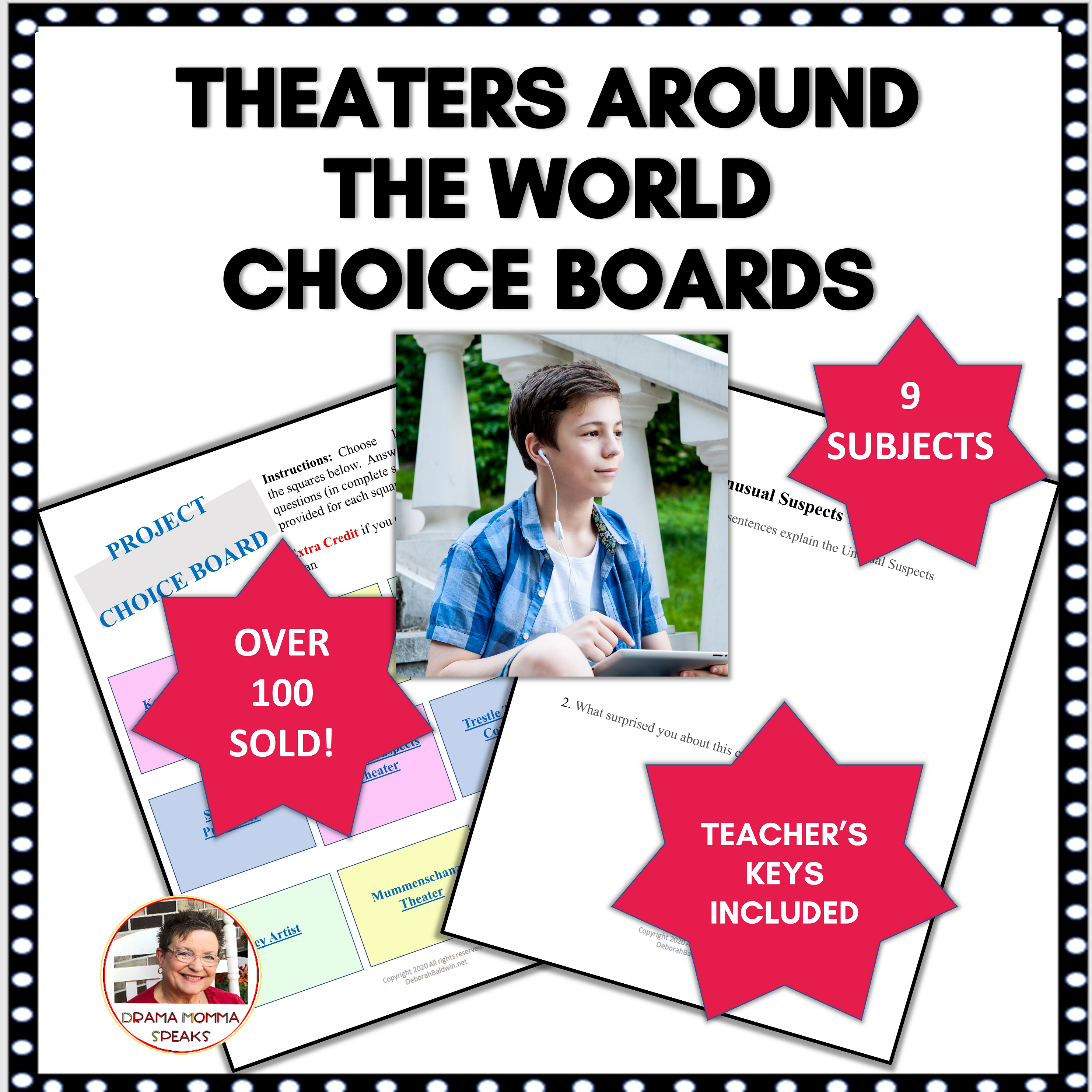
If you are looking for a way to teach students about theaters around the world, check out these Choice Boards. 

What are Choice Boards, you ask?  In this case, my choice boards are a collection of links which lead to video clips.  Students select the subjects they are most interested in, view the video clips and answer the questions.  This is super differentiation! By tailoring instruction to meet individual needs. through content, process, products, the learning environment,  ongoing assessment or  flexible grouping, differentiation creates a successful approach to instruction.

I hope you’ll considering teaching about stage makeup with your students.  It’s so important.  Just watch the transformation of your students as they apply it! Suddenly, you’ll see a student transform into a character.  Costumes do the same thing for them. As I mentioned above, these skills contribute to students’ overall artistic development and enable them to deliver compelling performances that captivate and engage audiences.
What styles of stage makeup design have you taught your students?  Did they enjoy it?  I’d love to learn about it.  Contact me at DhcBaldwin@gmail.com
Woman behind DramaMommaSpeaks

Share this:

  • Click to share on Tumblr (Opens in new window) Tumblr
  • More
  • Click to share on X (Opens in new window) X
  • Click to share on Facebook (Opens in new window) Facebook
  • Click to share on Pinterest (Opens in new window) Pinterest
  • Click to share on LinkedIn (Opens in new window) LinkedIn
  • Click to email a link to a friend (Opens in new window) Email
  • Click to share on Reddit (Opens in new window) Reddit
  • Click to share on Pocket (Opens in new window) Pocket
  • Click to share on Telegram (Opens in new window) Telegram
  • Click to share on WhatsApp (Opens in new window) WhatsApp

Like this:

Like Loading...

Filed Under: arts integration, community theater, drama education, drama integration, Education, excellence in teaching, middle grades, Teacherspayteachers, Teaching, theater, youth theatre Tagged With: choice boards, cooperative learning, differentiation, high school drama class, middle school drama class, stage makeup, stage makeup design, theater profession

Drama Lessons for High School from an Award Winning Drama Teacher

February 26, 2020 By dhcbaldwin 3 Comments

Drama Lessons for High School from an Award Winning Drama Teacher

Hello!

I wanted to introduce you to drama lessons for high school from an award-winning drama teacher. You may not know me or be familiar with my work.  I’m Deborah Baldwin (but my friends call me Deb.) I am a recently retired award winning drama teacher for thirty-eight years.  In that time, I directed over 300 plays and musicals with students and adults as well.  I taught every grade level, but the bulk of my time was spent with secondary students. I’m also an award-winning director and middle grade author.

Here is my resume if you’d like to see it: DeborahBaldwin.net

deb directing

My Teaching Style:

Drama is a hands-on class. To this end I’m always on my feet modeling for my students while teaching them a host of concepts. It is not unusual to hear my classroom in chortles of laughter because humor is an outstanding way to gain a student’s attention. I empower students at an early age.

Although I am always mindful of my learning objectives, I think it’s vital for students to experiment within the confines of my instruction. I encourage students to be independent and creative thinkers.

Many less confident or reluctant students benefit from my teaching methods as together we hit the challenges they encounter. I am creative, intense, driven and brave–these are qualities I nurture in all my students and generally receive outstanding results in them.

If you are looking for drama units, lessons and plays for your students, I can help you.  Here are a few of my lessons for high school students:

Billy Elliot
Billy Elliot, the Broadway Musical
The Invisible Man Radio Play Unit
Growth Mindset Posters
Rent, the Broadway Musical
Famous Theater Artists
Stage Makeup
Stage Makeup
Broadway Musical Lessons
Hamilton, the Musical
The Cask of Amontillado and Radio Theater Unit
Famous Theater Artists
BUNDLE HIGH SCHOOL LEVEL BLUE BACKGROUND400 (1)
COSTUME DESIGN HIGH SCHOOL COVER 38

Radio Play Performance

(Here is a production of this script by an ESL class in Tiblisi Georgia!)  “The Invisible Man” Radio Play

Dramamommaspeaks Resources

  • Radio Theater Unit Plus Radio Play of “The Invisible Man”
  •   The Producer
  • Rent, the Broadway Musical
  • Theater Artists You Should Know Growth Mindset
  • Bundle:  Biographies of Theater Artists–Lin Manuel Miranda, Audra McDonald, Hugh Jackman, Meryl Streep, Cynthia Erivo, Denzel Washington and Ming Cho Lee
  • Bundle:  Stage Makeup -Zombie, Fantasy, Basic-Old Age, Circus
  • Costume Design: High School
  • Bundle:  Costume, Stage Props., Set and Sound Design (sold separately as well)
  • Bundle:  Tony Awards & Broadway Musicals
  • Hamilton, the Broadway Musical
  • NEW!  Daveed Diggs Theater Artist Biography
  • NEW!  Camille A. Brown Theater Artist Biography
  • NEW!  Billy Elliot, the Broadway Musical
  • NEW!  Something Rotten Broadway Musical 
  • NEW!  Choice Board–Theater Around the World

Most lessons lasts at least two days.  The units’ length range from several days to three weeks.

I have lessons for younger students, too!  Check them out:

Creative Dramatics Lessons from an Award Winning Drama Teacher

Drama Lessons for Middle Grades from an Award Winning Drama Teacher

If you’d like a FREE lesson, be my guest and pick up one:   Free Stuff!

Here’s a recent review of one of my newest products, Acting Styles/Stanislawski, “Dramamommaspeaks hits it out of the park again!! Every unit I get is perfect. I teach three levels of theatre in the same class. The unit was great for the entry level students while still providing a challenge to my most advanced class.”  5 stars

Contact me at dhcbaldwin@gmail.com or DeborahBaldwin.net


Share this:

  • Click to share on Tumblr (Opens in new window) Tumblr
  • More
  • Click to share on X (Opens in new window) X
  • Click to share on Facebook (Opens in new window) Facebook
  • Click to share on Pinterest (Opens in new window) Pinterest
  • Click to share on LinkedIn (Opens in new window) LinkedIn
  • Click to email a link to a friend (Opens in new window) Email
  • Click to share on Reddit (Opens in new window) Reddit
  • Click to share on Pocket (Opens in new window) Pocket
  • Click to share on Telegram (Opens in new window) Telegram
  • Click to share on WhatsApp (Opens in new window) WhatsApp

Like this:

Like Loading...

Filed Under: acting, arts education, drama education, excellence in teaching, High School, Musical Theatre, performing arts, plays, Radio Theatre, Teacherspayteachers, theater Tagged With: Broadway musicals, costume design lesson, DISTANCE LEARNING, drama, drama education, famous theater artists, google classroom, high school drama lessons, high school lessons, play reading analysis, radio theater, set design lesson, stage makeup

What is Talk like a Pirate Day?

September 16, 2019 By dhcbaldwin 1 Comment

Today, I’d like to share about the question, What is Talk Like a Pirate day?” Simply put, it’s a non-official day where people talk like pirates.  It’s just fun!

Here is the origin:

Talk Like a Pirate Day is the brainchild (if that’s the right word) of two friends, John Baur and Mark Summers, who thought, ‘wouldn’t it be fun to have one day a year when people shake off their serious side and talk like pirates?’ The idea for the day actually originated on June 5, 1995, during a game of racquetball, when one of the men was injured and yelled “Aaarrr.” However, out of respect to the anniversary of the World War Two Normandy landings, the men postponed their celebration. They later chose September 19 because it was Summers’s ex-wife’s birthday and therefore would be easy to remember. (That is so funny!)

Since September 2002, when syndicated columnist, Pulitzer Prize Winner Dave Barry wrote about the idea, John and Mark have been deluged with letters and e-mails about how “Talk Like a Pirate Day” can be applied in various settings.

An observer of this holiday would greet friends not with “Hello, everyone!” but with “Ahoy, maties!” or “Ahoy, me hearties!”. The holiday, and its observance, springs from a romanticized view of the Golden Age of Piracy.

What is Talk like a Pirate Day?

English actor Robert Newton is the “patron saint” of Talk Like a Pirate Day. He portrayed pirates in several films, most notably Long John Silver in both the 1950 Disney film Treasure Island and the 1954 Australian film Long John Silver, and the title character in the 1952 film Blackbeard the Pirate. Newton was born in Dorset and educated in Cornwall, and it was his native West Country dialect, which he used in his portrayal of Long John Silver and Blackbeard, that some contend is the origin of the standard “pirate accent”. This was parodied in the 1950s and 1960s by British comedian Tony Hancock.

That’s so fun!

What is Talk like a Pirate Day?

You know who loves stuff like this?  Our students.

If you know me, you know I teach theater with a twist.  I thought, “How can I teach some acting skill, explore a radio theater play and celebrate Talk like a Pirate Day simultaneously?”

Enter:  Talk Like a Pirate Day drama lesson!

What is Talk like a Pirate Day?

I loved working on this lesson.  I decided to introduce dialects and accents through it.

Plus, how about reading aloud The Frozen Pirate radio theater play? If you haven’t figured it out yet, I’m really just a kid at heart.

When I began adapting radio plays for the classroom, I ran upon The Frozen Pirate.  I’d never heard of the story, but it’s a good one.

Who is William Clark Russell, the author?

At the age of 13 Russell joined the United Kingdom’s Merchant Navy, serving for eight years. Wow! The hardships of life at sea damaged his health permanently, but provided him with material for a career as a writer. He wrote short stories, press articles, historical essays, biographies and a book of verse, but was known best for his novels, most of which were about life at sea. He maintained a simultaneous career as a journalist, principally as a columnist on nautical subjects for The Daily Telegraph.

Russell campaigned for better conditions for merchant seamen, and his work influenced reforms approved by Parliament to prevent unscrupulous ship-owners from exploiting their crews. His influence in this respect was acknowledged by the future King George V. Among Russell’s contemporary admirers were Herman Melville, Algernon Swinburne and Sir Arthur Conan Doyle.

The Frozen Pirate is a story of a ship captain and his valet whose ship runs ashore on a desolate, icy island.  While scavenging for a place to protect themselves from the storm, they find a pirate ship frozen into the rocks. I’ve adapted it into a radio play.

The ship is full of loot, gold and oh yes, several pirates.  The valet makes a fire and guess what?  One pirate warms enough to come back to life!

Teaching with a Twist

This is a good example of how I teach theater with a twist–I view trendy topics and figure out how to assimilate them into a drama classroom.


Halloween? 

That’s an obvious one–stage makeup and studying sound effects. But how about costume design for Halloween characters?

Thanksgiving?

Tableau and movement do great with subjects of Thanksgiving.

Christmas?

Students can study stage properties through viewing video examples on holiday movies.  There are scads of them.  Also, another good costume design lesson is that of The Nutcracker Ballet.

See?

Costume Design with Nutcracker Characters

It’s not that the usual methods are poor.  Everyone does monologues, scenes, improvisation, etc. That’s important. However, I have found that if you teach any length of time, you are going to grow bored with the tried and true resources you use. Frankly, every lesson but acting is interesting to reluctant learners.  Acting makes you feel vulnerable and they don’t want that.  Check out: Ten Ways to Teach Reluctant Students in Your Theater Class

So how about trying something new?  

Once, a director suggested to me  I deliver a particular line in a play differently each night.  I was portraying the part for several weeks and I worried about becoming stale.

There’s an old exercise where we teach students the differences in the meaning to “Close the door. Close the door. Close the door.”

At first, I stayed with something safe such as, “You are welcome.”

Over time, I adapted the exercise with other lines.  You know, it worked! Suddenly, the lines became fresh to me all over again as if I had just picked up the script for the first time.

That’s why my resources work too!

Try a different lesson with a different perspective, like this Talk like a Pirate Day lesson.

What are some of your favorite lessons you have created?  I’d love to hear from you.

Contact me at dhcbaldwin@gmail.com or DeborahBaldwin.net

Deborah Baldwin, author


Share this:

  • Click to share on Tumblr (Opens in new window) Tumblr
  • More
  • Click to share on X (Opens in new window) X
  • Click to share on Facebook (Opens in new window) Facebook
  • Click to share on Pinterest (Opens in new window) Pinterest
  • Click to share on LinkedIn (Opens in new window) LinkedIn
  • Click to email a link to a friend (Opens in new window) Email
  • Click to share on Reddit (Opens in new window) Reddit
  • Click to share on Pocket (Opens in new window) Pocket
  • Click to share on Telegram (Opens in new window) Telegram
  • Click to share on WhatsApp (Opens in new window) WhatsApp

Like this:

Like Loading...

Filed Under: acting, arts education, drama education, excellence in teaching, High School, middle grades, Radio Theatre, Reading Literacy, Teacherspayteachers, teaching strategies, youth theatre Tagged With: accents, costume design, dialects, pirates, sound effects, stage makeup, stage properties, tableau and movement, Talk like a Pirate Day

Circus Themed Lesson Plans–a New Twist for Drama Classes

February 16, 2019 By dhcbaldwin 10 Comments

Circus Themed Lessons–a New Twist for Drama Classes

Let’s talk about circus themed lesson–a new twist for drama class, shall we? “Welcome to the circus!”–You know, I don’t think I’ve heard a circus master of ceremonies actually say this, have you?

It must be from the movie, Dumbo which was one of my favorites when I was a child. This is probably the reason I love elephants so much, too.

Recently, I saw a preview for the new Dumbo movie coming out soon and it reminded me of a couple of lessons I created about Cirque Du Soleil.  Students don’t study Cirque du Soleil per se, but they focus on Cirque Du Soleil lessons through a new twist: the performers costumes and makeup.

Acrobats, Cirque Du Soleil

In case you don’t know me, I taught drama at every grade level for over thirty-five years and as many as ten different subjects within it.  Everything from creative dramatics to technical theatre–second through twelfth grade.

Why is it Important to Create a Lesson Plan?

I had a good drama teacher when I was in high school during the Civil War (well, it feels like it sometimes).  Mr. Kent Chapman of Emporia High School got me started and for that, I am always grateful.  I loved everything about his classes–his warm ups, lessons, assignments and of course, direction of the plays.

 Like most educators, we emulate what we liked from our own teachers.  Over those many years of teaching, although I was modeling my lessons after Mr. Chapman’s it became dull and robotic. 

 As a result, I realized I was getting stale because I kept doing the same things over and over again. 

However, if you are going to repeat yourself (for thirty-eight years) you may as well toil on an assembly line someplace and make better money.  As a I was a  creative person I couldn’t abide by it.

If you keep teaching the same thing over and over it’s easier, right? It’s way boring, though. 

That’s just not my style.  I like to build a better mousetrap.

Cirque Du Soleil Lessons–a New Twist for Drama Classes

When our daughters were young, we traveled to Disney World and just happened to get tickets for our first Cirque Du Soleil show, La Nouba.  Oh my gosh, we were awestruck the entire time.  If you haven’t seen it or any of their circuses, you are missing out!  Here’s an example for you:

As you can see, their shows are magnificent!

Who is Cirque du Soleil?

According to Wikipedia, “Cirque Du Soleil is a Montreal-based entertainment company and the largest contemporary circus producer in the world.  Located in the innter-city area of Saint Michel, it was founded on June 16, 1984 by former street performers Guy Laliberte and Giles St.-Crois.  Like many new entertainment ventures, they had a great idea but not much money to make it happen.  Then in 1983 they received a government grant from the Canada Count for the Arts to perform as part of the 450th anniversary celebrations of Jacques Cartier’s voyage to Canada.  Its theatrical, character-driven approach and the absence of performing animals helped define Cirque du Soleil as the contemporary circus that it remains today.”

Circus Themed Lesson Plans--a New Twist for Drama Classes

Bringing Cirque to the Classroom: Inspiring Creativity Through Costume Design and Storytelling

When I returned to school that year, I got to thinking about how I could use La Nouba in the classroom.  First, I created a lesson on costume design about it.  Kids just LOVED it!

As a result of my attendance to the show, we’d see video snippets about La Nouba. I’d talk them through the various acts pointing out the costumes and makeup in particular.  Then the students would study costume design and its importance in theatre and finish by designing their own Cirque costume.

Since writing was a big push at our school,  I thought they needed to do more than design.  Consequently, I also assigned them to write a letter to a family member as if the student was hired by Cirque detailing their employment and subsequent training in the circus.

Time to Study Stage Makeup

Next it was time to study stage makeup–why not continue with the Cirque Du Soleil focus? 

For Grades 6-9

We did so, and I was amazed at their wonderful designs and ideas.  Here is one:

gotta put my face one (2)

Isn’t this awesome?

I thought other teachers may like to use these lessons as well.  Each lesson is about two days in length which could be stretched to a week if you did both. That’s a heck of a week of learning if you ask me.

Cirque Du Soleil Lessons–a New Twist for Drama Classes

For Grades 4 to 7.


DRAMA LESSON: COSTUME DESIGN STUDY WITH CIRCUS PERFORMERS

Check out the product here: Costume Design with Circus Performers

Purchase at Costume Design with Circus Performers 

New!  The Tricicle Theater Company and Movement Lesson! 


DRAMA LESSON: STAGE MAKEUP DESIGN STUDY WITH CIRCUS PERFORMERS

Stage Makeup Design with Circus Performers

These elements of drama lessons study costume design and stage makeup using circus performers (in particular Cirque Du Soleil) as their focus! These are great for an elementary gifted class or middle school drama class.

Students love to study stage makeup!  Even boys enjoy it as you can see from the above.

Costume Design and Stage Makeup Design:

Costume Design includes:

  • The History of Costume Design
  • The Rationale for Teaching Costume Design
  • Costume Notes for Students
  • Procedure
  • Teacher’s Script–what I say and how I say it!
  • Materials List
  • Source & Video link list (Cirque De Soleil, Ringling Brothers, etc.)
  • A Warm-Up—engaging and creative
  • Circus Performer list & skills
  • Two Assignments–one drawing and one creative writing
  • Student Examples

Stage Makeup Design:

  • Warm Up Game–Zip, Zap, Zop (MY version)
  • The History of Stage Makeup (separate file of Power Point slides & teacher’s lecture notes)
  • Teacher’s Script–what I say and how I say it
  • Procedure
  • Materials List
  • Source & Video link list (Cirque De Soleil makeup tutorials, Circus Shmurkus, Barnum and Bailey, etc.)
  • Pinterest board link with examples
  • Two Assignments–one drawing and one creative writing
  • Theatre Quote page–great to use for discussion and/or bell ringers

Check out my advice at: Why You Should Use These Effective Teaching Methods, Part Two

I hope you get a chance to see both Dumbo and a Cirque Du Soleil show soon.  You won’t regret it!

My favorite act at the circus is the trapeze.  What is yours?

I’d love to hear from you.  Contact me at dhcbaldwin@gmail.com or DeborahBaldwin.net

Deb


Share this:

  • Click to share on Tumblr (Opens in new window) Tumblr
  • More
  • Click to share on X (Opens in new window) X
  • Click to share on Facebook (Opens in new window) Facebook
  • Click to share on Pinterest (Opens in new window) Pinterest
  • Click to share on LinkedIn (Opens in new window) LinkedIn
  • Click to email a link to a friend (Opens in new window) Email
  • Click to share on Reddit (Opens in new window) Reddit
  • Click to share on Pocket (Opens in new window) Pocket
  • Click to share on Telegram (Opens in new window) Telegram
  • Click to share on WhatsApp (Opens in new window) WhatsApp

Like this:

Like Loading...

Filed Under: Arts, arts education, creative dramatics, Creativity, drama education, Education, excellence in teaching, middle grades, performing arts, Teacherspayteachers, theater, theatre, youth theatre Tagged With: costume design, lesson plans, stage makeup

Critical Steps in Producing a Play or Musical: Stage Makeup
May 15, 2018 By dhcbaldwin 3 Comments

PHOTO OF KABUKI ACTOR

Let’s talk about steps in producing a play or musical:  stage makeup

This is a true story.

When I was in seventh grade, I wanted to wear makeup. Of course, that was about 100 years ago, so let’s keep it in perspective….. My mother wasn’t ready for that step in my life quite yet, but I was.  Boy, was I ready. I read in a Seventeen magazine that I could make my own “home made” mascara using charcoal and petroleum jelly.  I went to work!

Now I’m not known to be very patient (although I am better now that I have grown older), so I looked around our house for the two ingredients I needed.  Hmmm.  I found a jar of petroleum jelly  in my bathroom cabinet, but charcoal?

The only charcoal I knew of was charcoal briquettes.  Being my impatient self and not taking into account that perhaps a charcoal briquette was the wrong kind of charcoal for my DIY mascara, I mixed it into the jelly anyway.  Yes. I. Used. A. Charcoal. Briquette.

No kidding.

Needless to say, it was a flop. Upon entering our dining room for dinner that evening while modeling my  “homemade mascara”, my mother let out an “Oh my!” Soon after  she drove to a Merle Norman store and enrolled me in a class about makeup.

I have refrained from making any other makeup products since that day.  I will admit that whenever we grill burgers over charcoal briquettes,  I grow a bit misty eyed remembering my DIY makeup days..

the-wizard-of-oz-516791_1280

The Thrill of Wearing a Costume

Like a costume, stage makeup ranks up there as one of the most popular aspects of theater.  For some people, donning a costume and applying makeup IS theater.

A costume and makeup psychologically comforts the actor and helps him to feel “safe.” A good director, especially in amateur theater, must be careful not to lean on a character’s costume and makeup as the only characterization of an actor.

In that case, let’s just put the costume designer on stage and let her perform the show (I doubt she would appreciate that…) because the character solely originates with her and not the actor.  Tsk,tsk…

Stage makeup is different than street makeup (makeup worn for everyday use).  It is durable, saturated color and easily blended. It’s sturdy–you can cry, eat and have water thrown in your face and the stuff stays on!

staging-258627_960_720[1].jpg
Makeup Designer

Makeup Designer

Since this series of posts concerns producing a play or musical and the critical steps one must take for a successful production, I  knew I should discuss stage makeup.

Do you have a makeup designer?  If not, a good place to find one is through hairstyling salons.  Most hairstylists are trained to do makeup as well as hair.  Many hairstylists LOVE this kind of work, because it is so creative.

If I need special makeup (say, for Ursula in Lil Mermaid), I give them photos of my ideas first.  Like set and costumes, a designer needs somewhere to begin in their designing.  In your budget, you need an amount for stage makeup.

I include wigs and hair needs in that budget, too–hairspray, bobby pins, hair nets, etc. If a designer must build a mustache or beard, that is an additional cost.  If you have someone who is familiar with stage makeup, so keep them around.  They are invaluable.

If you don’t have budget money for a designer, perhaps you could acknowledge them through your program and give them complimentary tickets to the production?

Specific Makeup Products

Every cast member should own their own makeup, however some things can be shared if you are on a tight budget.  If the makeup is selected ala carte, then I suggest you purchase:

  • foundation–several shades (I like crème foundation, but some people prefer pan.)
  • hi-light and shadow for contouring
  • translucent powder to match the foundation
  • eye brow pencil
  • blush–several shades
  • eye shadow–several shades
  • makeup sponges
  • spray sealer
  • makeup remover
  • eyeliner (should not be shared with others)
  • mascara (should not be shared with others)
  • lipstick (should not be shared with others)

You are going to pay more ala carte, than if you buy a kit or collection. Your actors may find that they like owning their own makeup.  I have my own makeup when I perform.

There are several companies and different size kits as well.  Like a “one size fits all” tee shirt (I have never understood that phrase), you can buy kits such as fair/lightest, to brown/Dark.  Ultimately, I suggest you find one close your skin color and work from there with the color provided in the kit.

Ben Nye Makeup is very good as is Mehron.  I’m partial to Ben Nye myself. The kits can run as little as $20.00 and upward to $150 for a comprehensive collection.  You’ll find what you need quite easily on line.

I played Nellie Forbush in South Pacific when I was in my twenties. This was NOT a character I ever thought I’d play.  In my mind, she was “101 pounds of fun” as the song says.  I wasn’t that poundage by a long shot.  The part called for a  bright, cute, sincere and naive young woman.   I worried that no one would believe my performance.

My favorite part of the whole experience (other than my husband, then fiancé who was the conductor) was the shower scene.

  I actually washed my hair and yes, danced with shampoo in my hair. Then I’d rinse it under ice cold water (!) while speaking with another character, wrapped it up in a towel and exited.  In the next five minutes, I dried my hair, reapplied my makeup and donned an elegant full length evening gown, drop earrings and elbow length gloves.  It was a blast to do!

Something about those two scenes helped me past the worry.  Every night as I stepped on the stage,  I knew I was surrounded by a wonderful armor which carried me past my fears and supported my character in a way I could never have done all by myself.

That’s what makeup and a costume can do for you.

As you may know, I have a store on Teacherspayteachers.com  I have created several lessons about stage makeup which you may be interested in using in your classroom.  

Stage Makeup with Circus Performers

DRAMA LESSON: COSTUME DESIGN STUDY WITH CIRCUS PERFORMERS

Stage Makeup with Zombies

STAGE MAKEUP ZOMBIE CHARACTERS

Or……here’s a bundle of all four of the lessons!  Bundle:  Stage Makeup Lessons 

Contact me at dhcbaldwin@gmail.com or DeborahBaldwin.net

I’d love to hear from you.

author's signature

Share this:

  • Click to share on Tumblr (Opens in new window) Tumblr
  • More
  • Click to share on X (Opens in new window) X
  • Click to share on Facebook (Opens in new window) Facebook
  • Click to share on Pinterest (Opens in new window) Pinterest
  • Click to share on LinkedIn (Opens in new window) LinkedIn
  • Click to email a link to a friend (Opens in new window) Email
  • Click to share on Reddit (Opens in new window) Reddit
  • Click to share on Pocket (Opens in new window) Pocket
  • Click to share on Telegram (Opens in new window) Telegram
  • Click to share on WhatsApp (Opens in new window) WhatsApp

Like this:

Like Loading...

Filed Under: community theatre, drama education, Producing plays and musicals, Production Questions, Teacherspayteachers, theater, theatre, youth theatre Tagged With: community theatre, costumes, hairstylist, makeup designer, production budget, stage makeup

Footer

Follow Us

logo3.png

FOLLOW US

Facebook X-twitter Pinterest Instagram Envelope Rss

Goodreads: read

Malibu Rising
Malibu Rising
by Taylor Jenkins Reid
People We Meet on Vacation
by Emily Henry
The Last Thing He Told Me
by Laura Dave
Faking It
Faking It
by Cora Carmack
Losing It
Losing It
by Cora Carmack

goodreads.com
Copyright © 2024 · Wellness Pro on Genesis Framework · WordPress.com.Log in
 

Loading Comments...
 

    %d