• Skip to primary navigation
  • Skip to main content
  • Skip to footer

Join Me in my new Facebook Group! https://www.facebook.com/groups/417126059784261

Menu
  • Meet Deb – The Heart Behind DramaMommaSpeaks
    • Work with Me! 
    • Photo Gallery of DramaMommaSpeaks
    • Directorial Credits
  • I Give Book Talks! 
    • Book Talk Through Skype
    • Books
  • Freebies!
  • Bumbling Bea
  • Teaching Resume
  • Acting Resume
  • Contact Me
  • Blog
    • Drama Education
    • Arts Education
    • Youth Theatre
    • Middle Grades
    • Musical Theatre
    • Teaching
  • Meet Deb – The Heart Behind DramaMommaSpeaks
    • Work with Me! 
    • Photo Gallery of DramaMommaSpeaks
    • Directorial Credits
  • I Give Book Talks! 
    • Book Talk Through Skype
    • Books
  • Freebies!
  • Bumbling Bea
  • Teaching Resume
  • Acting Resume
  • Contact Me
  • Blog
    • Drama Education
    • Arts Education
    • Youth Theatre
    • Middle Grades
    • Musical Theatre
    • Teaching

theater teacher

Improvisation in Theater: Myths vs. Reality

May 25, 2022 By dhcbaldwin Leave a Comment

Theatrical masks hanging in front of a vintage stage curtain.

What You Know About Improvisation In Theater And What You Don't Know About Improvisation In Theater

This is a great topic, don’t you think? Improvisation in Theater: Myths vs. Reality Let’s unpack this today. 

Improvisation.  Fun stuff, huh?

I was a child of the late 1960s and early 70s.  I didn’t study theater until I attended high school and even then, I barely got started.  My teacher never taught or used improvisation and consequently, I was sorely behind when I began my studies in college at Stephens College in Columbia, MO.

The first time my college acting teacher, Jean Muir, sat quietly in our classroom studio and said, “Today, we are going to use improvisation to study characterization.” I was a nervous wreck.  I had no idea what she meant.  Being a quick learner, though I soon loved it.

Improvisation in Theater: Myths vs. Reality

What You Know About Improvisation In Theater And What You Don't Know About Improvisation In Theater
Ligue d’improvisation montréalaise

I searched around on the internet and found this description on wikipedia.org:

“The earliest well-documented use of improvisational theatre in Western history is found in the Atellan Farce of  391   BC.  From the 16th to the 18th centuries, commedia del arte performers improvised based on a broad outline in  the streets  of Italy. In the 1890s, theatrical theorists and directors such as the Russian Konstantin Stanislavski and the French  Jacques Copeau, founders of two major streams of acting theory, both heavily utilized improvisation      in acting training and rehearsal.”

Wow!  I had no idea of its history, did you?

What You Know About Improvisation In Theater

What You KNow about Improvisation in Theater and What You Don't Know about Improvisation in Theater

I think it’s fair to say that most of theater educators know improvisation’s basic rules:

  1. Live in the moment–If the actor plays the moment, they will have plenty of ideas of which to choose.
  2. Employ active listening--This is absolutely vital in improv.
  3. Seek and nurture connection and interconnection–Humans experience many moments universally–a birthday, a loose tooth, losing a pet, getting in trouble with a parent.  Use these moments to you advantage.
  4. Always say ‘yes’–The first rule of improvisation is AGREE. Always agree and SAY YES. When you’re improvising, this means you are required to agree with whatever your partner has created. This keeps the scene going and doesn’t stall out.
  5.  Continue the improvisation as much as possible--You should agree and then add something of your own. If I start a scene with “I can’t believe it’s so hot in here,” and you just say, “Yeah…” we’re kind of at a standstill. But if I say, “I can’t believe it’s so hot in here,” and you say, “What did you expect? We’re in hell.” Or if I say, “I can’t believe it’s so hot in here,” and you say, “Yes, this can’t be good for the wax figures.”
  6. Make statements--Whatever the problem, be part of the solution. Don’t just sit around raising questions and pointing out obstacles.
  7. Give trust before it is earned–This helps everyone involved.  To know that your scene partner(s) has your back and will help you if you get stuck means everything.
  8. There are no mistakes, only opportunities–Make big ones!  Our instinct when we make mistakes is to minimize them as much as possible, and that shows in how the average person responds to those situations. I say go big or go home.

Improvisation in Rehearsal

Improvisation can be used in a variety of ways.  I’m most comfortable with using improv. to develop a character.  Spending time during a rehearsal acting as the character (though not rehearsing the production) is an excellent way to explore characterization. So, today I’m speaking different ways I use imiprovisation in rehearsal.

When blocking large groups of students, I use improvisation to create blocking for a particular moment.  For instance, in the scene where the Cossacks rampaged the wedding in Fiddler on the Roof, I instructed students to respond as their characters to the moment.

Generally, I encourage them to say whatever came to mind for them, to exclaim, weep, etc.  In this particular situation, there were a lot of giggles, frozen stances and wide eyes from my students.  However, after several times of improv. everyone felt more comfortable with the violence. (What a strange thing to write…)

This improv. was challenging for my home school students who were sheltered from anything violent (books, movies and television). Through trial and error, we came to an agreement about what we could demonstrate through the violence that we couldn’t with dialogue. By doing so, it gave them permission to act out their negative emotions and made for an thought- provoking moment.

Deb directing The Miracle Worker
DIRECTING THE MIRACLE WORKER

Use Improvisation in Your Blocking

A fun way to use improvisation is when blocking entrances and exits of characters.  Let’s face it–sometimes it’s just difficult to exit the stage without looking like a robot. The script merely says, “exit.” My questions are always–How?  When?  Doing what? Going where? Sometimes I use improvisation as a way for a character to make an exit believable rather than looking programmed.

It has been my experience that students under the age of fifteen have a difficult time blocking a scene without my help, unless they have years of past stage experience from which to draw.  With experienced actors, I can say, “How about you move around the stage as you feel the character would and we’ll see if it works?”

The only problem I find with experienced actors is they don’t always remember what they did the last time they rehearsed the scene and this makes for problems.  Even if my stage manager writes it down, somehow my experienced actors can’t get out of the habit of changing their blocking.

Usually, I pre-block scenes for novice actors because it’s tough enough just to learn the lines much less block yourself in a play.  But I can give novice actors an opportunity to try a bit of improv. if they are so inclined.  Some students ideas are much better than mine.

The Second City-Chicago Illinois Improvisational Theater Company
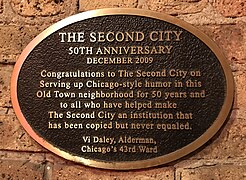
File:Second City (33479580494).jpg

One of the most popular and certainly the most centrally located improvisational company in the United States is The Second City.

Improv comedy ended up on the map thanks to The Second City. Along with launching the careers of famed comics like Tina Fey, Keegan-Michael Key, Stephen Colbert, Chris Farley, Steve Carell, and Amy Sedaris, it also offers classes to aspiring improv performers.

You’ll find improv shows seven nights a week, spread across the three available stages. It’s a genuine staple of the Chicago comedy community. Second City offers classes for all ages, workshops and the like.

Five Different Types of Improvisation

The HIdeout Theater in Austin, TX

I think it’s important to note that there are five different kinds of improvisation in theater.

  1. Basic Performance Improvisation–This type of improvisation is used to introduce improvisation to students, or to create comedy sketches which will be performed for a formal or informal audience.
  2. Devised Theater–This type of improvisation is used to create longer works of original theater.  This work can be used for classroom sharing or can grow into works for performance in front of an audience.
  3. Applied Theater--This type of improvisation is not focused on entertainment, but rather facilitates the exploration of an idea, theme, conflict, or question by a group of people. The purpose is communication among the participants. Drama therapists use this type of improvisation.
  4. Drama in the Classroom (Devised Drama)–Whenever students are acting a story without a script, or making up their own stories based on history, science, or a favorite book, they are improvising. Think drama integration! (Check out my  FREE drama integration lesson here.)
  5. Improvisation as a Scripted Theater Rehearsal Technique–As I mentioned above, this is the method I’m most familiar with and use frequently.

What You DON’T Know About Improvisation

Too many times, I read of theater teachers suggesting to a new teacher that they should, “Do improvs.! They love it.” as though improvisation is a great time filler or baby sitter.  Oh please, do not do this! Improvisation is just as important to studying theater as anything else.  Let’s not cheapen it and throw it out when we don’t know what else to do with our students. Long term, if you begin with improvisation students may think that theater is all fun and games, rainbows and unicorns. We know that theater is an art form, a very important and useful one at that!

Improvisation Can Be Scary to Some Students

Not every new theater student feels comfortable standing in front of their peers much less saying something. In fact, I think even the most experienced theater student will not want to jump right into improvisation.  Not everyone wants to feel vulnerable the minute they enroll in a class they’d never studied before.  You have to give them time feeling safe in your classroom and that “safe” is whatever they might be concerned about.

Are they concerned about others laughing at them and not with them?  Or they aren’t comfortable speaking spontaneously? Or they are afraid of being judged by the clothes they have to wear?  Throwing them on the stage and expecting them to turn out a school version of “Whose Lines Is It Anyway?” is not the answer when you have time left over at the end of your class.

However, if you really want to use improvisation check out Viola Spolin’s Improvisation for the Actor or Theater Games in the Classroom.  Both books will help you immensely–give you pointers, tips and even side coaching scripts!

Improvisation should be treated like any other element of theater.  It should be studied, practiced and perfected until its commonplace for a student.  My advice is to teach your students the rules of improvisation first, then graduate to structured improv and then to devised theater. Check out my FREE storytelling improvisation ice breaker warm up here.

How do you use improvisation in your classroom?  I’d love to hear about it.  Contact me at DhcBaldwin@gmail.com.  Let’s connect!

Woman behind DramaMommaSpeaks

Looking for additional improvisation exercises? Check out: The Crowd Pleaser


Share this:

  • Click to share on Tumblr (Opens in new window) Tumblr
  • More
  • Click to share on X (Opens in new window) X
  • Click to share on Facebook (Opens in new window) Facebook
  • Click to share on Pinterest (Opens in new window) Pinterest
  • Click to share on LinkedIn (Opens in new window) LinkedIn
  • Click to email a link to a friend (Opens in new window) Email
  • Click to share on Reddit (Opens in new window) Reddit
  • Click to share on Pocket (Opens in new window) Pocket
  • Click to share on Telegram (Opens in new window) Telegram
  • Click to share on WhatsApp (Opens in new window) WhatsApp

Like this:

Like Loading...

Filed Under: acting, arts education, arts integration, community theater, community theatre, creative dramatics, drama education, Education, middle grades, Teacherspayteachers, Teaching, teaching strategies, theater, theatre, youth theatre Tagged With: actor skills, drama teacher, improvisation in theater, improvisation skills, rehearsal techniques, teaching techniques, theater teacher

How to Be the Cool Theater Teacher When Broadway Re-opens

August 18, 2021 By dhcbaldwin Leave a Comment

Two theater masks and a red curtain with a blog post about being the cool theater teacher

How to Be the Cool Theater Teacher When Broadway Re-opens

Every teacher wants to be popular. Personally,  I think it’s an unfulfilled desire from our high school days when maybe we weren’t the coolest and our pick of friends, though loyal, wasn’t exactly a large number.

Today, I’m going to talk about how to be the cool teacher….at least for a day or two.

People ask what is my favorite musical. This is a difficult question to answer, because I love many.

If I have to pick one for today, I’ll say Hadestown. (Tomorrow it will probably be something else.)

This is a glorious show filled with everything which makes a great one– memorable music, tremendous lyrics, terrific plot and unique message.

Hadestown review – musical Orpheus myth is a beguiling fable for today | Theatre | The Guardian

All About Hadestown

If you don’t know much about Hadestown, here is a quick synopsis from Broadway.com:

Hadestown intertwines two mythic tales—that of young dreamers Orpheus and Eurydice, and that of King Hades and his wife Persephone—as it invites you on a hell-raising journey to the underworld and back. Mitchell’s beguiling melodies and Chavkin’s poetic imagination pit industry against nature, doubt against faith, and fear against love. Performed by a vibrant ensemble of actors, dancers and singers, Hadestown is a haunting and hopeful theatrical experience that grabs you and never lets go.

Hadestown is a 2016 stage musical adaptation of the 2010 folk opera concept album by Anais Mitchell.  As in the 2010 album, Hadestown adapts the myth of Orpheus and Eurydice to a Great Depression-era inspired post-apocalyptic setting.

One of the production’s messages defends beauty and the importance of music and love to the soul, even in an increasingly commercialized world.

I can’t count how many times someone has suggested a song which makes them feel better (especially in light of the pandemic.)  Music speaks to people. I don’t know about you, but I couldn’t live without music in my life.  See what I mean in my post, How Enriched is Life Without Music?

How to Be the Cool Theater Teacher When Broadway Re-opens

Hadestown Broadway review: An epic musical journey to the underworld | EW.com

What is the origin of Hadestown?

Scrolling around the internet, I found this post from Vulture, “To use the appropriate organic metaphors, Hadestown started as a seed with a community-theater project that Mitchell, a songwriter, first performed in Vermont in 2006. That grew into a concept album in 2010, which she recorded along with folk musicians like Bon Iver’s Justin Vernon. By 2013, Mitchell started working with Chavkin — who had been directing The Great Comet Off Broadway — to plant Hadestown back onstage.

They took it to New York Theatre Workshop in 2016 and then to Edmonton’s Citadel Theatre and London’s National Theatre before returning to Broadway, where the show began performances on March 22. Along the way they experimented with everything from the set design, to the size of the cast, to their way of thinking about the main characters’ roles in the story.”

How to Be the Cool Theater Teacher When Broadway Re-opens


 Hades and Persephone

Two mythological tales were combined to create the plot of Hadestown.  It’s important to understand the two myths separately in order to appreciate them being woven together for this musical.

Hades is the Ancient Greek god of the Underworld, the place where human souls go after death. In time, his name became synonymous with his realm. It has to be said unsurprisingly – since he barely left it. Appropriately, the most significant myth related to Hades concerns one of the very few times he did – to abduct Demeter’s daughter, Persephone.

As the ruler of the dead, Hades was a grim and ghastly figure, inspiring awe and terror in everybody. Consequently, he was rarely depicted in art. When he was, he was most commonly portrayed with a beard, and a solemn, mournful look. He frequently wears a helmet, named the Helm of Darkness or the Cap of Invisibility. Cerberus, the three-headed dog which guarded the entrance to the Underworld, is usually beside him. Every so often he carries a scepter or holds the key to his kingdom. At a later stage, he became associated with his weapon of choice, the bident, a two-pronged fork modeled after Poseidon’s trident.

How to Be the Cool Theater Teacher When Broadway Re-opens

Persephone, the daughter of Demeter and Zeus, became the wife of Hades and the Queen of the Underworld. She was a dual deity, since, in addition to presiding over the dead with intriguing autonomy, as the daughter of Demeter, she was also a goddess of fertility. The myth of her abduction by Hades was frequently used to explain the cycle of the seasons.

Who Wrote Hadestown? 

Anaïs Mitchell is an American singer-songwriter, musician, and playwright. Mitchell has released seven albums, including Hadestown (2010), Young Man in America (2012), and Child Ballads (2013). She developed Hadestown (together with director Rachel Chavkin) into a stage show which received its US debut at New York Theatre Workshop in summer 2016, and its Canadian debut at the Citadel Theatre, Edmonton the following year. In 2018 it was announced that the show would open at London’s National Theatre later in the year before transferring to Broadway.

Hadestown began as a DIY community theater project in Vermont in 2006. In 2013 Anais began the process of expanding and adapting the work into a full-length professional theatrical production. She worked closely with director Rachel Chavkin.


Rachel Chavkin on 'Hadestown,' female directors and her dream of a TV miniseries - Los Angeles Times

Who directed Hadestown?

Director Rachel Chavkin  (has a BFA from New York University’s Tisch School of the Arts and an MFA from Columbia University School of the Arts (2008). Chavkin directed Dave Malloy’s Natasha, Pierre & The Great Comet of 1812, which ran Off-Broadway in 2013-2014. Natasha, Pierre & The Great Comet of 1812 received the 2013 Obie Award, Special Citation. Under her direction, the musical opened on Broadway at the Imperial Theatre on November 14, 2016.

At the 71st Tony Awards, the musical received twelve nominations, the highest number for the 2016-17 season, including a nomination for Chavkin for Best Director of a Musical.

How to Be the Cool Theater Teacher When Broadway Re-opens

In an article in American Theatre, it was noted that she has a “diverse slate of work” united with “a distinctively multisensory sensibility…. When she staged Meg Miroshnik’s The Fairytale Lives of Russian Girls at Yale Repertory Theatre, she included a live female punk band; her work with the TEAM routinely blends text, video, and pervasive sound design. ‘She can squeeze a lot into a small space, and yet it feels epic and sprawling,’ said Ars Nova artistic director Jason Eagan.

I’m Here to Help You! 

In case you aren’t aware, I create drama education and resources. I have a unit for Hadestown which you might appreciate.

This Product includes:

  • Letter to Teacher
  • Warm Up–MY Version of a Popular Physical Warm Up
  • Teacher’s Script–What I Say and How I Say it! (No need to worry about what to say)
  • Photos of the Statues of Greek Gods or Persephone & Hades
  • Paintings of the Statues of Greek Gods of Eurydice & Orpheus
  • Plot of the Musical
  • Synopsis of the Musical
  • A Brief Description of the Four Mythological Characters to Help Your Students Understand the Musical More Fully
  • Separate File of Photos for Teacher’s Use in Lecture
  • History about the Origination of the Production
  • Information on the Director, Rachel Chavkin
  • Information on the composer, Anais Mitchell
  • Information about the music arranger and orchestrator, Michael Chorney
  • A Shortened Lesson on: What are the Tony Awards?
  • List of Tony Awards
  • New York City Map Link with Competing Theaters Labeled
  • Student Note Page
  • Teacher Note Page Key
  • Trivia about Broadway Musicals with Some Surprising Facts!
  • Partial lyrics from “Why We Build a Wall”–Good for Class Discussions or as a Jumping Off Point
  • Extension Activities–Terrific Suggestions of Ways to Secure the Learning and Enrich the Experience, Individual and Group
  • Sources & Hot Links to Video Clips from the Show!

Hadestown Preview 

If this sounds interesting to you, check out my store at Dramamommaspeaks to learn more about the unit.

How to Be the Cool Theater Teacher When Broadway Re-opens

I’ve found most students are familiar with the music from a musical and the plot. However they never have an opportunity to learn about its origin, trivia and creative team.  I create units the way I would use them.

Review: The Metamorphosis of 'Hadestown,' From Cool to Gorgeous - The New York Times

Want to impress your students?  Hadestown reopens on Broadway on September 2.  Your students will be impressed that you keep up with the hubbub of Broadway by teaching Hadestown.

When Broadway reopens its doors, there is going to be so much excitement we will hear the cheers in every theater classroom in the country, much less the world. What a fabulous image and sound that will be!

What musical is your favorite (at least today)? I’d love to hear about it.  Contact me at DhcBaldwin@gmail.com or DeborahBaldwin.net.

Want some free lessons?  Check out: Free Stuff! (Check this often because I add lessons as I have time to do so.)

woman behind DramaMommaSpeaks

Share this:

  • Click to share on Tumblr (Opens in new window) Tumblr
  • More
  • Click to share on X (Opens in new window) X
  • Click to share on Facebook (Opens in new window) Facebook
  • Click to share on Pinterest (Opens in new window) Pinterest
  • Click to share on LinkedIn (Opens in new window) LinkedIn
  • Click to email a link to a friend (Opens in new window) Email
  • Click to share on Reddit (Opens in new window) Reddit
  • Click to share on Pocket (Opens in new window) Pocket
  • Click to share on Telegram (Opens in new window) Telegram
  • Click to share on WhatsApp (Opens in new window) WhatsApp

Like this:

Like Loading...

Filed Under: acting, Arts, arts education, arts integration, Broadway, e-learning, Education, Education, excellence in teaching, High School, middle grades, Musical Theatre, Teacherspayteachers, theater, Tony Awards, youth theatre Tagged With: Broadway musical fan favorites, drama resources, drama teacher, Hadestown, musical theater units, mythology, theater education, theater teacher

Footer

Follow Us

logo3.png

FOLLOW US

Facebook X-twitter Pinterest Instagram Envelope Rss

Goodreads: read

Malibu Rising
Malibu Rising
by Taylor Jenkins Reid
People We Meet on Vacation
by Emily Henry
The Last Thing He Told Me
by Laura Dave
Faking It
Faking It
by Cora Carmack
Losing It
Losing It
by Cora Carmack

goodreads.com
Copyright © 2024 · Wellness Pro on Genesis Framework · WordPress.com.Log in
 

Loading Comments...
 

    %d