• Skip to primary navigation
  • Skip to main content
  • Skip to footer

Join Me in my new Facebook Group! https://www.facebook.com/groups/417126059784261

Menu
  • Meet Deb – The Heart Behind DramaMommaSpeaks
    • Work with Me! 
    • Photo Gallery of DramaMommaSpeaks
    • Directorial Credits
  • I Give Book Talks! 
    • Book Talk Through Skype
    • Books
  • Freebies!
  • Bumbling Bea
  • Teaching Resume
  • Acting Resume
  • Contact Me
  • Blog
    • Drama Education
    • Arts Education
    • Youth Theatre
    • Middle Grades
    • Musical Theatre
    • Teaching
  • Meet Deb – The Heart Behind DramaMommaSpeaks
    • Work with Me! 
    • Photo Gallery of DramaMommaSpeaks
    • Directorial Credits
  • I Give Book Talks! 
    • Book Talk Through Skype
    • Books
  • Freebies!
  • Bumbling Bea
  • Teaching Resume
  • Acting Resume
  • Contact Me
  • Blog
    • Drama Education
    • Arts Education
    • Youth Theatre
    • Middle Grades
    • Musical Theatre
    • Teaching

'tweens

Should Middle School Directors Cast Every Student?

December 21, 2025 By dhcbaldwin Leave a Comment

Should Middle School Directors Cast Every Student?

Should Middle School Directors Cast Every Student?

Part of my weekly activities is reading  various Facebook drama teachers group posts.  One subject is  mentioned at least once a month.  So let’s discuss Should Middle School Directors Cast Every Student?

No matter the grade level, whenever you direct (and produce) a youth theater play, one of the biggest challenges is auditions.  Every middle school theatre director eventually faces this question. Auditions are over, the sign-up sheet is full, and more students showed up than the script allows. Though exciting that many students want to be involved in your program it can be a worry, too!

Do you cast every student who auditions—or do you stick to the number of roles written in the script?

There isn’t a single “right” answer. But there are thoughtful, student-centered ways to approach the decision.

first rehearsal
First rehearsal of Oklahoma!

Why This Question Comes Up So Often in Middle School

Middle school students are incredibly brave just for auditioning. Many are trying theatre for the first time, stepping outside their comfort zone. Or they audition  responding to encouragement from a teacher or friend. Directors feel a natural pull to reward that courage with a role. We know how much a student’s life can change by being a part of the school production–it’s transformative.

There’s also the practical reality–numbers. Programs need participation to survive. This challenge is a every year.  I know I’ve sweated it out myself.  Administrators and parents often view theatre as inclusive by nature. Plus, teachers don’t want to discourage students from coming back. Even the most shy students can blossom on a stage.  Consequently, we like to include those students to see if it helps them.

These are valid concerns—and they deserve thoughtful consideration.

Should Middle School Directors Cast Every Student?

When Casting Every Student Can Be the Right Choice

Casting every student can work well in certain situations, especially when the show itself allows flexibility. Flexibility is the key. This approach tends to succeed when:

The script includes an ensemble, chorus, or expandable roles–this is the easiest way to include more students.

Additional characters can be added without harming the story–instead of one policeman, you have two. Instead of four children, you have six.

Every student has a clear purpose onstage. This is something you’ll have to teach them.  Use the 9 questions as a guide for them to create a character.  You can find out about them at: Uta Hagen’s Nine Questions resource.

Rehearsal time, space, and supervision allow for a larger cast. A word of warning here–you have to recruit extra adults to help oversee them. Without the supervision, a director can’t expect these students to behave appropriately. They are still learning theater etiquette.  Additionally, they are learning how to become an adult! Plus, it’s a liability issue. Usually, I had an adult assistant director who “rode the herd”, so to speak.

Should Middle School Directors Cast Every Student?

Inclusive Theater: When To Cast Everyone in Middle School

When I directed Fiddler on the Roof, Jr., I remember hearing a surprising amount of gossip about the single bed we had preset backstage. Comments like, “So-and-so were sitting too close—I bet they like each other,” circulated even though an adult was present at all times.

If the middle school Are you considering process or product with the show?  If it’s process, then casting many students will not impeded the show.  However, it is difficult to keep large numbers of children (because they still are) focused for longer than fifteen minutes.  Remember, their teachers usually change activities in their classes every fifteen or twenty minutes.  These brief learning times carries over to rehearsal and some students can’t adjust.

The key is intention. Casting everyone should mean actively including students—not simply placing them onstage with nothing meaningful to do. I know of one director who cast three different groups of Oompa Loompas for Willy Wonka and the Chocolate Factory.  Now, that’s just a crime.  No one really gets anything out of that kind of arrangement.

Should Middle School Directors Cast Every Student?

Two Very Different Casting Realities

In summer camps, I usually cast everyone because for some students this is the only time they can participate, especially if they are from a small town with no formal theater programs in their schools.

However, this idea did not work in a school production.  The principal manipulated me into casting 68 (yes, you read that correctly) middle school students in Fiddler on the Roof, Jr.  It was extremely stressful not just because of the numbers. Because these students were also involved in track and their coach wanted them at practices just as much as I did at rehearsals.  I tried to drop the students from the production, but the principal got in the way of that.  Oh, it was a terrible experience.

Should Middle School Directors Cast Every Student?

When Following the Script Makes Sense

It is also completely appropriate—and sometimes necessary—to limit the cast.

Following the script closely may be the best choice when:

The story relies on specific, well-defined roles.  If the play is titled, Five Little Peppers and How They Grew, there can only be five children. Or casting the class and very popular Sound of Music–-everyone knows there were only seven children.

Adding characters would weaken the storytelling.  Adding an extra Dracula to the play would not work at all.  You get what I mean.

Should Middle School Directors Cast Every Student?

Should Middle School Directors Cast Every Student?

Rehearsal logistics become unmanageable. Usually, middle school productions are relegated to the school cafetorium.  If you are unfamiliar with them think of a cafeteria with a stage located at the end of one wall.  It’s horrible, but it can work.

Students would be underused or disengaged. Yes, that occurs sometimes when a director/teacher pads roles.

The director wants to honor the playwright’s structure and intent. By far this is the best reason!

Not every “no” is a rejection. Sometimes it’s a way of protecting the quality of the production. If the musical needs good singers who can sing difficult music, then including someone who doesn’t see well can hamper the atmosphere.

The learning experience of the students could be hindered if too many people were added to the production. If a production is a classic such as The Sound of Music, it just doesn’t help the story if you add twenty-five extra nuns.  There is simply not enough for them to do in the production.  If the student feels taken advantage of or patronized, they may never audition for you again. Tip:  If you call your ensemble make certain your rehearse them that day. If not, you are sure to lose cast members.

Should Middle School Directors Cast Every Student?

Finding the Middle Ground

For many directors, the best solution lives somewhere in between. Personally, I like to double cast youth theater productions. Check out this blog post for more information about my opinion: Double Casting a Show? Here’s Advice. Usually, when I double cast, I’m guaranteed to have one of the double cast students  attend rehearsals.  I don’t like conflicts, but I discovered most of the time students are absent is because of illness.

Some alternatives to consider:

Creating understudy or swing positions.  Personally, I think there is little payoff to being an understudy.  Students this age don’t consider this an honor or compliment.  I think it sends a message of, “Your audition was good, but just not good enough to warrant a role.”  Eek.

Adding narrators or small featured moments.  Yes, this is a good way to include more students.  At the beginning of Into the Woods I’ve added additional narrators and created a chorus for particular moments in the music which sort of invite extra character such as at the end of act one.

Should Middle School Directors Cast Every Student?
First rehearsal of Mulan, Jr.

Keeping the Door Open: More Ways for Students to Belong

Offering meaningful technical theatre roles with real responsibility. A great way to learn more about the theater is to work on the stage crew.  In college, the theater department required freshmen to put in hours on crew or work in the stage or costume shops.  Because I worked backstage, I learned how important every technical aspect was to the success of the show.

Providing additional performance opportunities through class projects, readers or radio theatre, or showcases. One of the reasons this is a good idea is that is demonstrates there is more to theater than just a play or musical.  Maybe they are excellent mimics and great at creating a voice for a character?

Tell them about the readers theater or radio theater shows you have planned for later in the year.  By doing so, it keeps a door with more opportunities open for them. Here’s a radio theater play that gets lots of stars:  The Monkey’s Paw Radio Play.  Also popular is the readers theater script of The Little Girl and the Winter Whirlwinds. I adapted them to include more students than you’d expect, but it works well in both pieces.

Should Middle School Directors Cast Every Student?

What I always tell my students after casting

After auditions, I would remind my students that the production is not a be-all-end all situation. I invite them to look around the community and see where else they can audition for a production.  Community theater is a super place for these students. In a community theater, they’ll meet people who enjoy theater as much as they do.  They’ll make friends with adults, too.  Some students have little exposure to adults and observing them rehearsing or how they behave, teaches them a lot.

If a student can afford it, I suggest to them to take voice and dance lessons. Several of my students took voice lessons and strengthen their singing and confidence.  A dance class can build their coordination. Or join the drama club if you have one.  It’s another place students can spend time with their friends just enjoying the art form for fun.  If you need a resource for this, check out: Fairy Tale Camp

However, don’t be surprised if they never audition again. They may have found something else they want to do with their time such as sports.  Sometimes a student will take off a year and then return the following year.  My casts become like family and the student may miss that comradery, especially if they don’t feel seen the rest of the time at school.

Lastly, these options reinforce an important lesson: theatre is more than being center stage. This is so important to learn at a young age.

Should Middle School Directors Cast Every Student?
Alice in Wonderland, Jr.

What Matters Most

Middle school theatre is not about perfection. It’s about growth.

Students learn courage by auditioning and resilience by not always being cast.  Additionally, they learn to collaborate by working toward a shared goal. Directors serve students best when they are honest, thoughtful, and intentional—not when they try to please everyone. Casting decisions aren’t just about filling roles. They’re about creating the strongest learning environment possible for the students you serve. Let’s not even begin to discuss what to do with disgruntled parents after auditions…

What kind of audition challenges have you had with your productions?  I’d love to hear about them.  Contact me at DhcBaldwin@gmail.com

Click the image below and check out my new book! Or click here:  We’re Live! Radio Theater #101

Share this:

  • Click to share on Tumblr (Opens in new window) Tumblr
  • More
  • Click to share on X (Opens in new window) X
  • Click to share on Facebook (Opens in new window) Facebook
  • Click to share on Pinterest (Opens in new window) Pinterest
  • Click to share on LinkedIn (Opens in new window) LinkedIn
  • Click to email a link to a friend (Opens in new window) Email
  • Click to share on Reddit (Opens in new window) Reddit
  • Click to share on Pocket (Opens in new window) Pocket
  • Click to share on Telegram (Opens in new window) Telegram
  • Click to share on WhatsApp (Opens in new window) WhatsApp

Like this:

Like Loading...

Filed Under: acting, arts education, arts integration, community theater, community theatre, directing experiences, drama education, drama integration, High School, middle grades, music education, Musical Theatre, performing arts, Play, plays, Producing plays and musicals, Production Questions, Radio Theatre, Readers Favorite, Teacherspayteachers, theater, theatre Tagged With: 'tweens, casting, drama education, large cast versus small cast, Middle school, middle school drama teacher, production tips, youth theater

Creative Dramatics for Tweens: Build Confidence First

July 9, 2025 By dhcbaldwin Leave a Comment

Creative Dramatics for Tweens: Build Confidence First

I’ve wanted to blog on this subject for a long time–Creative Dramatics for Tweens: Build Confidence First. It’s easy to assume that the best way to begin a drama class is with scripts in hand or with a monologue or duet scene. After all, that’s what theater is all about—character, dialogue, blocking, memorization. Right?

Creative Dramatics for Tweens: Build Confidence First
Here I am with a former student sitting on the floor, playing the warm-up game with my class

Not quite.

When you’re working with middle school students, traditional scripted drama can be overwhelming. Many students at this age are still learning to navigate their emotions.  Additionaly, they are learning how to communicate effectively, and build trust with their peers. That’s why I believe the best way to start middle school theater is not with a script, but with creative dramatics.

What Is Creative Dramatics?

Creative dramatics is an unscripted, process-centered approach to theater. It includes improvisation, storytelling, pantomime, role play, and drama games. Unlike traditional scripted drama, it emphasizes exploration over performance. Additionally, it is less about perfect delivery and more about self-expression, teamwork, and discovery.

In short—it’s play with purpose.

Creative Dramatics for Tweens: Build Confidence First

Why Traditional Drama Doesn’t Work Right Away

Middle school students come to drama class with a wide range of abilities.  Plus, they join us with different comfort levels, and backgrounds.  Some are eager to perform; others are terrified of speaking aloud. When we hand them a script and ask them to “act,” we’re assuming they already have skills they may not have yet.

As we are aware, times have changed one generation to the next.  I was from the generation where parents said children were, “to be seen and not heard.’ My parents let my teachers deal with me at school–they did not intervene at all. My daughters weren’t raised as strictly but guardedly.  However, we did not ask them for their input in making decisions about and for them.  This latest generation is much more hands-on.

Modern parents are often more involved in their children’s lives than previous generations. They attend more events, know more about their kids’ social-emotional development, and are quicker to advocate in school or healthcare settings. This shift is partly due to greater access to parenting research, a cultural emphasis on emotional intelligence, and a desire to break cycles from their own childhoods.

Creative Dramatics for Tweens: Build Confidence First

How Developmentally Appropriate Drama Builds Success

How does that play out in the drama classroom?  In drama class we deal with our emotions right from the first day.  If a student is uncomfortable sharing emotion, they will shut down on a teacher before they have even begun.

This is the primary reason for beginning the school year or even second semester with creative dramatics and not jumping into more a more traditional theater class.  Take.your.time.

Here are a few reasons traditional methods may fall short:

They’re still figuring out who they are. Think of it–they enter your classroom as basically a 5th grader and leave the school as almost a 9th grader.  That’s huge growth!  Identity is a work in progress at this age. Asking them to take on another character can feel like too much when they’re unsure of themselves to begin with.

Reading aloud is a challenge for some. Not every student is a confident reader. Struggling through a script in front of peers can be a confidence killer.

Performance anxiety is real. Scripts and staged scenes can cause fear of failure, embarrassment, or judgment.

Additionally, they haven’t built ensemble yet. Trust is a crucial part of theater—and it takes time. Without it, collaborative scene work suffers. Students must feel safe in order to take chances and make mistakes in front of their peers.

Creative Dramatics for Tweens: Build Confidence First

What Creative Dramatics Offers Instead

Simply put, creative dramatics gives students the freedom to play, explore, and make choices.

Here’s why it works so well for middle schoolers:

Confidence Grows Naturally
I found that activities like studying movement and storytelling encourage participation without the pressure of “getting it right.” Students learn that all ideas are welcome, and that builds a safer space for risk-taking.

It Emphasizes Play
Middle schoolers need movement and laughter. Games and creative exercises channel their energy in productive ways—and make class genuinely fun. Students have shared with me that the warm-up games are their favorite part of their school day!  One exercise that is always successful is The Three Headed Monster.  Want a copy?  Pick it up here: Three Headed Monster

Creative Dramatics for Tweens: Build Confidence First

Why Creative Dramatics Works for Every Student

It Builds Ensemble
Middle schools are generally as large as a small high school.  That means your students may not be familiar with each other. Several elementaries can funnel into one middle school. Therefore, group work, partner activities, and group-based improvisation help students learn to listen, collaborate, and trust one another. These are the same skills that will serve them when they do move into scripted work. Check out this bundle:  Group Based Improvisation Exercises

 Skills Are Introduced Organically
Voice, body language, emotion, conflict, character motivation—these are all explored through creative dramatics. Often students aren’t even aware that they’re developing them. Because you have focused on participation rather than performance, your timid students have an opportunity to challenge their fears without criticism.

It Welcomes All Learners
Some students didn’t choose to take drama. Others are English language learners or neurodivergent. Creative dramatics gives everyone a way in—regardless of background or ability. My favorite memories of teaching middle school have always been when a secial needs student get to participate in the performance. Or the ELL students show their classmates that they don’t need to be good English speakers to win at a game! Need something for a substitute teacher to teach?  Check out: Emergency Sub Plan Bundle 

Creative Dramatics for Tweens: Build Confidence First

What It Looks Like in Practice

So, what does creative dramatics actually look like in the classroom?  A middle school drama classroom is joyful, dynamic and always fun!

Here are a few ways to begin your middle school drama class:

  • Tableaux exercises where students freeze in poses to tell a story or capture a scene–pick up Fairy Tales with Tableau
  • Improvisation games like “Yes, And…” or “What Are You Doing?”
  • Story circle activities where students help shape a narrative such as Magic Circle
  • Movement builds expression and clarity without words such as Creative Movement
  • Character walk explorations where students invent physical traits for imaginary people. This first begins with a charater analysis such as Character Analysis

None of these require a script. All of them build foundational theater skills.

Creative Dramatics for Tweens: Build Confidence First

When to Introduce Scripts

Scripts do have a place in middle school drama. They come after the ensemble is built, the fear is reduced, and the students are comfortable in their own creative voices.

When that time comes, try:

  • Class plays where the entire class is involved, such as The Brave Little Tailor
  • Reader’s theater as a gentle transition, such as The Magic Lake
  • Radio theater is non-threatening and requires very little preparation for you or the students, try Bow Wow Blues

Once they’re ready, traditional drama becomes much more successful—and meaningful. It’s worth noting you should also not begin the year delving into theater history.  If you’d like a  free lesson for this subject, check out: The Origin of Theater

Creative Dramatics for Tweens: Build Confidence First

Final Thoughts

Here’s some advice:  don’t be like me and get all caught up in the quality of the performance. When I first started teaching middle schoolers, I was too focused on the final performance.  Some students can only equate a play performance as doing “theater”. They may not come out of their shells until they are standing in front an audience (hopefully, someone else’s class of students are serving as audience).

What is key here is that your students are LEARNING. Once you accept this, your teaching will be much more fun and fulfilling.   Middle school drama is not about putting on a perfect show. It’s about helping students discover who they are, how they express themselves, and how they connect with others. Want more advice about teaching middle schoolers? Check out: How to Make Your Drama Class More Successful –Lessons Learned from 38 Years of Teaching-Middle School

Where Confidence Begins: Creative Dramatics

If we want them to fall in love with theater—and we do—we need to meet them where they are. That starts not with scripts, but with play. With movement, with laughter and 2ith ensemble.

It starts with creative dramatics.

Have you tried creative dramatics with your students?  Drop a comment and share what’s worked for you, or explore my ready-to-use lessons that make the first weeks of drama class engaging and low-stress—for you and your students.

Woman behind DramaMommaSpeaks

Share this:

  • Click to share on Tumblr (Opens in new window) Tumblr
  • More
  • Click to share on X (Opens in new window) X
  • Click to share on Facebook (Opens in new window) Facebook
  • Click to share on Pinterest (Opens in new window) Pinterest
  • Click to share on LinkedIn (Opens in new window) LinkedIn
  • Click to email a link to a friend (Opens in new window) Email
  • Click to share on Reddit (Opens in new window) Reddit
  • Click to share on Pocket (Opens in new window) Pocket
  • Click to share on Telegram (Opens in new window) Telegram
  • Click to share on WhatsApp (Opens in new window) WhatsApp

Like this:

Like Loading...

Filed Under: arts education, arts integration, creative dramatics, creative movement, drama education, drama integration, Education, Education, excellence in teaching, middle grades, Teacherspayteachers, Teaching, teaching strategies, youth theatre Tagged With: 'tweens, bow wow blues, character analysis, class plays, drama education, drama lessons, drama units, growing up, Middle school, movement, radio theater, reader's theater, storytelling, tableau, The Brave Little Tailor, The Magic Lake, The Origin orf Theater

Easy-to-Use Middle School Drama Lessons: Volume 1

June 25, 2025 By dhcbaldwin Leave a Comment

middle school students working together on a drama class project by Dramamommaspeaks

Easy-to-Use Middle School Drama Lessons: Volume 1

My second year of teaching
School photo of my second year of teaching

Today, let’s talk about easy-to-use middle school drama lessons, volume 1, shall we? I bet you’d agree with me–teachers are conscientious people. We are like a dog with a bone–we just don’t give up.  When I began teaching, my first three years of teaching (English) were exhausting and challenging.  In fact, I had never student taught the subject.  Plus, I was on my own  trying to understand the scope and sequence pacing.

Back then, we did not have mentor teachers. A nice, equally young teacher  gave me a huge tome complete with English department standards with outcomes expected by grade level.  It was filled with jargon which I had to translate into laymen terms before I could even consider teaching them! Talk about overwhelm. However, I never gave up and learned tons from teaching English for those three years.

From Grad School to the Classroom: What Really Works with Middle Schoolers

Time went by and I survived those first years of teaching.  Later, when I began teaching a pre-elective drama class for middle schoolers, I had just finished my M.Ed. in Creative Arts Learning. It was perfect timing—I ended up using so many of those teaching methods in the classroom right away.

What I learned over many years is that middle school students need variety and short bursts of learning.  Of course, it’s good if it’s fun, too.  (Trust me, here.  My students and I laugh a lot in a class period.) Looking for a play to direct? Check out: 8 Middle School Plays That Work Every Time

My lessons generally followed this pattern:

  • warm up (15 mins.)
  • teacher lesson (10 to 20 mins.)
  • student application (15 mins.)
  • cool down, exit slip, etc. (5-10 mins.)

What’s Inside Volume 1?

Easy-to-Use Middle School Drama Lessons: Volume 1

Even though this was a pass/fail class, I had the opportunity to teach as much or as little theater information as I liked. The principal left it up to me which was gratifying to way the least.   Also, I taught them the rudimentary concepts of stage geography, stage positions, blocking positions, acting positions, and movement. Most youth theater and school theater programs focus on the actor.  I knew that the concepts of stage orientation would be needed no matter what program or class they enrolled in next time.

Hooked from the Start: Building Excitement and Ownership in Drama Class

Additionally, students learned about the origin of theater (did it begin through myth or ritual?).  We had  lively debates discussing their opinions.  By establishing the class with this resource, a teacher can put their students in the driver’s seat right off the bat.  They learn that their opinions count!

Always I kept it in mind that I wanted my students to enroll in another drama class after mine.  Most importantly, I wanted them to leave my class so in love with theater arts they couldn’t wait to learn more about it.

Easy-to-Use Middle School Drama Lessons: Volume 1

Why Teachers Love It

It is not out of the ordinary for me to receive a positive review.  I’m thrilled that I helped a teacher! 

“My students loved this unit for my theater class.  I have always struggled on how to teach set deisng in this class and your presesntation took me step by step through the procerss! Plus, I was able to modify it for my Behavior Theater class who loved the hands on aspects of this unit. ”

“Thank you for the teacher’s script and details. YOu could easily print and use this in your classroom immediately. SO MUCH DETAILS and SO MANY OPTIONS! I can use it all or in pieces as time allows. Thank you.”

My Favorite Lessons in the Volume

Easy-to-Use Middle School Drama Lessons: Volume 1

One of my favorite units to teach is set design.  Students enjoy it because it’s concrete.  It’s not that scary acting/ emotion stuff! Plus, I focus on fairy tales as the theme.  When I first began teaching this unit, fairy tales hadn’t become as popular as they are at present.  In fact, some students weren’t even familiar with the story of The Three Little Pigs!

However, now that fairy tales are popular in television and film, students nearly jump at the opportunity to create their own set for whatever fairy tale story they choose. The unit includes titles such as Cinderella, Little Red Riding Hood or Jack and the Beanstalk.

Storytelling Japan Student Created Pictures Drama Lesson Kamishibai Drawing

In addition, I enjoy teaching about Kamishibai Storytelling.  If you are unfamiliar with Kamishibai, you’ll enjoy how well it works in the classroom.  Got shy students?  You can encourage to break out of their shell through this unit.  First, you’ll put your students into teams of two to create their stories. They draw their story and finally they perform them in tandem.  Talk about win-win!

How to Use It Throughout the Year

Easy-to-Use Middle School Drama Lessons: Volume 1

Have you picked up a copy of my Scope and Sequence resource of drama lessons?  It’s free to you and will give you a comprehensive and organized plan.  You can find it here: Scope and Sequence, Vol. 1.

When you pick up the scope and sequence guide, you’ll notice that I suggest beginning the learning with the basic components of theater.  They include tableaux, movement, sound effects, improvisation, movement, etc.  Furthermore, there is time for designing a set and costumes, too.  I’ve included everything a teacher may need from teacher’s scripts (so you know what to say) to procedures (with time stamps) to warm-up exercises, live video clip links and a rubric or two.

Drama Class Theater Curriculum Middle School Vol. 1 Acting Improvisation Plays

So, there you have it!  I hope you’ll grab Volume 1 here to take the guesswork out of teaching drama! Or…buy Volume 1 and 2 here: Bundle Volume 1 and 2 Middle School

Looking for more?  Check out my new book, We’re Live! Radio Theater #101–all about how to use radio theater to engage students in any classroom.

Easy-to-Use Middle School Drama Lessons: Volume 1

Got a question or request?  Just email me at DhcBaldwin@gmail.com.  I’d be happy to help you!

Woman behind DramaMommaSpeaks

P.S.  If you all ready own these, check out volume 3!  It’s brand new:  BUNDLE MIDDLE SCHOOL CURRICULUM VOLUME 3

Click here:  We’re Live! Radio Theater #101


Share this:

  • Click to share on Tumblr (Opens in new window) Tumblr
  • More
  • Click to share on X (Opens in new window) X
  • Click to share on Facebook (Opens in new window) Facebook
  • Click to share on Pinterest (Opens in new window) Pinterest
  • Click to share on LinkedIn (Opens in new window) LinkedIn
  • Click to email a link to a friend (Opens in new window) Email
  • Click to share on Reddit (Opens in new window) Reddit
  • Click to share on Pocket (Opens in new window) Pocket
  • Click to share on Telegram (Opens in new window) Telegram
  • Click to share on WhatsApp (Opens in new window) WhatsApp

Like this:

Like Loading...

Filed Under: acting, arts education, arts integration, Back to School, creative dramatics, creative movement, drama education, drama integration, Education, Education, excellence in teaching, gifted and talented, performing arts, readers theater, set design, storytelling, Teacherspayteachers, teaching strategies, youth theatre Tagged With: 'tweens, arts integration, costume design, creative dramatics, drama education, drama lessons, drama units, Kamishibai Storytelling, Middle school, radio theater, set design

8 Middle School Plays That Work Every Time

April 23, 2024 By dhcbaldwin Leave a Comment

8 Middle School plays that work every time

8 Middle School Plays That Work Every Time

Teachers often ask me for  middle school play titles.  So, let’s talk about this today, 8 middle school plays that work every time.  I hope this list will help you as you consider what you’d like to direct in the next school year.  Having directed hundreds of play and musical for over 38 years, I have a vast experience in this subject. It is my goal to provide all the details and links that lead you to purchasing a preview of the scripts. 

Before you begin reading this post, please know that I am a purist.  I don’t do direct cute bunny or zombie storis, if you know what I mean.  Frankly, I think a teacher shouldn’t cater to the emotional level of the students but have high expectations of them.  What could be better than a play based on a classic novel or one with historical significance?

Here are a few I recommend you read and consider. I’ve listed these scripts in no particular order. 

8 Middle School Plays That Work Every Time

8 Middle School Plays That Work Every Time

Anne of Green Gables adapted by Sylvia Ashby.

  • Drama/Comedy
  • 9 M and 7 F plus extras
  • 120 minutes in length

Synopsis: A refreshing, contemporary telling of the classic story. Stern Marilla and her warm-hearted brother Matthew hoped to adopt a boy to work on their farm. But the orphanage sends young, befreckled Anne by mistake, and their lives will never be the same. Her warmth and wit affect everyone around her – even, eventually, the cold Marilla. We follow Anne through her rebellious years, her transformation into a young woman, and her romantic pairing with Gilbert. This play has been charming audiences around the world. Read more about this script here: Ten Reasons Why Everyone Produces Anne of Green Gables

8 Middle School Plays That Work Every Time

Tom Sawyer adapted by Tim Kelly

  • Drama/ Comedy
  • 9 to 11M., 12F  plus extras
  • 90 minutes in length

The child in all of us never gets tired of reliving again and again the antics and adventures of Tom, Huck, Becky Thatcher and all the rest of Mark Twain’s beloved characters. All the familiar characters are here—Huckleberry Finn, Aunt Polly, Becky Thatcher, Widow Douglas, Muff Potter, Cousin Mary and menacing Injun Joe. The action flows well, and scenes fly by in a lively fashion: the classic “fence-painting” scene, the school lessons from strict Mr. Dobbins, the eerie murder of Doc Robinson in the graveyard at midnight, the pirate journey to Jackson’s Island where buried treasure proves very dangerous, Tom’s side-splitting “funeral,” Tom’s courtship of Becky and other scenes from the immortal classic. If you want a study guide for Tom Sawyer which includes a set design lesson, check out: Drama Lesson Tom Sawyer

8 Middle School Plays That Work Every Time

8 Middle School Plays That Work Every Time

Number the Stars  adapted by Douglas Larche

  • Drama
  • 7 M and 7 F, extras
  • 80 minutes in length

During the German occupation of Denmark in World War II, the Nazis closed down Jewish-owned businesses and began to round up the Jews for relocation to concentration camps for the final solution. Danish freedom fighters of all ages risked everything in daring, hurried attempts to rescue the entire Jewish population. In this stirring play, young Annemarie and Kirsti Johansen face soldiers, interrogations, fierce dogs, personal danger, the loss of loved ones and their own fears as they try to help their friend Ellen Rosen escape across the ocean to Sweden and safely.

Courage, faith, ingenuity and even their fledgling acting skills eventually win the day. All the drama, pathos, adventure, terror and humor that have made Number the Stars a national best seller (and winner of the Newberry Award and the American Library Association Book of the Year Award) come to life in this powerful adaptation.

8 Middle School Plays That Work Every Time

Bringing History to Life

If you are looking for a week’s worth of drama class lessons for the first week of school, check out: First Week of School Drama Lessons

Dramamommaspeaks resource for middle school drama teachers

Orphan Train by Aurand Harris

  • Drama/Comedy
  • 6m., 7w., 6 boys, 6 girls, or 11 (1m., 1w., 3 boys, 6 girls) with doubling.
  • 65 minutes in length

The play tells the story of nine orphans on an “orphan train” that left New York City on May 28, 1914. The train travels to Midwestern towns in search of homes, any homes, anywhere for the orphaned and unwanted children. There’s Mary, Evie, spunky Pegeen, Annie and Little Lucy, a quiet one. Other orphans include Frank (who later becomes Frankie, a small girl), Raymond, Lucky and Danny the song-and-dance boy. And there are the men and women hoping for children. The lonesome whistle wails as the train chugs between encounters of anxiety, laughter, wistfulness, rejection and acceptance. Eight stories unfold, each a memorable surprise. The Orphan Train is a charming heart-warmer and all we expect from one of legendary playwrights for children, Aurand Harris. The staging creates a highly theatrical story, moving, amusing and always tellingly human.

8 Middle School Plays That Work Every Time

More Middle School Plays

The Princess Who Became King 

  • Drama
  • 6w, 14m, 5 any gender (youth)
  • 90 minutes in length

From the author of the very popular Anne of Green Gables. Freely adapted from an Indian tale, this spritely comedy serves up a blend of love, adventure and intrigue. On the eve of their wedding, Ravi and Parijata flee from their homes because their fathers are feuding — due to the schemes of an ambitious Guru. Parijata’s father is the terrible tempered Raja; Ravi’s father is the foolishly superstitious Sultan. On a dangerous forest journey, the Princess loses her amazing performing monkey, Zmarti, and is kidnapped by Gumba, a cloddish thief. After numerous chases and mistaken identities, the play ends in happy reunion and reconciliation and a surprise coronation! This play can be produced with colorful, elaborate scenery, or with almost no scenery at all.

8 Middle School Plays That Work Every Time


Story Theater stories from Grimm Brothers and Aesop adapted by Paul Sills.

  • Drama/Comedy
  • When I direct this play, I split up the stories and used as many students as I needed for each one.
  • 90 minutes in length

Mr. Sills started in New Haven and wound up on Broadway with this group of famous fables from the Grimm Brothers and Aesop. Here you will meet again Henny Penny, the Golden Goose, Venus and the Cat, the Fisherman and His Wife, the Robber Baron, the Bremen Towson Musicians, and other favorites. The fables require talented actors with expressive bodies. And make no mistakes about the quality: this is top-drawer adult theatre.

8 Middle School Plays That Work Every Time

8 Middle School Plays That Work Every Time

The Little Princess adapted by June Walker Rogers

  • Drama
  • 6m 13F
  • 90 minutes in length

Sara Crewe is one of the most beloved fictional heroines, and June Walker Rogers has brought her to life in this funny, sad, wonderfully imaginative adaptation. Audiences will identify with Sara as she begins her adventures in “Miss Minchin’s Select Seminary for Young Ladies”; laugh with her as she brings happiness to others; weep with her as her fortune changes from rich girl to poor orphan; and rejoice with her when strange events bring still another reversal of her destiny. This is a lovely play!

8 Middle School Plays That Work Every Time

The Emperor’s New Clothes

  • Comedy
  • 11 actors, flexible (many of the roles can be played by men or women).
  • 50 minutes

A bright, crisp, well-tailored dramatization of the Hans Christian Andersen tale. Snip and Tuck, two swindlers posing as tailors, weave a jolly trick on Emperor Velvet, who is willing to sacrifice his castle, friends—even his Empress Velveteen and their children, Prince Terry Cloth and Princess Polly Ester—to buy the most luxurious new clothes available. As you might expect, the “tailors” pull the wool over everybody’s eyes until a homespun boy has the courage to speak the unadorned truth, and all the fools are uncovered at last—and the swindlers are turned over to Shroud, keeper of the (shh-whisper) dungeon. The cleverly patterned characters and silky smooth plot will keep your audiences in stitches. Sharon A. Cole brought the characters to life with strong but humorous personalities that your cast members will love playing. Every role is a gem.

8 Middle School Plays That Work Every Time

The Bridge to Terabithia Adapted by author, Katherine Patterson

  • Drama
  • 3 Male 6 Female
  • 90 minutes in length

This powerful adaptation, supported by a lyrical score, focuses the humor, warmth and emotional intensity of Katherine Paterson’s Newbery Award winning novel.

Jesse, alienated from the pragmatism of his family and rural Virginia culture, draws and dreams of becoming something special. Then the new girl, Leslie, who just moved in from the city and the ultimate outsider, opens a world of imagination, art and literature for him

Together they create Terabithia, a fantasy kingdom where they are safe from those who don’t understand them. Their friendship grows as Jesse’s world expands. However, when tragedy strikes, the strength gained in Terabithia takes Jesse forward on his own and lets him share the magic of his dreams

Lastly, I wanted to include one of my favorites to direct around Halloween.  It’s just fun!

8 Middle School Plays That Work Every Time

It’s a Howl! by Tim Kelly

  • Comedy
  • 8 M and 14W
  • 90 minutes in length

Teenager Jane Hastings inherits remote and creepy Wolfbane Abbey. It’s a combination school and clinic for students who have trouble “adjusting.” No wonder – they’re werewolves! To begin with, the doctor who runs the Abbey decides Jane must be driven out of her mind so he can be trustee. This isn’t as easy as it sounds – even though the place is filled with more horrors than a wax museum. With two friends, Jane does her best to sort out the Abbey’s problem and “curse.” The characters are great fun to play in this fast-paced spoof, including bewildered police, a werewolf hunter, weird students, a gypsy who spends most of her time in a scary laboratory, and a reporter from a scandal magazine. And that’s just for openers…don’t forget the vampire. Not surprisingly, laughs collide with screams and the ending has plenty of bite.

Looking for a few other plays that might be successful with your students? Check out: The Ten Reasons Everyone Produces The Best Christmas Pageant Ever

Looking for bundles of drama lessons for middle school?  You know I’ve got you covered. Bundle Volume 3 Middle School Drama Units

Whew!  That’s quite a list.  Have you directed any of these plays?  I’d love to hear about your experiences. Email me at DhcBaldwin@gmail.com

Click here:  We’re Live! Radio Theater #101

Woman behind DramaMommaSpeaks

Share this:

  • Click to share on Tumblr (Opens in new window) Tumblr
  • More
  • Click to share on X (Opens in new window) X
  • Click to share on Facebook (Opens in new window) Facebook
  • Click to share on Pinterest (Opens in new window) Pinterest
  • Click to share on LinkedIn (Opens in new window) LinkedIn
  • Click to email a link to a friend (Opens in new window) Email
  • Click to share on Reddit (Opens in new window) Reddit
  • Click to share on Pocket (Opens in new window) Pocket
  • Click to share on Telegram (Opens in new window) Telegram
  • Click to share on WhatsApp (Opens in new window) WhatsApp

Like this:

Like Loading...

Filed Under: arts education, community theater, community theatre, drama education, drama integration, Education, gifted and talented, middle grades, plays, Teacherspayteachers, theater, theatre, youth theatre Tagged With: 'tweens, acting, Anne of Green Gables, books adapted into plays, Bridge to Terabithia, Middle school, plays, The Little Princess, Tom Sawyer

Five Reasons to Watch The Grinch Live! on NBC

November 11, 2020 By dhcbaldwin Leave a Comment

Five Reasons to Watch The Grinch Live!  on NBC

Happy Holidays (okay, it’s a little early, but covid….)

Pretty soon, all of the holidays special will begin and luckily, this year is no exception.

On December 9, there is going to be a live version on NBC of the Broadway musical, “The Grinch”!

How awesome is that?

How the Grinch Stole Christmas

(Yes, I know this photo is from the movie.)

Five Reasons to Watch The Grinch Live! on NBC

#1  THE PLOT
If you don’t know the musical, (because you’ve been living in a cave or something) the story goes like this:

The action of the musical happens in mysterious Whoville. Christmas is a wonderful holiday, which is adored by all the residents of the fantastic town. Who doesn’t love this time of the year, when everything around is covered with fluffy snow, when we feel a smell of a fir-tree, and people exchange with magnificent gifts? Therefore, on the eve of the holiday, the inhabitants are concerned about purchases of the gifts, decoration of the houses and, of course, preparation of dishes for the holiday table.

Once upon a time, a man lived in a town. His was called Grinch. His body was green and hairy. That’s why nobody in the Whoville loved him. The main hero took offense on the inhabitants and decided to live on the lonely mountain, which was blown by winds. A dog was an only being, who kept his company. On this mountain, he sat in a cave and was angry at the whole world.

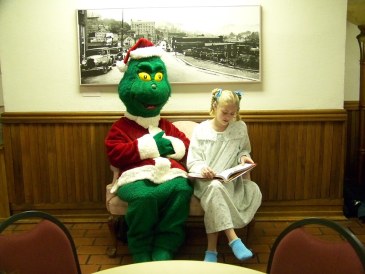
Breakfast with the Grinch 11-2010

Breakfast with the Grinch from vastateparkstaff

Grinch hated Christmas most of all. While the population of a town had fun with all hearts, the indicator of already bad Grinch’s mood expressed something awful. Each Christmas appeared to be a terrible torture for the green hermit. One day, a spiteful inhabitant of the mountain decided to finish a holiday once and for all. While the carefree Whovilleans were sleeping in holiday night with pleasure, perfidious Grinch decided to steal Christmas from the citizens, to make nobody able to have fun anymore.

Now, as well as the residents of the town, Grinch is in cares: he needs to prepare an ideal crime, that nobody could follow his ways. Two teenagers and two girls got on the mountain, where Grinch lived, and it finally angered him. He left the cave, put on a fancy dress and went down to the city, where he began to frighten everyone, who occurred on his path. What to do, if the circumstance, which is hard to cope with, unexpectedly interferes into the plans of Grinch? To speak more precisely, it is the little girl, who even wants to make friends with the character.

Five Reasons to Watch The Grinch Live on NBC

The girl, who helped the father with mail, was frightened so much that she fell in the packing machine, but then, probably, Grinch felt sorry and pulled her out. Cindy thanked him. Being raged by the fact that someone can think that he is kind, Grinch wrapped her with the tinsel. Then the girl thought that, maybe, Grinch is not so bad as everyone speaks about him. She also absolutely cannot understand the sense of Christmas and wants to reconcile him with the residents. However, finally, Grinch realizes that sense of Christmas is not in gifts. The repentant villain decided to return the gifts to the inhabitants, and they accepted him to their society.

#2 MATTHEW MORRISON

Matthew James Morrison will portray Grinch! Morrison is an American actor, dancer, and singer-songwriter. Morrison is known for starring in multiple Broadway and Off-Broadway productions, including his portrayal of Link Larkin in Hairspray  on Broadway, and for his role as Will Schuester on the television show Glee. He received a Tony Award nomination for his featured role as Fabrizio Nacarelli in the musical The Light in the Piazza.

#3 DENIS O’HARE

Denis O’Hare will play his dog, Max.  O’Hare is an American actor, singer, and author noted for his award-winning performances in the plays and musicals such as Sweet Charity,  as well as portraying vampire king Russell Eddington on HBO’s fantasy series True Blood. He has been nominated for an Primetime Emmy for Best Actor.

Five Reasons to Watch The Grinch Live on NBC

#4 THE COSTUMES

Personally, I think the costumes from the film version were exceptional.  I don’t know if they can reach that level of detail, but I’m interested in seeing if they do so.

#5 THE CHOREOGRAPHY

From viewing the snippet on NBC, I can tell the choreography is fun and playful.  That’s got to be a plus, huh? Here’s a trailer for the show:

https://www.today.com/popculture/nbc-bringing-grinch-life-new-musical-holiday-special-t198362

As you may know, several musicals have been performed live in recent years.  In my opinion, some were better than others.  I enjoyed NBC’s Hairspray and Jesus Christmas Super Star the most.  I would hope these production companies are learning how to produce a better product each time they attempt one.  Who knows?

Another was good production was  A Christmas Story.  In case you don’t me, I am a retired drama teacher having taught and directed for thirty-eight years.  You can find my resume here:Teaching Resume

A Christmas Story Broadway Musical Lesson

Now I created drama education resources for my business, Dramamommaspeaks.  I have a lesson about A Christmas Story which would complement the Grinch Live! If you are in a hybrid learning classroom or distance learning, these musicals work well for teachers.

You can find it here: A Christmas Story Broadway Musical Lesson

Five Reasons to Watch The Grinch Live on NBC

Need a quick emergency lesson plan? Or one for a substitute? Everything is provided for the busy teacher.

This Product includes:

  • Letter to Teacher
  • Two Warm Ups–MY Version of Popular Exercises
  • Teacher’s Script–what I say and how I say it!
  • Photos of the Production
  • Separate File of Slides for Teacher to Use to Lecture
  • Plot of the Musical
  • History about the Origination of the Production
  • Information concerning the composer, Pasek and Paul (who also co-wrote Dear Evan Hansen)
  • History about the Film and Musical Helping One Another
  • A Shortened Lesson on : What are the Tony Awards?
  • Tony Awards it Received
  • What are the Tony Awards
  • New York City Map with Competing Theatres Labeled
  • Student Note Page
  • Teacher Note Page Key
  • Trivia
  • Quotes from the Musical–Good for Discussions and Assignments
  • Extension Activities–Five different activities, individual and group
  • Sources & Links to Film Clips from the Show

This lesson works well with any grade level, although it was created for secondary students.  Reading, Language Arts, Vocal Music and Drama classes have success with it!

Or pick up my holiday lesson bundle at: Drama Lessons Holiday Themed 

I hope you’ll check out Grinch on December 9 and think about purchasing my Broadway lesson on A Christmas Story.  If nothing else, both will put you in the holiday spirit!

Which Grinch character is your favorite?  Mine is Max.  I’d love to hear from you.  Contact me at dhcbaldwin@gmail.com or DeborahBaldwin.net

Deborah Baldwin of DramaMommaSpeaks


Share this:

  • Click to share on Tumblr (Opens in new window) Tumblr
  • More
  • Click to share on X (Opens in new window) X
  • Click to share on Facebook (Opens in new window) Facebook
  • Click to share on Pinterest (Opens in new window) Pinterest
  • Click to share on LinkedIn (Opens in new window) LinkedIn
  • Click to email a link to a friend (Opens in new window) Email
  • Click to share on Reddit (Opens in new window) Reddit
  • Click to share on Pocket (Opens in new window) Pocket
  • Click to share on Telegram (Opens in new window) Telegram
  • Click to share on WhatsApp (Opens in new window) WhatsApp

Like this:

Like Loading...

Filed Under: acting, arts education, arts integration, Broadway, Distance Learning, drama education, e-learning, excellence in teaching, High School, middle grades, Musical Theatre, Teacherspayteachers, Teaching, theater, Tony Awards Tagged With: 'tweens, Broadway musicals, DISTANCE LEARNING, drama lessons, Family, family time, live musicals, middle grade books, Middle school, musical theater lessons, teacherspayteachers, VIRTUAL LEARNING, youth theatre

Drama Lessons for Home-Bound Students or During the Corona Virus Quarantine

March 9, 2020 By dhcbaldwin 6 Comments

Drama Lessons for Home-Bound Students or During the Corona Virus Quarantine 


In light of the Corona virus illness, and many people quarantined at home,  I thought I’d offer you some suggestions of  drama lessons a teacher could assign or a student could take home with them. I am part of several Facebook groups for teachers and typical of teachers, they are all ready preparing for the extended home stays which could happen.

Or……they have a student who will be absent for several days or even weeks.  It does occur.

You’d think it would be impossible for a teacher to assign drama lessons for students to study at home, because we are a performance oriented subject.

Not always, however.

I’d never thought of this learning obstacle until recently.  One of my students who teaches in South Korea has all ready been home for two weeks.  Unfortunately, I fear we are only days from staying home for several weeks here in the states.

A friend told me about a man who bought up all the Purel at a Walmart in Oklahoma.  What an opportunist!

He set up a booth across the street from the same Walmart and charged $100 for a bottle of it!  What?!

Crazy times we live in, huh?

Here are a list of drama lessons and units which your student(s) could complete at home (home bound lessons) either because they are quarantined by the coronavirus or plan to be absent for a week or two.

This gets a teacher started.  There are more lessons which will work and keep the learning going.  I promise.  

KIDS HANDS UP

Creative Dramatics (grades 2 to 5)

  • Costume Design with Goldilocks and the Three Bears

I simplified my middle grade lesson and enlarged the design templates.  I hope this encourages students to try their hand at costume design.  It’s such fun!

  • Costume Design with Red Riding Hood

There are different ways to look at designing costumes for this story.  What if Red Riding Hood lives in the city in 2020?

  • Set Design:  The Rendering (grades 5 to 8)

This is my most popular lesson to date!  Students get the chance to design the set for a play!

  • Saturday, Sunday and Monday Reader’s Theater Script

A student could read the script with a parent or even the family.  There are post discussion questions which might be of use to you as well. There is a bundle with many funny reader’s theater scripts so look for that in my store.

Lin Mauel 2
Lin Mauel 2

Middle School Drama Lessons and Units (grades 6 to 8)

  • Drama Lesson Choice Board

This choice board includes nine different theater companies, Marcel Marceau and what is means to be a Foley engineer.

  • Matilda, the Musical

Just put this up today (March 30).  It’s a great show and fun production to learn about.

  • Costume Design with Super Heroes

This is one which I bet your students would enjoy.  It’s all about costume design and the history of super heroes.

  • Monologue for St. Patrick’s Day 

This is a two-day lesson about playwriting.  It would be a lot of fun for them.

  • Tom Sawyer Play Study Guide

This would be a super unit if you could purchase a class set of the play ahead of the quarantine.  Or maybe get a few copies for your classroom if you have a student who will be absent for an extended period of time. )

You can purchase them at: https://www.dramaticpublishing.com/tom-sawyer- tr5000 

  • Set Design with a Fairy Tale Setting

This is a ten day unit, however a student could complete the entire unit at home by himself if need be.

  • Set Design the Rendering

This is a short lesson giving students an opportunity to draw a set for a fairy tale.

  • Character Development through Personality Profile 

Student can observe someone in their home and after doing a short quiz, write a description of the person.

  • Lin Manuel Miranda

This is a short newspaper formatted lesson about him.  It could be completed at  home with no problem.  The extension activity could be done independently.  This is a very popular lesson with students.

  • Cynthia Erivo Broadway Actress

This is a short biography lesson which students could do easily complete from home with internet access. She’s an up-and-coming actress which they may be not be familiar with.

  • Choice Boards

These boards are marvelous help in distance learning or when everyone needs a break.  They include theaters from around the world and short lessons on designers–costume, set, sound, etc.  Need some differentiation?  These will help.

High School Drama Lessons and Units (grades 9 to 12)

  • Play-writing Lesson Dialogue

This lesson is intended for gifted seventh graders through tenth grade.  Using a break dancer as the focus, students learn to write dialogue step by step.

  • Character Development through Personality Profile

This is a lesson for middle grade students, however you could change the assignment and make it more lengthy.

  • Growth Mindset in Theater Artists

This lesson is perfect for drama students. Students research a theater artist, answer questions about artist’s growth mindset, consider their own mindset and finish with a creative project. This unit was created for high school students, however it could be adapted for middle grade students.

  • Play Reading Analysis, Presentation and Project

I never thought of this for a situation like this, but you know it is perfect!  Students select a play, answer a group of very comprehensive questions.  Then they create a power point about the play thinking of it from a director and designer’s point of view. Lastly, they create a three-dimensional object which represents the play.

  • Bundle:  Set, Costume, Sound and Properties Design

This is a bundle of lessons (discounted) which pertain to technical aspects of a  production.  Students could select one of the four units or maybe a teacher gives them one assignment (such as sound design) and everyone turns in the same assignment.

As I mentioned earlier,  I have plenty of other lessons which could work. 

If you need some help deciding which would be best, do contact me.  Or check out my store at:  Dramamommaspeaks

Have you ever had a student who was home-bound?  I did and boy, was it tricky at the time. I wish I’d had home bound lessons at the time.  I’d love to hear from you.  Contact me at dhcbaldwin@gmail.com or DeborahBaldwin.net

Here is a FREE lesson if you are in a pinch:  Speech Review Worksheet (middle school and up)

Here are some other suggestions of products which may help you, all FREE:  Free Teaching Resources Blog Hop


Share this:

  • Click to share on Tumblr (Opens in new window) Tumblr
  • More
  • Click to share on X (Opens in new window) X
  • Click to share on Facebook (Opens in new window) Facebook
  • Click to share on Pinterest (Opens in new window) Pinterest
  • Click to share on LinkedIn (Opens in new window) LinkedIn
  • Click to email a link to a friend (Opens in new window) Email
  • Click to share on Reddit (Opens in new window) Reddit
  • Click to share on Pocket (Opens in new window) Pocket
  • Click to share on Telegram (Opens in new window) Telegram
  • Click to share on WhatsApp (Opens in new window) WhatsApp

Like this:

Like Loading...

Filed Under: arts education, creative dramatics, drama education, elementary, excellence in teaching, High School, middle grades, Teacherspayteachers, Teaching Tagged With: 'tweens, choice board, coronavirus, DISTANCE LEARNING, drama education, family activities, home school, home-bound students, on-line studying, teacherpayteachers

Next Page »

Footer

Follow Us

logo3.png

FOLLOW US

Facebook X-twitter Pinterest Instagram Envelope Rss

Goodreads: read

Malibu Rising
Malibu Rising
by Taylor Jenkins Reid
People We Meet on Vacation
by Emily Henry
The Last Thing He Told Me
by Laura Dave
Faking It
Faking It
by Cora Carmack
Losing It
Losing It
by Cora Carmack

goodreads.com
Copyright © 2024 · Wellness Pro on Genesis Framework · WordPress.com.Log in
 

Loading Comments...
 

    %d