• Skip to primary navigation
  • Skip to main content
  • Skip to footer

Join Me in my new Facebook Group! https://www.facebook.com/groups/417126059784261

Menu
  • Meet Deb – The Heart Behind DramaMommaSpeaks
    • Work with Me! 
    • Photo Gallery of DramaMommaSpeaks
    • Directorial Credits
  • I Give Book Talks! 
    • Book Talk Through Skype
    • Books
  • Freebies!
  • Bumbling Bea
  • Teaching Resume
  • Acting Resume
  • Contact Me
  • Blog
    • Drama Education
    • Arts Education
    • Youth Theatre
    • Middle Grades
    • Musical Theatre
    • Teaching
  • Meet Deb – The Heart Behind DramaMommaSpeaks
    • Work with Me! 
    • Photo Gallery of DramaMommaSpeaks
    • Directorial Credits
  • I Give Book Talks! 
    • Book Talk Through Skype
    • Books
  • Freebies!
  • Bumbling Bea
  • Teaching Resume
  • Acting Resume
  • Contact Me
  • Blog
    • Drama Education
    • Arts Education
    • Youth Theatre
    • Middle Grades
    • Musical Theatre
    • Teaching

play reading

Three Interactive Ways to Teach The Play Tom Sawyer To Your Students

December 26, 2019 By dhcbaldwin Leave a Comment

A white washed fence indicative of Mark Twain's book, The Adventures of Tom Sawyer

Three Interactive Ways to Teach The Play Tom Sawyer To Your Students

Today’s post is Three Interactive Ways to Teach Tom Sawyer To Your Students.  Several years ago, (for thirteen years) I taught sixth graders an introduction to theater class in a middle school. All the sixth graders–almost 500 of them each year. If you’d like to know more about that experience, check out this blog post: How to Make Your Drama Class More Successful

Mark Twain's Purpose for Writing The Adventures of Tom Sawyer

As any drama teacher worth her weight would tell you, it’s important for students to read fiction about kids around their age.  Now, I’m like anyone.  I like pop culture, but I happen to think our students need to still read classics.

In addition, I also like to include interactive instruction if at all possible.  Interactive instruction is when students learn through social interaction. Interactive instruction is just about everything we do in a theater class!

Meet Tim Kelly, Playwright

Three Interactive Ways to Teach The Play Tom Sawyer To Your Students

Thirty-one years ago, I co-developed a play writing contest for youth theater plays.  One of the winners was a prolific playwright, Tim Kelly.

When Tim entered the competition, I was aghast!  I only knew his plays as hokey.  They were silly, kind of awkward parodies of other plays, books, or television shows.

Shortly afterward, Tim discovered writing for middle school students and finally found his home, at least in my opinion.

We produced his play, It’s a Howl! and it was such fun.  I know, I said I didn’t like to do superficial stuff but It’s a Howl! is really clever–sort of Frankenstein meets the Werewolf.

Over several years, Tim and I would talk about other plays he wanted to enter in the contest.  He mentioned his Tom Sawyer script to me as well.

Three Interactive Ways to Teach The Play Tom Sawyer To Your Students

Three Interactive Ways to Teach The Play Tom Sawyer To Your Students

I don’t know why, but he never entered it in the competition.  But I read it and loved it!

Check out a synopsis of it here:   Dramatic Publishing Company

Back to the middle school with the gazillion students…Since seventy-five new students entered my drama classroom every twenty-five days, I had to come up with a variety of lessons for them.

Enter The Adventures of Tom Sawyer

Tom Sawyer fit two purposes for me.  One–it was a classic and abbreviated which was perfect especially for the classroom.  Two–it was a story about students around the ages of my students.  Three–it was a wonderful jumping off point for additional lessons about theater (set, costume, props, etc.)


Three Interactive Ways to Teach The Play Tom Sawyer To Your Students

Recently, I created two units using Tom Sawyer as my inspiration. Here is the production description:

Mark Twain’s classic novel, The Adventures of Tom Sawyer is an excellent story for our middle grade students to study. Here is study guide for a play version of the book. Questions for a read-aloud are included as well as questions to study the play from a theatrical perspective. Playwright, Tim Kelly was a prolific playwright and this script is a perfect example of his body of work. His plays are especially suited for middle grade students.

This product includes:

  • A Letter to the Teacher
  • Short Bio. on Mark Twain
  • Information about the novel, The Adventures of Tom Sawyer
  • Procedure
  • Warm Up
  • Teacher’s Script–What I say and How I say it!
  • Discussion Questions from a Theatrical Perspective
  • Discussion Questions for a Class Read-Aloud
  • Theater Vocabulary Words–34 In Total
  • Theater Words Definitions
  • Source Page

Three Interactive Ways to Teach The Play Tom Sawyer To Your Students

Study Set Design 

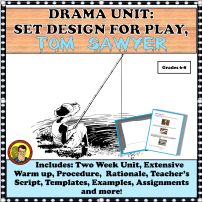
The second unit concerns set design.

This set design unit (48 page, 10 days) focuses on a play version of Mark Twain’s The Adventures of Tom Sawyer by Tim Kelley. This is great interaction! Students learn about the history of set design, famous set designers, develop a critical eye about what makes up an award winning set design, create a ground plan for a room in a school of their choosing and draw a rendering. In addition, the students must work with ratios and measuring. The first two assignments are completed individually, but then the fun begins! The students are paired up to create a model working together towards the goal. There is even room for parents to celebrate the end of the unit with your students.

Note: If a teacher chooses to use this particular set design unit, I would suggest purchasing a class set of Tom Sawyer by Tim Kelley at: https://www.dramaticpublishing.com/tom-sawyer-tr5000.

Included in the unit:

  • An overview of the unit for the teacher
  • Rationale for teaching set design
  • History of set design
  • Set designer’s responsibilities
  • Teacher’s Script–what I say and how I say it!
  • Extensive warm up
  • Procedures for each day (8 to 10) including exit prompts
  • Lecture notes including links
  • Information about the message color conveys
  • Rendering examples
  • Stage curtain sheets for rendering–one vertical, one horizontal
  • Step by step directions for model building including photo examples
  • Cheat sheet for various set pieces
  • Assignment sheet for each step of the design process
  • Grade sheet EDITABLE in a separate file
  • Source Page

Now I have a costume design unit to go with these two as well.  Talk about comprehensive!

Of course, there’s a bundle of the three together.  Check those out at:  Bundle Tom Sawyer Study Guide and Set Design Unit 

Three Interactive Ways to Teach The Play Tom Sawyer To Your Students

Honestly, I don’t know if The Adventures of Tom Sawyer is taught in the classroom anymore.  I could understand the reasons not to teach it.  However, Mr. Kelly’s script is well adapted and deletes any words which might be difficult for our students to accept in this day and age.

Three Interactive Ways to Teach The Play Tom Sawyer To Your Students

I hope you’ll consider ordering a perusal copy of the script. Perhaps you’ll use these two products in your drama classroom or at least study it in the language arts classroom.  It fits the “balanced reading” benchmark, too!

Mr. Twain wrote the book for all of us.   Of course, I think Mark Twain says it the best, “Although my book is intended mainly for the entertainment of boys and girls, part of my plan has been to pleasantly remind adults of what they once were themselves, and what they felt and thought.”

What young adult novels have you studied in play form?  I’d love to hear about them.  Contact me at dhcbaldwin@gmail.com or DeborahBaldwin.net

Woman behind DramaMommaSpeaks

Share this:

  • Click to share on Tumblr (Opens in new window) Tumblr
  • More
  • Click to share on X (Opens in new window) X
  • Click to share on Facebook (Opens in new window) Facebook
  • Click to share on Pinterest (Opens in new window) Pinterest
  • Click to share on LinkedIn (Opens in new window) LinkedIn
  • Click to email a link to a friend (Opens in new window) Email
  • Click to share on Reddit (Opens in new window) Reddit
  • Click to share on Pocket (Opens in new window) Pocket
  • Click to share on Telegram (Opens in new window) Telegram
  • Click to share on WhatsApp (Opens in new window) WhatsApp

Like this:

Like Loading...

Filed Under: arts education, drama education, excellence in teaching, middle grades, performing arts, play reading, plays, teaching strategies, theater Tagged With: cooperative learning, drama lessons, Mark Twain, play, play read aloud, reading aloud, script reading, set design, study guide, The Adventures of Tom Sawyer, Tom Sawyer

The Reasons Reader’s Theater is Successful with Our Students

December 6, 2019 By dhcbaldwin 8 Comments

The Reasons Reader’s Theater is Successful with Our Students

When I was a little girl, I loved to read aloud.  I was good at it, too!  I think it’s where I realized performing was something I loved because by reading aloud it gave me an opportunity to try out characters and voices.

My teachers readily noticed this about me, too. As a result, I was always asked to read aloud.  I felt very special at the moment.

Because I am very creative and drill work absolutely bores me, I wasn’t always the best student.

But reading aloud?  Oh, that’s so me….

I was looking around the internet to find some other educators (which there are many) who believed as strongly as I do about reading aloud.  My favorite method is through reader’s theater.

In case, you are unfamiliar with Reader’s Theater here is a good definition from the Education World website, a wonderful retired Language Arts Teacher,

“In Reader’s Theater, students “perform” by reading scripts created from grade-level books or stories — generally without benefit of costumes and props. The goal is to enhance reading skill and confidence through practice with a purpose. Reader’s Theater gives students a real reason to read aloud.

“A great deal of fluency research reiterates the need for repeated reading,” reported Finney. “Without fluency, there is little comprehension; the value of Reader’s Theater is increased tenfold when used as a strategy for increasing understanding of what is being read.”

Reader’s Theater motivates reluctant readers and provides fluent readers with the opportunity to explore genre and characterization.”

Yes, yes and one more yes!

Reader’s Theater motivate reluctant readers and provides them a safe environment.  They can actually “hide” behind a script.  As they focus on the script, they become unaware of reading aloud in front others.

Here are the Reasons I think Reader’s Theater Works:

  1.  It strengthens one’s reading–repeated reading of words makes them familiar.
  2.  It’s a safe way to involve reluctant readers.
  3.  Generally, the stories are short and highly engaging.  (No one wants to read a boring script aloud!)
  4.  It’s a great way to read different genres without having to commit to an entire book.
  5.  It “feels” like you are performing, but in a non-threatening manner.
  6.  Because students feel safe, their inner performer is more likely to emerge.

My only advice: I wouldn’t suggest putting kids on a stage to try out reader’s theater.  You have just shot yourself in the foot!  I promise, it won’t go well.

The Reasons Reader’s Theater is Successful with Our Students

Here is more from Education World.

Judy Freeman a literature consultant states,

“Reader’s Theater allows children the luxury of lingering over a story; acting it out many times so they come to understand all its nuances,” Freeman explained. “Too often, children read a story and only understand it at its most superficial literal level. With Reader’s Theater, they’re not just reading a story; they’re living it.”


“Always perform a Reader’s Theater script at least twice,” she advises. “The first time, the children will be struggling with words and their meanings, and with making sense of the play. It’ll be rough, but who cares? The second time, they’ll be able to focus on enjoying the performance and their parts in it. You can, if you wish, carry it further, adding props, costumes, and scenery; memorizing lines; or even putting on the play for other groups. You don’t have to, though. It’s the process that’s important here, not a finished product.”

That’s an important statement–it’s not a finished product.

To sum up in one phrase–Reader’s Theater allows for trial and error when reading.

Multicultural Folk Tales Reader’s Theater Scripts

I’ve penned several reader’s theater scripts.  Each is based on a multicultural folk tale.

Reader’s Theater:  The Sprightly Tailor

If you are looking for some different reader’s theater scripts, I’m your gal.  Because of my extensive experience teaching and directing (38 years–yikes!), you can trust the quality of these scripts.

AND HERE’S SOMETHING ELSE…

Each of these units comes with original songs written especially for the piece.  How cool is that?

This is not just a script, it’s a unit!

Here’s what you receive:

  •  Letter to teacher
  •  Warm up exercise
  •  Advice in directing reader’s theater
  • Blocking plot for teacher’s staging needs
  •  Scripts with roles for large classes
  • Original song

Does this sound good to you?  Check them out at:  Dramamommaspeaks Store

Here’s a new bundle you may enjoy:  Comical Reader’s Theater Scripts and Units

The Reasons Reader’s Theater is Successful with Our Students

When I taught at Smithton Middle School in Columbia, MO I used reader’s theater with an after school Drama club for ESL students.  This was about fifteen years ago.  At the time I used one of Aaron Shepherd’s scripts.  They are terrific.

Another time, I used a reader’s theater script version of Holes.  We invited reluctant readers to be involved.  I asked several administrators and teachers to play the adult roles.  It was absolutely awesome and we performed the script for the entire school.

What a boost in self confidence this was for those boys.

I co-created a youth theater program in Columbia as well–P.A.C.E. or Performing Arts in Children’s Education. We performed A Christmas Story as a stage reading.  Stage readings are very similar to reader’s theater.  You might think performing with script in hand would distract or detract from the performances.  Nope.  The audience loved it anyway.

So, I hope you’ll give reader’s theater a try whether you are in a drama class, high school language arts or social studies.  It’s not just for elementary students anymore.

What reader’s theater have you done in your class?  I’d love to hear about it.  Contact me at dhcbaldwin@gmail.com or DeborahBaldwin.net

Deborah Baldwin, Dramamommaspeaks

Abdullah's Gold
Abdullah’s Gold
The Little Girl and the Winter Whirlwinds
Saturday, Sunday and Monday
It Could Always Be Worse
Li Chi the Serpent Slayer
Sedna, an Inuit Tale
The Brave Little Tailor

Share this:

  • Click to share on Tumblr (Opens in new window) Tumblr
  • More
  • Click to share on X (Opens in new window) X
  • Click to share on Facebook (Opens in new window) Facebook
  • Click to share on Pinterest (Opens in new window) Pinterest
  • Click to share on LinkedIn (Opens in new window) LinkedIn
  • Click to email a link to a friend (Opens in new window) Email
  • Click to share on Reddit (Opens in new window) Reddit
  • Click to share on Pocket (Opens in new window) Pocket
  • Click to share on Telegram (Opens in new window) Telegram
  • Click to share on WhatsApp (Opens in new window) WhatsApp

Like this:

Like Loading...

Filed Under: arts education, drama education, excellence in teaching, play reading, Reading Literacy, reading skills, Teacherspayteachers, teaching strategies, theatre Tagged With: creative dramatics, elementary drama, middle school drama, reader's theater, reading class, reading strategies

Start a Playwriting Contest Using 20 Questions

May 20, 2018 By dhcbaldwin 1 Comment

How to Start a Playwriting C

Start a Play-writing Contest in 20 Easy Steps

How to Start a Playwriting C

Twenty-nine years ago, I was president of a community theater, the Columbia Entertainment Company, in Columbia, Missouri.  Also, I was the director of a youth theater program for them.   I volunteered hundreds of hours to both programs. It was an amazing learning experience and one that I draw upon from time to time in my career.

Here is the story of probably the most important thing we did in this company:  We created a national play writing contest for large cast youth theater plays.  It is called the Jackie White National Play writing Award Contest and still in existence to this day.  That’s a long time for a contest of this nature to flourish, especially sponsored by a community theater.

columbia-entertainment-company

The Origin

Thirty years ago I was a young woman who needed scripts for large student casts—over thirty students in number, ages fourth through ninth grade.  At the time, there were very few plays to choose from, much less musicals for kids.

 I lamented to a board I was having a difficult time finding any suitable plays for the season. In the past, I pad the roles with extra non-speaking characters or ones with little ad libs, but what I really needed was youth theatre plays with large casts, period. The board member suggested our company create our own playwriting contest specifically for this purpose.

So, really out of desperation, we created one!

Please understand, we had NO idea what we were doing.  We merely figured it out as we progressed.  It took us a few years to perfect the contest, but it is still one of the most valuable programs the theatre created.

The Why

Generally, playwrights need their plays or musicals to be produced before a publishing company will represent them. The Denver Performing Arts Center sponsors a New Play Summit each year in February.

Their contest is very clever.  The first time the winning entries are produced as stage readings with minimal set and costumes.  The audience gives feedback after the performance through a survey.

If the play suits DPAC’s needs, during the next season, they mount a full production of it.  My husband and I have attended several years of the New Play Summit and enjoyed being part of the creative process. We feel more invested in the play, because we offered our suggestions. Whether DPAC intends to or not, this is a terrific way to encourage audience members to return to see the production once it is produced.

Your contest could be created by your drama class, community theatre or even youth group.  There is no end to the possibilities a contest of this type affords a group. The contest can be as big or small as your group desires. You could sponsor whatever kind of contest you want—a ten minute plays, musicals for youth theatre, plays focused on bullying or plays concerning tolerance. It’s all up to you.

Now before you look at these questions and think is an overwhelming project, I want you to consider the people who will receive such fulfillment from the contest. Playwrights are always seeking places to get their plays read and produced.  That could be you!

Here are some questions to contemplate when creating your own playwriting contest:

1)     What is the mission of our contest?  What is our end result?  Are we looking for something particular subject to be explored? Reach a particular audience? Attract an underserved demographic?

2)     What are the requirements of the winning script?  Cast size, gender and age of characters, length of play or musical, set, costumes props and the feasibility of producing the script within the confines of our budget are all important questions to consider.

3)      Is any subject taboo? In some social circles, certain subjects are considered appropriate.

4)     How about inappropriate language?

5)     Should we charge a fee to enter the contest?  How much?

6)     Are there granting agencies or donors we could approach to fund the contest?

7)     What is our budget to spend to advertise the contest?

8)     What free media sources will we use to publicize the contest?

9)     Will we fully mount the winning entry?

10)  Should we present a stage reading?

11)  Can anyone enter the contest? Are we seeking only student scripts or adults?

12)  Who will read the scripts and make the final decision on the awardee?

13)  Will we award 1st 2nd and 3rd place awards as well as honorable mention? How many honorable mentions?

14)  What will the winner receive?  A cash award, gift, certificate, life time season tickets?

15)  Where will the cash award money come from? A donor?  A service organization? Your city’s arts council?

16)  After the awardee is selected, will we publicize the winner?

17)  Do we want to bring the winning playwright to the performance?

18)   If the winning playwright attends, is it our responsibility to provide room and board to them?

19)  If the playwright is present, do we want to host a social in their honor?

20)  What is our time line?

https://wpcomwidgets.com/render/

A Contest with Their Head in the Right Place 

I am an indie author, too. Recently, I ran upon an indie author book contest in England created by a popular children’s author, Edward Trayer.  The Whistling Shelf Award is a fairly new contest.

When I was perusing his website regarding it, I discovered he charges an entrance fee and donates a portion of money to the Blind Children fund in England. Now, that’s my kind of author.  Because of this, I quickly entered my book, Bumbling Bea into its competition.  I look forward to this year’s awards.

I believe in philanthropy and I believe in the power of theatre.  I bet you do, too.

Try your hand creating a playwriting contest. The Jackie White National Children’s Play Writing Contest is one of the most important programs the Columbia Entertainment Company ever created.

If a desperate, young director like me with no experience creating a contest can be successful, so can you!

Denver Performing Arts Center New Play Summit:

http://www.denvercenter.org/events/colorado-new-play-summit

Here is a play writing lesson for middle grade students, perfect for the holiday season:

Drama Lesson:  Monologue Holiday Theme

How to Start a Playwriting C

Here is another one for you:

Monologue Easter Theme

Have you created a theater contest?  Contact me at dhcbaldwin@gmail.com or check out my website at

DeborahBaldwin.net I’d love to hear from you!

author's signature


Share this:

  • Click to share on Tumblr (Opens in new window) Tumblr
  • More
  • Click to share on X (Opens in new window) X
  • Click to share on Facebook (Opens in new window) Facebook
  • Click to share on Pinterest (Opens in new window) Pinterest
  • Click to share on LinkedIn (Opens in new window) LinkedIn
  • Click to email a link to a friend (Opens in new window) Email
  • Click to share on Reddit (Opens in new window) Reddit
  • Click to share on Pocket (Opens in new window) Pocket
  • Click to share on Telegram (Opens in new window) Telegram
  • Click to share on WhatsApp (Opens in new window) WhatsApp

Like this:

Like Loading...

Filed Under: community theatre, drama education, Education, play reading, Producing plays and musicals, Teacherspayteachers, theater, youth theatre Tagged With: Columbia Entertainment Company, creating a playwriting contest, Denver Performing Arts Center, playwriting contest, playwriting lesson, Wishing Shelf Book Awards

Start a Playwriting Contest Using 20 Questions

May 8, 2018 By dhcbaldwin 4 Comments

Playwriting Contest

This is my most recent article I penned for Litpick. I hope it’s helpful to you.


Start a Playwriting Contest Using 20 Questions

by Deborah Baldwin

Twenty-nine years ago, I was president of a community theatre, the Columbia Entertainment Company, in Columbia, Missouri. Also, I was the director of a youth theatre program for them. I volunteered hundreds of hours to both programs. It was an amazing learning experience and one that I draw upon from time to time in my career.

Here is the story of probably the most important thing we did in this company: We created a national play-writing contest for large cast youth theatre plays. It is called the Jackie White National Play-writing Award Contest and is still in existence to this day. That’s a long time for a contest of this nature to flourish, especially sponsored by a community theatre.

The Origin

Thirty years ago I was a young woman who needed scripts for large casts—over thirty students in number, ages fourth through ninth grade. At the time, there were very few plays to choose from, much less musicals for kids. I lamented to a board that I was having a difficult time finding any suitable plays for the season. In the past, I pad the roles with extra non-speaking characters or ones with little ad libs, but what I really needed was youth theatre plays with large casts, period. The board member suggested our company create our own playwriting contest specifically for this purpose. So, really out of desperation, we did!

Please understand, we had NO idea what we were doing. We merely figured it out as we progressed. It took us a few years to perfect the contest, but it is still one of the most valuable programs the theatre created.

honk-jr

The Why

Generally, playwrights need their plays or musicals to be produced before a publishing company will represent them. The Denver Performing Arts Center sponsors a New Play Summit each year in February. Their contest is very clever. The first time the winning entries are produced as stage readings with minimal set and costumes. The audience gives feedback after the performance through a survey. If the play suits DPAC’s needs, during the next season, they mount a full production of it.

My husband and I have attended several years of the New Play Summit and enjoyed being part of the creative process. We feel more invested in the play, because we offered our suggestions. Whether DPAC intends to or not, this is a terrific way to encourage audience members to return to see the production once it is produced.

Your contest could be created by your drama class, community theatre or even youth group. There is no end to the possibilities a contest of this type affords a group. The contest can be as big or small as your group desires. You could sponsor whatever kind of contest you want—ten minute plays, musicals for youth theatre, plays focused on bullying or plays concerning tolerance. It’s all up to you.

Now before you look at these questions and think is an overwhelming project, I want you to consider the people who will receive such fulfillment from the contest. Playwrights are always seeking places to get their plays read and produced. That could be you!

studenst-reading-play

Here are some questions to contemplate when creating your own playwriting contest:

1) What is the mission of our contest? What is our end result? Are we looking for a particular subject to be explored? Reach a particular audience? Attract an underserved demographic?

2) What are the requirements of the winning script? Cast size, gender and age of characters, length of play or musical, set, costumes props and the feasibility of producing the script within the confines of our budget are all important questions to consider.

3) Is any subject taboo? In some social circles, certain subjects are considered inappropriate.

4) How about inappropriate language?

5) Should we charge a fee to enter the contest? How much?

6) Are there granting agencies or donors we could approach to fund the contest?

7) What is our budget to spend to advertise the contest?

8) What free media sources will we use to publicize the contest?

9) Will we fully mount the winning entry?

10) Should we present a stage reading?

11) Can anyone enter the contest? Are we seeking only student scripts or adults?

12) Who will read the scripts and make the final decision on the awardee?

13) Will we award 1st, 2nd and 3rd place awards as well as honorable mention? How many honorable mentions?

14) What will the winner receive? A cash award, gift, certificate, lifetime season tickets?

15) Where will the cash award money come from? A donor? A service organization? Your city’s arts council?

16) After the awardee is selected, will we publicize the winner?

17) Do we want to bring the winning playwright to the performance?

18) If the winning playwright attends, is it our responsibility to provide room and board to them?

19) If the playwright is present, do we want to host a social in their honor?

20) What is our time line?

I hope these twenty questions will help you create your playwriting contest.  Do keep me informed.  I’d love to hear from you.

wishing-shelf

A Contest with Their Head in the Right Place

I am an indie author, too. Recently, I ran upon an indie author book contest in England created by a popular children’s author, Edward Trayer. The Whistling Shelf Award is a fairly new contest. When I was perusing his website regarding it, I discovered he charges an entrance fee and donates a portion of money to the Blind Children fund in England. Now, that’s my kind of author. Because of this, I quickly entered my book, Bumbling Bea, into its competition. I look forward to this year’s awards.

Since the penning of this post, I received word I was a finalist in the children’s books division in the Wishing Shelf contest.  What an honor!

I believe in philanthropy and I believe in the power of theatre. I bet you do, too.
Try your hand creating a playwriting contest. The Jackie White National Children’s Play Writing Contest is one of the most important programs the Columbia Entertainment Company ever created. If a desperate, young director like me with no experience creating a contest can be successful, so can you!
Columbia Entertainment Company playwriting contest:

http://www.cectheatre.org/playwriting.html

Denver Performing Arts Center New Play Summit:

http://www.denvercenter.org/events/colorado-new-play-summit
Wishing Shelf Book Awards
http://www.thewsa.co.uk/

—————

Deborah is a veteran drama teacher having taught in Missouri and Colorado for nearly thirty-eight years. Specializing in youth and community theatre, Deborah has directed more than 250 plays and musicals with adults and children alike. Recently, she and her husband moved to Kansas to be near their family and first grandchild. Her award winning middle grade book, Bumbling Bea, can be purchased through Amazon.com.

Check out her blog at: Dramamommaspeaks.com or her website Deborahbaldwin.net. Deborah serves as handmaiden to her beloved cat and sings harmony to most any song she hears.

Share this:

  • Click to share on Tumblr (Opens in new window) Tumblr
  • More
  • Click to share on X (Opens in new window) X
  • Click to share on Facebook (Opens in new window) Facebook
  • Click to share on Pinterest (Opens in new window) Pinterest
  • Click to share on LinkedIn (Opens in new window) LinkedIn
  • Click to email a link to a friend (Opens in new window) Email
  • Click to share on Reddit (Opens in new window) Reddit
  • Click to share on Pocket (Opens in new window) Pocket
  • Click to share on Telegram (Opens in new window) Telegram
  • Click to share on WhatsApp (Opens in new window) WhatsApp

Like this:

Like Loading...

Filed Under: community theatre, drama education, play reading, plays, youth theatre Tagged With: playwrights, playwriting contest, stage reading

Announcing: Bumbling Bea The Play –Act one, Scene one

April 26, 2018 By dhcbaldwin 3 Comments

Here is the play adaptation of my book, Bumbling Bea.

I’m one of those people who do what they say they are gonna do.

Gulp!

I am adapting Bumbling Bea into a play!  (I feel we need trumpets blaring and hi-steppers stepping….This is HUGE people.  )

marching band

Now you would think this would be an easy feat for me considering how many years I have directed plays.

 Nay, nay I say. ( I heard this on the radio one day and it cracked me up.)

I’m stalling, I know.

Directing plays since the dawn of man does make my job easier.  It’s a laborious process, however.  It takes me about two hours to adapt four to eight pages of the book version. Then I poop out.

Note:  This is the first draft of the scene.  I haven’t given you a cast list, or description of the set.  For those of you who are familiar with the book version, I think you’ll be able to easily follow the play.  At least, that’s my hope.

BB the play

 PLEASE BE KIND.

Here it is the play adaptation of Bumbling Bea:

 Act one, Scene one.  Enjoy!

Bumbling Bea Act One Scene 1B

Note #2:  I’m seeking beta readers for the play.  Would you be interested in helping?  Just think–someday when it is published you can say you helped make it into the terrific play it is destined to be.

I’m a fan of the play version of The Best Christmas Pageant Ever.  Bumbling Bea the play is loosely patterned at it.

Also, this is family fair.  I expect to see youth theater and community theaters producing it.

I honestly think Bumbling Bea will have much success in play form.

Daring words coming from the cautious me.

Are you looking for a new play to workshop?  I’m very interested in working with a drama class or youth theatre program and crafting Bumbling Bea, the play.

I have experience in working with new plays.  About twenty-nine years ago, I co-developed a national playwriting contest for youth theatre plays.

I know what is needed and I know how to make it happen.

Contact me at dhcbaldwin@gmail.com or DeborahBaldwin.net

Information on this website may be copied for personal use only.  No part of this website may be reproduced, stored, or transmissed in any form or by any means, electronic, mechanical, photocopying, recording, scanning, or otherwise, except as permitted under Section 107 or 108 of the 1976 United States Copy right Act, without the prior written permission of the author.  Requests to the author and publisher for permission should be addressed to the following email:  dhcbaldwin@gmail.com


Share this:

  • Click to share on Tumblr (Opens in new window) Tumblr
  • More
  • Click to share on X (Opens in new window) X
  • Click to share on Facebook (Opens in new window) Facebook
  • Click to share on Pinterest (Opens in new window) Pinterest
  • Click to share on LinkedIn (Opens in new window) LinkedIn
  • Click to email a link to a friend (Opens in new window) Email
  • Click to share on Reddit (Opens in new window) Reddit
  • Click to share on Pocket (Opens in new window) Pocket
  • Click to share on Telegram (Opens in new window) Telegram
  • Click to share on WhatsApp (Opens in new window) WhatsApp

Like this:

Like Loading...

Filed Under: Play, play reading, plays, theatre, Uncategorized Tagged With: playwrights, playwriting

A Super Review of Bumbling Bea

November 26, 2016 By dhcbaldwin Leave a Comment

⭐️⭐️⭐️⭐️

STORY LINE BUMBLING BEA:In Bumbling Bea, author Deborah Baldwin creates an enjoyable look into growing up. Beatrice has one more chance to play the lead in the school play before she leaves middle school. After all, playing the lead will ensure she will be in with popular girls. She has planned all year towards this goal, she and her alter ego Bumbling Bea. However, things do not go as planned. A new girl has enrolled from Japan. Michiko talented, opinionated, and pretty, gets the lead roll. Beatrice and alter ego Bea refuse to be denied and devise plans to get rid of Michiko. Let the games begin.

Hilarity, missteps, and bungling follow as Bea and Michiko come to terms. My children’s contemporary novel review follows.

CHARACTERS, PLOTTING, AND DEVELOPMENT:

To begin with, I must tell you how much I enjoyed this book. Although classified as a children/preteen book, I found as a mature senior I thoroughly enjoyed this story. Filled with laughter, missteps, and trials of the young trying to grow up, I laughed out loud at Bea’s antics. As I read, I found myself remembering my preteen years and the emotions that ran riot. Author Deborah Baldwin captured the pain and confusion of transitioning from a child to preteen and the situations the immature mind can create.

Baldwin’s pacing of the story was inline with the length of the story. The pace did not lag or bog down, but was steady and smooth. Furthermore, I found the plotting skillful as Ms. Baldwin brought all the threads together to create a solid book.

Lastly, in concluding my contemporary children’s novel review, I found the book well written with well-developed main characters and secondary characters which added to the tension and story-line.

BUMBLING BEA RECOMMENDATION: STARS 4

In addition, I gave Bumbling Bea 4 well-deserved stars. Subsequently, I found Bumbling Bea suitable for children and preteens as well as adults. As a senior I enjoyed this funny look back at the preteen years.

To purchase a copy of Bumbling  Bea, go to Amazon at https://www.amazon.com/Bumbling-Bea-Deborah-Baldwin/product-reviews/1500390356/ref=cm_cr_dp_synop?ie=UTF8&showViewpoints=0&sortBy=recent#R1O9MYUNK49KNA

Share this:

  • Click to share on Tumblr (Opens in new window) Tumblr
  • More
  • Click to share on X (Opens in new window) X
  • Click to share on Facebook (Opens in new window) Facebook
  • Click to share on Pinterest (Opens in new window) Pinterest
  • Click to share on LinkedIn (Opens in new window) LinkedIn
  • Click to email a link to a friend (Opens in new window) Email
  • Click to share on Reddit (Opens in new window) Reddit
  • Click to share on Pocket (Opens in new window) Pocket
  • Click to share on Telegram (Opens in new window) Telegram
  • Click to share on WhatsApp (Opens in new window) WhatsApp

Like this:

Like Loading...

Filed Under: Book Reviews, Bumbling Bea, Indie books, Indie Publishing, play reading Tagged With: bullying, friendshi, growing up, school, social issues

« Previous Page
Next Page »

Footer

Follow Us

logo3.png

FOLLOW US

Facebook X-twitter Pinterest Instagram Envelope Rss

Goodreads: read

Malibu Rising
Malibu Rising
by Taylor Jenkins Reid
People We Meet on Vacation
by Emily Henry
The Last Thing He Told Me
by Laura Dave
Faking It
Faking It
by Cora Carmack
Losing It
Losing It
by Cora Carmack

goodreads.com
Copyright © 2024 · Wellness Pro on Genesis Framework · WordPress.com.Log in
 

Loading Comments...
 

    %d