• Skip to primary navigation
  • Skip to main content
  • Skip to footer

Join Me in my new Facebook Group! https://www.facebook.com/groups/417126059784261

Menu
  • Meet Deb – The Heart Behind DramaMommaSpeaks
    • Work with Me! 
    • Photo Gallery of DramaMommaSpeaks
    • Directorial Credits
  • I Give Book Talks! 
    • Book Talk Through Skype
    • Books
  • Freebies!
  • Bumbling Bea
  • Teaching Resume
  • Acting Resume
  • Contact Me
  • Blog
    • Drama Education
    • Arts Education
    • Youth Theatre
    • Middle Grades
    • Musical Theatre
    • Teaching
  • Meet Deb – The Heart Behind DramaMommaSpeaks
    • Work with Me! 
    • Photo Gallery of DramaMommaSpeaks
    • Directorial Credits
  • I Give Book Talks! 
    • Book Talk Through Skype
    • Books
  • Freebies!
  • Bumbling Bea
  • Teaching Resume
  • Acting Resume
  • Contact Me
  • Blog
    • Drama Education
    • Arts Education
    • Youth Theatre
    • Middle Grades
    • Musical Theatre
    • Teaching

cooperative learning

Unmasking Drama: Engaging Small Classes

February 27, 2025 By dhcbaldwin 2 Comments

A happy teacher calling on a small class of drama students.

Unmasking Drama: Engaging Small Classes

Unmasking Drama: Engaging Small Classes Effectively

Today, let’s discuss Unmasking Drama: Engaging Small Classes. Picture this: You are ready to teach on your very first day of classes. Excited, you double-check the student roster. Hmmm. At last check, there weren’t too many students signed up for your class. However, you knew that in the last days of summer, usually some stragglers sign up. In walk two students. Even though your roster listed these two students’ names, you are certain there are more arriving any minute.

You wait five minutes. The two students look uncomfortable and you are apprehensive. You think, “What can I do with a class of two? How can I still make this class engaging? “ Disappointed, you throw out your plans for the first week of class.

Unmasking Drama: Engaging Small Classes Effectively

Unmasking Drama: Engaging Small Classes

Does this sound like you? I’ve been in this position before. Teaching drama to a small group is a unique challenge. Unlike math or even art, drama thrives on human interaction, group dynamics, and ensemble work. So, what do you do when your “ensemble” consists of just two or three students?

Occasionally, a teacher will email me begging for help with teaching their class. They have a small class of students. The question to me is usually the same: Is it possible to teach drama to a small group of students?

My answer is always a resounding, yes! I’ve taught several classes with only one or two students. These were home school students in a huge enrichment program. Your success depends upon a few things, some of which are somewhat out of your control. However, there are many things you can control, and with a little creativity, you can turn a small class into an enriching experience.


Unmasking Drama: Engaging Small Classes Effectively

Unmasking Drama: Engaging Small Classes

1. Limited Ensemble Dynamics

With fewer students, it’s harder to create the rich, spontaneous interactions typical in larger ensembles. Each student’s contribution is magnified, and the diversity of ideas and energy might be more limited. At times, I’ve noticed that when a student receives too much attention, they can become overly dependent on me when struggling with a concept.

2. Individualized Needs

In a small group, differences in skill levels, personality, and confidence become more apparent. This is where the teacher’s level of exhaustion comes into play. You must tailor lessons, provide personalized feedback, and ensure that each student’s unique needs are met without compromising the group’s overall progress.

3. Risk and Vulnerability

Drama often involves improvisation and exposing one’s vulnerabilities. In a small setting, students may feel overly visible or pressured, making it tougher to foster a safe space for experimentation and risk-taking. (If one student resists and you only have two in the class, your chance of success has dropped by 50%!)

4. Building Group Cohesion

Developing trust and a sense of community is essential in drama. With fewer participants, it requires extra effort to ensure that all students connect and collaborate effectively. Absenteeism, students not learning their lines, or unfinished projects can bring your class to a standstill.


Solutions & Strategies for Success

Quick Fixes for Small Classes

  • Lean into one-on-one coaching: Treat it like a personalized drama mentorship.
  • Adjust group exercises for two or three people: Focus on duologues, monologues, and character studies.
  • Expand beyond acting: Let students explore directing, playwriting, and design.
  • Use multimedia tools: Record performances, create podcasts, or study filmed theater.

Now, let’s look at how I put these strategies into action.


Unmasking Drama: Engaging Small Classes Effectively

Emily’s Story: Adapting Drama for One Student

Emily was a wonderful homeschool student in my drama class. Several other students were signed up but dropped at the last minute. Since I had previous teaching experience with Emily and knew that if I canceled the class, she’d be crestfallen.

Inventory the Student’s Interests

To begin, I interviewed Emily to discover which aspects of theater interested her most. Ha! All of it! We discussed book titles that had been dramatized, musicals she liked.  Additionally, we considered whether she wanted to be realistic or fanciful in her set and costume designs. By giving Emily opportunities to choose the differentiation, I knew that we’d be more successful than had we not done so.

Unmasking Drama: Engaging Small Classes Effectively

Creating a Personalized Curriculum

Since I was teaching Emily once a week from August to May, we structured  our plan together. Here’s what it looked like:

Lesson Plan for a One-Student Drama Class

  • August: Icebreaker games and warm-ups that work for two people (e.g., Add a Word storytelling).*
  • September: Read the play version of Peter Pan aloud.
  • October: Studied and designed costumes for Peter Pan. Emily even sewed Peter Pan’s hat!
  • November: Explored set design and built a model of the Peter Pan set.
  • December: Watched the Peter Pan musical and compared it to the play version.
  • January & February: Studied stage properties. Emily designed and built a cardboard broadsword using an instructional video.
  • March: Studied stage makeup and designed a look for Captain Hook.
  • April: Selected a three-person scene from Peter Pan to perform. I invited two girls from another class to rehearse with Emily.
  • May: Performed the scene for Emily’s parents and she wrote a reflection about her experiences during the year of learning.

*Generally, we began each class with a warm-up exercise of some kind that tied to the subject of the day.

If you are in need of particular lessons for this plan, check out:  Dramamommaspeaks Store


Unmasking Drama: Engaging Small Classes Effectively

Alternative Approaches for Small Classes

Rotating Focus Each Class

Another way to teach a small drama class effectively is to structure your lessons to explore different aspects of theater each session:

  • Acting & Performance: Scene study, monologues, improv games.
  • Technical Theater: Costume and set design projects.
  • Theater History & Playwriting: Reading plays, writing scenes.
  • Production Elements: Sound design, lighting concepts, directing techniques.

Creative Drama Exercises for Small Groups

Here are a few engaging activities tailored for 1-3 students:

  • “Mirror, Mirror”: One student mimics another’s movements to build focus.
  • “What are you doing?: Take turns informing each other something they must do that is physical, “I’m mopping the floor.”
  • Table Reads: Read and analyze famous plays.
  • Monologue Swap: Perform the same monologue in different tones/moods.
  • Character Walks: Move around as different characters to develop physicality.

Unmasking Drama: Engaging Small Classes Effectively

Final Thoughts: Reframing Small Classes as an Opportunity

Thus, as you are aware, teaching a small drama class can feel isolating or discouraging. But it also offers a unique opportunity for deep, personalized instruction. Most importantly, the key is to lean into the strengths of a small class, offering students individualized coaching, creative freedom, and opportunities to explore theater beyond acting.

Your Turn!

  • Have you ever taught a small drama class? What creative solutions worked for you?
  • What are your favorite duo or trio scene studies? Drop your recommendations below! Or Email me at DhcBaldwin@gmail.com

I hope this blog post, Unmasking Drama: Engaging Small Classes Effectively has been helpful to you. Need more ideas? Check out my post on How to Use a Hybrid Lesson in Your Drama Classroom Tomorrow.

Woman behind DramaMommaSpeaks

Share this:

  • Click to share on Tumblr (Opens in new window) Tumblr
  • More
  • Click to share on X (Opens in new window) X
  • Click to share on Facebook (Opens in new window) Facebook
  • Click to share on Pinterest (Opens in new window) Pinterest
  • Click to share on LinkedIn (Opens in new window) LinkedIn
  • Click to email a link to a friend (Opens in new window) Email
  • Click to share on Reddit (Opens in new window) Reddit
  • Click to share on Pocket (Opens in new window) Pocket
  • Click to share on Telegram (Opens in new window) Telegram
  • Click to share on WhatsApp (Opens in new window) WhatsApp

Like this:

Like Loading...

Filed Under: acting, arts education, arts integration, Creativity, drama education, Education, Education, excellence in teaching, multiculturalism, set design, Teacherspayteachers, teaching strategies, theater, theatre, youth theatre Tagged With: acting, Broadway musicals, cooperative learning, costume design, drama education, drama lessons, ensemble acting, improvisation, Peter Pan play, reading play, set design, technical theater, theater, warm up exercises

Stage Makeup and Its Transformative Power for Students

July 19, 2023 By dhcbaldwin Leave a Comment

Theater student in stage makeup

I’m mentioned this in the past, but thought I’d reiterate it if you’ve not heard it. Let’s talk about Stage Makeup and Its Transformative Power for Students.

The Transformative Power When Students Apply Stage Makeup

Stage Makeup and Its Transformative Power for Students

This is a true story.

When I was in seventh grade, I wanted to wear makeup. Of course, that was about 100 years ago, so let’s keep it in perspective…My mother wasn’t ready for that step in my life quite yet, but I was.  Boy, was I ready.
I read in a Seventeen magazine that I could make my own “home made” mascara using charcoal and petroleum jelly.  I went to work!
Now I’m not known to be very patient (although I am better now that I have grown older), so I looked around our house for the two ingredients I needed.  Hmmm.  I found a jar of petroleum jelly  in my bathroom cabinet, but charcoal? The only charcoal I knew of was charcoal briquettes.

My Makeup Journey

Briquette - Wikipedia
Being my impulsive self as well and not taking into account that perhaps a charcoal briquette was the wrong kind of charcoal for my DIY mascara, I mixed it into the petroleum jelly anyway.  Yes. I. Used. A. Charcoal. Briquette. No kidding. Needless to say, it was a flop.
Upon entering our dining room for dinner that evening while modeling my  “homemade mascara”, my mother let out an “Oh my!” Not surprisingly, soon after she drove to a Merle Norman store and enrolled me in a class about makeup.

Stage Makeup and Its Transformative Power for Students

Luckily, I learned to apply makeup and in later years discovered in college that I really enjoyed designing stage makeup or theatrical makeup. It seems obvious that students would enjoy studying about stage makeup.  Additionally, it helps so much for novice actors to “see” what their character will look like.  Coupled with a costume, some actors come to life as the character for the first time.  It is really that magical.

Did you know I have the secret to boosting student engagement?  My new book, “We’re Live! Radio Theater #101” explains my journey to implementing this unique tool in the classroom. Check it out here

The Transformative Power When Students Apply Stage Makeup

Reasons To Study Theatrical Makeup

  1. Character Transformation: Stage makeup is a powerful tool that allows actors to transform their appearance and effectively portray a wide range of characters. By studying stage makeup, theater students learn how to use makeup techniques to enhance facial features, create age, gender, or ethnic-specific looks, and convey emotions. This skill helps them bring their characters to life and make them more believable on stage.
  2. Visual Communication: In theater, makeup serves as a visual language that communicates important information to the audience. Different makeup techniques can convey specific time periods, social statuses, or cultural backgrounds of characters. By understanding the principles of stage makeup, theater students learn how to use color, shading, highlighting, and contouring to visually communicate the desired message and enhance storytelling.
  3.  Versatility: Stage makeup is not limited to traditional theater productions. Various performing arts disciplines such as film, television, opera, and dance use stage makeup as well.  Students can study to become a professional stage makeup artist and they’ve got themselves a job!

Reasons to Study Theatrical Makeup

4.  Collaboration and Teamwork: For particular productions using a certain style or concept, stage makeup involves collaboration with other artists, such as costume designers, lighting designers, and directors. One of the most   important skills our students can learn is how to work with others because in the professional world of theater, it’s a team effort for certain. Learn more about how theater skills help in careers here: Why Theater Education Matters: Developing Key Life Skills

5.  Self-Sufficiency: In many theater companies (particularly those with small budget), actors are often responsible for applying their own makeup depending upon the budget of the show. By studying, designing and applying  stage makeup theater students gain the ability to create their own character looks.  Accordingly, this can be particularly beneficial in smaller productions, when working on independent projects. This independence allows actors to take more control over their creative process and in bringing their characters to life. What a terrific differentiation! 

6.   Understanding Lighting and Stage Effects: By studying stage makeup, theater students gain an understanding of how makeup interacts with stage lighting.  Thus, ensuring that their character’s features remain visible and expressive even under different lighting conditions. Having this information helps actors develop  makeup techniques to the specific requirements of a production.  Consequently, this results  in a more polished and professional performance.

A Bundle of Stage Makeup Units

You may be unaware, but I create theater education resources.  You can purchase them here.

I have a bundle of stage makeup units. Here’s its description for you:

SAVE 30%! This bundle contains 4 lessons on stage makeup (old age, neutral, circus, zombie and fantasy) and gives your students a chance to be makeup artists. They’ll view, study, take notes on concepts, apply the knowledge, design and apply their own ideas. These are great for an upper middle school ( a little challenging) or high school drama class.

Each Stage Makeup Lesson includes:

  • Warm-Up Exercises
  • The History of Stage Makeup (separate file of PowerPoint slides & teacher’s lecture notes)
  • Theatre Quote page–great to use for discussion and/or bell ringers
  • Teacher’s Script–what I say and how I say it!
  • Procedures
  • Materials List
  • Source & Video link list ( old age, basic and circus and fantasy makeup tutorials, etc.)
  • Pinterest board links with examples for some lessons
  • Female Makeup Design Template
  • Male Makeup Design Template

My stage makeup studies include entire lessons for you. If you still need some persuading, check out this blog post: Critical Steps in Producing a Play or Musical: Stage Makeup

The Transformative Power When Students Apply Stage Makeup

Choice Boards for Differentiation

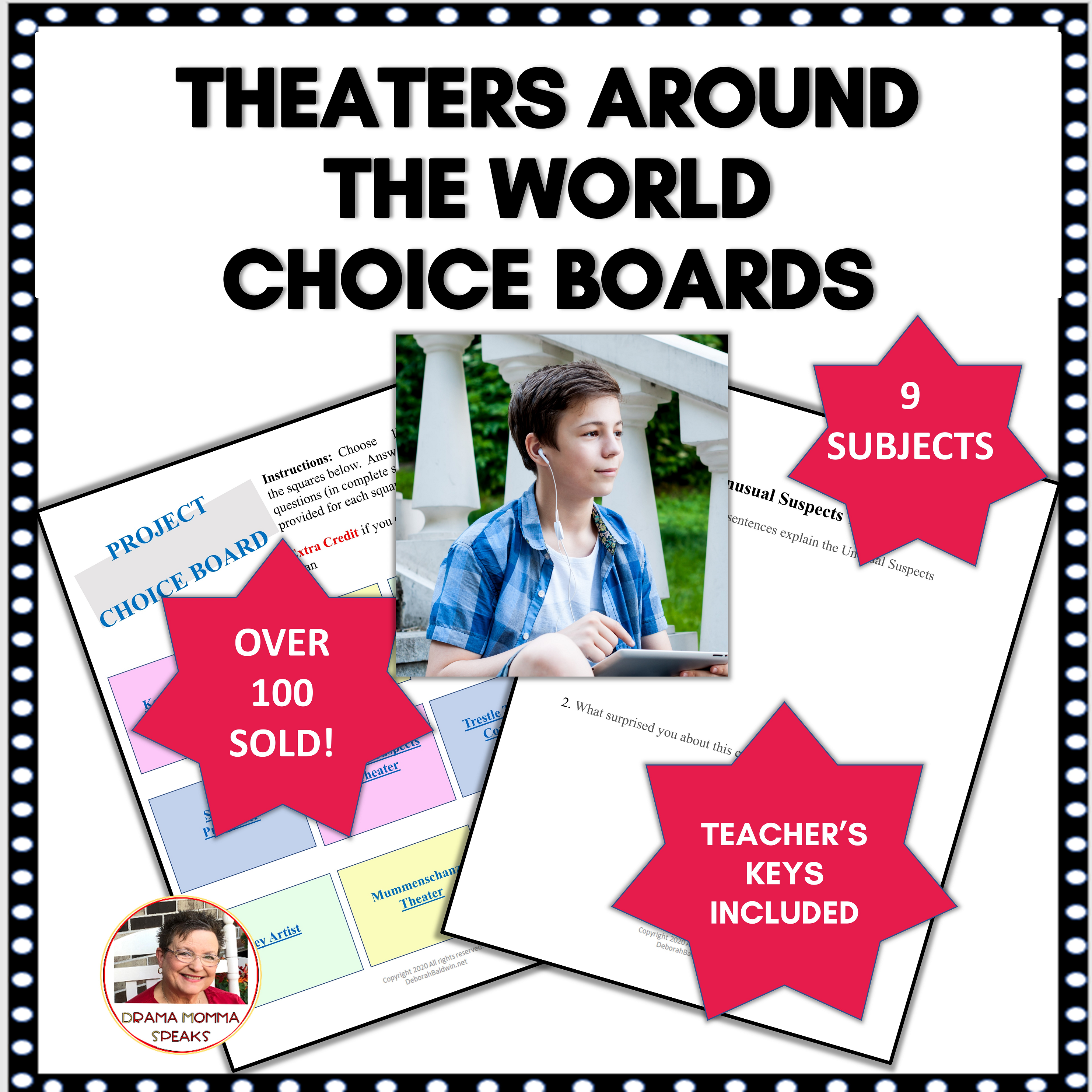
If you are looking for a way to teach students about theaters around the world, check out these Choice Boards. 

What are Choice Boards, you ask?  In this case, my choice boards are a collection of links which lead to video clips.  Students select the subjects they are most interested in, view the video clips and answer the questions.  This is super differentiation! By tailoring instruction to meet individual needs. through content, process, products, the learning environment,  ongoing assessment or  flexible grouping, differentiation creates a successful approach to instruction.

I hope you’ll considering teaching about stage makeup with your students.  It’s so important.  Just watch the transformation of your students as they apply it! Suddenly, you’ll see a student transform into a character.  Costumes do the same thing for them. As I mentioned above, these skills contribute to students’ overall artistic development and enable them to deliver compelling performances that captivate and engage audiences.
What styles of stage makeup design have you taught your students?  Did they enjoy it?  I’d love to learn about it.  Contact me at DhcBaldwin@gmail.com
Woman behind DramaMommaSpeaks

Share this:

  • Click to share on Tumblr (Opens in new window) Tumblr
  • More
  • Click to share on X (Opens in new window) X
  • Click to share on Facebook (Opens in new window) Facebook
  • Click to share on Pinterest (Opens in new window) Pinterest
  • Click to share on LinkedIn (Opens in new window) LinkedIn
  • Click to email a link to a friend (Opens in new window) Email
  • Click to share on Reddit (Opens in new window) Reddit
  • Click to share on Pocket (Opens in new window) Pocket
  • Click to share on Telegram (Opens in new window) Telegram
  • Click to share on WhatsApp (Opens in new window) WhatsApp

Like this:

Like Loading...

Filed Under: arts integration, community theater, drama education, drama integration, Education, excellence in teaching, middle grades, Teacherspayteachers, Teaching, theater, youth theatre Tagged With: choice boards, cooperative learning, differentiation, high school drama class, middle school drama class, stage makeup, stage makeup design, theater profession

5 Easy Drama Games for Emergency Sub Plans

May 31, 2023 By dhcbaldwin Leave a Comment

If you are reading this blog post, you are probably a. collecting materials for the next school for your theater class or b. sick as a dog and you need help fast!  Either way, you have come to the right place. I only offer sound teaching lessons (some made with Google slides)  or advice to teachers–no gimmicks!  Today, let’s talk about 5 easy drama games for emergency sub plans.

In some ways, I don’t want to divulge this secret I have.  The site I’m going to share with you is full of fabulous theater improv. games and exercises. But in the interest and support of theater teachers around the world, I would like to introduce Hoopla to you.

Who is Hoopla?

Hoopla is the United Kingdom’s first improvisation theatre, established for over twelve years.

From their website, “Hoopla is an improv comedy (also known as improvised comedy, impro and improvisation) company based in London, UK. Hoopla were founded in 2006 by Steve Roe and Edgar Fernando.

Hoopla run a selection of improv classes and courses across London and also an improv comedy club in London Bridge featuring a selection of groups from across the UK improv scene. Hoopla are the founders of the UK’s first ever improvised comedy club. Hoopla also do improv based corporate training.

Mission of Hoopla

The aim of Hoopla is to make improv fun and accessible for everyone from all backgrounds. We’re especially focused on teaching beginners improv and we love introducing people to improv for the first time in a fun, friendly and safe way.

Also, Hoopla encourages and supports a growing improv community with shows, courses, networking events, socials and more.”

Did you know I have the secret to boosting student engagement?  My new book, “We’re Live! Radio Theater #101” explains my journey to implementing this unique tool in the classroom. Check it out here

History of Hoopla

From their website, “Hoopla was founded in January 2006 by Steve Roe and Edgar Fernando, two old school friends who have known each other since they were 4 years old. Hoopla was originally based in Balham SW London, near to where Steve and Edgar grew up.

Originally it was just them and some school friends from their old GCSE drama group running a free workshop once a week, to have fun after work and keep the joy of drama and play in adult life. But it rapidly grew to friends of friends and then friends of friends of friends, and with word of mouth Hoopla soon became the UK’s biggest improv company.

Not surprisingly, Hoopla now teach 1000s of improv students a year in various venues around London and run shows five nights a week featuring improv groups from across the world. Don’t know much about improvisation?  Check out: What You Know About Improvisation In Theater And What You DON’T Know About Improvisation In Theater

5 Easy Drama Games for Emergency Sub Plans

In 2010 Hoopla’s shows moved to The Miller in London Bridge and with the help of the amazing staff there and a large community of improvisers the venue was converted to the UK’s first ever improv theatre.

Recently, the company is honored to have been involved in the huge rise of improv in the UK over the last decade and to be part of such a great improv community.”

The games I’ve included games would be best for middle school students and larger classes.  They take little to no set up and are easy to implement.  Here are several of their drama games that would work in a pinch if you needed something a substitute teacher could lead. 

5 Easy Drama Games for Emergency Sub Plans

1. Curveball Story ⚾️⚾️

Directions: 
This is played in pairs (trios work too). One person makes up a story. As they tell it, the other will call out random words that need to be incorporated into the story. Wait for the last word to be folded in before giving another.🌟

Variations
Similar to What If? where the other person says something like “what if it started raining?” “What if you jumped on a boat?” and they incorporate that into the story.

🌟Grades 3 and up would have gobs of fun with this warm-up. Use vocabulary words for the random “curve ball” or maybe characters from a book, or particular facts from a science lesson. Looking for additional warm up exercises?  Check out: Drama Class Exercises for the First Two Weeks of School

5 Easy Drama Games for Emergency Sub Plans

If you are looking for a lessons to begin the school year, check out: First Week of School Drama Class Lessons

2.  Book Club

Directions:
Two improvisers have a book each given to them from the audience and all their lines of dialogue come from those. The third person makes sense of those lines in the context of the scene. A location or relationship call-out helps at the beginning.

NOTE: I took quotes from Charlotte’s Web and Harry Potter and the Goblet of Fire to show you.

Example
Player A (No book): Thanks for helping me out today

Player B (Book): If I can fool a bug… I can surely fool a man. People are not as smart as bugs..

Player A (No book): Perhaps you are right. Go bugs!

Player B (Book): It is deeply satisfying to win a prize in front of a lot of people.

Players A (No book): I bet! So what will you do with the prize?

Third player enters

Player C (Book): It takes a great deal of bravery to stand up to our enemies, but just as much to stand up to our friends.

Player A (No book): Oh hi Kim! That’s a nice to thing to say after losing so terribly.

Player C (Book): Numbing the pain for a while will make it worse when you finally feel it.

Player A (No book): Well, that’s good know.

Player B (Book): Salutations are greetings; it’s my fancy way of saying hello.

Player A (No book): Wow, you win one game and now you think you are special!

Player B (Book): It matters not what someone is born, but what they grow to be.

Teaching Purpose
It’s fun! By the end, students learn how to accept and justify offers given. Got introvertive students?  Check out: Drama Games for the Introvertive Student

5 Easy Drama Games for Emergency Sub Plans

5 Easy Drama Games for Emergency Sub Plans

3. Car Journey 🚗🚕🚙( I renamed it, Family Vacation)

Everyone has stories of a family vacation or journey.  I think this is what makes this exercise so successful–it’s a universal theme! 

Directions:
Begin by having five people on stage in a car set-up.

Tell them they are on their way somewhere they don’t normally go (a convention, concert, festival, theme park, etc.).

They must be silent for the first 30 seconds of the scene.

Lastly, inform them that they cannot stop the car or get out.

Ideally they will establish relationship before any dialogue happens.

Variation
After you’ve done a few of these, ask the same casts to return to the stage and perform their return trips. They can swap places in the car.

With elementary students, you may need to get their creative juices flowing by asking them about what people talk about while they are traveling somewhere. 😊

I would think middle and high school students would have no trouble with this exercise.

Variation
After you’ve done a few of these, ask the same casts to return to the stage and perform their return trips. They can swap places in the car. (How fun would that be?)

If you choose to try this with elementary students, you may need to get their creative juices flowing by asking them about what people talk about while they are traveling somewhere. 😊
5 Easy Drama Games for Emergency Sub Plans

5 Easy Drama Games for Emergency Sub Plans

4. Columns/Pillars 👉👉

Description:
For this game you need 2 volunteers from the audience. They stand/sit at the front sides of the stage, and act as pillars for the players. 2 players do a scene, and whenever they need a word they tap one of the pillars on the shoulder.

The pillars say whatever comes to them, and the players then justify why that has been said. Some words fit perfectly, others will be completely random!

Example
Gary: Thanks for helping me fix this car, Denise.

Denise: No problem Gary, I’m glad I could (PILLAR) “help”.

Gary: I really appreciate it, you know I’m so nervous about the race tomorrow.

Denise: You shouldn’t be, you’re (PILLAR) “Batman”. The others don’t stand a chance!

Gary: I know, I’m just scared that if I don’t win I’ll also lose my (PILLAR) “cook”. He only wants to work for winners.

Denise: He does make great (PILLAR) “statues” out of chocolate. I’m sure you’ll win. Hand me the (PILLAR) “oats”.

Gary: I would never think to use oats to repair a car. You’re a genius.

⭐️Additional Tips for Playing

Give the pillars a chance to practice (e.g., “this morning for breakfast I had…”)
Repeat the word after the pillar has said it
Listen, and justify what has just been said

Remember to thank your lovely volunteers!

5 Easy Drama Games for Emergency Sub Plans

Are you looking for more warm up exercises?  Check out this category: Emergency Sub Plans

5.  Oracle

Directions:

The Oracle involves four people, set behind each other. (It will look a little like the photo above.) First, one person is at the front sitting on the floor, second one behind sits on a chair, the third one behind that standing and lastly, the fourth one stands on a chair. In this way, we can see all their faces. Oracle is a brilliant low stakes word-at-a-time short form game.

To begin, the host simply takes big life questions from the audience, like ‘Is there a God?’ and ‘Why are we here?’ or ‘Will the United States win the World Cup?’ and then asks the Oracle, who answers it a word at a time (per person). When Oracle is in action everyone’s arms wave to the side. If Oracle is in silent contemplation everyone’s hands are together in a kind of ‘prayer’ pose.

It’s funny, simple and daft. And being word at a time you can guess how wise oracle sounds. Sometimes very. Sometimes just plain ridiculous!

Example–

Audience question: What is love?

Player A: Love

Player B: is

Player C: hot

Player D: chocolate

Player A: on

Player B: a

Player C: rainy

Player D: day.

In this game listening and being obvious are important, as you follow what the previous person has said. You don’t have to make complete sense or try to be funny; just say the first thing that comes to you.

Or are you looking for Drama resources made with Google slides?

5 Easy Drama Games for Emergency Sub Plans

I hope these games/exercises work out well for you.  If you’d like more warm up exercises (and you can expect me to have many favorites over the 38 years of teaching and directing), check out my free collection of warm ups for middle school students.  You can pick it up here. Or maybe you are wanting something a little quieter and individual? Check out these word searches.

Did you know I have the secret to boosting student engagement?  My new book, “We’re Live! Radio Theater #101” explains my journey to implementing this unique tool in the classroom. Check it out here


A collection of theater warm-up exercises for middle schoolers.

What do you leave for your substitute to teach while you are absent?  I’d love to hear about it.  Feel free to email me at DhcBaldwin@gmail.com.

Dramamommaspeaks Blog Author Deborah Baldwin


Share this:

  • Click to share on Tumblr (Opens in new window) Tumblr
  • More
  • Click to share on X (Opens in new window) X
  • Click to share on Facebook (Opens in new window) Facebook
  • Click to share on Pinterest (Opens in new window) Pinterest
  • Click to share on LinkedIn (Opens in new window) LinkedIn
  • Click to email a link to a friend (Opens in new window) Email
  • Click to share on Reddit (Opens in new window) Reddit
  • Click to share on Pocket (Opens in new window) Pocket
  • Click to share on Telegram (Opens in new window) Telegram
  • Click to share on WhatsApp (Opens in new window) WhatsApp

Like this:

Like Loading...

Filed Under: acting, arts education, Back to School, drama education, drama integration, Education, English Language Learners, High School, middle grades, Musical Theatre, New Teacher, Teacherspayteachers, Teaching, teaching strategies, theater, theatre, youth theatre Tagged With: cooperative learning, emergency substitute plans, lesson plans for substitute, partner storytelling, reluctant student, shy student, storytelling, substitute lesson plans, theater games, warm up games

How to Excite Students With Drama Integration

March 30, 2023 By dhcbaldwin Leave a Comment

students with their hands raised in front of a chlkboard

Today, I want to blog about “How to Excite Students With Drama Integration”–one of my favorite subjects! I have an Instagram Profile which I maintain regularly. My followers are comprised of teachers who see the importance of drama but are unconfident using it. They are looking for a teaching method concerning how to excite students with drama integration.

Usually that’s not what they mention, however.  It’s more implied by statements such as “I just can’t get my students to do anything.” Or “They are too busy being too cool for school.”  Or, “They are completely checked out in my class.”

No one wants to say aloud what they are really thinking, “Help someone!”  I can tell by the number of likes I receive and my checking out their own IG account posts, these teachers want to use this fabulous tool with their students. They aren’t convinced they can do it with success. I’m here to tell you that you can!

How to Excite Students With Drama Integration

While we are on this subject….Did you know I have the secret to boosting student engagement?  My new book, “We’re Live! Radio Theater #101” explains my journey to implementing this unique tool in the classroom. Check it out here

How to Excite Students with Drama Integration

How to Excite Students With Drama Integration

I’m continually seeking the perfect magic words to get these teachers to cross the bridge from belief to action.  Understanding these are very busy people with far too much on their plate, I know it’s difficult to take a few minutes and consider strategies for student engagement.

Here I sit smiling at them through my IG profile.  Drama integration has been a part of my life since I was ten years old and in fourth grade when I played Queen Isabella.  That was in 1966!  My teacher engaged me right from the beginning by our class performing a short play about the meeting between Queen Isabella and Christopher Columbus. ( I always thought it was so funny because the boy who played Christopher was named Christopher himself!)

But I digress…

If you are someone searching for a way to integrate drama into your classroom, you came to the right blog.  I could give you my opinion, but sometimes we learn better from people of which we are unfamiliar.  Let’s see what other teachers and researchers  discovered.

How does drama help in the classroom?

How to Excite Students With Drama Integration

Drama encourages them to think and act creatively, thus developing critical thinking and problem-solving skills that can be applied in all areas of learning. Through drama, children are encouraged to take responsible roles and make choices – to participate in and guide their own learning.

How does drama help in the classroom?

Drama stimulates them to think and act creatively, thus developing critical thinking and problem-solving skills that can be applied in all areas of learning. Through drama, children are nurtured to take responsible roles and make choices – to participate in and guide their own learning. Check out this resource to use in your language arts class: You can find it on Teacherspayteachers.com at: The Cask of Amontillado radio play script.  Don’t know how to teach radio theater? Check out my Made by Teachers Store: Radio Theater Unit  or in my TPT store: Radio Theater Unit

Drama in the Reading Classroom

Plays inherently come with built-in strategies to help students read better. The acting out of play dialogue compels readers to work more closely with the text to interpret it and project meaning into the experience. As a result, students show improvement in vocabulary, comprehension, and retention.
Researching the drama integration subject, I ran on to Jane Udalla’s article, “The Effect of Drama Based Instruction on Reading Comprehension which states, “Drama-based activities can help struggling readers to “feel” the story, because students report being able to experience the emotions of the characters. Consequently, the students make personal connections to the text and characters while experiencing comparable emotions.  As you would expect, this experience inside the story changed students’ ability to comprehend.” Because it is made real to them, the story reading stays with them.

How to Excite Students With Drama Integration

Drama in the social studies classroom

Language Arts Teacher, Michelle Pieczura states in her article Decidedly Dramatic! The Power of Creative Drama in Social Studies, “Creative dramatics, a highly effective method for integrating arts education into core curriculum. It produces a positive and lasting impact on student learning, in terms of creative and critical thinking, language development, listening, comprehension, retention, cooperation, and empathy and awareness of others.
Creative dramatics not only has the power to bring curriculum to life, but also to stimulate active involvement in the development of conceptual understandings.” Personally, I think social studies is a fabulous place for a drama integration.
If you would like more information about how to integrate drama into social studies, check out my post: The Reasons Teaching Multiculturalism in the Classroom is Vitally Important or peruse my Teacherspayteachers.com product–Multicultural Readers Theater Units or check out The Magic Lake in my Payhip store.

Drama in the math classroom

How to Excite Students With Drama Integration
I know it’s difficult to believe, but drama can also make a math classroom sizzle with excitement! Here is one example.  In the article, The Effects of Drama on At-Risk Students, by  Patrick Kariuki and Steven G. Humphrey stating, “In a higher education classroom, a teacher used stories of mythology to help students understand statistical problems.
This teacher reasoned that storytelling is effective because it allowed him to share with students certain symbols– such as myths that everyone could understand. Furthermore, it also placed unfamiliar concepts in a more familiar setting. If you are intrigued by this idea, check out how to use Native American folk tales: 370 Million Indigenous People Want You to Know About Their Cultures

Outside help for your school

Photo Gallery of DramaMommaSpeaks

Maybe you would like to provide a full-scale musical production at your school as a way to engage students more fully? The Jump Start Theatre program is your answer.

The Jumpstart Theatre Program

The JumpStart Theatre program creates sustainable theatre arts programs in middle schools where there previously were none.  Participating schools are chosen through a rigorous application process and receive training, materials.  Plus there is  budget support to produce their first full-scale musical production. The support continues for three years until the program becomes self-sustaining.

Non-theatre teachers are equipped with skills and resources to produce their school’s first musical through a proven combination of bootcamp style training and hands-on mentoring. The Educational Theatre Foundation operates JumpStart Theatre through a national network of regional theatre company partners who are selected based on their track-record of success in running educational programs for children. In my opinion, this is just wonderful! 

JumpStart Theatre partners are:  Alliance Theatre, Atlanta, Ga.; La Jolla Playhouse, La Jolla, Calif.; Mountain City Center for the Arts, Frostburg, MD; Stages St. Louis, St. Louis, MO; and The Children’s Theatre, Cincinnati, OH.

How to Excite Students With Drama Integration

Drama Integration through Radio Theater

Here’s how I can help you. A fabulous way to use drama in your classroom is through radio theater.  Now. hear. me. out! Radio theater, now in existence for 100 years, is the predecessor to podcasts. (Ask your students if they know what a podcast is–they will!) I understand the actress Amy Poehler is starting a podcast series, Say More with Dr? Sheila. It will feature 30 comedic episodes spread across three seasons, starring Poehler as a couples therapist with questionable methods and credentials. Each ten-episode season will focus on a central character and distinct theme; however, characters will make crossover appearances across stories and seasons.

The great part of that news is that if one actor does this, more will come!

Harry Potter is entering the podcast scene

Recently, it was announced a brand-new co-production of the original Harry Potter stories, will revisit the beloved listening experience for the first time ever. Scheduled for late 2025, these full-cast audio productions will bring these iconic stories to life as never heard before, offering immersive audio entertainment through high-quality sound design in Dolby Atmos, stunning scoring, a full range of character voices, and real-world sound capture.

Some people would rather just jump in to learn about this incredible tool by experiencing it  on their feet. In that case, I have radio play scripts available (The Invisible Man, The Monkey’s Paw, Cask of Amontillado, Bow Wow Blues, The Frozen Pirate, It Could Always Be Worse, The Brave Little Tailor, etc.) You can find them here:  Dramamommaspeaks Products

How to Excite Students with Drama Integration

As teachers we know that teaching strategies play an important role in classroom instruction. Without the use of a strategy, teachers would be aimlessly projecting information that doesn’t connect with learners or engage them. Luckily, these strategies help learners participate, connect, and add excitement to the content being delivered. That, my friend, is where drama integration comes in!

I hope you’ll consider integrating drama into your classroom. I am always here to help you should you need me or need a sympathetic ear.  Just email me at DhcBaldwin@gmail.com Want to check out my new teacher guidebook, “We’re Live! Radio Theater #101?  It’s available on Amazon and in my Dramamommaspeaks store.

How to Excite Students with Drama Integration

Share this:

  • Click to share on Tumblr (Opens in new window) Tumblr
  • More
  • Click to share on X (Opens in new window) X
  • Click to share on Facebook (Opens in new window) Facebook
  • Click to share on Pinterest (Opens in new window) Pinterest
  • Click to share on LinkedIn (Opens in new window) LinkedIn
  • Click to email a link to a friend (Opens in new window) Email
  • Click to share on Reddit (Opens in new window) Reddit
  • Click to share on Pocket (Opens in new window) Pocket
  • Click to share on Telegram (Opens in new window) Telegram
  • Click to share on WhatsApp (Opens in new window) WhatsApp

Like this:

Like Loading...

Filed Under: arts education, arts integration, creative dramatics, Creativity, drama integration, Education, elementary, excellence in teaching, High School, middle grades, reading skills, Teacherspayteachers, teaching strategies Tagged With: arts integration, cooperative learning, drama integration, listening skills, radio theater, reading skills, speaking skills

Three Interactive Ways to Teach The Play Tom Sawyer To Your Students

December 26, 2019 By dhcbaldwin Leave a Comment

A white washed fence indicative of Mark Twain's book, The Adventures of Tom Sawyer

Three Interactive Ways to Teach The Play Tom Sawyer To Your Students

Today’s post is Three Interactive Ways to Teach Tom Sawyer To Your Students.  Several years ago, (for thirteen years) I taught sixth graders an introduction to theater class in a middle school. All the sixth graders–almost 500 of them each year. If you’d like to know more about that experience, check out this blog post: How to Make Your Drama Class More Successful

Mark Twain's Purpose for Writing The Adventures of Tom Sawyer

As any drama teacher worth her weight would tell you, it’s important for students to read fiction about kids around their age.  Now, I’m like anyone.  I like pop culture, but I happen to think our students need to still read classics.

In addition, I also like to include interactive instruction if at all possible.  Interactive instruction is when students learn through social interaction. Interactive instruction is just about everything we do in a theater class!

Meet Tim Kelly, Playwright

Three Interactive Ways to Teach The Play Tom Sawyer To Your Students

Thirty-one years ago, I co-developed a play writing contest for youth theater plays.  One of the winners was a prolific playwright, Tim Kelly.

When Tim entered the competition, I was aghast!  I only knew his plays as hokey.  They were silly, kind of awkward parodies of other plays, books, or television shows.

Shortly afterward, Tim discovered writing for middle school students and finally found his home, at least in my opinion.

We produced his play, It’s a Howl! and it was such fun.  I know, I said I didn’t like to do superficial stuff but It’s a Howl! is really clever–sort of Frankenstein meets the Werewolf.

Over several years, Tim and I would talk about other plays he wanted to enter in the contest.  He mentioned his Tom Sawyer script to me as well.

Three Interactive Ways to Teach The Play Tom Sawyer To Your Students

Three Interactive Ways to Teach The Play Tom Sawyer To Your Students

I don’t know why, but he never entered it in the competition.  But I read it and loved it!

Check out a synopsis of it here:   Dramatic Publishing Company

Back to the middle school with the gazillion students…Since seventy-five new students entered my drama classroom every twenty-five days, I had to come up with a variety of lessons for them.

Enter The Adventures of Tom Sawyer

Tom Sawyer fit two purposes for me.  One–it was a classic and abbreviated which was perfect especially for the classroom.  Two–it was a story about students around the ages of my students.  Three–it was a wonderful jumping off point for additional lessons about theater (set, costume, props, etc.)


Three Interactive Ways to Teach The Play Tom Sawyer To Your Students

Recently, I created two units using Tom Sawyer as my inspiration. Here is the production description:

Mark Twain’s classic novel, The Adventures of Tom Sawyer is an excellent story for our middle grade students to study. Here is study guide for a play version of the book. Questions for a read-aloud are included as well as questions to study the play from a theatrical perspective. Playwright, Tim Kelly was a prolific playwright and this script is a perfect example of his body of work. His plays are especially suited for middle grade students.

This product includes:

  • A Letter to the Teacher
  • Short Bio. on Mark Twain
  • Information about the novel, The Adventures of Tom Sawyer
  • Procedure
  • Warm Up
  • Teacher’s Script–What I say and How I say it!
  • Discussion Questions from a Theatrical Perspective
  • Discussion Questions for a Class Read-Aloud
  • Theater Vocabulary Words–34 In Total
  • Theater Words Definitions
  • Source Page

Three Interactive Ways to Teach The Play Tom Sawyer To Your Students

Study Set Design 

The second unit concerns set design.

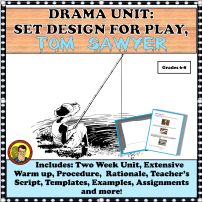
This set design unit (48 page, 10 days) focuses on a play version of Mark Twain’s The Adventures of Tom Sawyer by Tim Kelley. This is great interaction! Students learn about the history of set design, famous set designers, develop a critical eye about what makes up an award winning set design, create a ground plan for a room in a school of their choosing and draw a rendering. In addition, the students must work with ratios and measuring. The first two assignments are completed individually, but then the fun begins! The students are paired up to create a model working together towards the goal. There is even room for parents to celebrate the end of the unit with your students.

Note: If a teacher chooses to use this particular set design unit, I would suggest purchasing a class set of Tom Sawyer by Tim Kelley at: https://www.dramaticpublishing.com/tom-sawyer-tr5000.

Included in the unit:

  • An overview of the unit for the teacher
  • Rationale for teaching set design
  • History of set design
  • Set designer’s responsibilities
  • Teacher’s Script–what I say and how I say it!
  • Extensive warm up
  • Procedures for each day (8 to 10) including exit prompts
  • Lecture notes including links
  • Information about the message color conveys
  • Rendering examples
  • Stage curtain sheets for rendering–one vertical, one horizontal
  • Step by step directions for model building including photo examples
  • Cheat sheet for various set pieces
  • Assignment sheet for each step of the design process
  • Grade sheet EDITABLE in a separate file
  • Source Page

Now I have a costume design unit to go with these two as well.  Talk about comprehensive!

Of course, there’s a bundle of the three together.  Check those out at:  Bundle Tom Sawyer Study Guide and Set Design Unit 

Three Interactive Ways to Teach The Play Tom Sawyer To Your Students

Honestly, I don’t know if The Adventures of Tom Sawyer is taught in the classroom anymore.  I could understand the reasons not to teach it.  However, Mr. Kelly’s script is well adapted and deletes any words which might be difficult for our students to accept in this day and age.

Three Interactive Ways to Teach The Play Tom Sawyer To Your Students

I hope you’ll consider ordering a perusal copy of the script. Perhaps you’ll use these two products in your drama classroom or at least study it in the language arts classroom.  It fits the “balanced reading” benchmark, too!

Mr. Twain wrote the book for all of us.   Of course, I think Mark Twain says it the best, “Although my book is intended mainly for the entertainment of boys and girls, part of my plan has been to pleasantly remind adults of what they once were themselves, and what they felt and thought.”

What young adult novels have you studied in play form?  I’d love to hear about them.  Contact me at dhcbaldwin@gmail.com or DeborahBaldwin.net

Woman behind DramaMommaSpeaks

Share this:

  • Click to share on Tumblr (Opens in new window) Tumblr
  • More
  • Click to share on X (Opens in new window) X
  • Click to share on Facebook (Opens in new window) Facebook
  • Click to share on Pinterest (Opens in new window) Pinterest
  • Click to share on LinkedIn (Opens in new window) LinkedIn
  • Click to email a link to a friend (Opens in new window) Email
  • Click to share on Reddit (Opens in new window) Reddit
  • Click to share on Pocket (Opens in new window) Pocket
  • Click to share on Telegram (Opens in new window) Telegram
  • Click to share on WhatsApp (Opens in new window) WhatsApp

Like this:

Like Loading...

Filed Under: arts education, drama education, excellence in teaching, middle grades, performing arts, play reading, plays, teaching strategies, theater Tagged With: cooperative learning, drama lessons, Mark Twain, play, play read aloud, reading aloud, script reading, set design, study guide, The Adventures of Tom Sawyer, Tom Sawyer

What is Kamishibai Storytelling?

July 16, 2017 By dhcbaldwin Leave a Comment

What is Kamishibai?

What is Kamishibai Storytelling?

Child, Girl, Grandma, Grandmother, Story, Storytelling

Several years ago, I taught four hundred sixth graders each year (yikes!) I was always searching for different drama lessons including storytelling styles.

Then, I ran on to Kamishibai storytelling.

According to Wikipedia.com,

“Kamishibai, sometimes called Paper Drama, is a form of Japanese street theatre and storytelling that was popular during the Depression of the 1930s and the post-war period in Japan until the advent of television during the twentieth century. Kamishibai was told by a kamishibaiya (kamishibai narrator) who travelled to street corners with sets of illustrated boards that he or she placed in a miniature stage-like device and narrated the story by changing each image. Kamishibai has its earliest origins in Japanese Buddhist temples where Buddhist monks from the eighth century onward used emakimono (“picture scrolls”) as pictorial aids for recounting their history of the monasteries, an early combination of picture and text to convey a story. ”

Because of these many years of teaching storytelling, I created an upper elementary/middle grade unit using Kamishibai.  It is one of my most successful units. It incorporates writing, reading, storytelling, drawing and performing.  How much better can you get than that?

Students enjoy it very much.

Storytelling, Storybook, School, Education, Kids

I think one of its strengths is the fact that reluctant performers feel safe storytelling in this manner.  By holding picture boards in front of them while the students tell the story, they feel protected from the audience.  Better yet, my students performed in tandem on their stories. It’s great cooperative learning.

What’s the importance of teaching storytelling to students?

I was looking around for information for this post.

Luckily, I ran on to a great blog post about storytelling at mensaforkids.org:

“You are surrounded by stories every day. The news on television, radio, and in the newspaper is nothing but stories. The Bible and other religious books are full of stories. The lessons teachers give in school are often stories. Songs tell stories. Pictures tell stories. Movies tell stories. Comedians make up their routines with stories. When you tell a friend about something that happened to you, you are telling a story. Can you think of the last story you heard? Think hard: it may be something you just heard a few minutes ago!

Some stories have lasted hundreds and even thousands of years and are still being told. Stories began with the oral tradition, meaning they were passed on by being heard and retold. Later, people began to write the stories down, but we still love to hear stories told out loud.”


people having a bonfire

What is Kamishibai Storytelling?

“Stories are powerful. They can teach morals — the values that the author of the story thinks people should live by. They can teach history. They can entertain us. They can make us think about things in ways we’ve never thought of them before. They can make us laugh. They can make us cry. Telling stories is a large part of what makes people connected to each other.

Stories are a part of every culture. Stories about our country and its history help us feel proud of our nation. Stories about our ancestors teach us about where we came from and the things we have in common with other people around us.

A man named Robert Moss said that the Australian Aborigines think that the important stories are always seeking the right person to tell them, looking for the storyteller like an animal hunting its prey.”

Isn’t that great?

As adults, there are many times we must tell a story–when we have a car accident and must explain it to the police officer, explain to our children about a particular moment in their lives, asking a question of a company and explaining our problem to them, etc.

Over time, I perfected my Kamishibai storytelling unit.  It is one of my favorite units to teach because it allows the students a lot of creativity and imagination. As I mentioned previously, they must work cooperatively and finally share their story.

What is Kamishibai Storytelling?

This ONE WEEK unit  focuses on a Japanese form of storytelling called Kamishibai.  This unit is successful with third through seventh grade students and classes in language arts, reading, drama, world history, social studies and ESL.

Broken into eight class periods, the unit can be halted intermittently if need be.

The product includes:

  • What is Kamishibai storytelling (using its form as a model)
  • The History of Kamishibai
  • How to Analyze Illustrations Just Like Film Makers Do!
  • Effective Storytelling Techniques
  • Procedure
  • Teacher’s Script–What I Say and How I Say It!
  • Materials List–Most You Will Have in Your Classroom All Ready
  • Instructions How Create the Boards and the “Tricky Part”
  • Tips and Advice
  • Editable Storytelling Rubric
  • Sources

The best part? This storytelling style can be used with ANY story. Students are highly engaged and LOVE this unit!

Tips and Tricks of a Drama Teacher-- Drama Tools, That Is

Storytelling with Student Created Pictures

What is Kamishibai?

Storytelling Unit

You will find this unit and others pertaining to storytelling in my teacherspayteachers.com store at:  Dramamommaspeaks

Here is a storytelling rubric which I created.  It’s editable, so if you can give more points to the assignment or change the expectations if you’d like.

What is Kamishibai?

Storytelling Rubric 

What stories do you like to share with your family or friends?  I have several which come up ever so often when my family is together.  I know one about my brothers and sister nearly drowning when my father drove a car with them in it onto a frozen river.  It’s quite a funny, crazy story.

Contact me at dhcbaldwin@gmail.com or DeborahBaldwin.net

What is Kamishibai?


Share this:

  • Click to share on Tumblr (Opens in new window) Tumblr
  • More
  • Click to share on X (Opens in new window) X
  • Click to share on Facebook (Opens in new window) Facebook
  • Click to share on Pinterest (Opens in new window) Pinterest
  • Click to share on LinkedIn (Opens in new window) LinkedIn
  • Click to email a link to a friend (Opens in new window) Email
  • Click to share on Reddit (Opens in new window) Reddit
  • Click to share on Pocket (Opens in new window) Pocket
  • Click to share on Telegram (Opens in new window) Telegram
  • Click to share on WhatsApp (Opens in new window) WhatsApp

Like this:

Like Loading...

Filed Under: creative dramatics, Creativity, drama education, middle grades, storytelling, Teacherspayteachers, theater, theatre, Uncategorized, youth theatre Tagged With: communication skills, cooperative learning, Kamishibai Storytelling, listening skills, reading skills, storytelling, writing skills

Footer

Follow Us

logo3.png

FOLLOW US

Facebook X-twitter Pinterest Instagram Envelope Rss

Goodreads: read

Malibu Rising
Malibu Rising
by Taylor Jenkins Reid
People We Meet on Vacation
by Emily Henry
The Last Thing He Told Me
by Laura Dave
Faking It
Faking It
by Cora Carmack
Losing It
Losing It
by Cora Carmack

goodreads.com
Copyright © 2024 · Wellness Pro on Genesis Framework · WordPress.com.Log in
 

Loading Comments...
 

    %d