• Skip to primary navigation
  • Skip to main content
  • Skip to footer

Join Me in my new Facebook Group! https://www.facebook.com/groups/417126059784261

Menu
  • Meet Deb – The Heart Behind DramaMommaSpeaks
    • Work with Me! 
    • Photo Gallery of DramaMommaSpeaks
    • Directorial Credits
  • I Give Book Talks! 
    • Book Talk Through Skype
    • Books
  • Freebies!
  • Bumbling Bea
  • Teaching Resume
  • Acting Resume
  • Contact Me
  • Blog
    • Drama Education
    • Arts Education
    • Youth Theatre
    • Middle Grades
    • Musical Theatre
    • Teaching
  • Meet Deb – The Heart Behind DramaMommaSpeaks
    • Work with Me! 
    • Photo Gallery of DramaMommaSpeaks
    • Directorial Credits
  • I Give Book Talks! 
    • Book Talk Through Skype
    • Books
  • Freebies!
  • Bumbling Bea
  • Teaching Resume
  • Acting Resume
  • Contact Me
  • Blog
    • Drama Education
    • Arts Education
    • Youth Theatre
    • Middle Grades
    • Musical Theatre
    • Teaching

Radio Theatre

What No One Tells You About Creating An On-Line Course

December 2, 2022 By dhcbaldwin Leave a Comment

Woman sitting on a sofa filming herself like she is teaching an on-line class

What No One Tells You About Creating An On-Line Course

Woman behind DramaMommaSpeaks

Today I want to talk about what no one tells you about creating an on-line course. I can’t believe I am finally to a place where I can blog about this subject. I’m not kidding when I say I’ve been creating an on-line course for nearly a year.

In September of 2021, an idea to create an on-line course crept into my mind and I couldn’t shake it.  I happened to put it out there that I’d like to create a course which would complement a particular category of units in my Teacherspayteachers store. Building an on-line course seemed the next step in my business and I still think this was a good idea.

I’m fortunate in that I’m a student in a wonderful company called SBZ Enterprises. They taught me how to amplify my presence in social media through their course focused on Instagram.  If you don’t know much about the Instagram and how to market on it, I’d suggest you take this course. You can find it at: SBZ Enterprises

What No One Tells You About Creating An On-Line Course

Ironically, at the time I was considering this on-line course idea, SBZ was offering an affiliation with Digital Course Academy owned by Amy Porterfield.  Would I be interested in taking the course with them?  I excitedly agreed to do so, but really I had no idea what in the world I got myself into.

Persevering as I often do when I learn outside of my comfort zone, I enrolled with Morgan Sutton, CEO of SBZ as my mentor through the training. Morgan has been invaluable help in many ways and I will always be grateful for her support and confidence in me.

What No One Tells You About Creating An On-Line Course

What is Digital Course Academy?

DCA is an on line course which teaches you how to create a webinar for an on-line course you are selling.  At the same time I began creating my course, I studied DCA’s trainings.  Talk about information overload! I mean, I’m not going to quit just because I’m in deeper than I meant to be. I finished the DCA course in December and decided that although I understood the concepts of webinar development, I needed to concentrate on my own on-line course before I could create a webinar for it.

Some people create the course as they develop their email list.  In DCA you are encouraged to develop your course through the help of your email followers, gaining their insights and suggestions as you create it.

What No One Tells You About Creating An On-Line Course

My ideal client is a teacher who teaches theater or a core subject who wants to sharpen their teaching skills.  I all ready knew teachers don’t have time to give me feedback, especially over several months as we fleshed out the course. Nonetheless, I was advised to survey my email list and make the first three modules of my course, so I did so.

I had seven beta testers for the course back in August.  Not one of them completed the three module course.  Not one.  That disturbed me to say the least because personally I finish commitments even if I don’t want to. Morgan assured me it happens a lot in a situation like this.  Cray cray is all I can say.

I was naïve

I planned to unveil my course ready by January of 2022.  Oh my gosh, that was a ridiculous goal I could never accomplish.  However, I didn’t know that at the time.  In March I decided I’d hold my first webinars for the course.  As the days and weeks wore on, I realized I needed another month to make ready everything. Again, I was so clueless.

It took me eight more months. Course creation can be a time suck, so if you are considering creating a course you need lots.of.time. 

During those months, I built up my email list, put out more lead magnets for said email list, built sales pages for the webinar, created ten modules with guides for each and tried to hold three webinars.  I followed the launch sequence for the webinar, too.

Everything appeared ready to go.  What a flop!

Looking for a few free lessons from me? Or maybe a radio theater checklist?  Check out this Free Stuff!


What No One Tells You About Creating An On-Line Course

What No One Tells You About Creating An On-Line Course

You know how sometimes in your life, something stops you in your tracks and you can’t move on?  These webinars were a failure because of reasons some of which I can’t control.  My advice?  Only use Zoom to hold your webinars and no one else.  The company I selected for the first webinars completely messed up the dates and times of my webinars so the thirty people who signed up thought the webinars were cancelled. And you know, once your customer is confused they are leery to attend another webinar or buy your product.

Course Creation Takes More Time Than You Think

Licking my wounds for a couple of months I sat on the course. I wasn’t disillusioned but disappointed.  I hoped that my webinars would attract teachers and I wouldn’t have to spend any more time on the course creation. I was so wrong. At that point, I cared more about people attending than any money I could make.  In fact, I’m still of this belief.  Money comes if it’s supposed to–that much I know.

In September I finished creating the course--all ten modules and ten guides. We (my dear husband and I) completed the recordings in early November, tweaking everything as time progressed.  In the meantime, several hundred teachers joined my email list and I think I’m getting the right audience for the course.

What No One Tells You About Creating An On-Line Course

Course Creation is Expensive

When you consider creating a course, there are expenses that no one tells you about for reasons unknown to me. Some of the expenses I never considered before beginning my course creation because I had no idea of all the details of doing this.  In hindsight I guess I should have researched the idea more fully before I began.

I use these platforms

  • course creation (Canva)
  • platform to hold course (Samcart)
  • payment page  (Samcart)
  • payment processing platform (Stripe)
  • sales page (Ontraport)
  • emails    (Ontraport)
  • recording equipment (I was lucky here, as we owned good recording equipment from a previous project.)

Webinar Building is Expensive Too

Building a webinar has its expenses, too.  Honestly, I didn’t know if Digital Course Academy is expensive, but there are extra (though optional) expenses involved if you use it. (Such as a course about email list building, for example.) These courses  really do help you.  Once the dust settles on this experience, I plan to re-enroll in some of Amy’s courses so I can pick up more tips. She’s really a gold mine of help!

Another expense–you need a platform for on-line meetings such as webinars and meetings with your students. I use Zoom because it’s the most respected and reliable.

Getting the word out about your course is a must–social media helps with that.  You need to publicize both the webinar and the course.  In my case, I use every available free platform–Instagram, Facebook, Pinterest. Linkedin.

If you have a blog and website as I do some of their costs play into this.  So, I must count WordPress and Wix for my blog and website and being seen on Linktree,etc.

What’s the Course?

What No One Tells You About Creating An On-Line Course

My course is titled,  “We’re Live! Radio Theater 101”–a step by step blueprint using a unique teaching tool to engage students when you’ve tried everything else. Interested? Email me at DhcBaldwin@gmail.com

This week I announced the course is open and available for purchase.  To be honest, I hate this part because I can’t control the outcome. I could wax philosophical and discuss how I don’t think we actually control anything, but you get the idea.

What No One Tells You About Creating An On-Line Course

One of the most difficult challenges is making a paradigm shift in teachers who think they can’t possibly use this in their classroom. They worry that they are expected to be a theater teacher and director, but I can assuage their worries. My guess is that I will probably spend a lot of time for the next month convincing teachers.

As of this writing, the webinars are planned for January when the teachers’ brains are rested and more apt to be open to new ideas. I know one thing for certain–it’s the cheapest it is every going to be. Once I begin the webinars, the course will cost more than it does at present.

I hope this helps you.  It’s been good for me to write down my thoughts about it–that’s for sure.  Have you created an on- line course?  How did it go for you?  Would you do it again?  Feel free to email me at DhcBaldwin@gmail.com

Woman behind DramaMommaSpeaks


Share this:

  • Click to share on Tumblr (Opens in new window) Tumblr
  • More
  • Click to share on X (Opens in new window) X
  • Click to share on Facebook (Opens in new window) Facebook
  • Click to share on Pinterest (Opens in new window) Pinterest
  • Click to share on LinkedIn (Opens in new window) LinkedIn
  • Click to email a link to a friend (Opens in new window) Email
  • Click to share on Reddit (Opens in new window) Reddit
  • Click to share on Pocket (Opens in new window) Pocket
  • Click to share on Telegram (Opens in new window) Telegram
  • Click to share on WhatsApp (Opens in new window) WhatsApp

Like this:

Like Loading...

Filed Under: Arts, arts education, e-learning, Education, Education, Radio Theatre, Teaching, teaching strategies, theater, theatre, youth theatre Tagged With: digital course academy, on line course, radio theater, suebenterprises

Ten Facts About Radio Theater That Will Blow Your Mind

October 6, 2021 By dhcbaldwin 1 Comment

TEN FACTS ABOUT RADIO THEATER

Ten Facts About Radio Theater That Will Blow Your Mind

Radio Theater is near and dear to my heart. Having been involved in it for most of my life, I understand it well.  I’ve performed in radio theater, directed many productions and even adapted and written several of my own. I have ten facts about radio theater that will blow your mind.

It’s such a wonderful combination which incorporating one’s skills in reading, speaking, cooperative learning, listening and using one’s imagination.  In my opinion, it’s one of the best ways to reach students and engage them.

Here are some interesting facts about radio theater scripts. They did mine and I’ve been teaching radio theater for at least twenty-five years. While searching for information to share in this post, I found these fascinating facts through wikipedia.com.

Ten Facts About Radio Theater That Will Blow Your Mind

Ten Facts about Radio Theater

Number One–This first fact really surprised me, because honestly I’d never heard it before researching this topic. The Roman playwright Seneca was claimed as a forerunner of radio drama because his plays were performed by readers as sound plays, not by actors as stage plays; but in this respect Seneca had no significant successors until 20th-century technology made possible the widespread dissemination of sound plays.

Number Two–Again, I thought radio theater did not originate until the early 1900s. However, radio theater has been around for many years.  Its roots began back to the 1880s.  In 1881 French engineer Clement Ader had filed a patent for ‘improvements of Telephone Equipment in Theatres'”

Number Three–Did you know entire musicals with original casts aired on the radio?  It began in February of 1922 airing from the  WJZ’s Newark studios.

Want some more help in the classroom? Check out my FREE Guide and lesson Here

First True Radio Drama

Number Four–What is considered the first true radio drama?  The credit goes to Wyllis Cooper’s Lights Out radio show which ran from 1934-47.  An American writer and producer, Arch Oboler suggested Lights Out was the first true radio drama to make use of the unique qualities of radio.  If you’d like to here it, listen here: https://youtu.be/J39pzN1eBm0

Ten Facts About Radio Theater That Will Blow Your Mind

Though the series is often remembered solely for its gruesome stories and sound effects, Cooper’s scripts for Lights Out were later recognized as well written and offered innovations seldom heard in early radio dramas, including multiple first-person narrators, stream of consciousness monologues and scripts that contrasted a character’s internal monologue and his spoken words.

Number Five–Probably one of the most famous radio drama broadcasts in the United States is  Orson Welles’ The War of the Worlds (a 1938 version of H. G. Wells’ novel), which convinced large numbers of listeners that an actual invasion from Mars was taking place.  (Thinking of using radio theater as a student engagement tool?  Look no further.  Check out: The Canterville Ghost and Radio Theater Unit.

Radio Drama Flops

Number Six–There were several flops, however.  Producers of radio drama soon became aware that adapting stage plays for radio did not always work, and that there was a need for plays specifically written for radio, which recognized its potential as a distinct and different medium from the theatre.

A page of my original radio theater script, Bow Wow Blues.

Number Seven–Nonetheless, several famous works were created for radio, including Dylan Thomas’s Under Milk Wood (1954), Samuel Beckett’s All That Fall (1957), Harold Pinter’s A Slight Ache (1959), and Robert Bolt’s A Man for All Seasons (1954).

Number Eight–On certain occasions television series have been revived as radio series. For example, a long-running but no longer popular television series can be continued as a radio series because the reduced production costs make it cost-effective with a much smaller audience.

Looking for a list of live sound effects and how to make them?  Pick up this FREE Checklist!

Ten Facts About Radio Theater That Will Blow Your Mind

When an organization owns both television and radio channels, such as the BBC, the fact that no royalties have to be paid makes this even more attractive. Radio revivals can also use actors reprising their television roles even after decades as they still sound roughly the same. A good example is the Dr. Who show.

Number Nine–The lack of visuals also enable fantastical settings and effects to be used in radio plays where the cost would be prohibitive for movies or television. The Hitchhiker’s Guide to the Galaxy was first produced as radio drama, and was not adapted for television until much later, when its popularity would ensure an appropriate return for the high cost of the futuristic setting.

And Lastly…

Number Ten--You may think radio theater went the wayside once television became popular.  I’m glad to report radio theater is alive and well on the internet!  I ran on to a wonderful radio show, Wooden Overcoats (Season 1, Episode 1).  You simply must listen. Wooden Overcoats

Bonus Fact–Check out Podcast Festivals which are another home to radio dramas.  Here’s a calendar for 2021-2022 Podcast Conferences 

DramaMommaSpeaks Store Radio Theater Products

In case you are not familiar with my store, I create drama education units and lessons. Some of my most popular lessons are radio theater! I offer units in radio theater for grades third to twelve.

Ten Facts About Radio Theater That Will Blow Your Mind

This BIG bundle includes a TEN DAY unit, nearly 30 pages in length, which is suitable for middle and high school drama classes and includes:

  •  a lesson on the history of radio theater
  •  information about Foley engineers
  • three links to video clips of Foleys
  • student created sound effect project
  • five links to radio play performances (some vintage and some recent)
  •  a lesson in writing and producing radio commercials
  •  links to four commercials and two acting exercises focused on sound effects
  • procedure plan to follow throughout the unit
  • teacher’s questions–what I say and how I say it!
  • a sound effects quiz
  • a student group example of a radio commercial
  • trivia about radio theater stars
  • a page demonstrating how to direct a radio play
  • a floor plan for blocking and an explanation of the floor plan
  • a page advising what certain stage directions mean which are specific to radio plays
  • a page with synopses of three radio play adaptations

The radio play products include:

  • note for the teacher/director
  • brief biographies on the author of the books or stories– H.G. Welles, William Clark Russell, Edgar Allen Poe and Oscar Wilde
  • radio play, including sound and music cues
  • The Frozen Pirate contains an original song reminiscent of a sea shanty of the time period & sound byte

These plays are royalty free! Perform them for the school, a parent open house or the end of the semester. You can spend one day studying radio theater or several days. Either way, they are ready to go–just copy and start in on the fun!

My most popular radio theater unit is my play, Bow Wow Blues.

Ten Facts About Radio Theater That Will Blow Your Mind

Check out my post where I give my thoughts about studying different cultures through drama integration: 370 Million Indigenous People Want You to Know About Their Cultures

Which of the ten facts shocked you the most?  I’d love to know.  Contact me at DhcBaldwin@gmail.com or DeborahBaldwin.net and share your thoughts with me.

Until next time.

woman behind DramaMommaSpeaks

Share this:

  • Click to share on Tumblr (Opens in new window) Tumblr
  • More
  • Click to share on X (Opens in new window) X
  • Click to share on Facebook (Opens in new window) Facebook
  • Click to share on Pinterest (Opens in new window) Pinterest
  • Click to share on LinkedIn (Opens in new window) LinkedIn
  • Click to email a link to a friend (Opens in new window) Email
  • Click to share on Reddit (Opens in new window) Reddit
  • Click to share on Pocket (Opens in new window) Pocket
  • Click to share on Telegram (Opens in new window) Telegram
  • Click to share on WhatsApp (Opens in new window) WhatsApp

Like this:

Like Loading...

Filed Under: acting, arts education, arts integration, community theater, community theatre, creative dramatics, drama education, Education, excellence in teaching, plays, Radio Theatre, Teacherspayteachers, theatre, youth theatre Tagged With: cooperating learning, history of radio theater, how to strengthen reading skills, listening skills, Seneca, speaking skills

My Theatre Vocabulary List for the Classroom

June 23, 2021 By dhcbaldwin 4 Comments

My Theatre Vocabulary List for the Classroom

My Theatre Vocabulary List for the Classroom

My theater vocabulary list for the classroom

Let’s talk about my theatre vocabulary list for the classroom.  I apologize. It never occurred to me that teachers needed a list of vocabulary for their theatre classes.

Theatre is such a major part of my life, I’d forgotten not everyone comes into teaching theatre classes as knowledgeable as I was. However, as I think about it, I remember what it’s like getting started teaching a theatre class.

It’s tough to get started.  Although there are colleagues who will advise you, sometimes you need someone sort of “at your finger tips” to help you.  That’s me!

Why teach vocabulary words?

This seems this would have an obvious answer.  But just as in every other subject students teach, theater students need to know the words and phrases you will use in your classroom.  We can’t expect out students to be good communicators if we don’t help them, yes?

There are many processes students can  use to learn these words.  If you pick up my Word Wall product, I’ve included several different ways to learn the vocabulary words.

Teach by osmosis!  What’s that, you say?  Learning by proxy, or being exposed to someone, can naturally achieve an unconscious assimilation of ideas, vocabulary, knowledge and even technical skills. It’s called osmosis.

A teacher could share a vocabulary word each day. Start the day with the word and even demonstrate it.  Honestly, you will be surprised how quickly the students will learn them using osmosis. Just by seeing, demonstrating themselves and writing them, they’ll learn many of these words as if by magic.

++++++++ I am sorry there aren’t more words and their definitions listed here. I think students were coming here and filling out their vocabulary and definition sheet list and not finding the words and their definitions on their own.

Tsk, tsk. So, I edited the list to give you a basic idea..

My theater vocabulary list for the classroom

Actor to Choreography:

Actor    A male  person who performs a role in a play, work of theatre, or movie

Actress     A female person who performers in a role in a play, work of theatre, or movie.

Apron    The section of the stage floor which projects towards or into the auditorium. In proscenium theatres, it’s the part of the stage in front of the house tabs, or in front of the proscenium arch, above the orchestra pit

My Theatre Vocabulary List for the Classroom (Example)

Cast       A set of actors in a play

Catharsis    A moment of high tragedy at the emotional climax of a play is followed by an emotional cleansing for the characters and the audience

Chanting     A word or phrase repeated for an effect

Character   A person in a novel, play, or movie

Are you considering becoming a teacher?  Check out this blog post Why is it Important to Create a Lesson Plan?

My theater vocabulary list for the classroom

If you are a student, sorry.  You are going to have to look up these words yourself to attain the rest of the defintions.

Looking for a lesson for tomorrow?  Pick up this one about Lin Manuel Miranda.

My Theatre Vocabulary List for the Classroom

My theatre vocabulary list for the classroom

I was looking around the internet and found this great blog post about the reasons it is important to know how to spell.

Everything is provided for you.  Check it out at: Word Wall


My Theatre Vocabulary List for the Classroom

The Reasons It’s Important to Learn to Spell

  • It develops reading skills: Knowing how to spell correctly helps children become better readers. If they don’t know how to spell a word, they’re more likely to guess at its meaning, rather than understand its true meaning. Additionally, being able to accurately spell words helps to build fluency and allow kids to read faster.
  • It enhances writing skills: Knowing how to spell words correctly helps children become better writers as well. When they’re able to accurately spell words, they can express their thoughts and feelings more clearly, resulting in stronger writing overall.
  • It builds confidence: Being able to accurately spell words is a great confidence booster for primary school kids. Knowing that they can spell words correctly helps them become more confident readers and writers.
  • It improves vocabulary: Learning how to spell words correctly helps children learn the meanings of unfamiliar words and increase their vocabulary. This can be very beneficial for them in the future as they continue their education.
  • It helps with concentration: Spelling correctly requires focus and concentration, both of which are important skills for primary school children to learn. By mastering spelling, kids will be able to transfer these skills to other areas of their studies as well.
  • Ultimately, spelling is an essential skill for primary school children to learn. Not only does it help them become better readers and writers, but it also boosts their confidence, expands their vocabulary, and helps them develop concentration skills. Therefore, it’s important that primary school kids take the time to practice their spelling regularly.

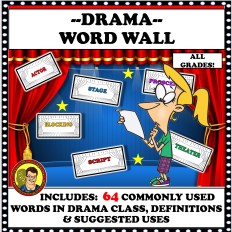
Instead of copying all of these words and making printables for your students, there are 64 in this product! Check out this WORD WALL:

My Theatre Vocabulary List for the Classroom

First African American to Win National Spelling Bee

Have you heard of Zaila Avant-garde?  The multitalented teenage phenomenon Zaila Avant-garde, became an overnight sensation with her Scripps National Spelling Bee win at the age of fourteen, when she became the first African American contestant to win. Zaila Avant-garde, now sixteen, will add “author” to her already-impressive list of accolades that includes: 2021 Scripps National Spelling Bee champion, 2021 Sports Kid of the Year by Sports Illustrated Kids; and two-time Guinness World Record holder for feats related to her basketball prowess.

Her books, IT’S NOT BRAGGING IF IT’S TRUE: HOW TO BE AWESOME AT LIFE, a non-fiction middle-grade and a picture book, WORDS OF WONDER FROM Z TO A, a children’s picture book, will be published on June 27, 2023, by Doubleday Books for Young Readers and edited by VP, Editor-in-Chief Frances Gilbert.

Pick up my Drama Word Wall.  Everything is provided for you.  Check it out at: Word Wall or you can pick up posters (some are FREE) for your classroom, too!  Growth Mindset Posters and Vocabulary

I hope this helps you.  Please feel free to contact me at DhcBaldwin@gmail.com or DeborahBaldwin.net

Want some more help in the classroom? Check out my FREE Guide and ten page lesson Here 

woman behind DramaMommaSpeaks

Share this:

  • Click to share on Tumblr (Opens in new window) Tumblr
  • More
  • Click to share on X (Opens in new window) X
  • Click to share on Facebook (Opens in new window) Facebook
  • Click to share on Pinterest (Opens in new window) Pinterest
  • Click to share on LinkedIn (Opens in new window) LinkedIn
  • Click to email a link to a friend (Opens in new window) Email
  • Click to share on Reddit (Opens in new window) Reddit
  • Click to share on Pocket (Opens in new window) Pocket
  • Click to share on Telegram (Opens in new window) Telegram
  • Click to share on WhatsApp (Opens in new window) WhatsApp

Like this:

Like Loading...

Filed Under: Arts, arts education, arts integration, creative dramatics, creative movement, drama education, Education, elementary, excellence in teaching, High School, middle grades, Musical Theatre, performing arts, Play, Professional Theatre, Radio Theatre, Teacherspayteachers, Teaching, youth theatre Tagged With: drama terminology, drama terms, drama vocabulary, spelling words, theatre terminology, theatre terms, word wall

Creative Dramatics Lessons That Kids Love

July 22, 2020 By dhcbaldwin 1 Comment

Creative Dramatics from an Awarding Winning Drama Teache

Creative Dramatics Lessons That Kids Love

Dramamommaspeaks Blog Author Deborah Baldwin

Hello!

Today, I wanted to blog about Creative Dramatics Lessons That Kids Love. You may not know me or be familiar with my work.  I’m Deborah Baldwin (but my friends call me Deb.)  I am a recently retired award-winning drama teacher of thirty-eight years.  In that time, I directed over 250 plays and musicals with students and adults as well.  I taught every grade level, but the bulk of my time was spent with secondary students.

Here is my resume if you’d like to see it:

If you’d like a free guide And lesson plan from me, click here LESSON PLAN

Creative Dramatics Lessons That Kids Love

My Teaching Style

Drama is a hands-on class. To this end, I’m always on my feet, modeling for my students while teaching them a host of concepts. It is not unusual to hear my classroom in chortles of laughter because humor is an outstanding way to gain a student’s attention. I empower students at an early age. Although I am always mindful of my learning objectives, I think it’s vital for students to experiment within the confines of my instruction.

I encourage students to be independent and creative thinkers. Many less confident or reluctant students benefit from my teaching methods as together we hit the challenges they encounter. I am creative, intense, driven and brave–these are qualities I nurture in all my students and generally receive outstanding results.

Creative Dramatics Lessons for Elementary Grades by an Award Winning Drama Teacher

If you need some warm ups for your class, whether a core or drama class check out Theatre Games Guide

Strengthening Reading Comprehension Skills

When I was researching this blog post, I found a wonderful site,  http://www.understood.org.  They discussed the reasons for reading aloud (aka drama class!):

1. Decoding

Decoding is a vital step in the reading process. Kids use this skill to sound out words they’ve heard before but haven’t seen written out. The ability to do that is the foundation for other reading skills.

Decoding relies on an early language skill called phonemic awareness. (This skill is part of an even broader skill called phonological awareness.) Phonemic awareness lets kids hear individual sounds in words (known as phonemes). It also allows them to “play” with sounds at the word and syllable level.

2. Fluency

To read fluently, kids need to instantly recognize words, including ones they can’t sound out. Fluency speeds up the rate at which they can read and understand text. It’s also important when kids encounter irregular words, like of and the, which can’t be sounded out.

Sounding out or decoding every word can take a lot of effort. Word recognition is the ability to recognize whole words instantly by sight, without sounding them out.

3. Vocabulary

To understand what you’re reading, you need to understand most of the words in the text. Having a strong vocabulary is a key component of reading comprehension. Students can learn vocabulary through instruction. But they typically learn the meaning of words through everyday experience and also by reading.

What can help: The more words kids are exposed to, the richer their vocabulary becomes. You can help build your child’s vocabulary by having frequent conversations on a variety of topics. Try to include new words and ideas. Telling jokes and playing word games is a fun way to build this skill.

Creative Dramatics Lessons for Elementary Grades by an Award Winning Drama Teacher

4. Sentence Construction and Cohesion

Understanding how sentences are built might seem like a writing skill. So might connecting ideas within and between sentences, which is called cohesion. But these skills are important for reading comprehension as well.

Knowing how ideas link up at the sentence level helps kids get meaning from passages and entire texts. It also leads to something called coherence, or the ability to connect ideas to other ideas in an overall piece of writing.

What can help: Explicit instruction can teach kids the basics of sentence construction. For example, teachers can work with students on connecting two or more thoughts, through both writing and reading.

Making Connections: Using What They Know to Understand

5. Reasoning and Background Knowledge

Most readers relate what they’ve read to what they know. So it’s important for kids to have background or prior knowledge about the world when they read. They also need to be able to “read between the lines” and pull out meaning even when it’s not literally spelled out.

What can help: Your child can build knowledge through reading, conversations, movies and TV shows, and art. Life experience and hands-on activities also build knowledge.

6. Working Memory and Attention

These two skills are both part of a group of abilities known as executive function. They’re different but closely related.

When kids read, attention allows them to take in information from the text. Working memory allows them to hold on to that information and use it to gain meaning and build knowledge from what they’re reading.

What can help: There are many ways you can help improve your child’s working memory. Skill builders don’t have to feel like work, either. There are a number of games and everyday activities that can build working memory without kids even knowing it.

Creative Dramatics from an Awarding Winning Drama Teacher

Maybe you are researching Back to School lessons. Or you are looking for drama units, lessons and plays for your elementary students. Or you want to save yourself time? 

I can help you. 

Here is my opinion about expectations of our elementary students. My Pet Peeve

Here are a few of my lessons for elementary students:

Birthday cake with puppy wearing a hat

It Could Always Be Worse Readers Theater

  • Tableau, Grades 3 and 4
  • Chanting, Grades 3 to 5
  • Costume Design with Goldilocks and the Three Bears
  • Creative Movement
  • Costume Design with Snow White and the Seven Dwarfs
  • The Little Girl and the Winter Whirlwinds
  • Costume Design with Alice in Wonderland Characters

Each lesson comes with a teacher’s letter, procedure, a warm-up, materials list, teacher’s script and assignments.

Recently, I created fifteen minute radio theater plays for grades 3 to 5.  These are royalty free, too! 

  • Radio Theater Play of The Brave Little Tailor
  • Radio Theater Play of It Could Always Be Worse

Recently, I created fifteen minute radio theater plays for grades 3 to 5.  These are royalty free, too!

I hope you’ll check out my creative dramatics lessons.  My thirty-eight years of teaching drama education serve me well in creating these lessons and/or adapting some which I all ready used in the classroom.

Have you taught creative dramatics with your students?  I’d love to hear about it.  Contact me at DhcBaldwin@gmail.com or DeborahBaldwin.net

Looking for a freebie or two?  Go to:

Free Teaching Resources Blog Hop

Free Stuff!


Share this:

  • Click to share on Tumblr (Opens in new window) Tumblr
  • More
  • Click to share on X (Opens in new window) X
  • Click to share on Facebook (Opens in new window) Facebook
  • Click to share on Pinterest (Opens in new window) Pinterest
  • Click to share on LinkedIn (Opens in new window) LinkedIn
  • Click to email a link to a friend (Opens in new window) Email
  • Click to share on Reddit (Opens in new window) Reddit
  • Click to share on Pocket (Opens in new window) Pocket
  • Click to share on Telegram (Opens in new window) Telegram
  • Click to share on WhatsApp (Opens in new window) WhatsApp

Like this:

Like Loading...

Filed Under: arts education, Back to School, creative dramatics, creative movement, Creativity, DeborahBaldwin.net, drama education, Education, play reading, Radio Theatre, Reading Literacy, reading skills, teaching strategies, theater, youth theatre Tagged With: arts integration, back to school, costume design, creative dramatics lesson for back to school, drama lessons, dramamommaspeaks, elementary level plays, radio plays for elementary, radio theater for elementary, reading comprehension, teaching style, VIRTUAL LEARNING

Drama Lessons for High School from an Award Winning Drama Teacher

February 26, 2020 By dhcbaldwin 3 Comments

Drama Lessons for High School from an Award Winning Drama Teacher

Hello!

I wanted to introduce you to drama lessons for high school from an award-winning drama teacher. You may not know me or be familiar with my work.  I’m Deborah Baldwin (but my friends call me Deb.) I am a recently retired award winning drama teacher for thirty-eight years.  In that time, I directed over 300 plays and musicals with students and adults as well.  I taught every grade level, but the bulk of my time was spent with secondary students. I’m also an award-winning director and middle grade author.

Here is my resume if you’d like to see it: DeborahBaldwin.net

deb directing

My Teaching Style:

Drama is a hands-on class. To this end I’m always on my feet modeling for my students while teaching them a host of concepts. It is not unusual to hear my classroom in chortles of laughter because humor is an outstanding way to gain a student’s attention. I empower students at an early age.

Although I am always mindful of my learning objectives, I think it’s vital for students to experiment within the confines of my instruction. I encourage students to be independent and creative thinkers.

Many less confident or reluctant students benefit from my teaching methods as together we hit the challenges they encounter. I am creative, intense, driven and brave–these are qualities I nurture in all my students and generally receive outstanding results in them.

If you are looking for drama units, lessons and plays for your students, I can help you.  Here are a few of my lessons for high school students:

Billy Elliot
Billy Elliot, the Broadway Musical
The Invisible Man Radio Play Unit
Growth Mindset Posters
Rent, the Broadway Musical
Famous Theater Artists
Stage Makeup
Stage Makeup
Broadway Musical Lessons
Hamilton, the Musical
The Cask of Amontillado and Radio Theater Unit
Famous Theater Artists
BUNDLE HIGH SCHOOL LEVEL BLUE BACKGROUND400 (1)
COSTUME DESIGN HIGH SCHOOL COVER 38

Radio Play Performance

(Here is a production of this script by an ESL class in Tiblisi Georgia!)  “The Invisible Man” Radio Play

Dramamommaspeaks Resources

  • Radio Theater Unit Plus Radio Play of “The Invisible Man”
  •   The Producer
  • Rent, the Broadway Musical
  • Theater Artists You Should Know Growth Mindset
  • Bundle:  Biographies of Theater Artists–Lin Manuel Miranda, Audra McDonald, Hugh Jackman, Meryl Streep, Cynthia Erivo, Denzel Washington and Ming Cho Lee
  • Bundle:  Stage Makeup -Zombie, Fantasy, Basic-Old Age, Circus
  • Costume Design: High School
  • Bundle:  Costume, Stage Props., Set and Sound Design (sold separately as well)
  • Bundle:  Tony Awards & Broadway Musicals
  • Hamilton, the Broadway Musical
  • NEW!  Daveed Diggs Theater Artist Biography
  • NEW!  Camille A. Brown Theater Artist Biography
  • NEW!  Billy Elliot, the Broadway Musical
  • NEW!  Something Rotten Broadway Musical 
  • NEW!  Choice Board–Theater Around the World

Most lessons lasts at least two days.  The units’ length range from several days to three weeks.

I have lessons for younger students, too!  Check them out:

Creative Dramatics Lessons from an Award Winning Drama Teacher

Drama Lessons for Middle Grades from an Award Winning Drama Teacher

If you’d like a FREE lesson, be my guest and pick up one:   Free Stuff!

Here’s a recent review of one of my newest products, Acting Styles/Stanislawski, “Dramamommaspeaks hits it out of the park again!! Every unit I get is perfect. I teach three levels of theatre in the same class. The unit was great for the entry level students while still providing a challenge to my most advanced class.”  5 stars

Contact me at dhcbaldwin@gmail.com or DeborahBaldwin.net


Share this:

  • Click to share on Tumblr (Opens in new window) Tumblr
  • More
  • Click to share on X (Opens in new window) X
  • Click to share on Facebook (Opens in new window) Facebook
  • Click to share on Pinterest (Opens in new window) Pinterest
  • Click to share on LinkedIn (Opens in new window) LinkedIn
  • Click to email a link to a friend (Opens in new window) Email
  • Click to share on Reddit (Opens in new window) Reddit
  • Click to share on Pocket (Opens in new window) Pocket
  • Click to share on Telegram (Opens in new window) Telegram
  • Click to share on WhatsApp (Opens in new window) WhatsApp

Like this:

Like Loading...

Filed Under: acting, arts education, drama education, excellence in teaching, High School, Musical Theatre, performing arts, plays, Radio Theatre, Teacherspayteachers, theater Tagged With: Broadway musicals, costume design lesson, DISTANCE LEARNING, drama, drama education, famous theater artists, google classroom, high school drama lessons, high school lessons, play reading analysis, radio theater, set design lesson, stage makeup

The Reasons Thematic Units in Teaching are Successful

October 9, 2019 By dhcbaldwin Leave a Comment

A teacher's desk with an apple, textbooks and pencils.

The Reasons Thematic Units in Teaching Are Successful 

I love this time of year.  Once we reach October, it is such fun for several months. Let’s talk about the reasons thematic units in teaching are successful, shall we? 

You know, I’m such a kid at heart. I still get all excited about the season! It’s fun, fun, fun! 

When the Halloween season was upon us when I was a child, I could hardly contain myself.  It was really tough to concentrate in class.  We didn’t do a lot of learning using themes, but I wish we had.

Let me tell you,  our teachers have it figured out–thematic units work.  

As a child, I don’t remember learning through a theme.  Of course, that was back when we had desks with a top which raised and used a pencil sharpener which was screwed to the blackboard at the front of the classroom.

The Reasons Thematic Units in Teaching are Successful

Yup, it was pretty much like this.

What is a thematic unit in teaching?

“Thematic unit is the organization of a curriculum around a central theme. In other words, it’s a series of lessons that integrate subjects across the curriculum, such as math, reading, social studies, science, language arts, etc. that all tie into the main theme of the unit. Each activity should have a main focus toward the thematic idea.”

As most people know, a teacher needs various teaching methods to reach the students.  Thematic teaching is sly.  It encourages learning using a back door approach.

Sort of like saying, “Oh, neat!  Let’s celebrate Halloween through costume design today.” Here is a lesson to use.

Generally, students are very intrigued.

The Reasons Thematic Units in Teaching are Successful

The Reasons Thematic Units in Teaching Are Successful

When I was looking for some information which support this approach, I found a lengthy blog post about the subject.  Here are some highlights from it at Forensicoutreach.com:

Thinking outside the box: encouraging understanding beyond the syllabus

Consider this: was there ever a time an issue (perhaps in the arena of current affairs) was raised by a friend or a colleague, to which you hadn’t very much to contribute due to insufficient interest, and therefore knowledge, in that particular area? Once you’d done your homework, so to speak, it probably provoked several questions in your mind that weren’t previously there — simply because you hadn’t had enough material to really examine it.

The involvement of a relevant subject (or theme for our purposes) — drawn into the classroom to help drive a particular unit objective home — has been shown to consistently elicit intriguing questions from enquiring young minds for very much the same reasons. Simply put, entrenching the curriculum firmly within a wider, topical context allows students to look at the same matter in a radically new and different light.

It’s this new lens that allows students to probe the subject with relative ease, and makes thematic teaching (in some cases) more effective than a simple reading assignment.

Making it work: including resources not commonly utilized

We’ve found that classrooms have (perhaps in days of yore) invested in several teaching aids that are seldom used. It’s a frequent finding as we step into the shoes of a teacher for a day at the over one-hundred different institutions we’ve visited: a skeleton in the corner; and unused chemistry slime set; or even crime scene tape, found underneath the cupboard in the room’s front standing area. Thematic teaching allows you to make use of these valuable resources in ways that aren’t limiting or formulaic. Build your unit theme with what is already available to you.

Thematic Units are Wonderful

The Reasons Thematic Units in Teaching are Successful

In another blog post from edtechlens.com, more points are made:

1. It’s more fun to teach and learn using a theme. (Boy, that’s the truth!)

Chris believes fun is a key ingredient in learning. “If children are happy, they are confident, and so are teachers. This magic combination makes teaching and learning so much more effective. Children become inspired and wider-thinking. Teachers may still be exhausted, but now it’s an exhaustion that makes them feel fulfilled and valued,” she says.

2. It harnesses curiosity to motivate learning.  (Probably the most important asset!)

“To me it’s the most natural way to learn,” says Chris. “A child or adult finds something that intrigues them, maybe a foreign stamp or a stone. They want to know more and so they start on a journey of collecting ideas and information. With the stamp, the child finds out about its source, the geography of its people, the music of their homeland, the art work within it. They investigate its richness, draw its setting, sing its songs, write letters to find out more, investigate in books and on the internet. The learning is never sluggish, but is vibrant and exciting.”

3. Educators transition to being facilitators of learning. (Yes, they do.)

“The teacher is no longer a provider of facts copied from the board and learned for homework,” Chris says. “Instead, because the boundaries of exploration are far wider than the teacher can predict, he or she becomes a learning manager.” A learning manager guides children while keeping open the opportunity for self-guided discovery.

4. It teaches children how to learn.  (Such a necessary part of learning–becoming an independent learner.)

With theme-based learning, children are thinking for themselves, following the thread of a topic to explore and discover more. Chris says, “It gives them a taste of moving from one related area to another related area and one builds on another. It’s a way of learning throughout life.”

Thematic Learning in Drama Class.

We use thematic learning in a drama class, too.  In fact, I would imagine every drama teacher uses a theme without even thinking about it.

Here is one for tableau using a holiday theme:

A snowman with a green scarf celebrating the winter season

Tableau Exercises Holiday Themed

Here is another on the Broadway musical, A Christmas Story

A Christmas Story, the Musical

Because I know they work, I created several thematic units which are available through my store, Dramamommaspeaks at Teacherpayteachers.com.

Here is one for Halloween:

Drama Units Halloween Theme  

or a smaller one--Bundle: Halloween Drama Lessons, Designing and Fun

or my newest: Set Design Halloween Themed

or design and make a Halloween costume using only garbags and masking tape!

If you’d like a free guide and lesson plan from me, click here LESSON PLAN

Winter Thematic Units at the Ready

Maybe you are skipping the fall season opportunities for thematic learning and winter is more your style.

Check out: Bundle: Drama Lessons and Plays Winter Theme


If you ask me, bundles are the way to go.  You always get a discount of some kind and many times I give another free lesson as a thank you for purchasing from me.

I have many more, so do check them out at Dramamommaspeaks

Each lesson includes will save you heaps of time, low prep, step by step instructions and extras.

  • a letter to teacher
  • procedure
  • warm up
  • teacher’s script
  • materials list
  •  lesson
  • exercises
  • extensions
  • source list
  • video clip list, hot linked for you

So, if you are thinking about using drama in your classroom check me out.

Here are two new ones:  The Cask of Amontillado and The Monkey’s Paw

The Reasons Thematic Units in Teaching are Successful The Reasons Thematic Units in Teaching are Successful

What thematic units are you using at present?  How are they working for you?

I’m always interested in hearing what a teacher is doing or needs created for their classes. These thirty-eight years of teaching should benefit someone other than myself, you know?  Ask away.

Contact me at dhcbaldwin@gmail.com

Deborah Baldwin, Dramamommaspeaks


Share this:

  • Click to share on Tumblr (Opens in new window) Tumblr
  • More
  • Click to share on X (Opens in new window) X
  • Click to share on Facebook (Opens in new window) Facebook
  • Click to share on Pinterest (Opens in new window) Pinterest
  • Click to share on LinkedIn (Opens in new window) LinkedIn
  • Click to email a link to a friend (Opens in new window) Email
  • Click to share on Reddit (Opens in new window) Reddit
  • Click to share on Pocket (Opens in new window) Pocket
  • Click to share on Telegram (Opens in new window) Telegram
  • Click to share on WhatsApp (Opens in new window) WhatsApp

Like this:

Like Loading...

Filed Under: acting, arts education, creative dramatics, creative movement, drama education, excellence in teaching, performing arts, Radio Theatre, reading skills, teaching strategies, theater, youth theatre Tagged With: bundles, drama lesson plans, Halloween theme, theater class, thematic units, winter theme

« Previous Page
Next Page »

Footer

Follow Us

logo3.png

FOLLOW US

Facebook X-twitter Pinterest Instagram Envelope Rss

Goodreads: read

Malibu Rising
Malibu Rising
by Taylor Jenkins Reid
People We Meet on Vacation
by Emily Henry
The Last Thing He Told Me
by Laura Dave
Faking It
Faking It
by Cora Carmack
Losing It
Losing It
by Cora Carmack

goodreads.com
Copyright © 2024 · Wellness Pro on Genesis Framework · WordPress.com.Log in
 

Loading Comments...
 

    %d