• Skip to primary navigation
  • Skip to main content
  • Skip to footer

Join Me in my new Facebook Group! https://www.facebook.com/groups/417126059784261

Menu
  • Meet Deb – The Heart Behind DramaMommaSpeaks
    • Work with Me! 
    • Photo Gallery of DramaMommaSpeaks
    • Directorial Credits
  • I Give Book Talks! 
    • Book Talk Through Skype
    • Books
  • Freebies!
  • Bumbling Bea
  • Teaching Resume
  • Acting Resume
  • Contact Me
  • Blog
    • Drama Education
    • Arts Education
    • Youth Theatre
    • Middle Grades
    • Musical Theatre
    • Teaching
  • Meet Deb – The Heart Behind DramaMommaSpeaks
    • Work with Me! 
    • Photo Gallery of DramaMommaSpeaks
    • Directorial Credits
  • I Give Book Talks! 
    • Book Talk Through Skype
    • Books
  • Freebies!
  • Bumbling Bea
  • Teaching Resume
  • Acting Resume
  • Contact Me
  • Blog
    • Drama Education
    • Arts Education
    • Youth Theatre
    • Middle Grades
    • Musical Theatre
    • Teaching

Middle school

Five Reasons to Watch The Grinch Live! on NBC

November 11, 2020 By dhcbaldwin Leave a Comment

Five Reasons to Watch The Grinch Live!  on NBC

Happy Holidays (okay, it’s a little early, but covid….)

Pretty soon, all of the holidays special will begin and luckily, this year is no exception.

On December 9, there is going to be a live version on NBC of the Broadway musical, “The Grinch”!

How awesome is that?

How the Grinch Stole Christmas

(Yes, I know this photo is from the movie.)

Five Reasons to Watch The Grinch Live! on NBC

#1  THE PLOT

If you don’t know the musical, (because you’ve been living in a cave or something) the story goes like this:

The action of the musical happens in mysterious Whoville. Christmas is a wonderful holiday, which is adored by all the residents of the fantastic town. Who doesn’t love this time of the year, when everything around is covered with fluffy snow, when we feel a smell of a fir-tree, and people exchange with magnificent gifts? Therefore, on the eve of the holiday, the inhabitants are concerned about purchases of the gifts, decoration of the houses and, of course, preparation of dishes for the holiday table.

Once upon a time, a man lived in a town. His was called Grinch. His body was green and hairy. That’s why nobody in the Whoville loved him. The main hero took offense on the inhabitants and decided to live on the lonely mountain, which was blown by winds. A dog was an only being, who kept his company. On this mountain, he sat in a cave and was angry at the whole world.
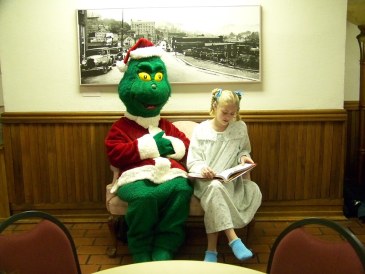
Breakfast with the Grinch 11-2010

Breakfast with the Grinch from vastateparkstaff

Grinch hated Christmas most of all. While the population of a town had fun with all hearts, the indicator of already bad Grinch’s mood expressed something awful. Each Christmas appeared to be a terrible torture for the green hermit. One day, a spiteful inhabitant of the mountain decided to finish a holiday once and for all. While the carefree Whovilleans were sleeping in holiday night with pleasure, perfidious Grinch decided to steal Christmas from the citizens, to make nobody able to have fun anymore.

Now, as well as the residents of the town, Grinch is in cares: he needs to prepare an ideal crime, that nobody could follow his ways. Two teenagers and two girls got on the mountain, where Grinch lived, and it finally angered him. He left the cave, put on a fancy dress and went down to the city, where he began to frighten everyone, who occurred on his path. What to do, if the circumstance, which is hard to cope with, unexpectedly interferes into the plans of Grinch? To speak more precisely, it is the little girl, who even wants to make friends with the character.

Five Reasons to Watch The Grinch Live on NBC

The girl, who helped the father with mail, was frightened so much that she fell in the packing machine, but then, probably, Grinch felt sorry and pulled her out. Cindy thanked him. Being raged by the fact that someone can think that he is kind, Grinch wrapped her with the tinsel. Then the girl thought that, maybe, Grinch is not so bad as everyone speaks about him. She also absolutely cannot understand the sense of Christmas and wants to reconcile him with the residents. However, finally, Grinch realizes that sense of Christmas is not in gifts. The repentant villain decided to return the gifts to the inhabitants, and they accepted him to their society.

#2 MATTHEW MORRISON

Matthew James Morrison will portray Grinch! Morrison is an American actor, dancer, and singer-songwriter. Morrison is known for starring in multiple Broadway and Off-Broadway productions, including his portrayal of Link Larkin in Hairspray  on Broadway, and for his role as Will Schuester on the television show Glee. He received a Tony Award nomination for his featured role as Fabrizio Nacarelli in the musical The Light in the Piazza.

#3 DENIS O’HARE

Denis O’Hare will play his dog, Max.  O’Hare is an American actor, singer, and author noted for his award-winning performances in the plays and musicals such as Sweet Charity,  as well as portraying vampire king Russell Eddington on HBO’s fantasy series True Blood. He has been nominated for an Primetime Emmy for Best Actor.

Five Reasons to Watch The Grinch Live on NBC

#4 THE COSTUMES

Personally, I think the costumes from the film version were exceptional.  I don’t know if they can reach that level of detail, but I’m interested in seeing if they do so.

#5 THE CHOREOGRAPHY

From viewing the snippet on NBC, I can tell the choreography is fun and playful.  That’s got to be a plus, huh? Here’s a trailer for the show:

https://www.today.com/popculture/nbc-bringing-grinch-life-new-musical-holiday-special-t198362

As you may know, several musicals have been performed live in recent years.  In my opinion, some were better than others.  I enjoyed NBC’s Hairspray and Jesus Christmas Super Star the most.  I would hope these production companies are learning how to produce a better product each time they attempt one.  Who knows?

Another was good production was  A Christmas Story.  In case you don’t me, I am a retired drama teacher having taught and directed for thirty-eight years.  You can find my resume here:Teaching Resume

A Christmas Story Broadway Musical Lesson

Now I created drama education resources for my business, Dramamommaspeaks.  I have a lesson about A Christmas Story which would complement the Grinch Live! If you are in a hybrid learning classroom or distance learning, these musicals work well for teachers.

You can find it here: A Christmas Story Broadway Musical Lesson

Five Reasons to Watch The Grinch Live on NBC

Need a quick emergency lesson plan? Or one for a substitute? Everything is provided for the busy teacher.

This Product includes:

  • Letter to Teacher
  • Two Warm Ups–MY Version of Popular Exercises
  • Teacher’s Script–what I say and how I say it!
  • Photos of the Production
  • Separate File of Slides for Teacher to Use to Lecture
  • Plot of the Musical
  • History about the Origination of the Production
  • Information concerning the composer, Pasek and Paul (who also co-wrote Dear Evan Hansen)
  • History about the Film and Musical Helping One Another
  • A Shortened Lesson on : What are the Tony Awards?
  • Tony Awards it Received
  • What are the Tony Awards
  • New York City Map with Competing Theatres Labeled
  • Student Note Page
  • Teacher Note Page Key
  • Trivia
  • Quotes from the Musical–Good for Discussions and Assignments
  • Extension Activities–Five different activities, individual and group
  • Sources & Links to Film Clips from the Show

This lesson works well with any grade level, although it was created for secondary students.  Reading, Language Arts, Vocal Music and Drama classes have success with it!

Or pick up my holiday lesson bundle at: Drama Lessons Holiday Themed 

I hope you’ll check out Grinch on December 9 and think about purchasing my Broadway lesson on A Christmas Story.  If nothing else, both will put you in the holiday spirit!

Which Grinch character is your favorite?  Mine is Max.  I’d love to hear from you.  Contact me at dhcbaldwin@gmail.com or DeborahBaldwin.net

Deborah Baldwin of DramaMommaSpeaks


Share this:

  • Click to share on Tumblr (Opens in new window) Tumblr
  • More
  • Click to share on X (Opens in new window) X
  • Click to share on Facebook (Opens in new window) Facebook
  • Click to share on Pinterest (Opens in new window) Pinterest
  • Click to share on LinkedIn (Opens in new window) LinkedIn
  • Click to email a link to a friend (Opens in new window) Email
  • Click to share on Reddit (Opens in new window) Reddit
  • Click to share on Pocket (Opens in new window) Pocket
  • Click to share on Telegram (Opens in new window) Telegram
  • Click to share on WhatsApp (Opens in new window) WhatsApp

Like this:

Like Loading...

Filed Under: acting, arts education, arts integration, Broadway, Distance Learning, drama education, e-learning, excellence in teaching, High School, middle grades, Musical Theatre, Teacherspayteachers, Teaching, theater, Tony Awards Tagged With: 'tweens, Broadway musicals, DISTANCE LEARNING, drama lessons, Family, family time, live musicals, middle grade books, Middle school, musical theater lessons, teacherspayteachers, VIRTUAL LEARNING, youth theatre

How to Use a Hybrid Lesson in Your Drama Classroom Tomorrow

May 31, 2020 By dhcbaldwin Leave a Comment

How to Use a Hybrid Lesson in Your Drama Classroom Tomorrow

Brain, Mind, Psychology, Idea, Hearts, Love, Drawing

I’m a creative and imaginative person.  If you follow my blog, you’ll know that when I was ten years old I decided I would direct Mary Poppins in my backyard and have my father hire a helicopter to fly me into the yard near the forsythia.

Yes, I’m that kind of creative.

I get an itch in my fingers if I’m not creating something.  Usually, I can appease this creative itch by cooking something new or coloring in a coloring book or developing a new product for drama teachers.

Author Susan Vreeland thinks, “Painting feeds the eye just as poetry feeds the ear, which is to say that both feed the soul.”

I agree. Without being creative and imaginative, I am pretty unhappy.

Yet, even with this new interest of mine in developing drama education resources, I was becoming a bit stale.

I’ve been making drama lessons and adapting some of my former lessons for two years.  Two years and 220 products later, I have created quite a library for the busy drama teacher to use.  If you are interested in checking them out, grades second to twelve, go here:  Dramamommaspeaks Store

Enter Boom Learning

Among the many resources I used in my classroom in the past, recently I’ve learned how to make word walls,  growth mindset posters, one pager assignments, word searches, short biographies, Broadway musicals units, Google slides, etc.

Lately, I’ve been interested in digital task cards.  These puppies are HOT in the education market.  There’s great interest in using them in the classroom because I think we all know our students are going to have at least six months to a year of distance learning.

Because of this, I thought about what I could create for distance learning in particular hybrid learning.

Boom Learning is a website of digital task cards for all subjects and grade levels.  They are called Boom Cards.  Here is their description,

“Boom Cards are interactive lessons created by teachers like you. Using our platform, you can easily create Boom Cards to use in your class, or sell them in our marketplace. made for teachers and parents Teachers can use Boom Cards in the classroom or parents can use them at home.”

I have to say these digital task cards are really cool.  Teachers assign the cards and the students work through a set. Without them realizing it, the students grasp a concept (through short games) or practice a skill.

Hybrid Learning and Differentiation

As I mentioned, I’m a creative person.  I got to thinking………………is there some way to teach both through digital task cards AND through instruction from the teacher?

Of course!

As usual  whenever I blog, I searched the internet and found this helpful definition of Hybrid Blended Instruction from Schoology.com says:

“Beyond differentiation in terms of content, process, product, or modifying the traditional learning environment, blended hybrid learning combines face-to-face instruction with some form of “computer-mediated instruction.” Blended hybrid learning “has the opportunity to provide personalized instruction with some element of student control over path, pace, time, and place.” Thus, it is a mode of instruction that adds a significant amount of student agency to learning that is not otherwise possible through in-person differentiation, which still occurs synchronously and, in practice, largely at the direction of the teacher.”

How do I use hybrid blended instruction in my drama classroom?  

Primarily, this hybrid blended instruction could be used with drama subjects which could be best taught with limited but not limited to topics such as the  history of scenic design, stage properties, lights, costumes, etc.

The first hybrid  lesson I developed was my Costume Design with Fairy Tale Characters. I adapted parts of my PDF lesson to make it.

Drama Lesson:  Costume Design with Boom Cards!

COSTUME DESIGN MIDDLE GRADE BOOM CARDS COVER400 (1)

For Distance Learning–

It’s a three-step process. First, the teacher assigns the student to view a portion of a video which demonstrates the costume design concepts. Next, she assigns the Boom Cards! for the student to study prior to the assignments. Finally, the teacher charges the student to design a costume for a fairy tale character and complete the creative writing assignment. This lesson can last one or two days.

Included in the PDF product:

  • Letter to Teacher
  • Rationale for Teaching Costume Design
  • Costume Design Template (Female)
  • Costume Design Template (Male)
  • Writing Assignment Sheet
  • Writing Assignment Sheet Examples
  • Sources
  • Video Links

Included in the Boom Cards! product:

  • 16 Boom Cards which include the history of costume design
  • True/false questions to secure the learning as the student progresses through them

For the Blended Classroom

This is a definite paradigm shift for a drama teacher.  We are used to doing all the teaching ourselves. However, if other teachers in a school are using digital learning  in their classes the students may adapt quickly to our use of them.

What are the benefits for the teacher?

  • It frees up your time to take attendance, speak to individual students about their progress in class, take a break for! a few minutes!
  • The digital task cards are self grading. A teacher checks the students’ knowledge on a subject without having to grade another set of papers.  Yet, they are continuing to teach the students.

What are the cons to the Hybrid Blended Classroom?

According to Schoology.com

“….the blended hybrid classroom must bring true computer-mediated instruction into the mix, creating learning outcomes that aren’t possible through traditional methods. It takes technology infrastructure, planning, and hard work to make that ideal a reality.”

In other words it is going to take some time to prepare the lesson, accept the paradigm shift and conquer! In the long run, I think you’ll be glad you did. Until then, lean on me for help.

Hey, if I can do it then so can you?

If you would rather use just the digital task cards without the hybrid lesson, you can find them here:

Here are three sets of digital task cards which may come in handy for you.  (Tap on them to see their entire description.)

BUNDLE DRAMA VOCAB. COVER      ROMEO AND JULIET BOOM CARDS TPT COVER300 (1)

COSTUME DESIGN MIDDLE GRADE BOOM CARDS COVER

Here is my newest hybrid lesson. Costume Design Halloween Characters and Boom Cards!

COSTUME DESIGN HALLOWEEN LESSON PLUS BOOM CARDS400


What lessons have you created which lend themselves to Hybrids?  I’d love to hear about them?  Contact me at DhcBaldwin@gmail.com or DeborahBaldwin.net


Share this:

  • Click to share on Tumblr (Opens in new window) Tumblr
  • More
  • Click to share on X (Opens in new window) X
  • Click to share on Facebook (Opens in new window) Facebook
  • Click to share on Pinterest (Opens in new window) Pinterest
  • Click to share on LinkedIn (Opens in new window) LinkedIn
  • Click to email a link to a friend (Opens in new window) Email
  • Click to share on Reddit (Opens in new window) Reddit
  • Click to share on Pocket (Opens in new window) Pocket
  • Click to share on Telegram (Opens in new window) Telegram
  • Click to share on WhatsApp (Opens in new window) WhatsApp

Like this:

Like Loading...

Filed Under: arts education, Boom Cards, creative dramatics, Distance Learning, drama education, e-learning, Education, excellence in teaching, Teaching, teaching strategies, theater, youth theatre Tagged With: Boom Learning, costume design, DISTANCE LEARNING, drama class, drama vocabulary, e-learning, hybrid blended classroom, middle grades, Middle school

How to Audition Children for a Play or Musical

March 4, 2020 By dhcbaldwin Leave a Comment

How to Audition Children for a Play or Musical

This is a subject near and dear to my heart.

I became a youth theater director by accident.  My college friends would say they thought that’s what I would end up doing with my theater degree.

I had no idea, really. But it stuck with me.  I really did enjoy it!

How to Audition Children for a Play or Musical

In thirty-eight years of teaching and directing, I directed over 250 plays and musicals with adults and children alike.

During that time, I started the careers of several child actors who have gone on to be Broadway performers or work in the industry.  That’s a really cool thing.

In addition, there are probably several hundred who are still involved in theater in their communities.  I love that even more!

If you think of all the people which I’ve auditioned– just crazy!

As a result of these experiences I’ve learned a thing or two about auditioning and directing children.

Of course, It depends upon the age of the child and the production, but here are some questions to ask yourself prior to auditions if you plan to direct them.

How to Audition Children for a Play or Musical

How to Audition Children for a Play or Musical

Here are some questions to ask yourself:

(I’m assuming you are working in a community theater or semi-professional.)

  • How young can a student be to audition for the production?
  • Is there anything in the production that would be too adult for a young child to comprehend?
  • Could an older student portray the role?
  • What is more important to me–to cast someone who is the essence of the character or someone who is the true age of the character?
  • How essential is it to me that the child’s parents are cooperative?
  • Are the parents allowed to sit in auditions?
  • Can parents sit in on rehearsals?
  • How many late evening rehearsals are planned?
  • Will I send the child home early?  Why or Why not?
  • How many conflicts will I accept from the child (school functions, sports games, etc.)
  • Some children don’t do well at cold readings.  Will I allow children to see the script beforehand?
  • Should the child bring in their own monologue for their audition?
  • If the show is a musical, do I expect them to sing a song from the show for their audition?
  • Will I hold callbacks for the child role?
  • How will I handle their callbacks?  Will I run them through a series of improvisations?
  • Should I cast two students in the role with one an understudy?
  • Would it be better to double cast the child role?
  • Do I expect the child to say any swear words written in the play or will I substitute something for them?

Tony Award-Winning Child Actors

How many child actors go on to make a career of it?  When I was researching this topic, I found several biographies on Wikipedia.com.  I remember seeing these four perform.

They were absolutely stellar.

Daisy Eagan started her early theatre training at the Neighborhood Playhouse School of the Theatre’s Junior School where she had classes in acting, singing, and dancing in the early 1990s. She then went on to star on Broadway in “The Secret Garden” with Mandy Patinkin and Rebecca Luker. She became the youngest recipient to receive the TONY award for featured actress in a musical.


How to Audition Children for a Play or Musical

The Billy Elliott Boy Dancers

David Alvarez is one of the three boys originally cast to play Billy in the Broadway production of Billy Elliot the Musical, along with Trent Kowalik and Kiril Kulish. He needed to study tap, acrobatics, voice and acting for the role and spent July 2007 through March 2008 preparing. Billy Elliot the Musical began previews in New York on October 1 and officially opened on November 13, 2008. His first preview performance was on October 2, 2008. He played his final performance on January 3, 2010. Alvarez’s portrayal of Billy Elliot was highly praised by the critics.

Alvarez, jointly with Kiril Kulish and Trent Kowalik won Tony Awards for Best Actor in a Musical 

How to Audition Children for a Play or Musical

Kiril Kulish was born in San Diego, California on February 16, 1994. His parents, Raisa Kulish and Phil Axelrod, are Jewish immigrants from Ukraine. His older brother, Victor, is a singer/songwriter and recording engineer, and his older sister Beata is a TV/film producer. He grew up speaking Russian, Ukrainian, and English. He started studying ballet at age five and ballroom dancing at age 8. He studied at the San Diego Academy of Ballet and was the youngest male to be admitted to their junior company.

Kiril was the winner of the Junior division Grand Prix at the Youth America Grand Prix in 2006, 2007, and 2008  and won the Hope Award in the Pre-Competitive division in 2006. Kiril Kulish won first place in Latin Ballroom at the USA National Dance Championships in 2006 and 2007. In 2012 and 2013 Kiril Kulish became the Youth USA Champion in Latin DanceSport and will represent the USA in Beijing and Paris.

Trent Kowalik was born in Wantagh, New York, the son of Lauretta (née Splescia), an organist and pianist at St. Raphael’s Roman Catholic Church in East Meadow, New York, and Michael Kowalik, a surveyor. He has three older sisters. He started dance lessons at the age of three at Dorothy’s School of Dance in Bellmore, New York. At age four, he began instruction in Irish dancing. At age six, he was competing at the highest level, Open Championship. He danced with the Inish free School of Irish Dance.

In April 2006, at age 11, Kowalik won the youngest male age group of the World Irish Dancing Championship (Irish: Oireachtas Rince na Cruinne) in Belfast. He is a five-time undefeated North American Champion and a World Champion. He holds multiple national titles in Scotland, England, and Ireland, and continues to study ballet, tap, jazz, and lyrical dance.  He graduated from The Jacqueline Kennedy Onassis School–Pre-Professional Division American Ballet Theatre in 2013. He graduated from Princeton University in June 2018. He was a member of student dance groups Princeton University Ballet and BodyHype Dance Company.

Note:  Most child actors grow up to lead lives away from the stage.

However, if you have the chance to get them started take heed of my questions.  They will help you immensely.

If you’d like a lesson concerning Billy Elliott, check out Billy Elliott The Broadway Musical Lesson

How to Audition Children for a Play or Musical

For more information about working with children, check out these posts:

Double Casting a Show? Here’s Advice

How to Make Your Drama Class More Successful–Lessons Learned from 38 Years of Teaching Drama-Elementary

How to Make Your Drama Class More Successful –Lessons Learned from 38 Years of Teaching-Middle School

What child actors have you started?  I’d love to hear about them.  Contact me at dhcbaldwin@gmail.com or DeborahBaldwin.net


Share this:

  • Click to share on Tumblr (Opens in new window) Tumblr
  • More
  • Click to share on X (Opens in new window) X
  • Click to share on Facebook (Opens in new window) Facebook
  • Click to share on Pinterest (Opens in new window) Pinterest
  • Click to share on LinkedIn (Opens in new window) LinkedIn
  • Click to email a link to a friend (Opens in new window) Email
  • Click to share on Reddit (Opens in new window) Reddit
  • Click to share on Pocket (Opens in new window) Pocket
  • Click to share on Telegram (Opens in new window) Telegram
  • Click to share on WhatsApp (Opens in new window) WhatsApp

Like this:

Like Loading...

Filed Under: arts education, community theater, directing experiences, drama education, youth theatre Tagged With: 'tweens, auditions, child actors, directing tips, drama education, Middle school, professional theater, youth theater, youth theater directing

Middle School Drama Lessons from a Veteran Drama Teacher

January 24, 2020 By dhcbaldwin 5 Comments

d

Middle School Drama Lessons from a Veteran Drama Teacher

Hello!

You may not know me or be familiar with my work.  I’m Deborah Baldwin (but my friends call me Deb.)  I am a recently retired award winning drama teacher of thirty-eight years.  In that time, I directed over 300 plays and musicals with students and adults as well.  I taught every grade level, but the bulk of my time was spent with secondary students.

Here is my resume if you’d like to see it: DeborahBaldwin.net

If you are looking for lessons for high school theater classes, check out Drama Lessons for High School from an Award Winning Drama Teacher or elementary classes at Creative Dramatics Lessons for Elementary Grades by an Award Winning Drama Teacher

My Teaching Style

Drama is a hands-on class. To this end, I’m always on my feet, modeling for my students while teaching them a host of concepts. It is not unusual to hear my classroom in chortles of laughter because humor is an outstanding way to gain a student’s attention. I empower students at an early age.

Although I am always mindful of my learning objectives, I think it’s vital for students to experiment within the confines of my instruction. I encourage students to be independent and creative thinkers. Many less confident or reluctant students benefit from my teaching methods as together we hit the challenges they encounter. I am creative, intense, driven and brave–these are qualities I nurture in all my students and generally receive outstanding results.

Check out my store at Dramamommaspeaks.

Here is my opinion about expectations of middle school My Pet Peeve

Drama Lessons with Easy Prep for the Teacher

If you are looking for drama units, lessons and plays for your students, I can help you.  Here are a few of my lessons for middle grade students:

Drama Curriculum and Units

Drama Lessons for Middle Grades from an Award Winning Drama Teacher

Set Design Units

Set Design, the Rendering

If you need theater lessons for elementary students, check out Creative Dramatics Lessons for Elementary Grades by an Award Winning Drama Teacher

Choice Boards 

Drama Lessons for Middle Grades from an Award Winning Drama Teacher

If you have reluctant students in your class, try choice boards.  They give students an opportunity to learn what they want to know the most about.

Wicked Costume Design Boom Cards

Drama Lessons for Middle Grades from an Award Winning Drama Teacher

Do you ever use Boom cards?  This lesson is great for teaching about the musical Wicked, while also studying costume design near Halloween.

Costume Design with Superheroes


Bow Blues Radio Play Unit

t


Drama Lessons for Middle Grades from an Award Winning Drama Teacher

Invite a Play Character to dinner

Pick up this bundle with Wicked, Idina Menzel and Kristin Chenoweth Biographies

Also, this Google Classroom version: Wicked, the Broadway Musical (Google Classroom)

You might enjoy this Famous Theater Artist Biography for the Google Classroom:  Sarah Bareilles

Middle School Drama Lessons from a Veteran Drama Teacher

Cynthia Erivo (FREE)

Wicked Broadway Musical


Lin Manuel Miranda cover

Famous Theater Artists:  Lin Manuel Miranda Biography (FREE)

Additionally, here is a new readers theater script lesson based on an Inca legend:  The Magic Lake 

Satisfied Customers 

I’m so flattered by reviews such as these:

  • “Absolutely brilliant! Brightened my classroom with purpose!” (Famous Theater Artist Pendants)
  • “What a terrific and thorough study of Sarah Bareilles. My students really enjoyed learning about her. She’s a great role model for having a growth mindset.”
  • “I used this Lin Manuel Mirranda lesson in conjunction with the Hamilton unit, and my students really enjoyed it. Thank you for putting this together!”
  • ” Set Design with School Setting has been a great lesson for my students during digital learning last year. They really enjoyed doing it and I got some great set designs turned in.”
  • “This unit, The Wiz Broadway musical resourcse is highly detailed and contains all of the information I need to support my unit on the Wiz.”
  • “Wow! This resource is filled with activities that can give students an experience outside of the classroom! You can design independent lessons from this unit, where students can explore radio show history and listen to examples. My class is going to perform our radio show over a zoom call. Deborah is great; she responded promptly to my questions and even added resources for me!” (Bow Wow Blues Radio Theater Unit)
  • I used this resource to get my students ready to attend the Come From Away musical as a field trip. Back in September, we had written letters of gratitude to the people of Gander for what they did on 9/11. Long story short and a few interviews in-between, my EL’s got to attend the musical in Houston in early March 2020 with Captain Bass herself! Thank you for this resource. It helped them prepare for what we would see onstage before seeing it in real life. THANK YOU!!

I hope you’ll check out my drama education products.  There are nearly 450 of them ready and waiting for you.

Lastly…

Looking for something free?  There are free lessons here in my blog and in my store.  Here is something for you: Freebies Stuff

If you don’t find what you need, contact me.  Chances are I’d be interested in creating what you are needing.  That’s always fun! I also customize bundles so if that is something you’d be interested in, do email me.

Contact me at dhcbaldwin@gmail.com or DeborahBaldwin.net

Woman behind DramaMommaSpeaks

Share this:

  • Click to share on Tumblr (Opens in new window) Tumblr
  • More
  • Click to share on X (Opens in new window) X
  • Click to share on Facebook (Opens in new window) Facebook
  • Click to share on Pinterest (Opens in new window) Pinterest
  • Click to share on LinkedIn (Opens in new window) LinkedIn
  • Click to email a link to a friend (Opens in new window) Email
  • Click to share on Reddit (Opens in new window) Reddit
  • Click to share on Pocket (Opens in new window) Pocket
  • Click to share on Telegram (Opens in new window) Telegram
  • Click to share on WhatsApp (Opens in new window) WhatsApp

Like this:

Like Loading...

Filed Under: Arts, arts education, Broadway, DeborahBaldwin.net, drama education, excellence in teaching, middle grades, Musical Theatre, performing arts, plays, Teacherspayteachers, Teaching, teaching strategies, theater, Tony Awards, youth theatre Tagged With: Broadway musicals, choice board, costume design, creative dramatics, Drama Lessons: Middle Grades, Middle school, playwriting, radio theater, set design

Surprising Bumbling Bea Reviews and a FREE Chapter

June 7, 2019 By dhcbaldwin 4 Comments

Wishing Shelf

Wishing Shelf


Surprising Bumbling Bea Reviews–

I never thought I’d be writing that!

When Bumbling Bea was first published, I was very surprised by the reviews. I hoped middle school students would enjoy the story, but I never considered readers of all ages (some as young as seven and one a sixty-five year old grandma) would appreciate it, too.  I’m  flattered.

So, if you are seeking reviews of Bumbling Bea check out Amazon at http://tinyurl.com/lk5db54

There are nearly 50.

If you are wanting to read a few snippets, here are some:

  • “Quirky, fun and intensely close capturing of middle school angst.”

******Emily Bassinger

  •  “In Bumbling Bea, author Deborah Baldwin creates an enjoyable look into growing up. Hilarity, missteps, and bungling follow as Bea and Michiko come to terms. The plot line is written skillfully.”

****Verabookreviews

  • “Deborah ensures that her story constantly generates mental images and tugs at heartstrings. The choice of words used reflect the effort that she must have put in to make this story both child-friendly and adult-friendly.”

*****Rajalakshmi Prithviraj\

  • “This book is utterly charming, with many fun and surprising twists that equally offer loads of entertainment as well as a variety of opportunities to feel validated!! Thank you, ‘Bumbling Bea’ for teaching me that these awkward moments we experience during our most awkward years are forgivable and not defining, and more importantly, that they are ALWAYS opportunities to LEARN ******Becca Ayers
img_0832
  • “Baldwin reached out to an audience that is often overlooked in writing (the middle school theater crowd) but does it in a fun and humorous way.”****Amy Dawn Kostecki
  • “Bumbling Bea is a wonderful example of what is like to be a middle school student trying to figure just who you really are and how the world really works. Baldwin does an excellent job sharing Bears inner turmoil, thoughts, emotions……. As a theater lover and teacher myself I loved this book and would highly recommend it to anyone who works with children, has children, is a child at heart, or who enjoys the stage!
           *****Blair McCotter 
Wishing Shelf
Bumbling Bea was a finalist in the 2016 Wishing Shelf Book Award Contest
Are you looking for a different way to teach about drama in your classroom?
Consider Bumbling Bea.
AND…..you can download the first chapter and its study guide for FREE here:  Dramamommaspeaks Store–Bumbling Bea
Bumbling Bea Reviews
If you haven’t heard of Bumbling Bea, here is a short synopsis:
Beatrice thinks she has no acting talent but that doesn’t stop her from auditioning for the annual middle school play. Easy! Except Michiko, a new girl from Japan, shows up and ruins everything! So begins Beatrice’s diabolical and hilarious plan to scare away Michiko. But Michiko has goals of her own with no plans to leave soon. Then there’s that other girl who is such a blabbermouth. What’s a girl to do? Plenty. A great book for those who love theater and every part of it–the good, the bad and the crazy.
Why did I write this book?
When I was a young student, I didn’t know I loved theater….yet.  It wasn’t until I was in high school when I first was cast that I realized theatre was my thing.
Also, I didn’t get to study drama until high school either.  Just imagine how much happier I would have been if I had studied it sooner like so many students do at present.
I wrote Bumbling Bea for those kids, just like me.  There aren’t many books focused on drama and there are certainly no books about Kabuki theater AND drama….until I came along.
You can find Bumbling Bea on Amazon at:  Bumbling Bea  and at Barnes and Noble at:  Barnes and Noble

I’d be really flattered if you’d take a look at it.  It’s not what you think when you begin the book.  That’s my favorite kind of book–it surprises you.

What’s your favorite book?  I’d love to hear from you.

Contact me at dhcbaldwin@gmail.com or DeborahBaldwin.net

Deborah Baldwin


Share this:

  • Click to share on Tumblr (Opens in new window) Tumblr
  • More
  • Click to share on X (Opens in new window) X
  • Click to share on Facebook (Opens in new window) Facebook
  • Click to share on Pinterest (Opens in new window) Pinterest
  • Click to share on LinkedIn (Opens in new window) LinkedIn
  • Click to email a link to a friend (Opens in new window) Email
  • Click to share on Reddit (Opens in new window) Reddit
  • Click to share on Pocket (Opens in new window) Pocket
  • Click to share on Telegram (Opens in new window) Telegram
  • Click to share on WhatsApp (Opens in new window) WhatsApp

Like this:

Like Loading...

Filed Under: Book Reviews, Bumbling Bea, Indie Publishing, Teacherspayteachers, theater, theatre, youth theatre Tagged With: award winning, middle grades, Middle school, middle school books, young teens

The Reasons Teaching Multiculturalism in the Classroom is Vitally Important

March 19, 2019 By dhcbaldwin 10 Comments

The Reasons Teaching Multiculturalism is Vitally Important

The Reasons Teaching Multiculturalism in the Classroom is Vitally Important

I thought the reasons teaching multiculturalism in the classroom is vitally important was a good subject to blog about today.

My Teaching Journey with Multiculturalism

Multiculturalism is here to stay. I am thrilled by that statement! I am very fortunate in having traveled to many countries around the globe.  This wanderlust came from my mother who was born in Japan (my grandparents were missionaries there) and continued her whole life. That’s one of the reasons I enjoy multiculturalism in the classroom!

I enjoy people from other cultures very much.  I find immigrants and visitors very interesting.  They are far more fascinating than someone who lives near me and has never stepped past the U.S. border.

About ten years ago, I taught drama in a middle school in Missouri. During that time I was charged with teaching the students about drama and its many components.  Since there was no set curriculum (Hallelujah!) I loved that I could create lessons and units as I deemed fit.


A Perfect Arts Integration Project

At the end of each six week session, I would produce a small class play with my students. I mean, that’s what theater is all about, right?

This was the late 1990’s I think, multiculturalism was a big trend in education.  Desperate to find scenes or plays about the topic, I began to research and adapt multicultural folk tales into short class plays.  I needed them to be about fifteen minutes in length and suitable for other classes and my students’ parents to attend. If you are interested, here is a readers theater unit about an Incan legend, the Magic Lake

There are many reasons we need to continue to teach multiculturalism.  First and foremost, the United States is a melting pot and that makes us unique in many respects. But that isn’t enough of a reason, is it?

Students study culture through plays

I ran on to an article on Ascd.org, a professional organization for school administrators and educators. I think it says it best.

“People coming from Asia, the Middle East, Latin America, Eastern Europe, and Africa differ greatly from earlier generations of immigrants who came     primarily from western and northern Europe. These unfamiliar groups, cultures, traditions, and languages can produce anxieties, hostilities, prejudices, and racist behaviors among those who do not understand the newcomers or who perceive them as threats to their safety and security.

These issues have profound implications for developing instructional programs and practices at all levels of education that respond positively and constructively to diversity.

Incorporating Multicultural Education

First, Irvine and Armento (2001) provide specific examples for incorporating multicultural education in the classroom by  planning language arts, math, science, and social studies lessons for elementary and middle school students and connecting these lessons to general curriculum standards.

One set of lessons demonstrates how to use Navajo rugs to explain the geometric concepts of perimeter and area. In addition,  students learn how to calculate the areas of squares, rectangles, triangles, and parallelograms. Isn’t this terrific? 

These suggestions indicate that teachers need to use systematic decision making approaches to accomplish multicultural curriculum integration. In practice, this means developing intentional and orderly processes for including multicultural content.

The Reasons Teaching Multiculturalism is Vitally Important

Other Benefits of Teaching with Multiculturalism

Creating learning goals and objectives that incorporate multicultural aspects, such as ―Developing students’ ability to write persuasively about social justice concerns. Using a frequency matrix to ensure that the teacher includes a wide variety of ethnic groups in a wide variety of ways in curriculum materials and instructional activities.

Introducing different ethnic groups and their contributions on a rotating basis. Talk about beneficial aspects of multiculturism in education! It is suggested to include several examples from different ethnic experiences to explain subject matter concepts, facts, and skills.  Additionally, showing how multicultural content, goals, and activities intersect with subject’s specific curricular standards. Here is another exciting unit. This time about an Inuit creation myth, adapted into a one act play, Sedna.

More Benefits

Virtually all aspects of multicultural education are interdisciplinary. As such, they cannot be adequately understood through a single discipline. For example, teaching students about the causes, expressions, and consequences of racism and how to combat racism requires the application of information and techniques from such disciplines as history, economics, sociology, psychology, mathematics, literature, science, art, politics, music, and health care.

Theoretical scholarship already affirms this multiculturism in education; now, teachers need to model good curricular and instructional practice in elementary and secondary classrooms. Furthermore, putting this principle into practice will elevate multicultural education from impulse, disciplinary isolation, and simplistic and haphazard guesswork to a level of significance, complexity, and connectedness across disciplines.”

The Reasons Teaching Multiculturalism is Vitally Important

Aren’t these excellent ideas for multiculturalism?

Here is another….Theater is a fabulous vehicle to use in one’s teaching.  It’s even better with multiculturalism.  It is quite easy to teach about other cultures using plays and in fact, fun.  There isn’t a  jarring or obstructive shift in one’s teaching. I kid you not!

Here’s a Plan for You

For instance, let’s think multiculturism in education through teaching about the country of Japan.  One way to approach it from the basis of studying the country’s geography and culture.  Those are obvious methods.  Additionally, one could also study the Japanese art of origami but again, it’s a fairly traditional pedagogy.

However, a teacher could teach about Japan in a more unique way– present a play based on a Japanese folk tale.

“What?” you say, “That sounds really challenging and I have limited time to put together the unit.”

This is where I can help you. 🙂

The Reasons Teaching Multiculturalism in the Classroom is Vitally Important

Picture This in Your Classroom

You have your materials you need to teach the basics to the students (maps, articles, coloring pages, worksheets, etc.) Once you have spent the time you plan  for learning, segue to the play unit.

As I mentioned, I created several fifteen minute class plays.  Plus, there are reader’s theater versions as well.  You can incorporate them into your study of a culture or country today!

To date, there is one for Bulgaria, German, Japan, China, Alaska, India, Peru, Canada and one of the Jewish culture.  Keep checking back, because more multicultural plays are added every month.  These plays are written for fifth through eighth grade classes, however, I twice adapted Ojisan and the Grateful Statues–once for younger students (grades  2 to 4)  and another version for students (6-9). My newest offerings are from the Inca and Zuni indigenous people–The Magic Lake and Maidens of the Corn.  You can find them here: DramaMommaSpeaks

Check out here the one for lower elementary grades here: Ojisan and the Grateful Statues (Creative Dramatics Level) 

The Reasons Teaching Multiculturalism in the Classroom is Vitally Important

Or a large cast script with unit at:  The Little Girl and the Winter Whirlwinds 

Here are some others….

The Reasons Teaching Multiculturalism in the Classroom is Vitally Important

Abdullah’s Gold is a funny story about being grateful for what you have and spreading your wealth with others.

Saturday, Sunday and Monday is a very funny tale with plenty of roles for the whole gang.  My daughter remembers when she was a student of mine in middle school and we performed this play.  It’s such fun.

The Reasons Teaching Multiculturalism in the Classroom is Vitally Important

Sedna, an Inuit Tale is engaging, full of spectacle and dramatic. It is one of my favorites!


The Reasons Teaching Multiculturalism in the Classroom is Vitally Important

Li Chi the Serpent Slayer tells the story of a girl as the hero.

The Reasons Teaching Multiculturalism in the Classroom is Vitally Important

The Brave Little Tailor is a funny take on the Grimm Brother’s tale, complete with a song for the Giant.


The Reasons Teaching Multiculturalism in the Classroom is Vitally Important

It Could Always Be Worse is a Jewish folk tale full of funny moments and opportunities for your students to study improvisation as well. Or find it at:  It Could Always Be Worse Play and Unit

Here is a terrific multicultural musical lesson, too:  Once on this Island

The Reasons Teaching Multiculturalism in the Classroom is Vitally Important

I challenge you to be different. Only you know what your students need and how they’ll embrace multiculturalism in your classroom.  Plus, your students will benefit from it and so will you.

What multicultural materials do you use in your classroom?  I’d love to hear about them.

Contact me at dhcbaldwin@gmail.com or DeborahBaldwin.net

Deborah Baldwin


Share this:

  • Click to share on Tumblr (Opens in new window) Tumblr
  • More
  • Click to share on X (Opens in new window) X
  • Click to share on Facebook (Opens in new window) Facebook
  • Click to share on Pinterest (Opens in new window) Pinterest
  • Click to share on LinkedIn (Opens in new window) LinkedIn
  • Click to email a link to a friend (Opens in new window) Email
  • Click to share on Reddit (Opens in new window) Reddit
  • Click to share on Pocket (Opens in new window) Pocket
  • Click to share on Telegram (Opens in new window) Telegram
  • Click to share on WhatsApp (Opens in new window) WhatsApp

Like this:

Like Loading...

Filed Under: arts education, creative dramatics, drama education, excellence in teaching, teaching strategies, theater, theatre Tagged With: classroom plays, cultures, elementary, elementary school, indigenous people, Irvine and Armento, Middle school, multilculturalism

« Previous Page
Next Page »

Footer

Follow Us

logo3.png

FOLLOW US

Facebook X-twitter Pinterest Instagram Envelope Rss

Goodreads: read

Malibu Rising
Malibu Rising
by Taylor Jenkins Reid
People We Meet on Vacation
by Emily Henry
The Last Thing He Told Me
by Laura Dave
Faking It
Faking It
by Cora Carmack
Losing It
Losing It
by Cora Carmack

goodreads.com
Copyright © 2024 · Wellness Pro on Genesis Framework · WordPress.com.Log in
 

Loading Comments...
 

    %d